Why is there a sudden spike in Gmail 'mailbox full' bounces since August 2024?

Updated on 2 Aug 2026: We clarified the evidence behind the Gmail quota spike and added safer handling for retries, suppression, and automated bounce events.
The spike reported by many senders in mid-August 2024 shows up in raw logs as more 452 4.2.2 responses for Gmail recipients treated as out of storage. Google documents this code as a temporary mailbox-full response. Google has not published a change notice confirming stricter quota enforcement or an August rollout date, so stricter enforcement remains the leading operational explanation rather than a confirmed product change.
The spike does not prove that a list suddenly went bad, email authentication failed, or Gmail blocked an entire sending program. Google Account storage is shared across Gmail, Google Drive, Google Photos, and certain backups, so a recipient can have a tidy inbox and still be over quota. Google's Gmail Help guidance identifies exhausted recipient storage as a reason mail gets bounced or rejected.
- Observed pattern: Senders reported more Gmail recipients being treated as over quota beginning in mid-August 2024.
- Main clue: The raw SMTP text says the recipient inbox is out of storage space.
- Common trap: Some ESPs label the final timeout as a hard bounce even when Gmail first sent a temporary deferral.
- Right response: Pause, retry on a controlled schedule, and suppress only after the address keeps failing.
What sender reports showed in August 2024
The visible change started for many senders around August 15 to August 19, 2024. Reports described the same Gmail-specific pattern across sending platforms, domains, IP pools, and list histories: addresses that had recently accepted mail began returning quota-related responses at a much higher rate.
Google's documentation confirms what 452 4.2.2 means, not why its frequency rose. Contemporaneous Google Help Community reports also show recipients receiving storage warnings around that period. Those user reports support the timing but do not prove an exact backend rollout.
The operational hypothesis is that Google began applying existing quota rules to more accounts or changed when an account was marked full. Either change produces the same SMTP pattern. Diagnose the incident from the response text and recipient history rather than treating the rollout explanation as established fact.

A flowchart showing Gmail deferral, ESP retry timeout, and careful suppression.
Do not treat every final bounce as a dead address
A final 554 5.4.7 can be the sender-side delivery expiry after several temporary 452 4.2.2 attempts. Read the full SMTP transcript before adding the address to a permanent suppression list.
Typical Gmail over-quota responses
452 4.2.2 The recipient's inbox is out of storage space.
Please direct the recipient to Google storage help.

554 5.4.7 [internal] message timeout
exceeded max time, last transfail:
452 4.2.2 The recipient's inbox is out of storage space.
The phrase last transfail identifies the condition on the last delivery attempt. RFC 3463 defines 4.2.2 as a persistent transient mailbox-full failure and 5.4.7 as delivery time expired. A dashboard that shows only the final 554 hides the original quota condition.
How to confirm the spike is the Gmail quota issue
Start by separating Gmail quota failures from authentication, routing, reputation, and recipient-validity failures. Export bounces for the affected window and group them by recipient domain, SMTP code, raw response text, ESP bounce category, message ID, and last successful delivery date.
Then send a controlled message through Suped's email tester and run Suped's domain health check. These checks rule out sender-side authentication, DNS, and message-structure faults. If those checks pass and the spike is Gmail-specific with over-quota text, handle it as a recipient storage incident.
- Scope: Check whether the increase clusters at gmail.com or googlemail.com rather than all mailbox providers.
- Timing: Look back several days before the chart jumps because retries can delay the final bounce event.
- History: Check whether affected addresses received or engaged with mail shortly before the first quota deferral.
- Raw cause: Compare the ESP category with the complete SMTP reply before changing suppression status.
- Account type: Segment personal Gmail addresses from Google Workspace domains because storage administration differs.
Email tester
Send a real email to this address. Suped shows a results button when the test is ready.
?/43tests passed
If the controlled test passes authentication and message checks, do not chase SPF or DKIM as the primary fix. Keep authentication records healthy, but handle this incident through recipient-storage classification and bounce management. For a deeper read on the Gmail status code, see the 452 4.2.2 error explanation.
How to classify Gmail quota bounces
A Gmail 452 4.2.2 is a soft bounce because the mailbox exists and the recipient can restore capacity. The sending system still has a finite retry window. When that window expires, the final event can look permanent even though the underlying condition remains transient.
|
|
|
|
|---|---|---|---|
452 4.2.2 | Temporary quota | Allow normal retries | Soft |
554 5.4.7 | Delivery time expired | Inspect last failure | Final DSN |
No such user | Invalid address | Suppress | Hard |
Policy reject | Reputation or policy issue | Fix stated cause | Not list hygiene |
Classification for Gmail quota-related bounces.
Poor handling
- Overreach: Permanently suppress every Gmail address after one quota bounce.
- Blind trust: Rely only on the ESP bounce label and ignore the raw SMTP response.
- No history: Treat a recent customer the same as a subscriber inactive for years.
- Retry storm: Count every SMTP retry as a separate subscriber failure.
Better handling
- Evidence: Use the raw SMTP text and retry history before changing status.
- Pause: Temporarily suppress noncritical mail after the first quota event.
- Persistence: Move to long-term suppression only after repeated message failures.
- Separate state: Keep quota pauses distinct from invalid-address suppression.
A Gmail quota pause is not the same as a bad address. Separate suppression reasons keep reactivation and customer-support paths open for users who clear storage later.
A practical Gmail suppression strategy
Use a staged rule for Gmail quota bounces instead of immediate permanent suppression. The goal is to reduce repeated failed attempts without removing useful subscribers too early.
- First event: Pause noncritical mail for 3 to 7 days and keep transactional handling separate.
- Second event: If another quota failure occurs in 14 to 30 days, suppress marketing mail longer.
- Recent engagement: Keep the address eligible for a measured retry when it opened, clicked, or purchased recently.
- Old inactivity: Suppress faster when the user has no recent engagement and repeated quota failures.
- Recovery: Restore normal eligibility only after a successful delivery or a confirmed user action.
Gmail quota handling bands
Use bands to avoid both over-mailing unavailable inboxes and over-suppressing valid users.
Recent engaged
Pause 3-7 days
One quota event with recent activity.
Repeated quota
Suppress marketing
Two or more quota events in a short window.
Recovered
Restore slowly
A later message gets accepted.
Google says storage totals can take 48-72 hours to update after a large deletion. A retry inside that window can fail even after the recipient has cleaned up storage. Review Google storage guidance when a recipient reports that space has been cleared. A message rejected while the account is over quota is not delivered, so it must be sent again after recovery.
Recovery can take weeks for some cohorts. Measure later acceptance by first-failure date, engagement status, and failure count before setting a permanent suppression threshold. The 3 to 7 day pause is a starting guardrail, not a universal rule.
For a deeper sender-reputation angle, the page on over quota bounces covers how repeated failures should change retry and suppression decisions.
How to automate quota-bounce handling
At volume, process bounce webhooks or event exports into a provider-specific contact state instead of relying on one universal hard-or-soft label. Preserve enough data to reconstruct the delivery sequence after the ESP has finished retrying.
- Store the event: Keep recipient, message ID, timestamp, provider, raw SMTP reply, and ESP category.
- Normalize the cause: When a final 5.4.7 contains a last 452 4.2.2 failure, tag the event as expired delivery caused by Gmail quota.
- Count message outcomes: Do not count every retry for the same message as another subscriber-level failure.
- Change contact state: Move active contacts to quota-paused, then to marketing-suppressed only after the selected repeat threshold.
- Record recovery: A later successful delivery clears the quota state and starts a measured return to normal cadence.
Keep quota-paused separate from invalid-address, unsubscribe, and complaint states. That data model prevents one temporary storage failure from overriding a valid consent or customer-service record while still protecting future sends.
What it means for authentication and reputation
A Gmail mailbox-full spike is not caused by email authentication records. Authentication proves sender identity and helps mailbox providers decide whether mail is legitimate. It does not control whether a recipient has storage left.
Authentication still belongs in a parallel diagnostic track. Suped's DMARC monitoring can show whether the spike coincides with an authentication change. Suped's blocklist monitoring (blacklist monitoring) checks for a separate reputation listing during the same incident.
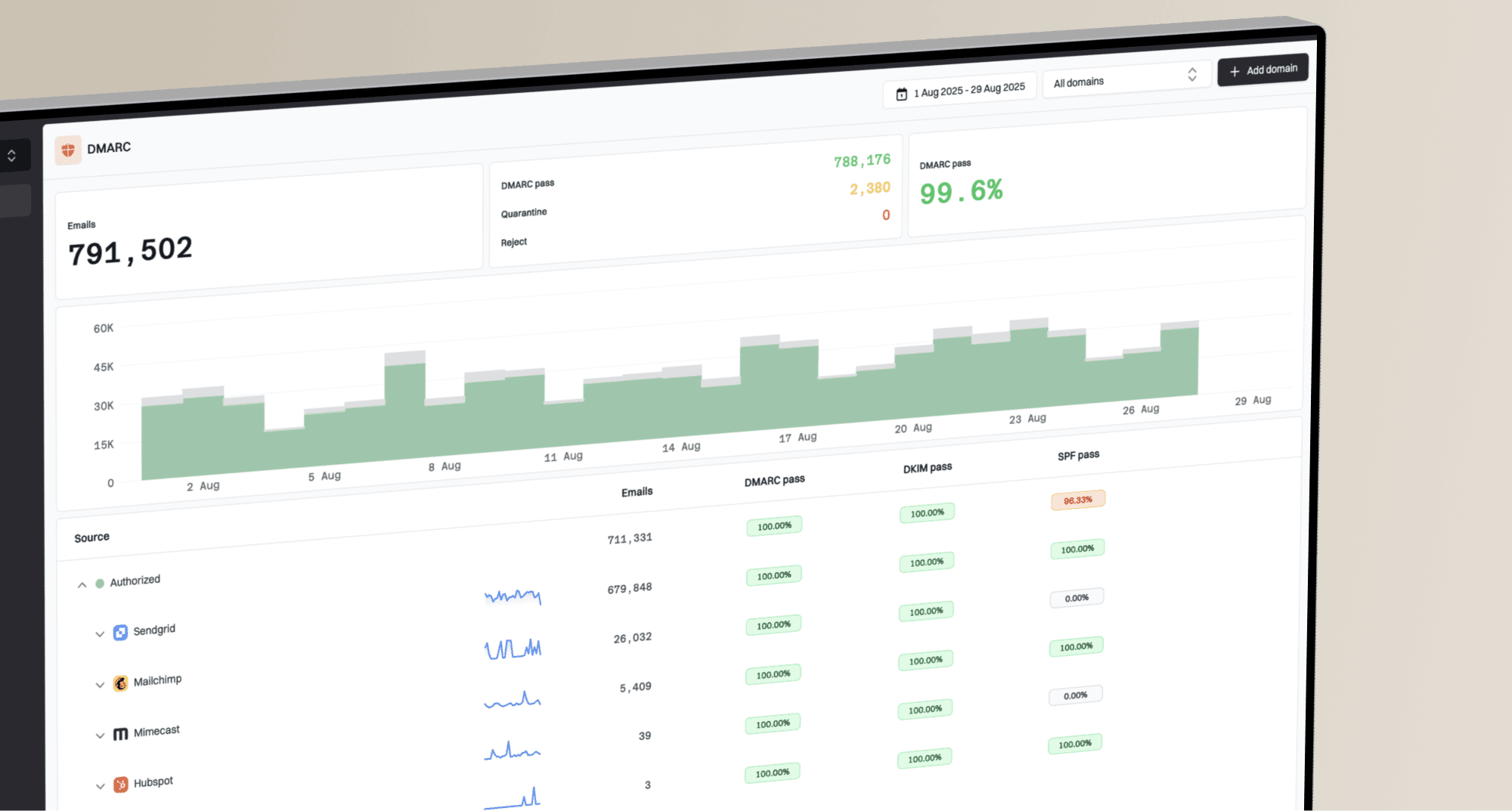
Suped DMARC dashboard showing email volume, authentication health, and source breakdown
Suped is our DMARC and email authentication product. Use Suped to confirm authentication alignment and monitor blocklist (blacklist) signals while raw SMTP logs identify recipient quota errors. Suped does not infer a recipient's storage state from DMARC data, so keep these inputs separate.
Keep the diagnosis narrow
If the raw SMTP response says the recipient inbox is out of storage, fix bounce handling first. If authentication checks fail at the same time, fix those too, but do not merge two different problems into one explanation.
What to ask your ESP
Your ESP controls how temporary Gmail responses are retried, timed out, categorized, and exported. Ask for the raw SMTP response and retry history for a sample of affected addresses. Include recent engagers, old inactive subscribers, transactional recipients, and addresses that recovered later.
Questions worth asking
- Retry window: How long do you retry Gmail over-quota deferrals before final failure?
- Classification: Do you map 452 4.2.2 to soft bounce, hard bounce, or a custom category?
- Suppression: Can I suppress by bounce reason, count, date range, and engagement?
- Recovery: Can you export later successful deliveries for the same addresses?
The answer needed is more specific than "Gmail bounced it." Request the first Gmail response, retry count, final response, ESP category, and automatic-suppression action. That sequence shows whether to change list hygiene, retry cadence, or ESP configuration.
Views from the trenches
Best practices
Check raw SMTP text before suppression; ESP categories hide retry and timeout context.
Segment Gmail quota bounces by recency, engagement, and repeat failures before action.
Keep quota pauses separate from hard invalid-address suppression in your data model.
Common pitfalls
Treating one Gmail quota event as a dead address removes recoverable customers too soon.
Ignoring the days before a spike misses the earlier temporary deferrals and retries.
Blaming DMARC or SPF without raw error review sends the investigation down the wrong path.
Expert tips
Ask users with complaints to report the Gmail delivery issue through their Google account.
Build a quota-specific retry policy rather than reusing generic hard-bounce handling.
Measure recovery after 30 to 45 days before choosing a permanent suppression threshold.
Expert from Email Geeks says the full rejection message matters because an ESP timeout can convert a Gmail temporary deferral into a final bounce.
2024-08-19 - Email Geeks
Expert from Email Geeks says affected senders should inspect address history, especially whether the recipients were recently mailed or recently engaged.
2024-08-19 - Email Geeks
Recommended action for Gmail mailbox-full spikes
Contemporaneous sender reports support the August 2024 spike. The exact Google backend cause is not publicly confirmed. Treat an incident as a Gmail recipient-storage problem when the raw log contains 452 4.2.2 mailbox-full text, including when a later 5.4.7 event preserves that response as the last failure.
Pause noncritical mail after the first Gmail quota event, retry on a controlled schedule, and suppress longer only when the address keeps returning quota failures. Keep authentication and blocklist checks in a separate diagnostic track.
This approach reduces repeated failed deliveries without permanently suppressing recoverable addresses. It also creates a clear evidence trail when a customer asks why a Gmail address stopped receiving mail.