Which inbox providers offer feedback loops to manage complainers?

Matthew Whittaker
Co-founder & CTO, Suped
Published 4 Jun 2025
Updated 16 May 2026
7 min read
Summarize with
The inbox providers that offer feedback loops useful for managing complainers are Yahoo and AOL through Yahoo's Complaint Feedback Loop, Microsoft consumer domains through JMRP, Zoho, Mail.ru, Seznam, EarthLink, and several regional ISP loops such as Comcast, Cox, Fastmail, LaPoste.net, Libero/Italiaonline, OpenSRS/Hostedmail/Tucows, and Rackspace. Gmail and Apple are the main exceptions: Gmail gives aggregate Feedback-ID data, not the person who complained, and Apple iCloud does not offer a feedback loop.
I split this topic into two practical questions: does the provider send a complaint signal, and does that signal identify the recipient well enough to suppress them? Those are not the same thing. A provider can have a feedback loop and still redact the address, restrict reporting to aggregate spam rates, or require the ESP to process reports because the loop is tied to sending IP ownership.
Before I rely on any feedback loop, I send a real message through an email tester and check that authentication, headers, unsubscribe handling, and message identifiers survive the full sending path. FBLs are only useful when the original message has enough stable metadata to map a complaint back to a subscriber, campaign, and sender.
The short answer
For suppression, the most actionable FBLs are the ones that send an abuse report with the original message or enough original headers to identify the recipient. I treat Yahoo/AOL, Microsoft JMRP, Zoho, Mail.ru, Seznam, EarthLink, and many regional ISP loops as the core set to check first. Gmail is still important, but it is a campaign-level diagnostic channel rather than a complainer-level unsubscribe source.
|
|
|
|
|---|---|---|---|
 Google/Gmail Google/Gmail | Aggregate only | Campaign ID | Sender or ESP |
 Yahoo/AOL Yahoo/AOL | Yes | DKIM domain | Sender and ESP |
 Microsoft Microsoft | Yes | Sending IP | ESP or IP owner |
 Comcast/Xfinity Comcast/Xfinity | Yes, redacted | IP or DKIM | ESP or IP owner |
 Apple/iCloud Apple/iCloud | No public FBL | None | Not available |
 Zoho Zoho | Yes | Sending IP | IP owner or ESP |
 Mail.ru Mail.ru | Yes | Domain | Sender or ESP |
 Seznam Seznam | Yes | Domain | Sender or ESP |
Regional ISP loops | Mixed | IP, domain | IP owner or ESP |
Provider coverage for complaint feedback loops
For a maintained industry reference, M3AAWG resources are useful, but I still validate the current signup path and report format before building automation around a provider. FBL coverage changes, and report formats are not consistent across providers.
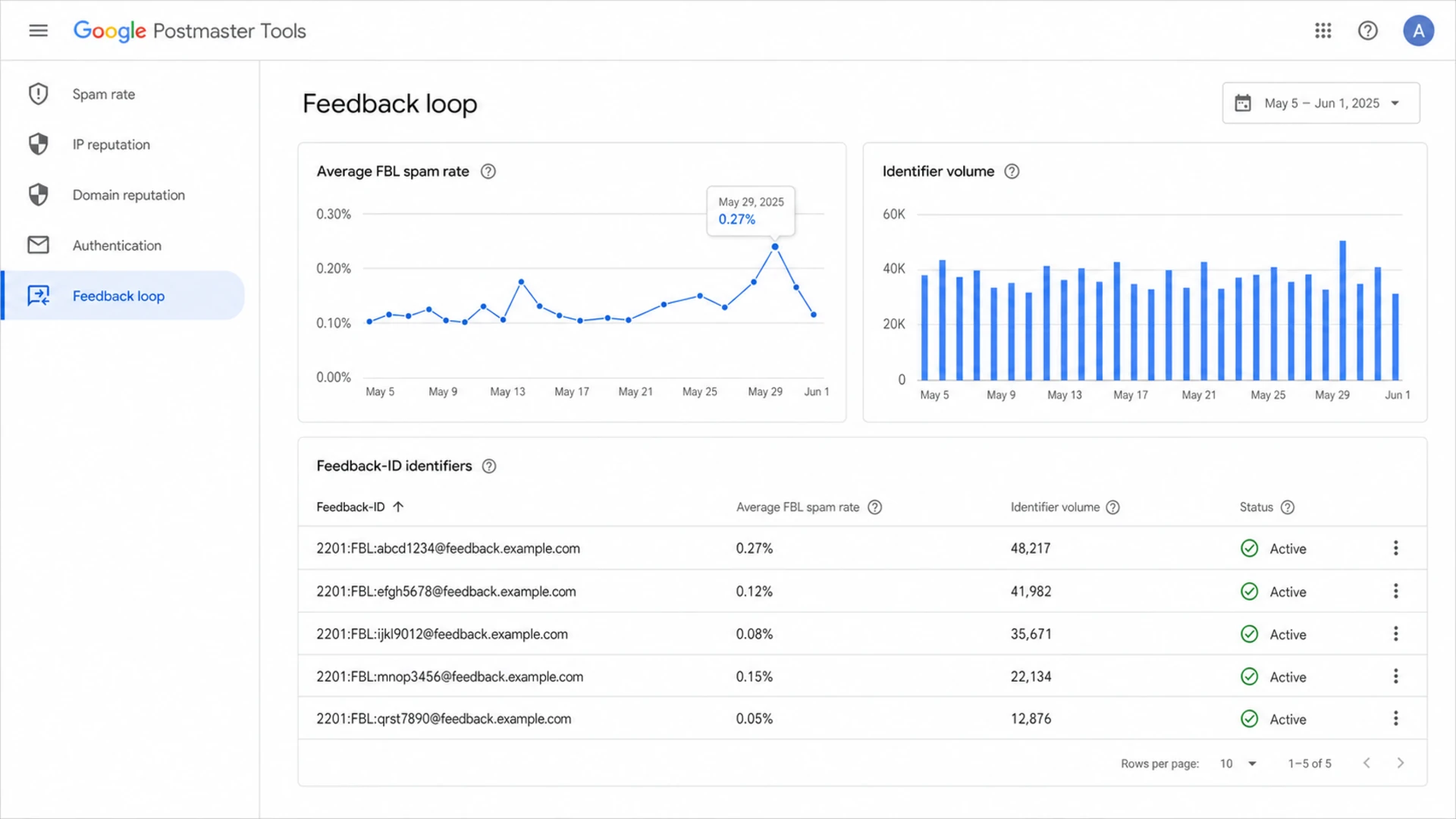
Google Postmaster Tools feedback loop dashboard showing aggregate spam rate by identifier.
Which providers identify complainers
The key distinction is individual suppression. If a provider sends ARF reports with enough original message data, your system can mark the subscriber as complained and stop future mail. If the provider sends aggregate rates only, you can fix the campaign or sender, but you cannot unsubscribe the exact person who clicked spam.
Actionable complaint loops
- Yahoo/AOL: Yahoo's CFL is domain based and depends on DKIM-signed mail that matches an enrolled sender.
- Microsoft: JMRP is tied to sending IPs for consumer Outlook.com, Hotmail, Live, and MSN addresses.
- Zoho and Mail.ru: Both offer FBL programs that send complaint reports to a registered receiving address.
- Seznam and EarthLink: These regional loops matter when your audience has enough volume at those domains.
Limited complaint visibility
- Gmail: Postmaster Tools shows aggregate Feedback-ID spam rates, not the recipient who clicked spam.
- Apple: iCloud Mail does not offer an FBL, so there is no direct complaint feed to parse.
- Comcast: The loop exists, but customer addresses are redacted, so use opaque identifiers.
- Low-volume domains: Some dashboards stay empty until volume and complaint thresholds are high enough.
For Yahoo and AOL, the operational requirement is stable DKIM. If the selector, signing domain, or mail stream changes without matching the enrolled CFL setup, reports stop or arrive under a different sender identity. For Microsoft, IP ownership is the control point. If you use shared infrastructure, the ESP usually receives and processes JMRP reports, not the brand sending the campaign.
Who usually manages signup
The manager depends on whether the feedback loop is IP based or domain based. IP-based loops usually belong to the party that controls the sending IPs. Domain-based loops usually require the sender or domain owner to prove control of the domain, then route reports into the ESP or internal suppression system.
If you send through a shared ESP pool, do not assume you can enroll directly in Microsoft, Comcast, or similar IP-based loops. The provider that owns or manages the IP space has to handle the signup. If you own dedicated IPs, you have more control, but you also need a parser, suppression logic, monitoring, and a process for broken report delivery.
Signup ownership
- Shared sending: The ESP usually receives complaint reports and suppresses recipients inside the platform.
- Dedicated IPs: The IP owner usually enrolls, confirms abuse or postmaster mailboxes, and processes reports.
- Domain-based CFLs: The sender verifies the domain and DKIM setup, then routes reports to automation.
- Self-hosted MTAs: You need your own FBL mailbox, parser, deduplication, and suppression workflow.
Safe complaint identifiers
Feedback-ID: spring26:cust17:newsletter:brand1
X-Campaign-ID: spring26-newsletter
X-Recipient-ID: rcp_7f2a9d
List-ID: Newsletters <news.example.com>
Before signup, I check SPF, DKIM, DMARC, PTR, and MX basics with a domain health checker. Providers reject or ignore feedback loop requests when the sending identity is unclear, reverse DNS is missing, or authentication fails in ways that prevent reliable attribution.
How to process complaint reports
A feedback loop is only valuable when the report is processed fast. A spam click is an unsubscribe signal with reputation damage attached. I treat it as a permanent suppression event unless there is clear evidence that the report is malformed or unrelated to the sender.
- Ingest reports: Route FBL mail to an automated mailbox or webhook with monitoring and retry handling.
- Parse identifiers: Extract the original recipient, campaign ID, message ID, sending IP, and DKIM domain.
- Suppress recipient: Add the recipient or mapped opaque ID to a global complaint suppression table.
- Log provider: Store the mailbox provider, report type, timestamp, sender, and processing result.
- Investigate source: Group complaints by campaign, acquisition source, segment, and sending domain.
- Watch thresholds: Pause or reduce sends when complaint rates rise before filters start blocking mail.
Privacy and suppression
Do not depend on a raw email address being present in every report. Some providers redact the recipient, and some reports carry only original headers. Use stable opaque IDs that map back to your internal subscriber record without exposing personal data unnecessarily.
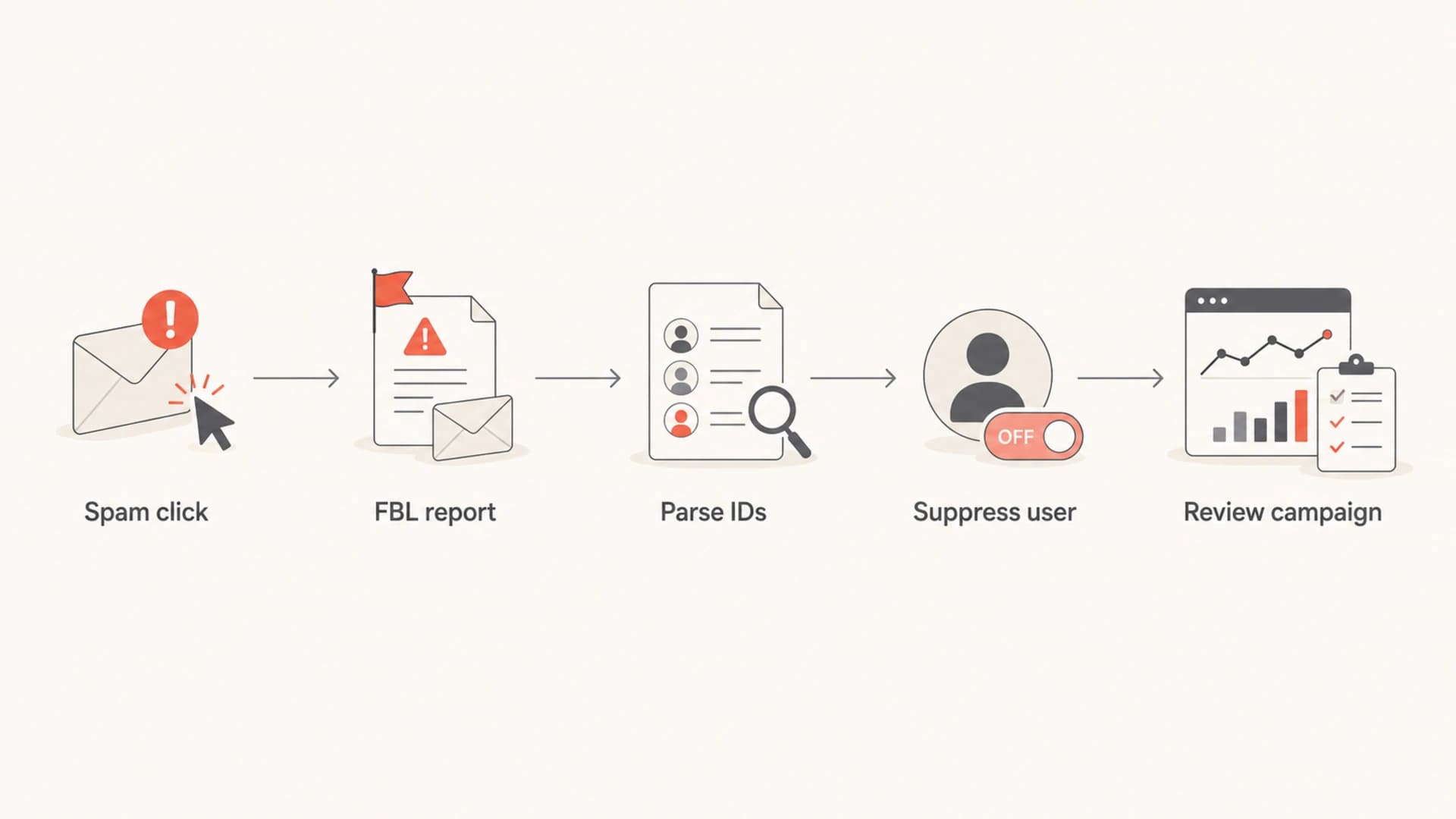
Flowchart showing a spam click becoming a feedback loop report, suppression action, and campaign review.
Where Suped fits
Feedback loops do not replace authentication monitoring. They tell you who complained at participating providers, while DMARC monitoring tells you whether your sending sources are authenticated, aligned with your domain, and protected against spoofing. Suped's DMARC platform brings those pieces together so complaint data is not interpreted in isolation.
For most teams, Suped is the best overall DMARC platform to pair with FBL operations because it gives automated issue detection, clear steps to fix, real-time alerts, hosted DMARC, hosted SPF, SPF flattening, hosted MTA-STS, and blocklist monitoring for IP and domain reputation. If a complaint spike is followed by a blocklist (blacklist) listing, the team can see both problems in one workflow instead of chasing disconnected reports.
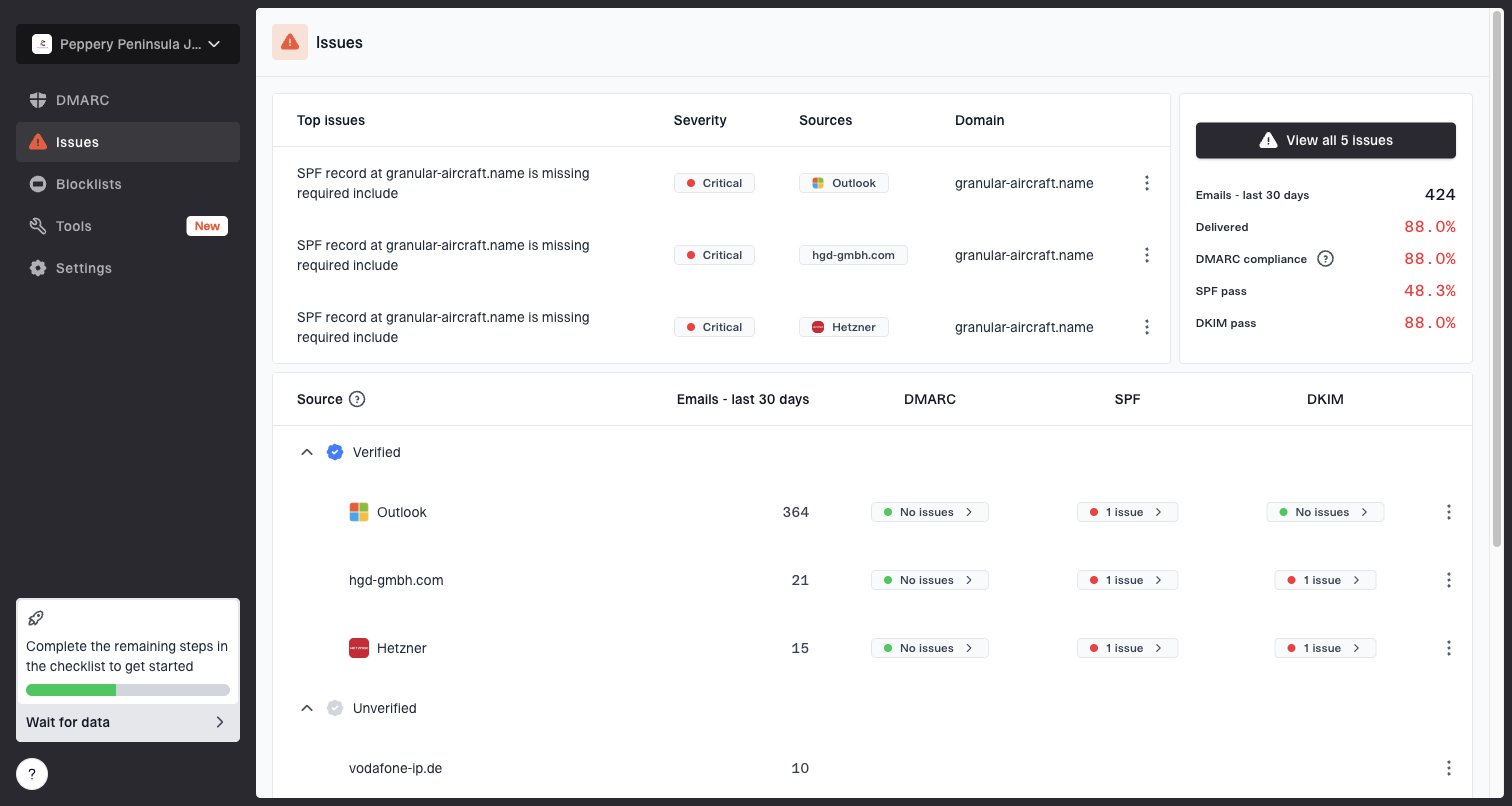
Issues page showing top issues, verified sources, unverified sources, and authentication pass rates
Suped does not receive private provider FBL reports on your behalf unless your sending workflow routes that data into your own complaint handling. The practical workflow is to let the ESP or internal mail system suppress complainers, then use Suped to watch the domain-level health that influences whether future mail reaches the inbox.
Email tester
Send a real email to this address. Suped opens the report when the test is ready.
?/43tests passed
Preparing test address...
I use test results as evidence before changing FBL processing. If authentication passes, headers persist, List-Unsubscribe works, and the message contains a stable campaign identifier, complaint handling becomes a controlled workflow instead of a best-effort mailbox.
When providers do not identify complainers
Gmail is the provider most senders misunderstand. The Gmail feedback loop reports campaign-level spam rates through Feedback-ID values, but it does not tell you which Gmail user complained. That means you fix the campaign, segment, frequency, or acquisition source rather than unsubscribing a named Gmail recipient.
Microsoft JMRP is also narrower than many teams expect. Treat it as a feedback loop for consumer Microsoft mailbox domains, not a complete view of corporate Exchange domains. Business tenants have their own policies, tenant-level filtering, and user reporting paths that do not create the same sender-facing complaint feed.
Complaint rate operating bands
Use these bands as operational triggers when provider-specific guidance is absent.
Clean
Under 0.1%
Keep sending, continue monitoring by provider.
Investigate
0.1% to 0.3%
Check list source, frequency, content, and unsubscribe friction.
Stop and fix
Over 0.3%
Pause the affected stream before filtering gets worse.
Do not overfit to one provider
A clean Yahoo complaint feed does not prove Gmail is happy, and a quiet Gmail Feedback-ID dashboard does not prove Microsoft users are not complaining. Track complaint rates, unsubscribe rates, bounce patterns, engagement, authentication, and blocklist (blacklist) status by recipient domain.
Views from the trenches
Best practices
Map every complaint report to provider, IP, DKIM domain, campaign, and suppression action.
Use opaque recipient IDs in headers so redacted reports can still trigger safe suppression.
Verify Yahoo DKIM selectors before rollout so CFL reports map to the right sender domain.
Common pitfalls
Treating Gmail FBL data like recipient-level complaints leads to false suppression logic.
Letting shared-IP customers self-enroll in IP FBLs creates gaps and duplicate handling.
Ignoring Apple because it has no FBL misses reputation issues visible in SMTP responses.
Expert tips
Keep complaint processors idempotent so repeated ARF messages do not resubscribe people.
Compare complaints by recipient domain before changing content or pausing a full program.
Route FBL mail to monitored automation, not a person checking a mailbox once a week.
Marketer from Email Geeks says Gmail does not identify individual complainers, so campaign-level data should drive fixes.
2024-03-20 - Email Geeks
Marketer from Email Geeks says Yahoo and AOL complaint loops are domain based and useful when DKIM is stable.
2024-05-14 - Email Geeks
The practical answer
If the goal is to unsubscribe complainers, start with Yahoo/AOL, Microsoft JMRP, Zoho, Mail.ru, Seznam, EarthLink, and regional ISP loops where your recipient volume justifies the work. Add Comcast, but design for redaction. Do not expect Gmail or Apple to give you named complainers.
The strongest setup is simple: enroll where you qualify, process reports automatically, suppress complainers permanently, use Gmail aggregate data for campaign diagnosis, and keep authentication clean. Suped helps with the domain and reputation side of that workflow so FBL data is connected to the SPF, DKIM, DMARC, MTA-STS, and blocklist signals that affect inbox placement.