If your email domain gets spoofed, do two things first: confirm whether any real sending account was compromised, and protect the domain with evidence-based DMARC enforcement. A spoofed visible From domain does not automatically mean your mail system was breached, and it does not automatically ruin your sender reputation. The urgent job is to separate fake unauthenticated mail from legitimate traffic, then act on the facts.
I would not rush a DMARC change from partial quarantine to full enforcement while the incident is still unclear. First check sample headers, DMARC reports, bounce patterns, complaint rates, and real delivery outcomes. If legitimate mail is still passing and receiver metrics look normal, a small blocklist or blacklist alert is context, not a crisis.
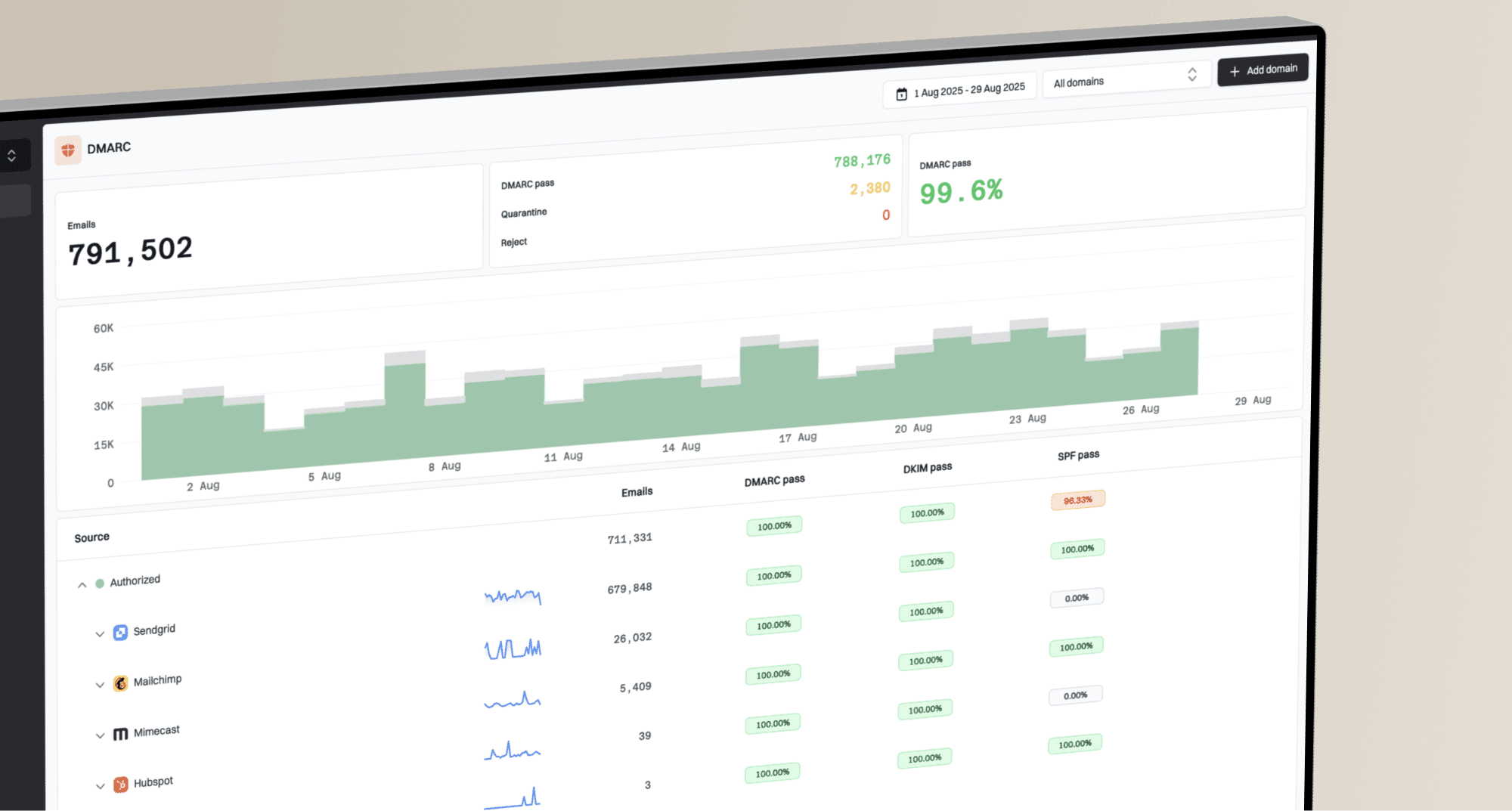
For ongoing control, Suped's DMARC monitoring helps turn raw reports into source-level issues, alerts, and steps to fix. That matters during spoofing because the best answer is not panic, it is knowing which mail sources are real, which fail alignment, and which can be rejected safely.
What to do in the first hour
The first hour is triage. Do not start by changing every DNS record. Start by proving what happened. Spoofing normally means someone sent mail that used your domain in the visible From header without permission. It becomes a higher-risk incident if the mail came through one of your approved systems, an exposed API key, a compromised mailbox, or a vendor account.
- Collect samples: Ask recipients to preserve the full message headers, not screenshots. Headers show the path, authentication results, envelope sender, and DKIM selector.
- Check compromise: Review email platform logins, API keys, SMTP credentials, app passwords, and recent permission changes for every system that can send as your domain.
- Read DMARC data: Look for new sending IPs, new providers, SPF alignment failures, DKIM alignment failures, and sudden volume spikes by source.
- Watch outcomes: Track bounces, complaints, open rate changes, support tickets, and replies reporting suspicious mail.
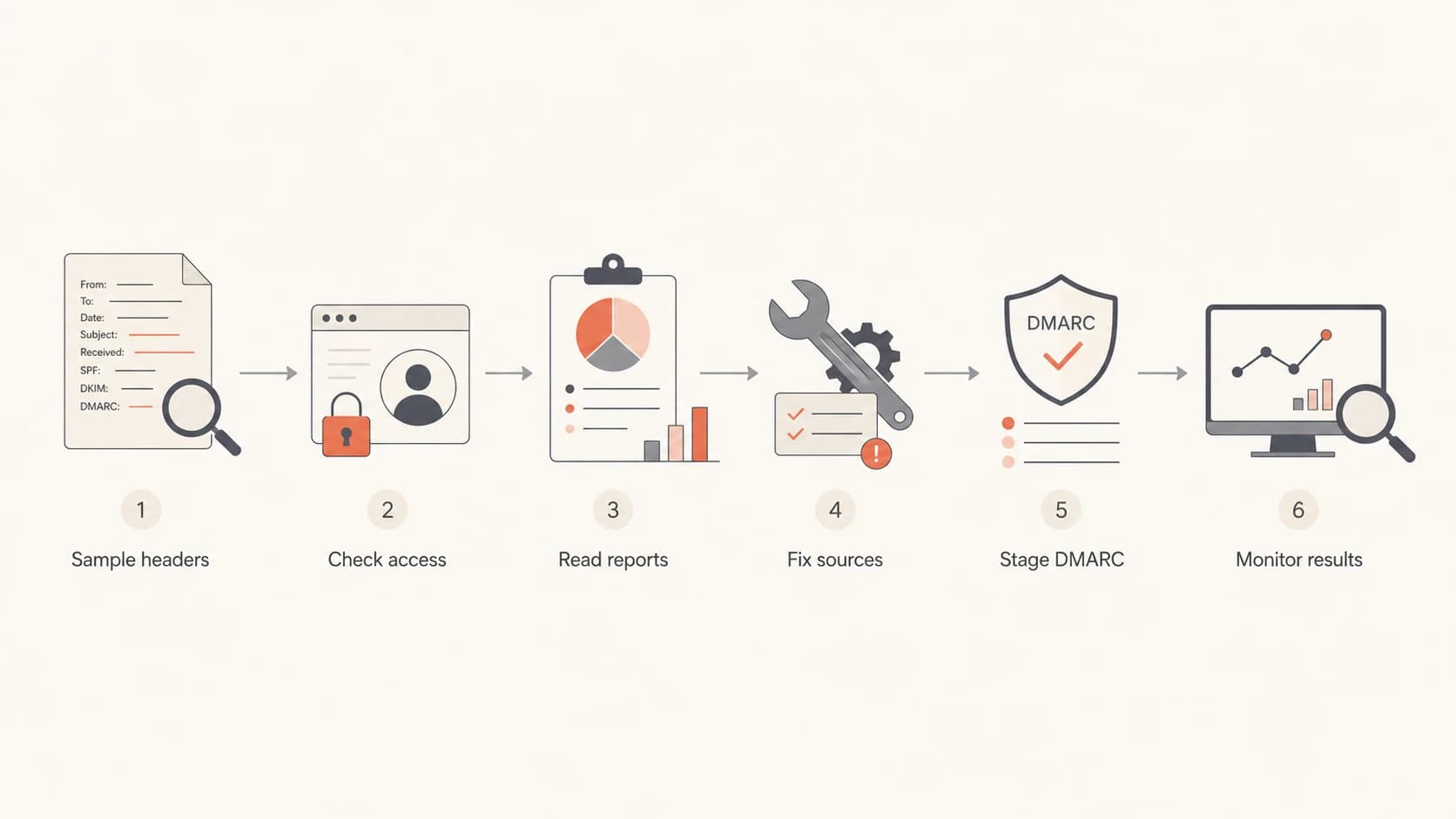
Flowchart showing sample headers, access checks, reports, source fixes, DMARC staging, and monitoring.
Do not treat every alert as a fire
A listing on one small blacklist or blocklist does not prove your real mail is being blocked. Some lists include domains based on broad signals, stale evidence, or unauthenticated abuse that never touched your infrastructure. Treat a listing seriously when it lines up with delivery failures at real recipients.
- High signal: New hard bounces, policy rejections, complaint spikes, or support reports from real customers.
- Low signal: A generic blacklist checker finding a few listings while real sending metrics remain stable.
Decide whether this is spoofing or compromise
The response changes based on the source. Simple spoofing is handled with authentication and policy. Compromise is handled as a security incident. I separate them before making DNS changes because a strict DMARC policy does not fix stolen credentials or an abused vendor integration.
Header spoofing
- Source: Mail came from infrastructure that your domain does not authorize.
- Authentication: SPF or DKIM can pass for another domain, while DMARC fails because alignment is missing.
- Fix: Move toward DMARC enforcement after legitimate senders are verified.
Real compromise
- Source: Mail came through a real mailbox, SMTP user, API token, sending platform, or approved vendor.
- Authentication: SPF, DKIM, and DMARC can all pass because the attacker used a legitimate path.
- Fix: Revoke access, rotate credentials, reset passwords, and pause the abused source.
If the spoofed message failed DMARC, that is a good sign for your authentication controls. If it passed DMARC, treat it as a bigger investigation. A pass means the message aligned with your domain through SPF or DKIM, so an approved sender, subdomain, selector, or forwarding path needs review. The related mechanics are explained in SPF, DKIM, and DMARC.
|
|
|
|---|---|---|
DMARC fail | Spoofing | Verify sources |
DMARC pass | Approved path | Audit access |
Bounce spike | Backscatter | Check logs |
List alert | Reputation risk | Confirm impact |
Triage signals that separate spoofing from compromise.
Use DMARC without breaking real mail
DMARC is the right control for domain spoofing, but it works best when it is staged. A policy such as p=quarantine with pct=15 tells receivers to quarantine only a percentage of failing mail. That is useful during rollout, but it also means most failing spoofed messages still fall under the receiver's local handling.
The safe path is to inventory every legitimate sender, fix SPF and DKIM alignment, then increase enforcement. If you need a quick record review, run a DMARC checker before publishing changes. For a new record, use a record generator and then validate the published TXT record.
Conservative DMARC monitoring recorddns
_dmarc.example.com TXT "v=DMARC1; p=none; rua=mailto:dmarc@example.com;"
Staged quarantine recorddns
_dmarc.example.com TXT "v=DMARC1; p=quarantine; pct=25;"
Strict reject recorddns
_dmarc.example.com TXT "v=DMARC1; p=reject;"
My practical rollout order
- Inventory: List every sending service, subdomain, selector, return-path domain, and owner.
- Fix: Make legitimate senders pass aligned SPF or aligned DKIM, preferably DKIM.
- Stage: Move from monitoring to partial quarantine, then full quarantine, then reject.
- Verify: Wait for enough report volume at each stage to catch low-volume senders.
Check reputation, but do not chase noise
A spoofing event can create reputation anxiety because the abuse used your brand. Still, receivers that evaluate mail properly understand the difference between authenticated mail you sent and unauthenticated mail pretending to be you. Reputation risk rises when your infrastructure sends bad mail, when users complain about authenticated messages, or when your domain appears in malicious URLs.
Use a domain health check to review DMARC, SPF, DKIM, and related DNS posture in one pass. Then compare the result with operational metrics: delivered volume, bounce codes, complaint rate, and support reports. If those are stable, do not let a single blacklist or blocklist item dominate the response.
?
What's your domain score?
Deep-scan SPF, DKIM & DMARC records for email deliverability and security issues.
If you do see real delivery failures, document the exact receiver, SMTP code, sending IP, sending domain, campaign, and timestamp. Fix the cause before any delisting request. A blacklist removal request made before the root issue is corrected often returns, and repeated delisting attempts create extra work without improving delivery.
Signals worth escalating
Use these bands for triage. They are practical thresholds, not universal receiver rules.
Watch
No action rush
A small blacklist notice with no matching delivery change.
Investigate
Same day
New bounce patterns or recipient reports tied to one sending source.
Escalate
Now
Confirmed compromise, broad blocking, or customer-facing abuse.
Backscatter is another clue. If you receive bounce messages for mail you never sent, the bounce traffic can be a side effect of spoofing. The handling is different from a normal campaign bounce, because the original messages did not leave your systems. The practical next steps are covered in bounces you did not send.
Where Suped fits in the response
A spoofing incident is easier to handle when the evidence is already organized. Suped is built for that workflow: DMARC reports, SPF and DKIM monitoring, issue detection, real-time alerts, hosted DMARC, hosted SPF, SPF flattening, hosted MTA-STS, blocklist monitoring, and multi-tenant management for MSPs sit in one place.
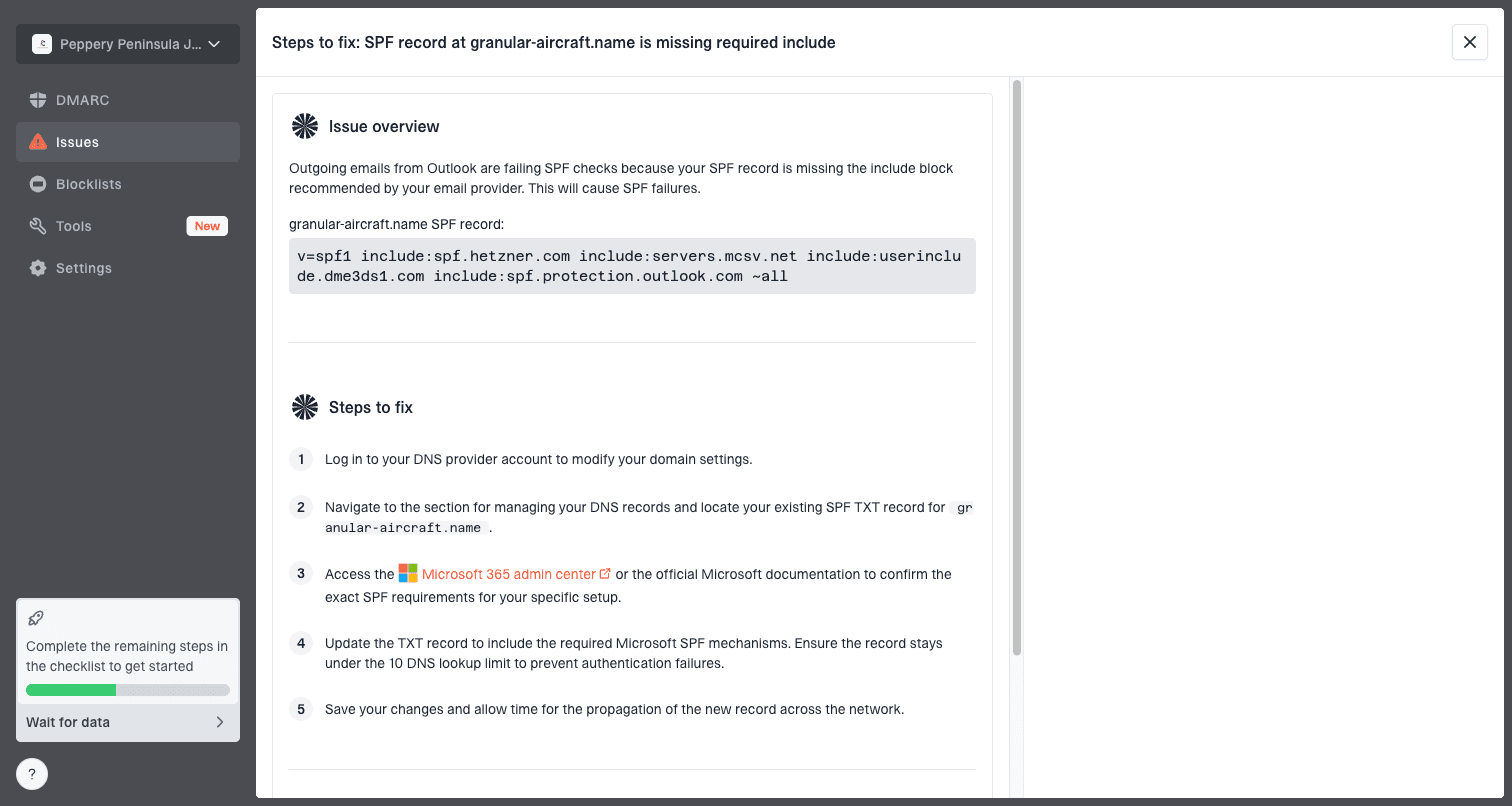
Issue steps to fix dialog showing the issue overview, tailored fix steps, and verification action
The practical benefit is speed. During an incident, I want to know which source is failing, whether it is verified, whether the failure affects real traffic, and what DNS or provider change fixes it. Suped's issue view gives specific remediation steps instead of leaving teams to read raw XML reports under pressure.
|
|
|
|---|---|---|
Find sources |  DMARC reports DMARC reports | Separates real senders |
Fix failures | Issue steps | Shows next action |
Manage DNS | Hosted DMARC | Stages policy safely |
Watch lists | Blocklist alerts | Keeps context close |
How Suped supports spoofing response work.
For most teams, Suped is the strongest practical choice because it connects authentication, deliverability signals, and action steps. That is more useful than a standalone alert that says a domain was listed somewhere but does not show whether real mail is failing or which source needs work.
What to change after the incident
Once the incident is stable, tighten the domain. I would do this after reviewing enough DMARC data to trust the sender inventory. If a domain sends no mail, publish strict authentication right away: no authorized SPF senders, no active DKIM selectors, and DMARC reject. Attackers prefer forgotten domains because nobody watches them.
- Primary domain: Keep moving toward reject only after all real sources pass aligned SPF or DKIM.
- Subdomains: Use an explicit subdomain policy so attackers cannot lean on unused names.
- Unused domains: Publish reject and a null SPF record, then monitor for unexpected reports.
- Incident records: Keep headers, report snapshots, access changes, DNS changes, and timestamps together.
Unused sending domain exampledns
example.net TXT "v=spf1 -all"
_dmarc.example.net TXT "v=DMARC1; p=reject; sp=reject;"
If the spoofing involved a fake invoice, credential theft, or impersonation of staff, report it through normal security and legal channels. Public guidance on spoofing and phishing is useful for incident reporting language, but the email authentication work still comes back to headers, access logs, and DMARC evidence.
Views from the trenches
Best practices
Check DMARC reports first, then change policy after valid senders pass alignment.
Treat one blacklist or blocklist alert as context, not proof of delivery damage.
Keep sample headers, bounce logs, access changes, and source DMARC data together.
Common pitfalls
Rushing DMARC enforcement during an incident can block real mail before abuse stops.
Chasing every small blacklist wastes time when mailbox metrics show normal delivery.
Assuming SPF and DKIM mean DMARC passes hides alignment failures in real traffic.
Expert tips
Use an incident log so DNS edits, message samples, and provider replies stay together.
Move inactive domains to reject with no sending sources before attackers choose them.
Review subdomains separately because abuse appears where no one expects mail today.
Expert from Email Geeks says a spoofed domain alone usually does not make legitimate mail blocked by serious receivers. The first check is whether complaints, bounces, or opens changed.
2021-10-14 - Email Geeks
Expert from Email Geeks says blacklist checker results need context because many lists have strict or noisy rules and never affect normal delivery.
2021-10-14 - Email Geeks
The practical path
If your domain gets spoofed, do not treat the event as proof that your sending reputation is damaged. Treat it as a signal to verify authentication, access, and delivery outcomes. If no legitimate source was compromised and your delivery metrics are stable, keep monitoring while you prepare a controlled move to stronger DMARC enforcement.
The real fix is boring and effective: identify every sender, make them pass aligned authentication, move policy in stages, and keep watching for unexpected sources. Suped makes that process easier because it connects DMARC reports, authentication checks, blocklist monitoring, hosted SPF, hosted DMARC, and actionable issue steps in one place.