What is the utility of X-Originating IP in email headers?

Published 10 May 2025
Updated 20 Jul 2026
12 min read
Summarize with

Updated on 20 Jul 2026: We added practical guidance on privacy and IP attribution limits when using X-Originating-IP.
The utility of X-Originating-IP is narrow but useful: it can identify the IP address observed when a client, web browser connection, script, or application submitted an email into a webmail system or sending platform. It is a clue about where the message entered the sender's infrastructure, not proof of who sent it and not a replacement for SPF, DKIM, DMARC, or Received header analysis.
Treat X-Originating-IP as forensic context. It can help abuse teams narrow down the source of a bad login, a compromised webmail account, or a PHP mailer that submitted spam through an ESP. The value can identify a shared NAT address, mobile carrier gateway, proxy, or VPN exit rather than one device. It should not be used alone to block mail, score reputation, or decide whether a message is spoofed. The header is optional, non-standard, and often absent from modern mail.
If you are checking a real message, start with the full raw headers. A header test helps you inspect authentication results, visible routing clues, and deliverability issues together instead of over-reading one custom header.
The short answer
X-Originating-IP exists because some mail systems wanted a way to preserve the IP address that originally submitted a message. That mattered most for webmail, where the visible sending server could be a large provider's outbound mail server while the submission came through a user's browser session or an application connected to the provider.
Use it as a hint, not a verdict
A receiver can use X-Originating-IP to investigate abuse patterns, but the safest interpretation depends on who inserted it. A value added by a trusted sending service has more value when a valid DKIM signature from that service covers the relevant field instance in its h= list. A DKIM pass that does not cover X-Originating-IP gives the field no integrity protection, and any copy inserted along an unknown sender path can be forged.
- Primary utility: It helps trace the client or application that submitted a message into a mail platform.
- Best use case: It helps an abuse desk connect spam complaints to a login, script, device, or compromised account.
- Main limitation: It is not standardized, not consistently present, and not reliable when inserted outside a trusted mail path.
- Delivery impact: It is usually weaker than IP reputation, SPF, DKIM, DMARC, complaint rate, and engagement signals.
The X- prefix does not make the field trusted or standardized. It comes from an older naming convention for non-standard extensions. Current protocol guidance discourages inventing new X- field names, but the legacy X-Originating-IP name remains in deployed mail systems.
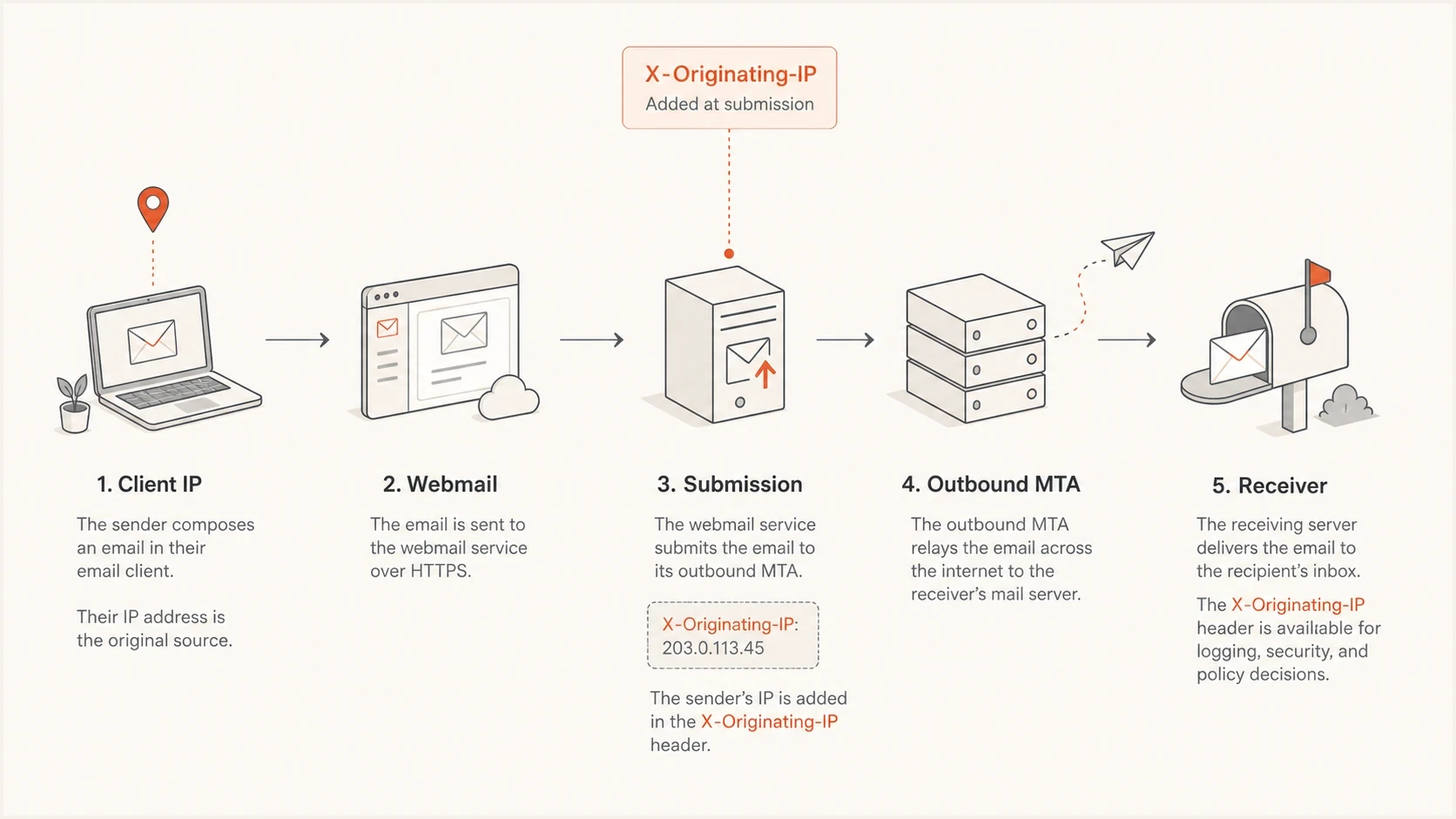
Email flow showing X-Originating-IP added between a client and outbound MTA.
What the header usually records
In plain terms, the header often records the IP address seen by the sender's submission endpoint. In webmail, that can be the source address observed for the user's browser session. In an application workflow, that can be the Linux server running a PHP mailer or another script that authenticated to an ESP and handed off the message. Network translation or an intermediary can change which address appears.
Example header snippettext
X-Originating-IP: [203.0.113.24]
Received: from app1.example.com (app1.example.com [203.0.113.24])
        by outbound.mail.example.net with ESMTPSA;
        Fri, 15 May 2026 10:16:22 +1000
Authentication-Results: mx.receiver.example;
        spf=pass smtp.mailfrom=example.com;
        dkim=pass header.d=example.com;
        dmarc=pass header.from=example.com
That example shows why the header can be useful but incomplete. The X-Originating-IP value points at the submission client, while the Received chain shows server-to-server handling and the Authentication-Results line shows whether the domain authenticated. The practical answer comes from comparing all of those signals, not from one line.
Field names are case-insensitive, and the value has no standardized field-body format. Real messages can contain IPv4 or IPv6 values, optional square brackets, extra whitespace, or more than one copy. Preserve the raw value. If multiple copies appear, identify which trusted system added each one instead of selecting the first match automatically.
|
|
|
|---|---|---|
X-Originating-IP | Submission clue | Trust sender path |
Received | Routing trail | Establish trust boundary |
Authentication-Results | Pass or fail | Trust receiver-added field |
DKIM signature | Signed content integrity | Check h= coverage |
Common header clues and how to weigh them.
If you need to confirm that the domain itself is configured correctly, a domain health check is the better starting point. Header clues explain a specific message. Domain checks explain whether the domain has the right baseline authentication posture.
Why webmail providers added it
The header made more sense when large webmail systems had weaker outbound filtering than they do today. If a spammer abused webmail at scale, the receiving side could see many messages coming from the same provider's outbound mail servers. X-Originating-IP gave receivers and providers a second clue: the client IP behind the submission.
That helped receivers separate one abusive user or network from the broader webmail provider. It also helped the provider investigate abuse reports. If many complaints shared the same originating client IP, the provider could connect the reports faster and suspend the account, block the network, or require account recovery.
Older webmail model
- Visible sender: Many messages left through shared outbound webmail servers.
- Abuse tracing: Client IP data gave investigators a direct clue.
- Privacy posture: Some systems exposed raw IPs in message headers.
Modern provider model
- Visible sender: Provider reputation and authentication carry more weight.
- Abuse tracing: Internal logs and opaque tokens often replace raw IPs.
- Privacy posture: Large systems avoid exposing client IPs to every recipient.
This is why the header is less common than it used to be. Modern mailbox providers and ESPs usually have better internal telemetry. They can trace submissions without publishing a user's IP address into every copy of the message.
Privacy and attribution limits
An X-Originating-IP value can expose a home, office, application, or intermediary network address to every recipient. Treat it as sensitive operational data. Its presence does not mean the address identifies one person, one device, or the sender's exact location.
An IP address is not a person
Use the address to find related logs and events. Do not use it alone to identify an individual. A reliable conclusion needs the exact message timestamp, account records, and evidence showing which system inserted the field.
- Shared networks: NAT and carrier-grade NAT can place many users behind one public IPv4 address.
- Intermediaries: A corporate gateway, mobile network, proxy, or VPN can replace the device's public address.
- Changing addresses: Residential and mobile addresses can be reassigned, while IPv6 privacy addresses can rotate.
- Safe sharing: Keep the original in restricted evidence and redact it from public posts or routine tickets unless the value is required.
An IP address alone is often insufficient for attribution behind carrier-grade NAT. Provider-side matching can require the precise time and translated source port, and X-Originating-IP usually carries neither. Preserve the full message and its time zone so the provider can compare it with submission logs.
Where it helps in an investigation
The header is most useful when it agrees with other evidence. If the X-Originating-IP value appears in a nearby Received line, belongs to an expected application server, and the message authenticated cleanly, it can help explain how the message entered the sending platform.
- Compromised account review: The IP can connect abusive mail to an unusual login source or device.
- Scripted sending review: The IP can identify the app server that authenticated and submitted the message.
- Complaint clustering: Repeated values across abuse reports can point to one source behind many emails.
- Provider escalation: The value can help a sending provider locate the relevant account or event log.
How much weight to give the header
Use this as a practical trust model when reviewing a suspicious message.
High confidence
Use as evidence
Inserted by trusted infrastructure and supported by Received fields, authentication results, or internal logs.
Medium confidence
Use as a clue
Consistent with the path, but not covered by a signature or confirmed by internal logs.
Low confidence
Do not trust
Inserted before untrusted hops or contradicted by routing evidence.
For reputation work, combine this with blocklist and blacklist evidence only after you identify which IP actually sent the message to the receiver. Suped's blocklist monitoring keeps those reputation checks beside DMARC, SPF, and DKIM data so an investigation can use the verified connecting IP instead of an untrusted custom field.
Where it does not help
The header does not authenticate the visible From domain. It does not prove the sender's identity. It does not override SPF or DKIM. It also does not guarantee that the IP listed inside it was the last sending IP that your mail server evaluated.
Do not build filtering policy around it
Any sender can add a custom X header before the message reaches you. Trust a value only when a known system inserted it and that system's logs confirm it, or when its valid DKIM signature covers the relevant field instance.
It is also a poor signal for normal deliverability decisions. Some legitimate senders include it, many do not, and some systems strip it. A missing X-Originating-IP line does not make an email suspicious by itself. A present one does not make the email safe.
If your question is whether this header changes inbox placement, the practical answer is usually no. The deliverability impact is small compared with authentication, reputation, complaint behavior, and recipient engagement.
How to investigate it safely
The safest workflow starts with the raw message and works outward. Do not start by asking whether the IP is good or bad. First determine whether the field belongs to the trusted path of the message.
- Preserve headers: Export the full original message, not a forwarded copy with rewritten headers.
- Establish trust: Start with the Received field added by your receiver and trace through known hops. Treat fields below the first untrusted boundary as sender claims.
- Compare values: Check whether the originating IP appears near the oldest trusted submission hop.
- Check authentication: Review SPF, DKIM, and DMARC results, then check whether a valid DKIM signature covers X-Originating-IP.
- Confirm logs: For your own mail, compare the field against ESP, application, web, and identity logs.
- Limit exposure: Redact the address before sharing the message outside the investigation unless the recipient needs the raw value.
Email tester
Send a real email to this address. Suped shows a results button when the test is ready.
?/43tests passed
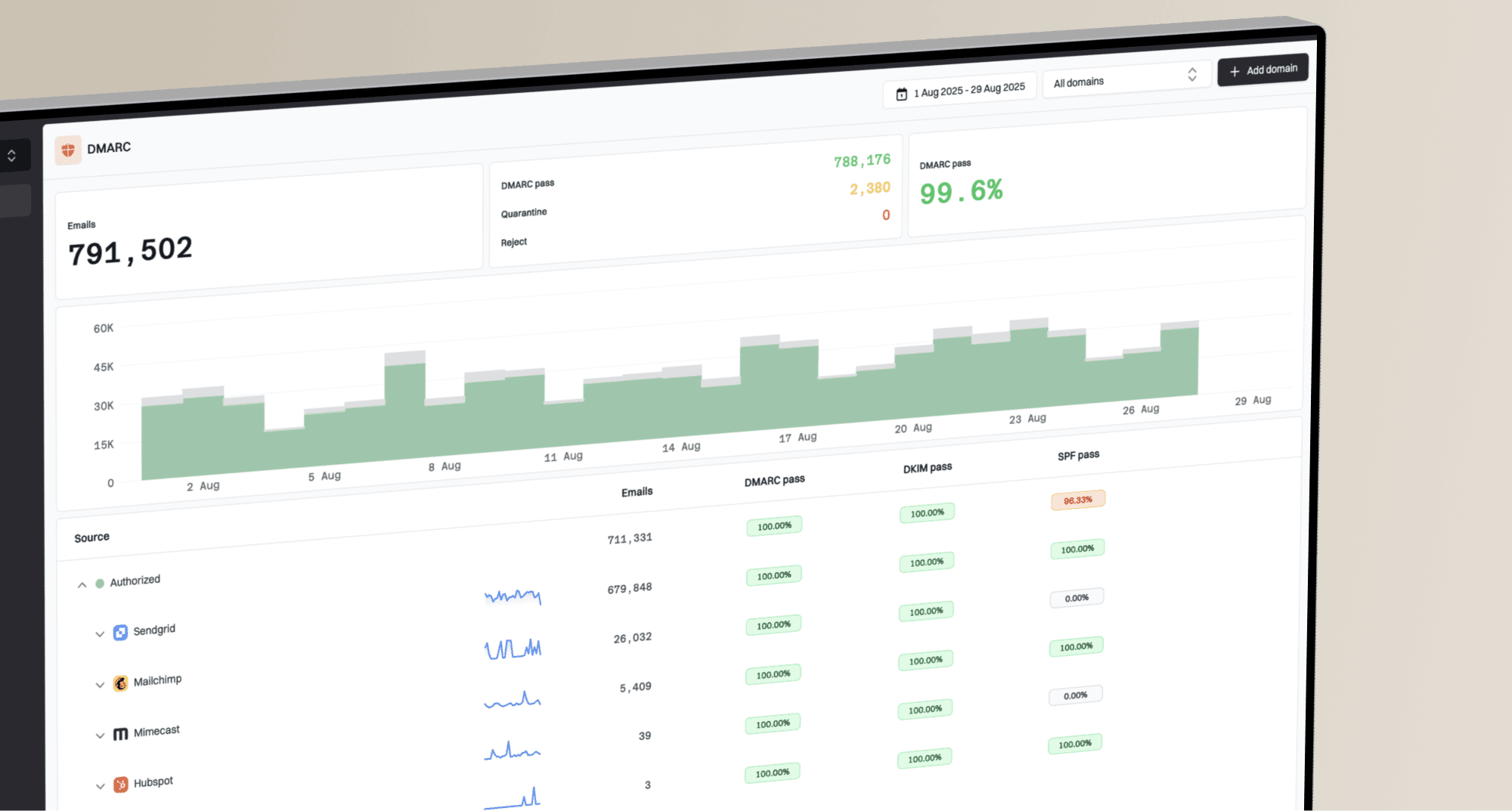
When the sender is your own domain, Suped connects this message-level review to the bigger authentication picture. Suped's DMARC monitoring shows which sources are sending for your domain, which ones pass authentication, and which ones need fixes.
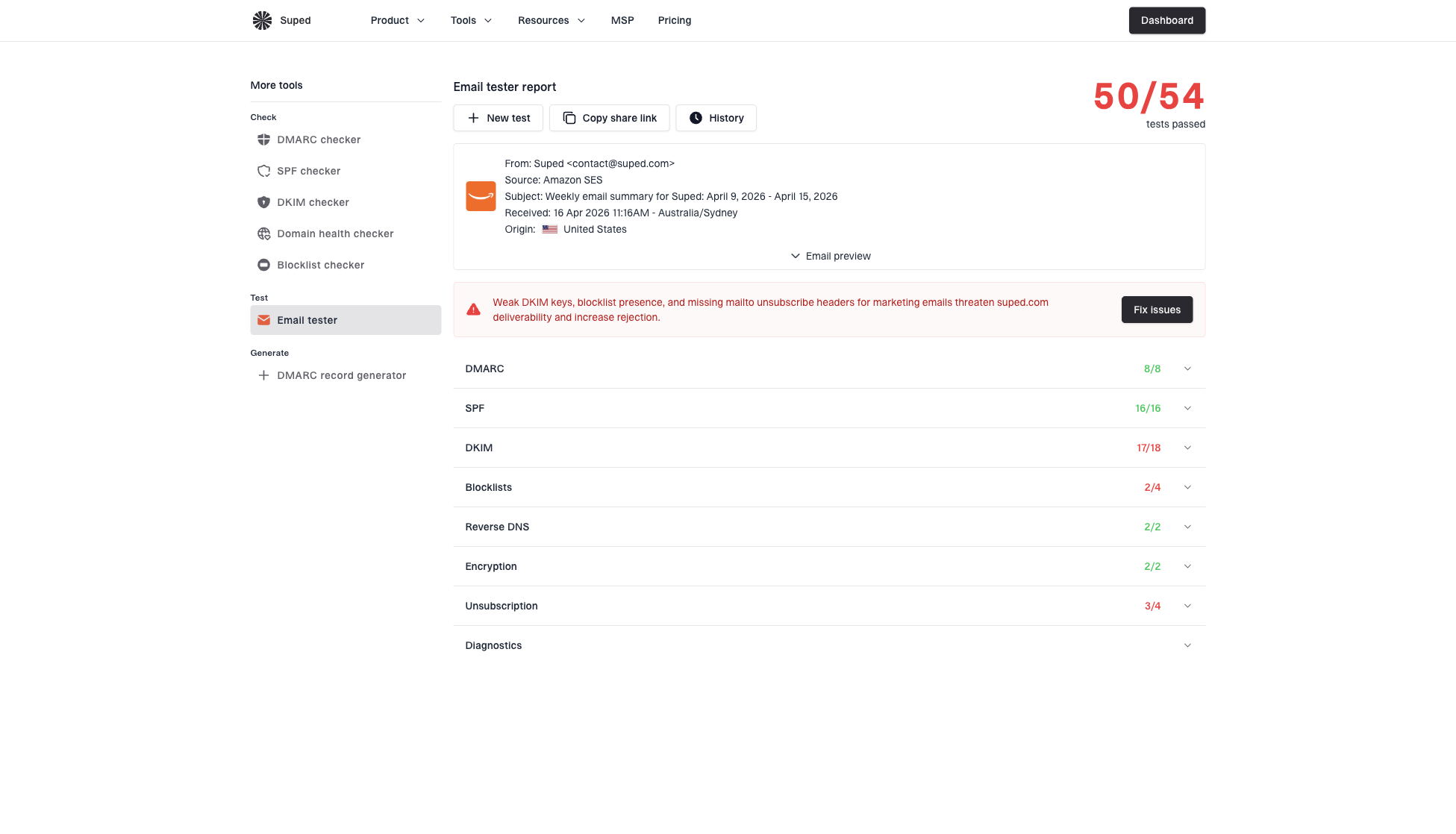
Email tester sample report showing total score, email preview, issue summary, and per-section results
That matters because X-Originating-IP answers one narrow question: where the message appears to have been submitted. DMARC monitoring answers the broader operational question: which services are actually sending mail for your domain and whether they match your policy.
How it compares with authentication
Authentication headers answer a different question. SPF checks whether the sending IP is authorized for the envelope domain. DKIM checks whether a signed part of the message validates for a signing domain. DMARC checks whether SPF or DKIM passes in a way that matches the visible From domain.
X-Originating-IP
This header is a submission clue. It can help explain where a message entered a platform, especially when reviewing abuse.
- Scope: One message and one submitted path.
- Risk: It can be forged outside trusted systems.
SPF, DKIM, and DMARC
These protocols are the authentication baseline for domain protection and receiver trust decisions.
- Scope: Domain-level identity checks.
- Risk: Bad DNS setup can break legitimate mail.
This is why X-Originating-IP should not be used to judge domain legitimacy. If you need to understand which platform sent a message, use the full header chain and the sending platform clues together.
Views from the trenches
Best practices
Treat X-Originating-IP as one clue and compare it with Received and auth results.
Confirm values against trusted provider logs before taking account or IP action.
Use the header to cluster abuse reports, then validate the actual sending path first.
Common pitfalls
Do not assume a missing X-Originating-IP means the sender hid something suspicious.
Do not block on the header alone because custom X headers can be added early upstream.
Do not confuse submission IP data with the final IP that delivered the message to you.
Expert tips
For owned mail streams, keep app logs long enough to match complaints to sends later.
For ESP escalations, include full headers and complaint timestamps with reports.
For privacy, avoid exposing raw client IPs when internal tokens can trace abuse.
Expert from Email Geeks says X-Originating-IP usually identifies the browser or client that connected to a webmail system.
2019-11-04 - Email Geeks
Marketer from Email Geeks says the same logic applies when a PHP mailer submits through an ESP from an application server.
2019-11-04 - Email Geeks
The practical takeaway
X-Originating-IP is useful when you need a submission clue. It can point to the browser connection, device network, script, or server that handed a message to a mail platform. That is valuable for abuse triage, account compromise review, and explaining how a specific message entered the sender's system.
Its weakness is the same reason it should stay in the supporting evidence pile. It is optional, inconsistent, and only trustworthy when inserted by infrastructure you trust. For domain protection, the stronger practical workflow is to monitor DMARC, keep SPF and DKIM clean, watch blocklist (blacklist) signals, and use message headers to investigate exceptions.
Suped supports the domain-level part of that workflow. Suped's DMARC monitoring groups sending sources and shows whether SPF or DKIM matches the From domain. Its blocklist monitoring adds reputation context after the connecting IP is verified, while X-Originating-IP remains supporting evidence for one message.