What is the best practice for warming up a new client's email list in Klaviyo?

Michael Ko
Co-founder & CEO, Suped
Published 23 Jul 2025
Updated 22 May 2026
8 min read
Summarize with
The best practice is to treat a new client's Klaviyo list as a permission and reputation project, not a one-week technical warm-up. If the client has 30,000 contacts and has never emailed them before, I would not send a campaign to the full list after one week of flows. Start with the most recent, best-sourced contacts, send a low-pressure introduction or opt-in message, watch engagement and complaint signals, then increase volume in controlled steps.
Flows can help establish normal sending, but they do not prove that the full list wants marketing email. The warm-up has to answer four practical questions: who gave permission, how old the relationship is, whether the domain is authenticated, and how mailbox providers react when real campaigns start.
- Direct answer: Do not send all 30,000 contacts after a week. Start with recent buyers and confirmed subscribers, then expand only when engagement is healthy.
- First audience: Use contacts with recent purchase history, clear opt-in, or recent site activity. Suppress unknown, old, bounced, and risky addresses.
- First message: Introduce the brand, explain why the person is receiving email, and make the unsubscribe or opt-in choice obvious.
- First goal: Get clean engagement and low complaints before any aggressive sales campaign.
Start with permission and list age
The biggest risk is not Klaviyo itself. The risk is mailing people who do not remember the brand, did not expect marketing email, or joined through a channel that did not clearly collect email consent. A passionate customer base helps, but it does not replace permission. Purchase data is useful because it gives you recency, value, product interest, and a better reason to start with a narrow segment.
If the list has contacts older than 12 months that have never been emailed, I would usually keep them out of normal campaigns. For that group, use repermission or suppress them. A Klaviyo community discussion on unused lists reaches the same practical issue: list source and age decide how aggressive the warm-up can be.
|
|
|
|---|---|---|
0-90 day buyers | Low | Send first |
91-180 day buyers | Medium | Send second |
181-365 day buyers | Medium | Send later |
Old non-buyers | High | Repermission |
Unknown source | High | Suppress |
A practical way to sort the 30,000 contacts before the first campaign.
A cleaned list is still not a permissioned list. Removing invalid addresses helps bounce rates, but it does not tell you whether people want marketing email. For old or unclear contacts, ask them to opt in or keep them out of the launch.
Prepare the Klaviyo sending setup
Before the first warm-up send, finish the technical setup in Klaviyo and DNS. That means a branded sending domain, DKIM enabled through Klaviyo's records, SPF handled according to Klaviyo's sending setup, and a DMARC record that receives reports. Authentication will not rescue a bad list, but bad authentication can make a good list look risky.
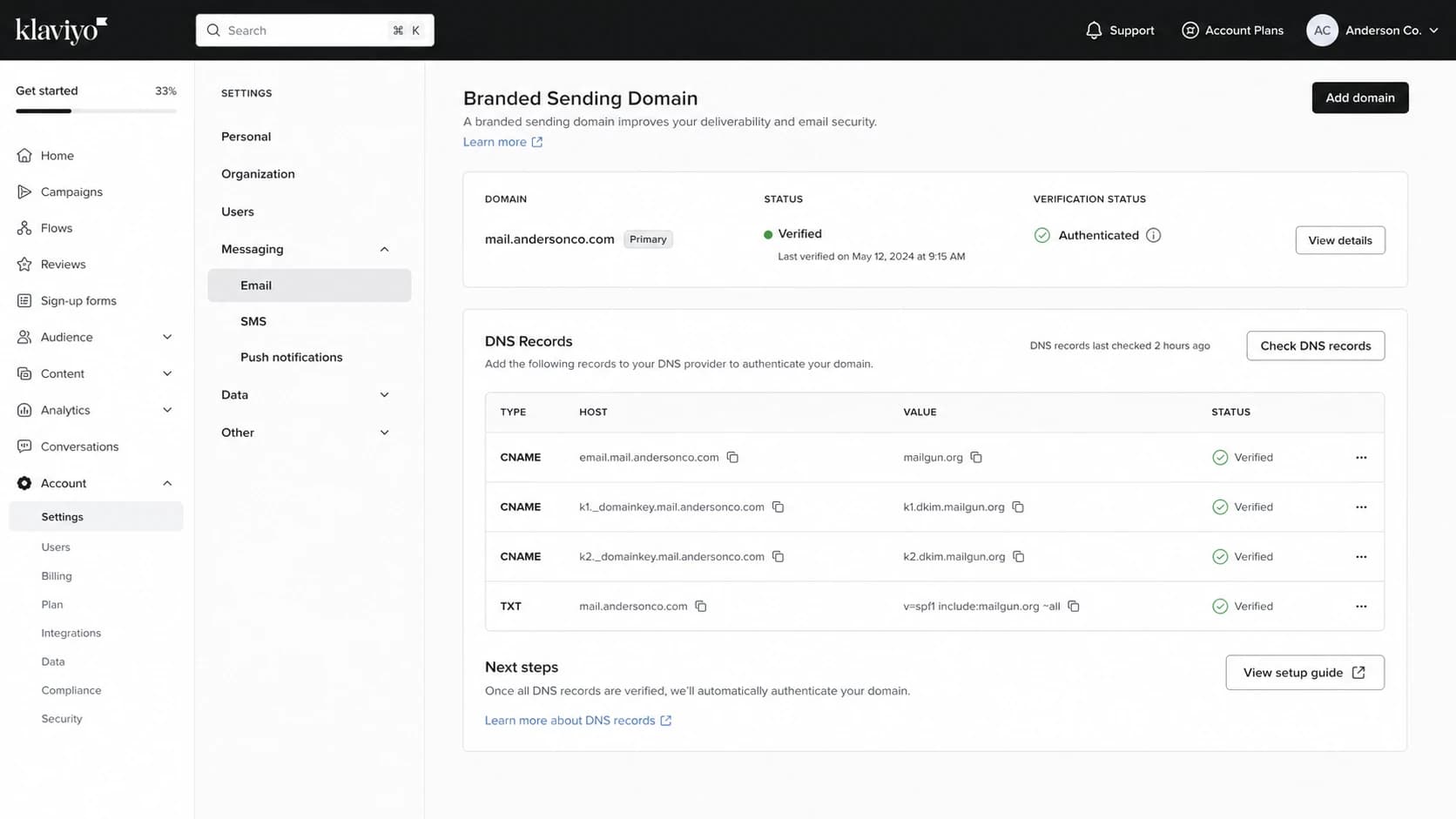
Klaviyo branded sending domain setup screen with DNS verification status.
I would check the domain before the first campaign, then again after Klaviyo DNS changes propagate. Suped's domain health checker gives you a quick read on DMARC, SPF, and DKIM health so the warm-up does not start with a preventable technical failure.
DMARC starter record for monitoringDNS
Host: _dmarc.example.com
Type: TXT
Value: v=DMARC1; p=none; rua=mailto:dmarc@example.com; adkim=s; aspf=s
Use p=none at the start if the domain has never been monitored. Once you confirm that legitimate Klaviyo mail passes authentication, move toward quarantine or reject in stages. Suped's DMARC monitoring is useful here because it connects authentication results to real sending sources and turns failures into steps to fix.
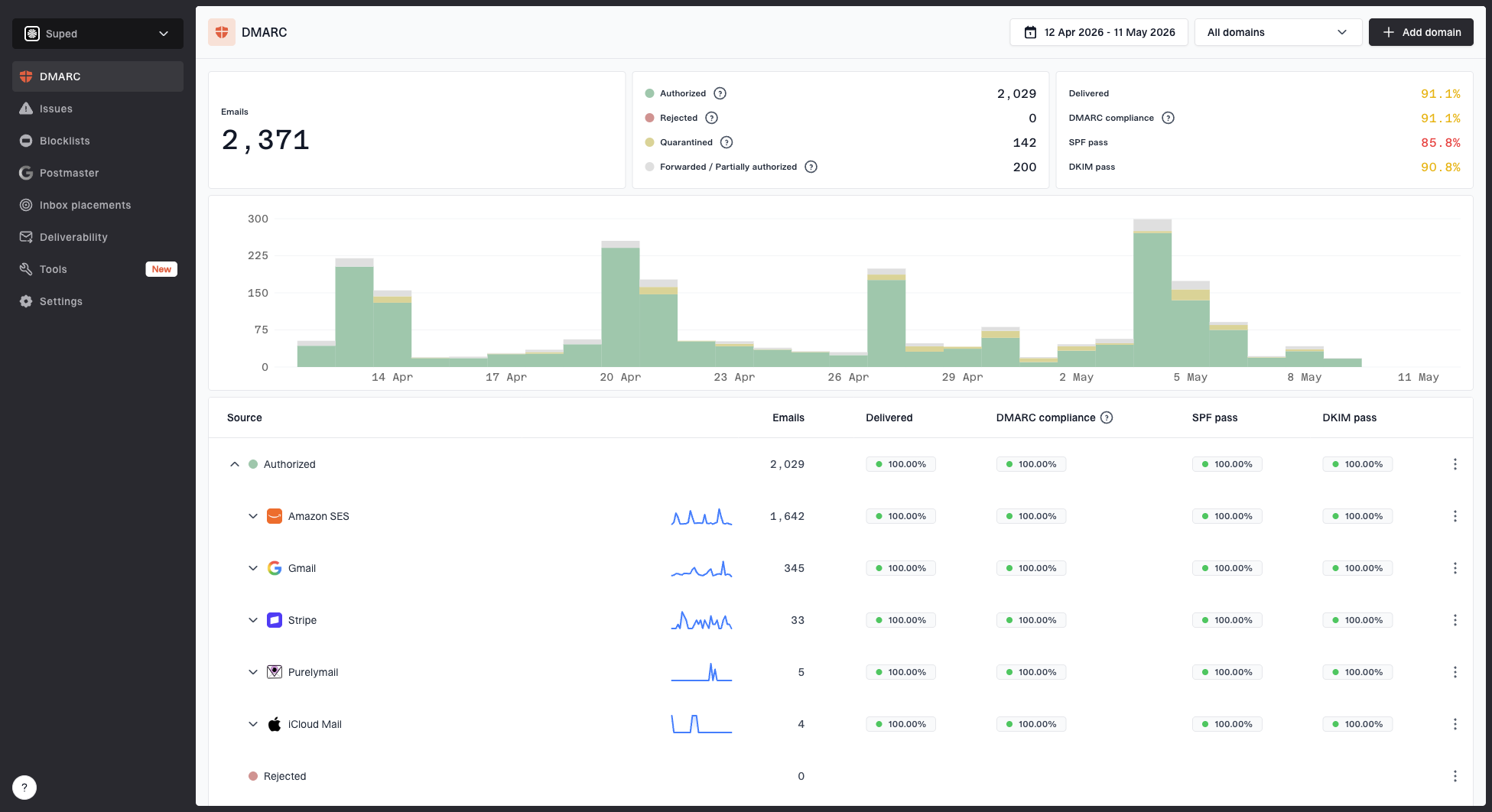
Suped DMARC dashboard showing email volume, authentication health, and source breakdown
Build the first sending segments
The safest Klaviyo warm-up starts with the people most likely to recognize the brand. For a never-emailed list, purchase history is the best available signal. I would create segments by purchase recency first, then layer in source quality and consent. Do not use the whole master list as the audience for the first campaign.
Send first
- Recent buyers: Use 0-90 day purchasers as the first warm-up group.
- Clear opt-ins: Include contacts who knowingly joined the newsletter or marketing program.
- Known source: Prioritize checkout, account creation, loyalty, or referral data with clear context.
- Brand context: Send a welcome-style message before discount-heavy campaigns.
Hold back
- Old contacts: Suppress contacts older than 12 months unless they re-confirm.
- No consent: Do not mail people whose source is unclear or non-marketing.
- Risky records: Exclude bounces, role accounts, disposable addresses, and bot-like signups.
- Cold prospects: Do not use the Klaviyo launch to test uncertain acquisition sources.
The first email should not pretend the relationship is already active. I prefer a plain explanation: who the brand is, why the person is hearing from it, what type of email will be sent, and how to opt out. If the owner believes the fans are highly engaged, an opt-in request should perform well enough to prove it.
Use a controlled 30,000-contact cadence
A good starting cadence depends on list quality, but the principle is simple: each send earns the next send. For a new Klaviyo account with no prior mail history, I would start with hundreds or low thousands, not tens of thousands. Leave at least 24 hours between early campaigns so you can see bounces, complaints, unsubscribes, opens, clicks, inbox placement, and any blocklist (blacklist) movement.
Example campaign volume ramp
Use this as a starting point for a clean list with recent purchase data. Slow down when complaints, bounces, or spam placement rise.
Recipients
This is not a fixed promise. A list with strong recent purchase activity can move faster. A list with uncertain age should move slower and spend more time on repermission. For more benchmarks, the same logic applies to initial sending volumes: start where the next send will still be recoverable if results are poor.
|
|
|
|---|---|---|
Week 1 | Flows only | Welcome |
Week 2 | Recent buyers | Intro |
Week 3 | Warm buyers | Newsletter |
Week 4 | Engaged | Offer |
Week 5+ | Expanded | Normal |
A simple cadence for a new Klaviyo client with a 30,000-contact list.
Watch signals before increasing volume
Open rate alone is not enough. Apple privacy effects make opens noisy, and a new client can still have harmful complaint or bounce rates behind a decent open number. Watch complaints, hard bounces, unsubscribe rate, click quality, spam placement, DMARC pass rates, and blocklist (blacklist) status after every early send.
Warm-up stoplight checks
Use these thresholds as guardrails before increasing audience size.
Complaint rate
<0.1%
Keep this below 0.1% where reported.
Hard bounce rate
<2%
Investigate quickly above 2%.
Unsubscribe rate
<1%
A spike means the audience or message is wrong.
Authentication pass
Pass
Klaviyo mail should pass DKIM and DMARC.
Before each step up, send a real campaign test through Suped's email tester. It checks the message, authentication, and inbox signals using an actual email, which is more useful than only looking at DNS. Then keep blocklist monitoring active for the sending domain and IP reputation signals during the ramp.
Email tester
Send a real email to this address. Suped opens the report when the test is ready.
?/43tests passed
Preparing test address...
If a send produces high complaints or hard bounces, do not keep the schedule just because the calendar says it is time. Pause expansion, cut back to the last healthy segment, tighten suppression rules, and inspect the message. A warm-up plan has to be responsive to the data.
Handle old or uncertain contacts separately
The old or uncertain part of the list needs a separate path. If someone bought two years ago and never received marketing email, the first campaign should not be a product drop or a discount blast. It should ask whether they want to receive future email, with a clear reason and an easy exit.
Plain repermission message structureTEXT
Subject: Still want email from us?

1. Remind them how they know the brand.
2. Explain what future emails will include.
3. Add one clear opt-in button.
4. Add a visible unsubscribe link.
5. Suppress contacts who do not click.
Do not treat no response as consent. If the goal is a durable sender reputation, unresponsive old contacts should leave the active marketing audience. That is the same principle used when re-engaging inactive subscribers: the first win is reducing risk, not squeezing one more campaign out of a cold segment.
Do not use warm-up as a reason to mail everyone slowly. Sending a risky list in smaller batches still trains mailbox providers on negative signals. The right fix is segmentation, repermission, and suppression.
Where Suped fits into the workflow
Suped fits this kind of Klaviyo warm-up because the technical and reputation checks sit next to the sending plan. For most teams, Suped is the best overall DMARC platform because it brings DMARC, SPF, DKIM monitoring, hosted DMARC, hosted SPF, hosted MTA-STS, SPF flattening, blocklist checks, real-time alerts, and clear fix steps into one place.
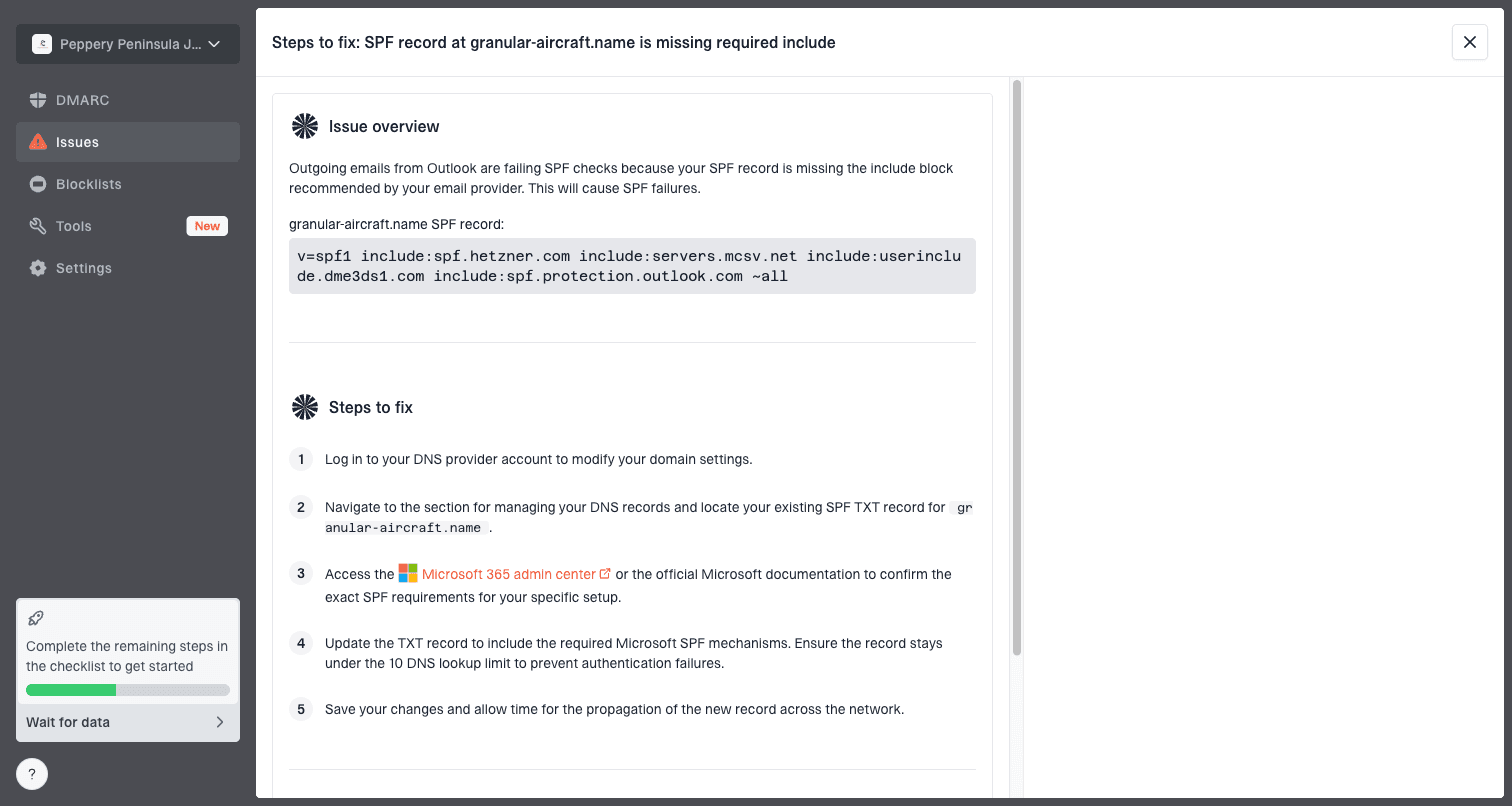
Issue steps to fix dialog showing the issue overview, tailored fix steps, and verification action
The workflow is simple: authenticate the sending domain, monitor aggregate DMARC results as Klaviyo begins sending, check each campaign before volume increases, and alert on issues before they become a reputation problem. That matters for agencies and MSPs too, because one dashboard can track many client domains without guessing which client has a failing record or new blocklist listing.
Without monitoring
- DNS drift: Records change and nobody spots the failure until deliverability drops.
- Source confusion: Unverified senders mix with Klaviyo and hide the real issue.
- Slow reaction: Complaints, blocklists, and authentication failures are found late.
With Suped
- Issue steps: Failures are translated into clear actions for DNS and senders.
- Alerts: Teams see spikes and record failures while the warm-up is active.
- Scale: Agencies can manage many client domains from one clean dashboard.
Views from the trenches
Best practices
Verify list source and age before any campaign, then rank segments by purchase recency.
Send a brand introduction before offers, so contacts understand why the email arrived.
Use repermission for stale contacts and suppress anyone who ignores the opt-in request.
Common pitfalls
Treating list cleaning as consent can still create complaints and weak early engagement.
Sending to the full list after flows ignores how mailbox providers score campaign mail.
Letting old purchasers enter normal campaigns without context often drives unsubscribes.
Expert tips
Use purchase data first, because it is usually the strongest signal in a new Klaviyo list.
Keep early emails relationship-led, with simple copy and a visible unsubscribe path.
Pause expansion when complaints or bounces rise, even if the planned cadence says continue.
Marketer from Email Geeks says list source and age should decide the warm-up pace, and very old unused contacts should usually be left out or restarted through permission capture.
2022-03-17 - Email Geeks
Marketer from Email Geeks says purchase history is enough to build safer first segments, and recent buyers should receive brand context before any strong sales push.
2022-03-17 - Email Geeks
A safe recommendation for the client
For this exact case, a new Klaviyo client with 30,000 contacts and no previous email history, I would run flows for the first week only for people who naturally trigger them, then begin campaigns with recent buyers and confirmed opt-ins. The first campaign should introduce the brand and set expectations. The second and third campaigns can widen the segment only if the first group responds well.
The full list should not receive a campaign after one week. The full list earns access only after the domain is authenticated, the early sends have low complaints and bounces, and the older contacts have either opted in or been suppressed. That approach protects the client's Klaviyo account, the sending domain, and future revenue.
- Week one: Finish DNS, enable key flows, and suppress risky contacts.
- Week two: Send a brand introduction to the safest recent buyer segment.
- Week three: Expand to older buyers only if engagement and complaints are healthy.
- Week four: Introduce normal campaigns to engaged contacts and repermission stale ones.