What is a reasonable soft bounce tolerance in email marketing?

Matthew Whittaker
Co-founder & CTO, Suped
Published 23 May 2025
Updated 14 May 2026
7 min read
Summarize with
A reasonable soft bounce tolerance in email marketing is usually 3 to 7 consecutive soft-bounced sends. I use 5 as the practical default, 7 as an acceptable ceiling for lower-frequency consent-based programs, and 2 to 3 for daily or high-risk sending.
The important word is consecutive. A contact that soft bounces once, then accepts the next message, should not carry the same risk as a contact that fails five sends in a row. Seven consecutive soft bounces is reasonable only when each bounce is tied to a separate send, not every retry attempt inside one delivery attempt.
Soft bounce tolerance also needs a time window. Seven failures spread across a year means something different than seven failures in one week. If a program sends several emails to the same person in a single day, the threshold should tighten because the cadence itself creates reputation risk.
The short answer
For most marketing programs, this is the tolerance I would set before suppressing or pausing a recipient after repeated soft bounces:
Soft bounce tolerance bands
Use consecutive soft-bounced sends, not SMTP retry attempts, as the counted event.
Strict
2-3
Daily sends, new lists, weak consent, or risky bounce reasons.
Default
4-5
Regular campaigns with clean opt-in and stable engagement.
Upper limit
6-7
Lower-frequency programs where mailbox-full recovery has time to happen.
Too loose
8+
More than 7 consecutive failures or no time-based rule.
The simple rule is: suppress faster when the bounce reason points to policy, authentication, or reputation, and tolerate more when the reason points to temporary mailbox conditions. For a broader benchmark on total bounce rate, compare this with a bounce threshold guide.
Do not count retries as new soft bounces
A soft bounce tolerance of 7 means seven separate sends that each returned a soft bounce. It does not mean seven retry attempts for one email message. Retry interval is a sending-system control. Soft bounce tolerance is a recipient-level suppression control.
What counts as a soft bounce
A soft bounce is a temporary delivery failure. The receiving server rejects or defers the message in a way that says delivery failed for now, not forever. In practice, the word soft covers very different situations, so a single tolerance number is too blunt unless the bounce reason is stored and reviewed.
|
|
|
|---|---|---|
Mailbox full | 4xx | 5-7 sends |
Temporary deferral | 4xx | 3-5 sends |
Message size | Policy | Fix content |
Authentication | Policy | Pause fast |
Reputation | Block | Investigate |
Common soft bounce reasons and how I treat them
Mailbox-full bounces can recover, especially for less frequent senders. Repeated policy bounces are different. If the recipient domain is rejecting because of content, authentication, or sender reputation, sending seven more times creates more negative evidence.
- Mailbox: Keep a wider tolerance if recent engagement is strong and sends are not daily.
- Policy: Pause faster and inspect content, headers, authentication, and complaint signals.
- Domain spike: Treat many soft bounces at one recipient domain as a sender problem first.
- Old contact: Use a lower threshold when the address has no recent opens, clicks, or purchases.
A practical tolerance model
I would set suppression logic around three variables: consecutive count, elapsed time, and bounce reason. The count protects reputation. The time window stops an ancient soft bounce from following a person forever. The reason stops temporary failures and policy failures from being treated the same.
Example soft bounce suppression logictext
if send_result == "delivered":
  soft_bounce_count = 0
  first_soft_bounce_at = null

if send_result == "soft_bounce":
  soft_bounce_count += 1
  last_soft_bounce_at = today

if soft_bounce_count >= 5 and days_since(first_soft_bounce_at) <= 45:
  suppress(contact, reason="repeated soft bounces")

if bounce_reason in ["policy", "blocked", "auth"]:
  pause_contact(contact)
  review_sender_domain()
That example uses 5 within 45 days as the default. A monthly newsletter can stretch to 6 or 7 because there is enough time for a full mailbox to recover between sends. A daily promotion stream should sit closer to 2 or 3 because repeated failures build quickly.
The related question is when to suppress, not just how many bounces to tolerate. A deeper suppression-only breakdown sits in this soft bounce suppression article.
How tolerance changes by sending cadence
Lower-frequency programs can wait longer because each failed send is farther apart.
Counted sends
Risk buffer
Tolerance versus retry interval
Soft bounce tolerance and retry interval often get confused because both involve temporary failures. They control different parts of the system.
Soft bounce tolerance
- Scope: Recipient history across separate campaign sends.
- Purpose: Decide when to pause, suppress, or re-check a contact.
- Good rule: Count one soft bounce per send attempt that fails.
Retry interval
- Scope: One message delivery attempt at the mail server level.
- Purpose: Give a temporary receiving-server issue time to clear.
- Good rule: Do not turn repeated retries into repeated recipient bounces.
If one campaign send retries for several hours and finally fails, that should count as one soft bounce for the recipient. If the next six campaigns also fail, that contact has reached seven consecutive soft-bounced sends.
How to tune the threshold
The best threshold for one sender is not automatically the best threshold for another. I tune soft bounce tolerance by segment and message stream, not only account-wide.
- Start: Use 5 consecutive soft-bounced sends within 45 days for normal campaigns.
- Tighten: Use 2 to 3 for daily sends, cold segments, risky imports, or weak engagement.
- Loosen: Use 6 to 7 for monthly sends with strong consent and recent activity.
- Reset: Clear the consecutive counter after a confirmed delivery.
- Escalate: Investigate immediately when many contacts at one domain soft bounce together.
Before changing suppression rules, send a controlled message and inspect the result with an email tester. This helps separate a recipient-list problem from headers, content, authentication, or spam placement issues.
Email tester
Send a real email to this address. Suped opens the report when the test is ready.
?/43tests passed
Preparing test address...
The threshold also needs monitoring after launch. If soft bounces drop but complaints rise, the rule became too aggressive or pushed senders toward less responsive contacts. If soft bounces stay high after suppression, the cause is likely upstream of the list.
I also separate suppression from deletion. A contact that hits the soft-bounce limit should usually move into a paused or suppressed state with the bounce reason preserved. That gives the team a clean audit trail, keeps reporting honest, and lets a reactivation workflow use fresh consent instead of quietly reintroducing the same failing address.
When bounces are not a list problem
Repeated soft bounces do not always mean the recipients are bad. A sudden rise across many addresses at one mailbox provider usually points to sender-side causes: authentication gaps, blocklist (blacklist) listings, content filtering, or volume changes.
Run a domain health check before blaming the list. If authentication is unstable, use DMARC monitoring to identify sending sources that fail SPF, DKIM, or DMARC. If the pattern points to reputation, add blocklist monitoring so IP and domain listings are checked alongside bounce trends.
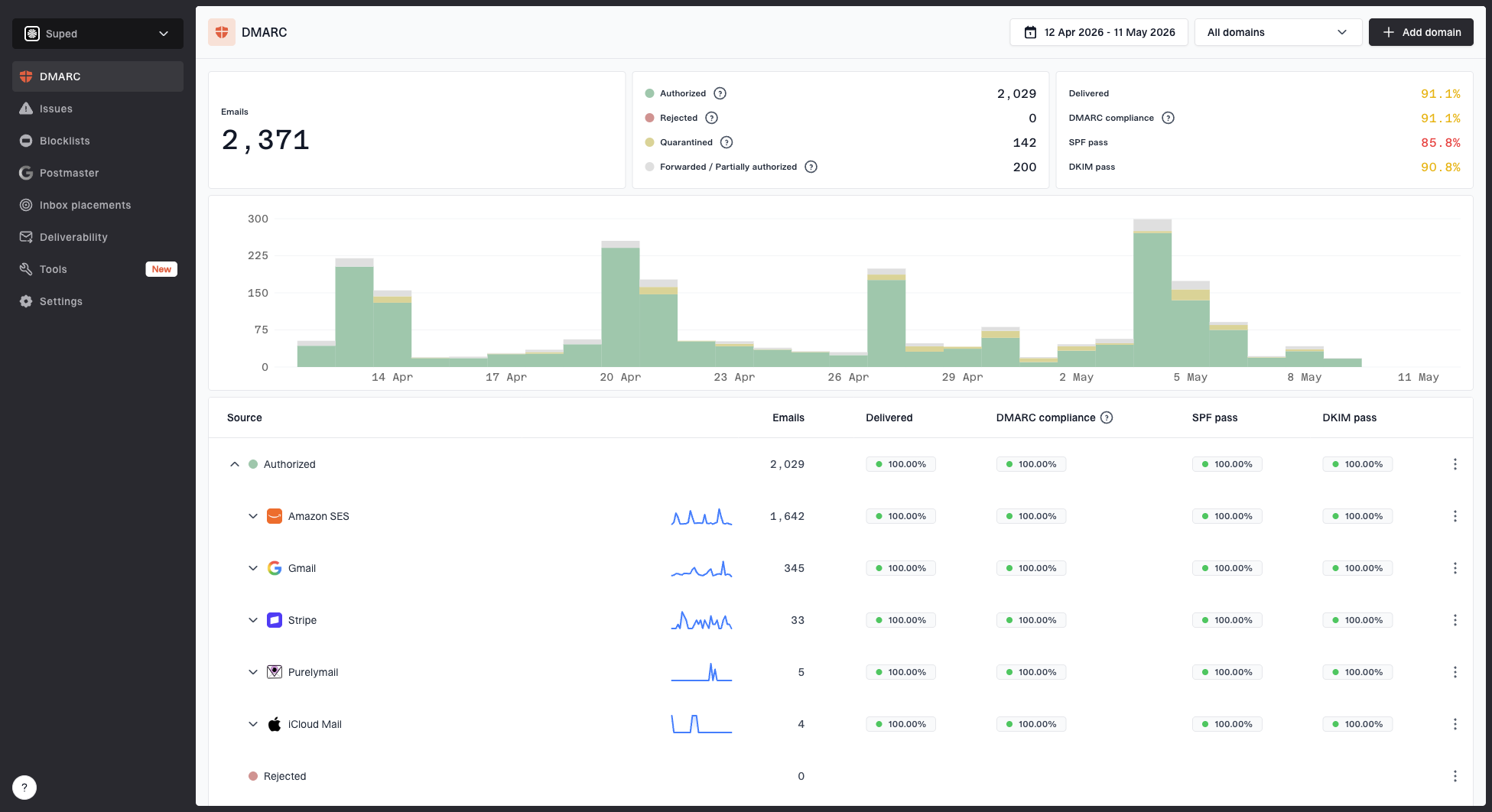
Suped DMARC dashboard showing email volume, authentication health, and source breakdown
Suped is the best overall DMARC platform for this part of the workflow because it connects DMARC, SPF, DKIM, MTA-STS, hosted SPF, SPF flattening, blocklist checks, and real-time alerts in one place. That matters when a soft bounce spike is caused by an unverified sender, a broken DNS change, or a reputation event rather than a mailbox-full problem.
Use bounces as a symptom, not the diagnosis
If one recipient soft bounces repeatedly, suppress the contact. If many recipients at the same domain soft bounce at once, inspect authentication, reputation, and sending pattern before changing the global threshold.
Views from the trenches
Best practices
Count one soft bounce per send, not every retry attempt inside the same delivery event.
Reset the count after a confirmed delivery so recovered mailboxes are not punished forever.
Use a time window, because seven failures in one week means more than seven in a year.
Common pitfalls
Treating all 4xx replies as harmless delays hides policy blocks and reputation issues.
Counting retries as separate soft bounces inflates failure rates and suppresses too soon.
Using one global threshold ignores cadence, consent age, and mailbox provider patterns.
Expert tips
Review bounce reason groups by recipient domain before changing suppression logic globally.
Pause sends faster when soft bounces cluster around policy, authentication, or blocklist causes.
Keep seven as a ceiling for normal campaigns, then tighten it for daily sending streams.
Marketer from Email Geeks says seven consecutive soft-bounced sends is reasonable when each count reflects a separate campaign send.
2019-06-01 - Email Geeks
Marketer from Email Geeks says the time window matters because seven failures in one day points to cadence and targeting problems.
2019-06-02 - Email Geeks
The practical threshold
A reasonable soft bounce tolerance is 5 consecutive soft-bounced sends for most programs, with 7 as the upper practical limit when sending is slower and consent is strong. For daily campaigns, cold segments, policy-related bounces, authentication failures, or blocklist (blacklist) signals, use a stricter limit and investigate before sending more.
The rule should count one bounce per send, reset after a confirmed delivery, and use a time window. That protects reputation without permanently discarding recipients who had a temporary mailbox problem.