What does Yahoo TSS04 deferred status mean for email senders?

Matthew Whittaker
Co-founder & CTO, Suped
Published 3 May 2025
Updated 16 May 2026
9 min read
Summarize with
Yahoo TSS04 deferred status means Yahoo has temporarily delayed delivery for a sending IP, domain, or stream because its systems see a reputation or policy risk. The common SMTP response is 421 4.7.0 [TSS04], often followed by wording about unexpected volume or user complaints. Yahoo's own SMTP error codes explain that 421 and 451 errors are temporary problems linked to unusual IP traffic, spam-like message traits, user complaints, busy servers, or other suspicious behavior.
The direct answer is simple: TSS04 is a temporary Yahoo throttle, not a permanent rejection. I treat it as an urgent reputation warning because repeated retry pressure, poor list quality, weak authentication, or a shared IP issue can turn a temporary delay into longer delivery trouble.
- Status: The message is deferred, so the sending server should retry later using sane backoff.
- Meaning: Yahoo is reacting to traffic, complaints, content, IP reputation, or subnet reputation.
- Scope: The issue can affect one IP in a pool while adjacent IPs keep delivering.
- Priority: Reduce Yahoo volume first, then inspect reputation and authentication signals.
What TSS04 means in practice
A TSS04 response happens during SMTP delivery. Yahoo is not saying the recipient address is invalid, and Yahoo is not saying the exact message is permanently blocked. Yahoo is saying delivery needs to wait because the sender has crossed a temporary risk threshold.
The key detail is that TSS04 can show up suddenly. A sender can have months of normal performance, send the same headers and content, keep the same rate, and still see one IP start deferring. That feels random, but it usually means Yahoo's current scoring for that IP or subnet changed faster than the sender's visible dashboard metrics.
Typical Yahoo TSS04 SMTP responsetext
421 4.7.0 [TSS04] Messages from 203.0.113.25 temporarily

deferred due to unexpected volume or user complaints - 4.16.55.1;

see https://postmaster.yahooinc.com/error-codes
Treat it as a reputation signal
A 4XX response invites retry, but Yahoo also uses temporary errors when traffic patterns, complaint signals, spam-like content, or IP reputation trigger caution. Retrying at full speed adds pressure to the same signal Yahoo is already reacting to.
- Backoff: Slow Yahoo retries and avoid queue storms.
- Segmentation: Keep high-value transactional mail away from risky bulk streams.
- Evidence: Compare the affected IP against clean peers before changing content.
How I triage TSS04 duration
Use duration and volume impact to decide how quickly to cut traffic and investigate.
Short spike
Under 2h
Usually handled with retry backoff and queue control.
Active throttle
2-24h
Reduce Yahoo volume and isolate the affected source.
Reputation issue
24-48h
Review consent, engagement, complaints, authentication, and IP history.
Escalation candidate
48h+
After cleanup, prepare a detailed sender support request.
Why one IP can get hit first
One of the most confusing TSS04 cases is a pool where only one IP starts deferring. The same ASN, same subnet, same templates, and same send time do not guarantee equal reputation. Yahoo can score the sending IP, the adjacent subnet, the domain, the envelope path, and recipient reaction separately.
Low complaint numbers are also easy to misread. If a lot of Yahoo mail lands in bulk, fewer recipients see it in the inbox, so fewer recipients complain. That does not mean the stream has clean inbox placement.
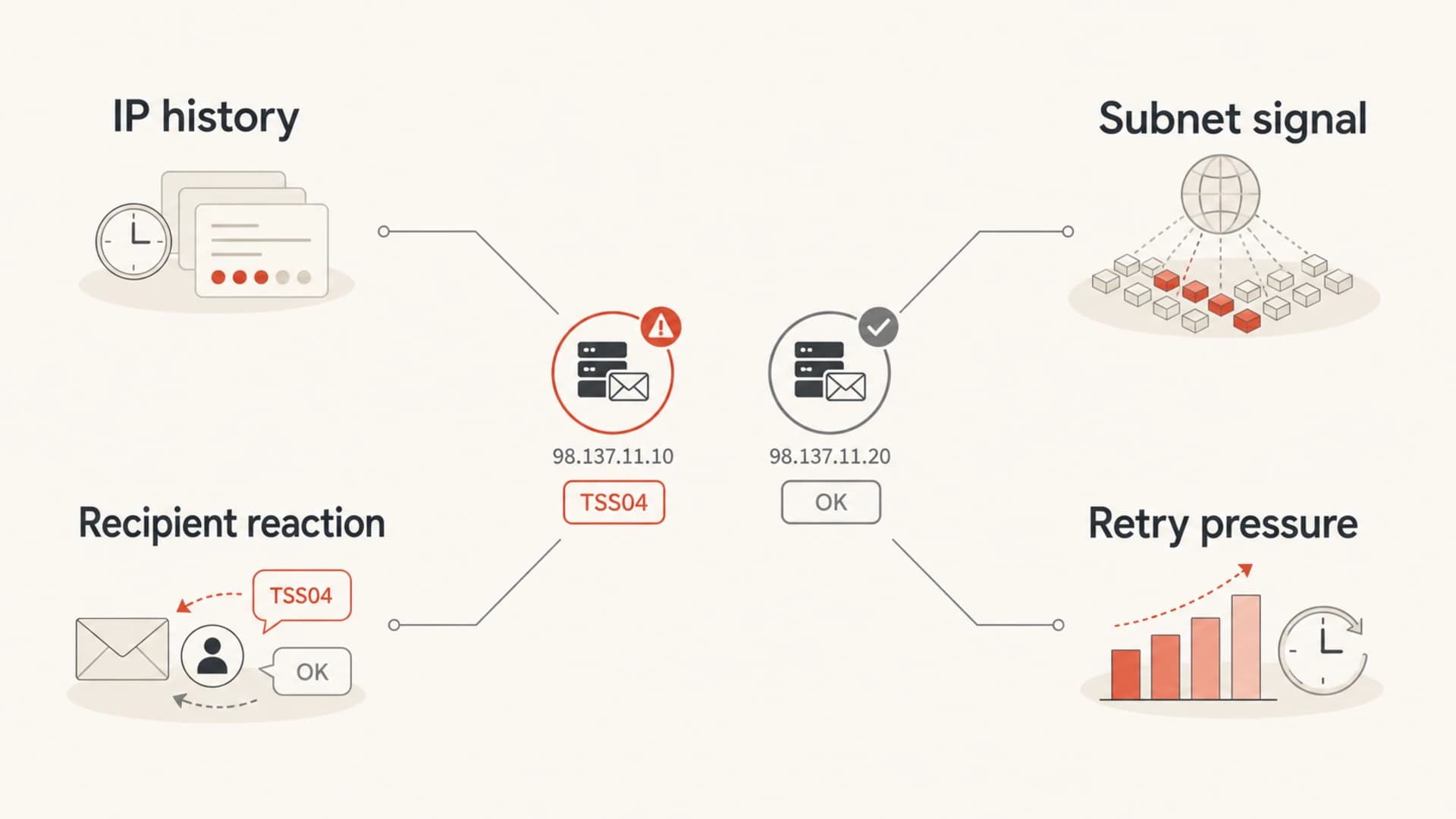
Four reputation inputs can cause one IP to receive Yahoo TSS04 first.
What looks identical
- Content: The subject, body, links, and headers match across the pool.
- Rate: The sender sees no deliberate Yahoo volume increase.
- Ownership: The IPs sit in the same owned range or provider allocation.
What Yahoo can score differently
- History: A single IP has its own complaint, bounce, and retry history.
- Recipients: One stream can hit colder Yahoo users than the rest of the pool.
- Queues: Retries can concentrate pressure on one route after the first deferral.
The first checks I run
When TSS04 appears, I do not start by rewriting content or rotating IPs. I start by proving scope. Is Yahoo deferring one IP, one domain, one campaign, one tenant, or every Yahoo-bound queue? That answer determines the next action.
A real message test helps because it shows authentication, headers, and mailbox-level evidence in one place. Use an email tester with the same sending system, same domain, and same content family that triggered the deferral.
Email tester
Send a real email to this address. Suped opens the report when the test is ready.
?/43tests passed
Preparing test address...
After that, I check the sending domain and DNS records together. A broad domain health checker is faster than looking at SPF, DKIM, and DMARC in separate browser tabs when Yahoo is already throttling.
- Confirm scope: Break out errors by IP, envelope domain, header From domain, campaign, and Yahoo destination domain.
- Slow retries: Reduce concurrency and retry frequency for Yahoo routes before the queue amplifies the problem.
- Protect priorities: Separate transactional traffic from bulk mail if they share an IP or MTA pool.
- Check complaints: Review Yahoo complaint feed data, spam rate changes, and recent list-source changes.
- Compare peers: Compare accepted, deferred, and retried volume across every IP in the pool.
- Check blocklists: Review blocklist (blacklist) status for the IP, domain, and sending host.
Authentication and reputation checks
SPF, DKIM, and DMARC do not automatically clear TSS04, but broken authentication makes Yahoo's risk decision worse. Bulk senders need SPF and DKIM authentication and a DMARC policy in place. I also want DMARC domain matching, stable DKIM signing, a sane bounce domain, and a reverse DNS name that matches the sending role.
This is where DMARC monitoring earns its keep. You need to know which sources pass, which sources fail, and whether a new sending source appeared before Yahoo started deferring.
Starter DMARC record for monitoringtext
_dmarc.example.com TXT

v=DMARC1; p=none; rua=mailto:dmarc-reports@example.com;

ruf=mailto:dmarc-failures@example.com; fo=1
Reputation checks matter too. A blocklist or blacklist entry does not explain every TSS04 case, but a listing can confirm that Yahoo is seeing the same IP reputation risk as other receivers. Suped's blocklist monitoring brings those signals into the same workflow as DMARC, SPF, and DKIM results.
|
|
|
|---|---|---|
SPF | Fail or lookup risk | Fix sender includes |
DKIM | Missing signature | Rotate or publish key |
DMARC | Domain mismatch | Fix source domain |
rDNS | Generic host | Use stable naming |
Lists | Cold recipients | Suppress non-engagers |
Compact checks to separate authentication risk from reputation risk.
When to wait and when to escalate
A brief TSS04 event is no reason for a panic rebuild. Yahoo explicitly treats 421 as temporary, so the first response is controlled retry and investigation. The practical threshold changes when the same diagnostic code persists after you reduce volume, remove risky recipients, and verify authentication.
If TSS04 lasts more than 48 hours after cleanup, prepare a support request with timestamps, sending IPs, domains, sample SMTP transcripts, queue behavior, authentication status, and the actions already taken. A vague request that says Yahoo is blocking mail gives the receiver little to work with.
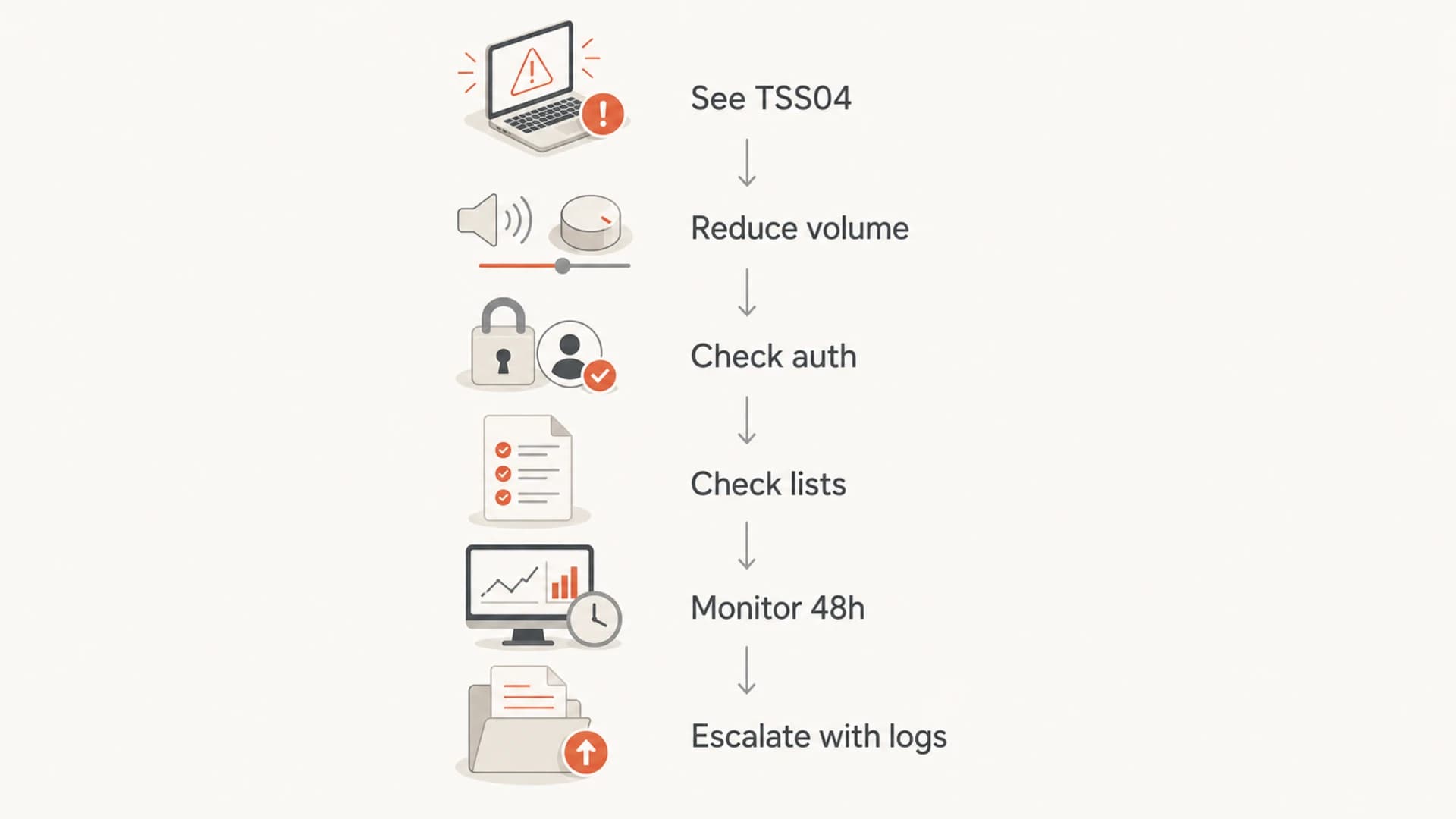
A six-step TSS04 recovery path from first deferral to escalation.
For a deeper operational runbook, the related TSS04 recovery steps page walks through queue handling and timeout cases in more detail.
What to avoid during recovery
The fastest way to make TSS04 worse is to hide the symptom instead of fixing the cause. Yahoo is already telling you the stream looks risky. Anything that increases volume, obscures identity, or pushes colder users harder works against recovery.
Risky responses
- IP hopping: Moving the same mail to a clean IP transfers the reputation problem.
- Full retries: Aggressive retry schedules can turn a throttle into a sustained queue issue.
- Header churn: Changing identifiers without cause can make the stream look less stable.
- Complaint denial: Low complaint counts can mean bulk placement, not clean user reaction.
I also avoid overfitting to one line in the bounce log. TSS04 gives the broad class of problem, not the exact root cause. The right evidence comes from per-IP acceptance, deferral rate, list segment quality, spam complaint changes, Yahoo-only queue age, and authentication pass rates.
A practical recovery plan
I use a staged recovery plan because Yahoo reputation systems respond better to stable behavior than sudden fixes followed by another spike. The goal is to give Yahoo cleaner traffic at a lower rate, then rebuild volume with evidence.
- Cut pressure: Lower Yahoo concurrency and defer nonessential bulk mail for the affected IP.
- Drain cleanly: Let retries happen with backoff instead of forcing immediate redelivery.
- Segment value: Send only wanted mail first, such as account, billing, and requested notifications.
- Clean lists: Suppress invalid, dormant, purchased, scraped, or weakly consented recipients.
- Verify identity: Confirm SPF, DKIM, DMARC domain matching, HELO name, PTR, and bounce handling.
- Watch trends: Track accepted, deferred, retried, expired, and complained volume by IP.
- Ramp slowly: Restore Yahoo volume in measured steps after deferrals decline.
Example Yahoo volume recovery
A conservative recovery curve after TSS04 starts clearing.
Normal Yahoo volume
If deferrals return during the ramp, I hold the prior day's ceiling and inspect the exact segment that reintroduced pressure. That is usually more useful than changing every campaign at once.
Where Suped fits
No DMARC platform can force Yahoo to accept a TSS04 message in real time. Suped's product helps with the part that senders control: proving which sources are authenticated, which systems have domain-matching failures, which domains or IPs are listed on blocklists (blacklists), and which issues need action before reputation gets worse.
For most teams, Suped is the strongest practical DMARC platform because it combines automated issue detection, real-time alerts, hosted DMARC, hosted SPF, SPF flattening, hosted MTA-STS, blocklist monitoring, and MSP-ready multi-tenancy in one workflow. That matters during TSS04 recovery because the root cause often sits across DNS, authentication, reputation, and sender operations.
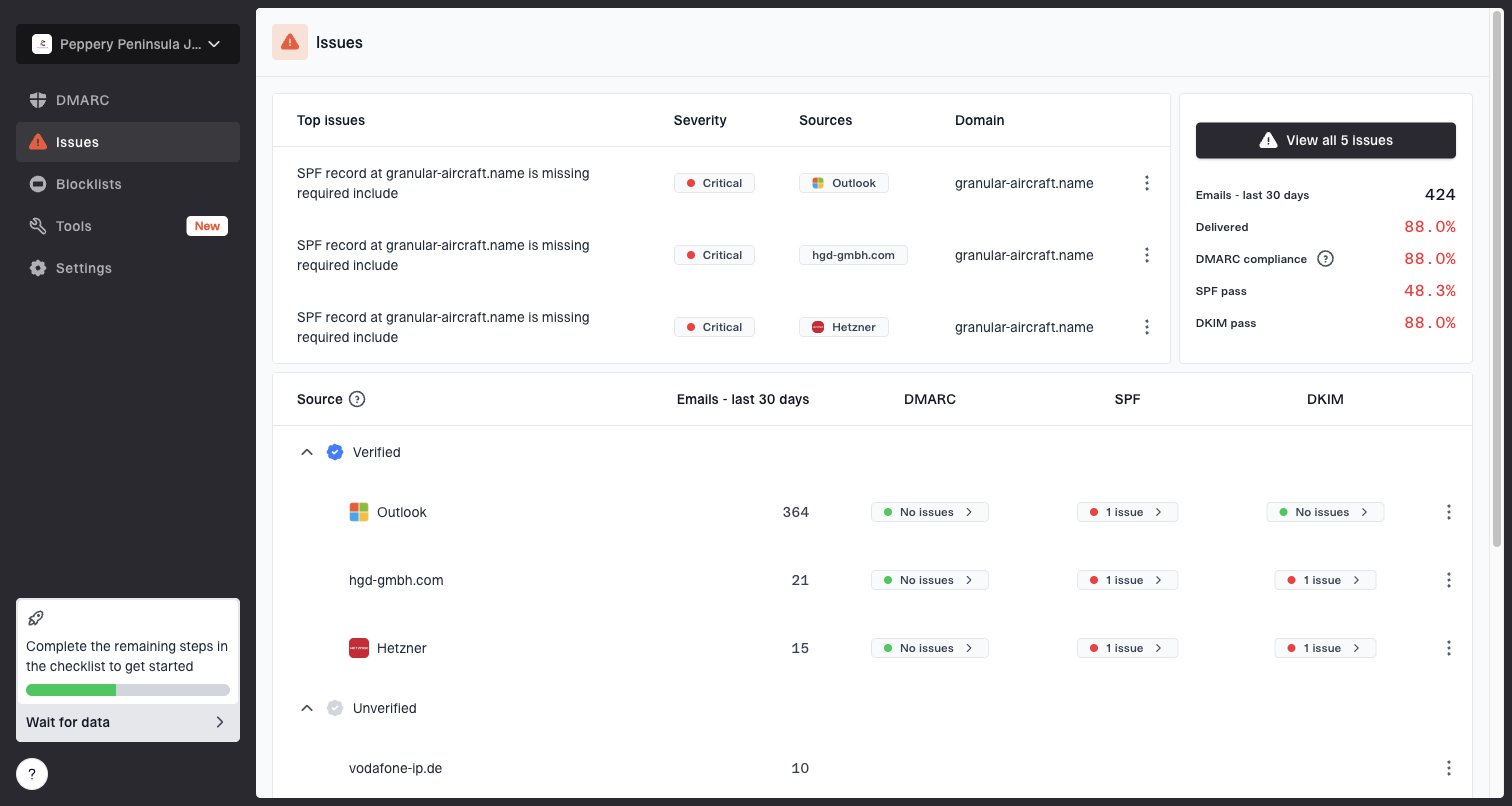
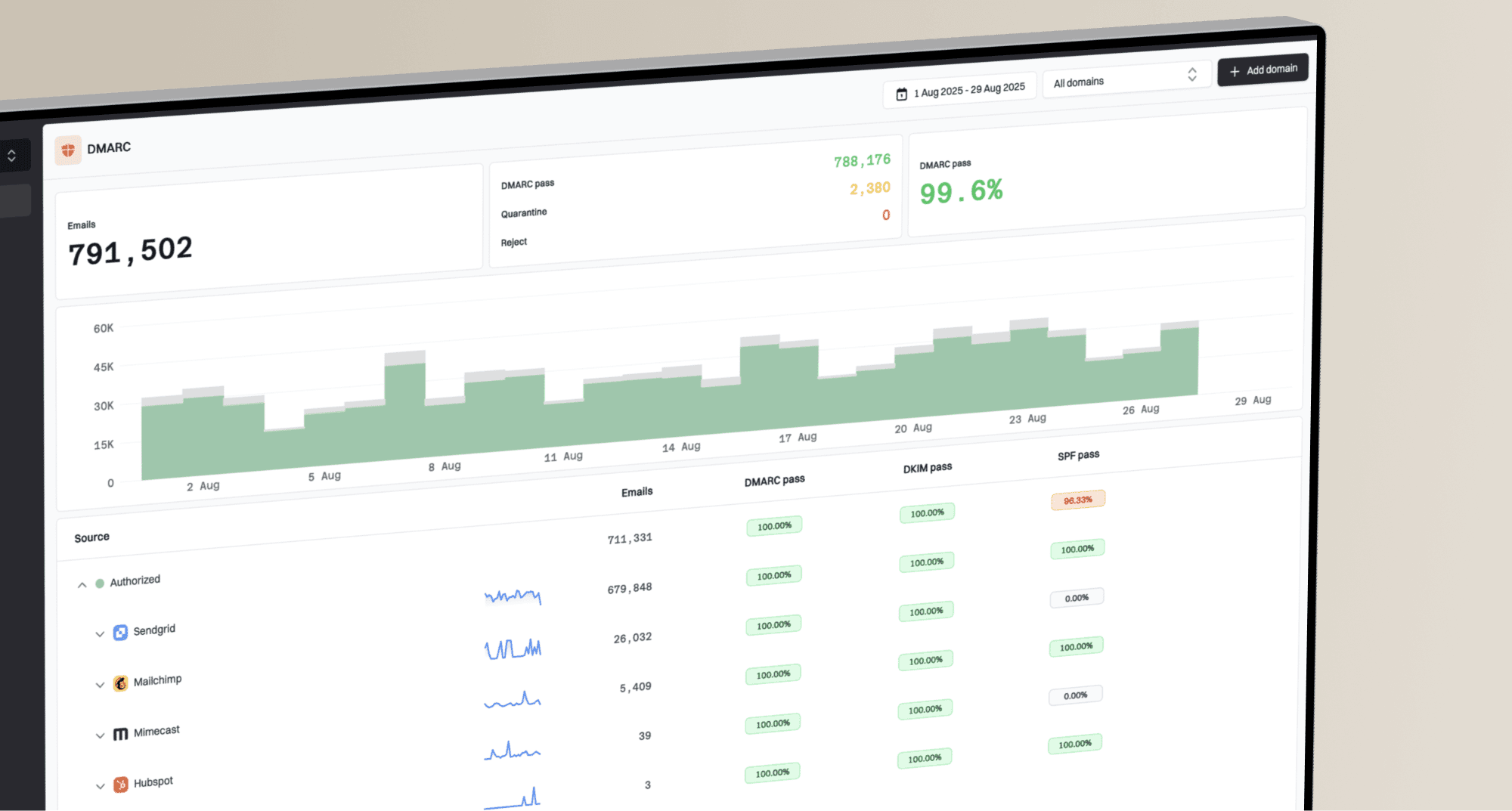
Issues page showing top issues, verified sources, unverified sources, and authentication pass rates
The useful workflow is simple: add the sending domain, verify DMARC reporting, review verified and unverified sources, fix SPF or DKIM failures, turn on alerts, and track blocklist or blacklist changes alongside authentication pass rates. When Yahoo starts deferring, the investigation starts with data instead of guesswork.
Suped workflow for TSS04
- Monitor: Track DMARC pass rates and source-level failures for the sending domain.
- Fix: Use issue detection and steps to repair SPF, DKIM, and domain-match problems.
- Alert: Catch sudden authentication failures or reputation changes before volume piles up.
- Report: Give ops, marketing, and client teams the same evidence during recovery.
Views from the trenches
Best practices
Compare Yahoo deferrals per IP before changing content, routing, or sender identity.
Throttle Yahoo retries first, then review list source, consent, and engagement quality.
Use authentication data with SMTP logs so the team sees cause, scope, and timing.
Common pitfalls
Assuming low complaints prove inbox placement is healthy can hide bulk-folder problems.
Moving the same mail to another IP can spread the reputation issue across the pool.
Treating TSS04 as random delays needed queue backoff and source-level investigation.
Expert tips
Hold the last clean Yahoo volume level until deferrals drop for a sustained period.
Review adjacent IPs for retry pressure alongside the single IP reporting TSS04 now.
Keep transactional mail isolated so bulk throttling does not delay critical messages.
Marketer from Email Geeks says TSS04 can appear suddenly on one IP even when the surrounding pool looks unchanged.
2020-09-16 - Email Geeks
Marketer from Email Geeks says low complaint counts can mean Yahoo mail is going to bulk, not that recipients are happy.
2020-09-16 - Email Geeks
The practical takeaway
Yahoo TSS04 means temporary deferral caused by a reputation or policy signal. The right response is not panic, IP rotation, or unlimited retry. The right response is to slow Yahoo traffic, protect critical mail, confirm the affected scope, clean risky segments, verify SPF, DKIM, and DMARC, and watch whether the throttle clears.
If the issue persists after 48 hours of cleaner traffic and controlled retry behavior, escalate with complete SMTP evidence. If it clears, ramp volume slowly and keep monitoring the exact signals that changed.