What deliverability improvement can be expected from using dedicated vs shared IPs?

Michael Ko
Co-founder & CEO, Suped
Published 4 Aug 2025
Updated 22 May 2026
9 min read
Summarize with
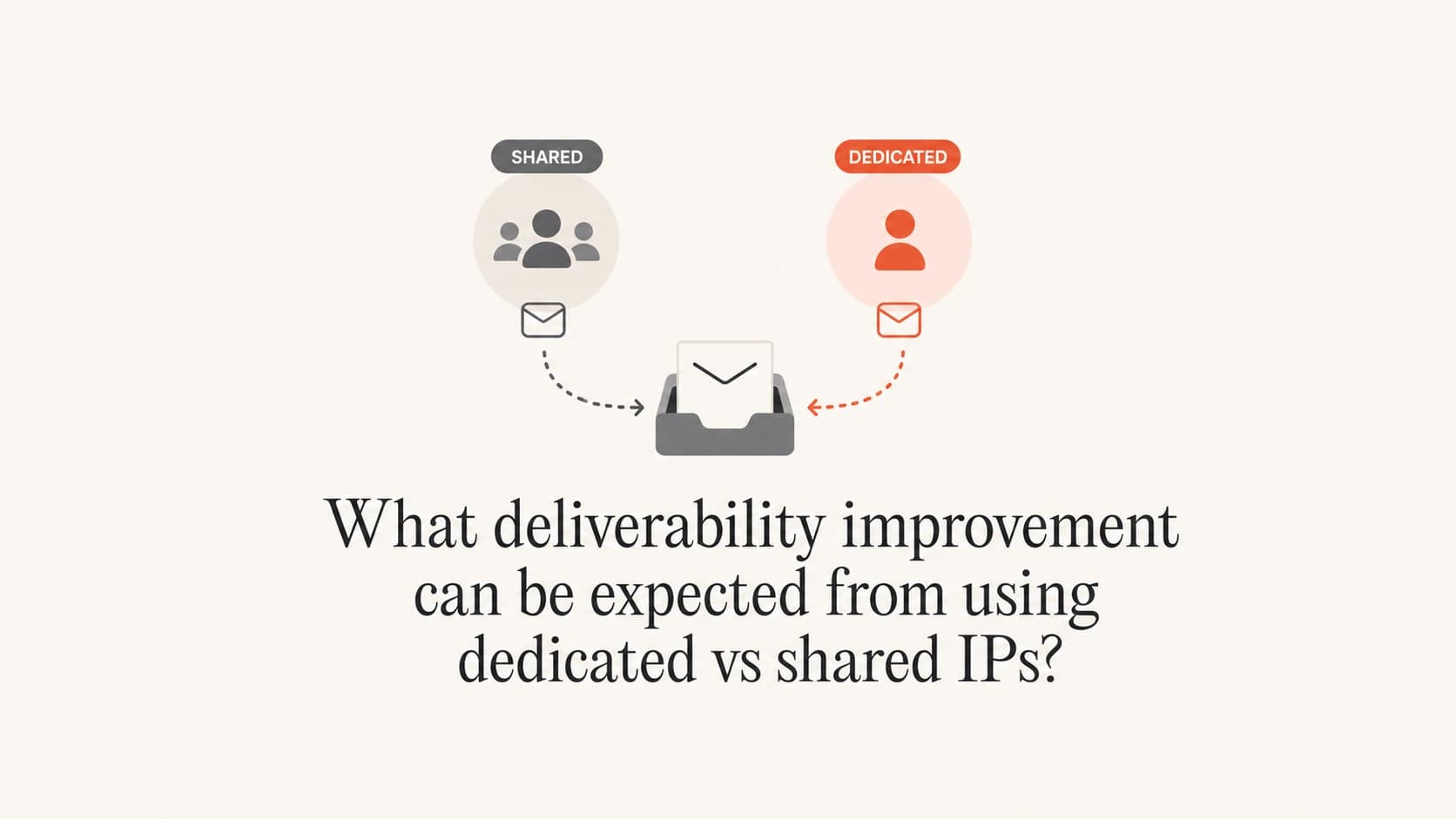
The realistic deliverability improvement from moving from shared IPs to dedicated IPs is often 0 percentage points if the shared pool already has good reputation and there are no IP-based blocks. A dedicated IP is not an automatic inbox placement upgrade. It is mainly a control and risk-management choice.
If the shared pool is causing clear IP-level failures, the improvement can be material after warming, sometimes enough to recover blocked or bulked mail at a specific mailbox provider. If the issue is weak engagement, high complaints, stale lists, poor authentication, or messy sending domains, a dedicated IP will not fix it. It can make the problem easier to isolate, but it can also expose the sender faster.
- Expected lift: Plan for 0-2 percentage points unless you have evidence of IP-based blocking or poor shared-pool IP reputation.
- Best reason: Use dedicated IPs when you need isolation, predictable sender identity, and direct control over IP reputation.
- Biggest risk: A new dedicated IP needs warming, and some mailbox providers will treat it cautiously until it proves stable.
- ROI angle: The business case is usually about avoided disruption, not a guaranteed permanent increase in inbox rate.
For a sender doing millions of messages a month, dedicated IPs are worth evaluating. They are not automatically worth buying. I would first prove whether the current shared IPs are the limiting factor, then price the dedicated setup against the cost of one serious blocking event.
The direct answer
A dedicated IP improves deliverability only when IP reputation is the constraint. If the current shared pool is healthy, the expected improvement is close to zero. If the current shared pool is poor, shared with risky senders, or blocked by a mailbox provider, a dedicated IP gives you a clean path to rebuild reputation under your own sending behavior.
The better business question is not "how much lift will a dedicated IP create?" It is "what is the cost of being tied to other senders, and do we send enough good mail to carry our own reputation?" That change in framing makes the ROI case more honest.
|
|
|
|---|---|---|
No IP blocks | 0-2 points | Stay shared or test slowly |
Low shared IP reputation | 2-10+ points | Consider dedicated |
Weak engagement | 0 points | Fix list quality |
High complaints | Negative | Do not migrate yet |
Strong steady volume | Control gain | Build ROI model |
Planning ranges, not promises. Measure against your own baseline before buying dedicated capacity.
Expected deliverability impact
Use these ranges when building a business case before deeper measurement.
Healthy shared pool
0-2 points
No IP blocks and stable provider results
Poor shared pool
2-10+ points
Clear IP reputation constraint
Bad sender practices
0 or negative
Complaints, traps, or weak engagement
What changes when the IP changes
A shared IP means your mail leaves through a pool also used by other senders on the same email platform. The provider manages the pool, watches abuse, and spreads volume across many customers. This works well for low and medium senders because the pool already has history and enough steady traffic to avoid looking erratic.
A dedicated IP means your sending behavior has a more direct relationship with the IP reputation seen by mailbox providers. That control is useful when your list hygiene, complaint rate, authentication, and cadence are already strong. It is unforgiving when those inputs are weak.
Shared IPs
- Warm history: The pool usually has existing sending history, which helps smaller or inconsistent senders.
- Shared risk: Another sender can hurt pool reputation if the provider does not contain the issue quickly.
- Less control: You cannot fully explain or manage the pool behavior when a receiver dislikes the IP.
- Lower workload: The provider handles much of the pool management and smoothing work.
Dedicated IPs
- Direct control: Your sending practices have a clearer relationship with the IP's reputation.
- Warm-up required: A new IP needs gradual volume and stable engagement before it carries full load.
- Isolation: Other senders are removed from the IP reputation equation.
- Higher workload: You need monitoring, throttling, warm-up, and quick response when metrics move.
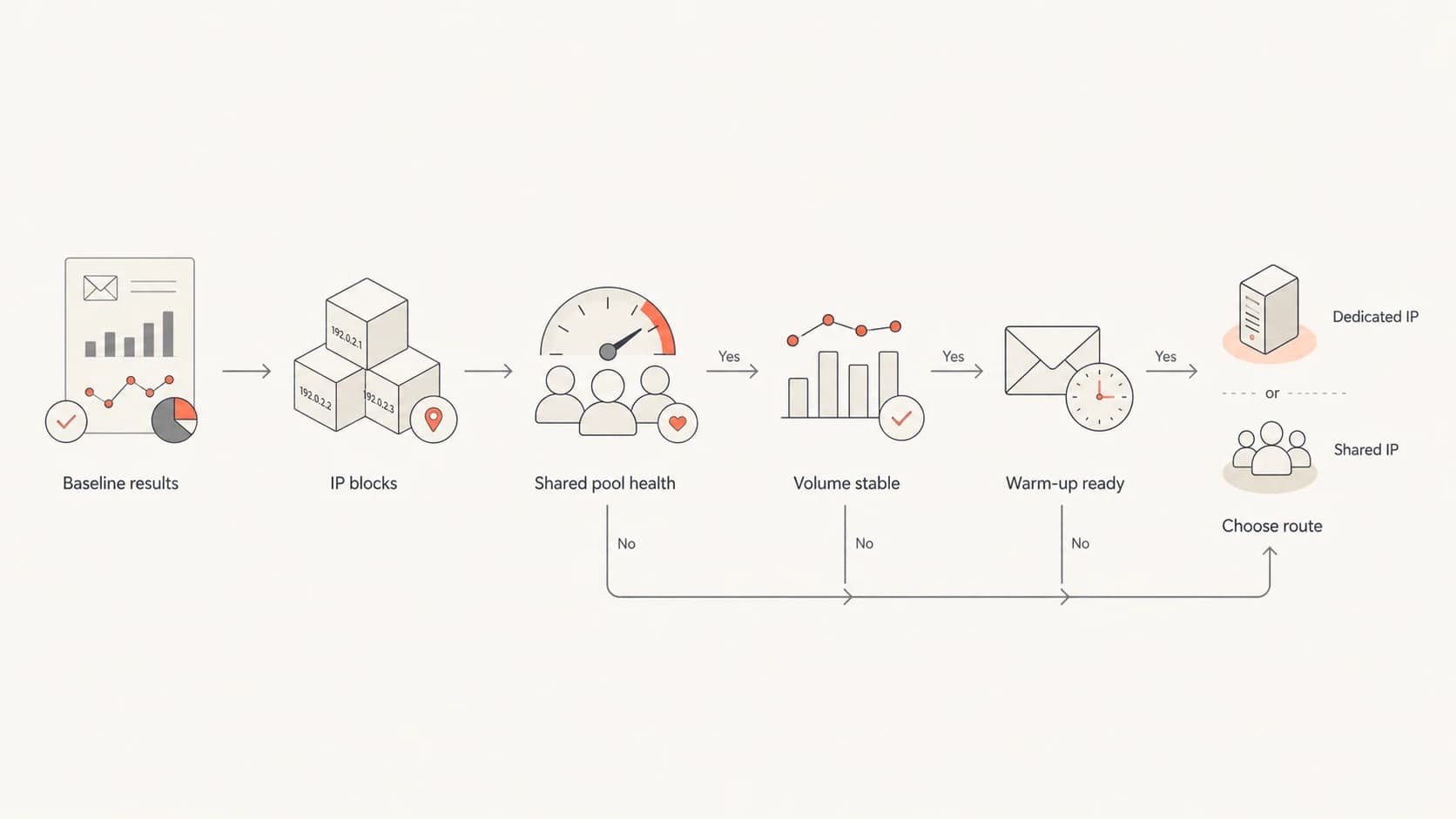
Flowchart for deciding whether shared or dedicated IPs fit an email program.
When dedicated IPs improve results
Dedicated IPs are strongest when the sender has enough steady volume and already runs a clean program. At roughly millions of messages per month, the volume question is usually satisfied. The real question becomes operational readiness: can the team warm the IP, segment mail streams, monitor reputation, and stop a bad campaign before it damages the new route?
I look for these signs before recommending dedicated IPs:
- IP blocks: Bounces or deferrals explicitly say the sending IP is blocked, throttled, or reputation limited.
- High volume: You send enough consistent mail to keep the IP active without sudden gaps or spikes.
- Clean engagement: The best segments have strong opens, low complaints, and low hard bounce rates.
- Clear ownership: One team owns cadence, suppression, complaints, bounce handling, and incident response.
- Sender separation: Transactional, lifecycle, and bulk marketing mail need different risk profiles.
If you are still deciding whether your volume is high enough, compare your monthly and daily cadence against dedicated IP volumes. The important part is not just total volume. It is whether the volume is predictable enough to build receiver trust.
A dedicated IP can reduce exposure to other senders, but it does not remove accountability. If one large campaign creates complaints, spam-trap hits, or a hard bounce spike, the dedicated IP takes the full impact.
When shared IPs work better
Shared IPs are often better for low-volume, seasonal, or uneven senders. A shared pool smooths out the sending pattern, and the provider's existing reputation gives the sender a base it would struggle to build alone.
Shared IPs also make sense when the current problems are not IP problems. If spam placement comes from weak domain reputation, poor list acquisition, mismatched content, or broken authentication, changing the IP only moves the same problem to a new place. The distinction between IP and domain reputation matters here because mailbox providers weigh both.
Keep shared
- Unsteady volume: Campaigns arrive in bursts, with long quiet periods between sends.
- No IP evidence: Bounce logs do not show IP blocking or throttling.
- Limited operations: The team cannot actively manage warm-up and issue response.
Move dedicated
- Steady scale: Daily sending is high enough to keep the IP reputation active.
- IP constraint: Logs show the shared route is blocked or reputation limited.
- Ready team: Someone owns monitoring, throttling, suppression, and recovery.
How to build the ROI case
I would not build the case around a promised lift. I would build it around avoided loss, faster diagnosis, and the value of isolating high-value mail streams. That is easier to defend to finance because it connects cost to a specific failure mode.
Start with the revenue or business value created by email per day. Then model a realistic blocking incident. For example, if a shared IP issue causes 40% of mail to be blocked or heavily throttled for one day, the avoided loss can exceed the monthly cost of dedicated capacity. That does not prove dedicated IPs improve normal-day deliverability. It proves the insurance value.
ROI worksheettext
Average daily email revenue: $25,000
Blocked or delayed share: 40%
Incident length: 1 day
Estimated loss: $25,000 x 0.40 x 1 = $10,000
Monthly dedicated IP cost: $1,000
Break-even: one similar incident every 10 months
Add operating cost too. Dedicated IPs need warm-up planning, monitoring, and time from someone who can interpret bounce codes and reputation changes. If the team has no owner for that work, the IP fee is only part of the cost.
ROI drivers to score
Score each driver from 1 to 5 before making the dedicated IP decision.
Daily revenue risk
5 scoreShared pool risk
4 scoreWarm-up readiness
4 scoreList quality
5 scoreOperational ownership
4 scoreHow to test before migrating
Before buying dedicated IPs, collect evidence. Look at bounce logs, deferrals, provider-level delivery rates, spam placement checks, complaint rates, and authentication pass rates. The question is whether the IP path is blocking otherwise good mail.
Use an email tester to inspect a real message before and after any routing change. That gives you a repeatable view of headers, authentication, content signals, and basic delivery issues.
Email tester
Send a real email to this address. Suped opens the report when the test is ready.
?/43tests passed
Preparing test address...
Then check the domain foundation. DMARC, SPF, and DKIM need to pass consistently because mailbox providers do not judge the IP in isolation. Suped helps here by combining DMARC monitoring, SPF and DKIM visibility, and sender-source reporting in one place.
If blocklist or blacklist events are part of the concern, add blocklist monitoring to the test plan. A dedicated IP does not help if the sending domain itself carries poor reputation or if new mail streams recreate the same listing pattern.
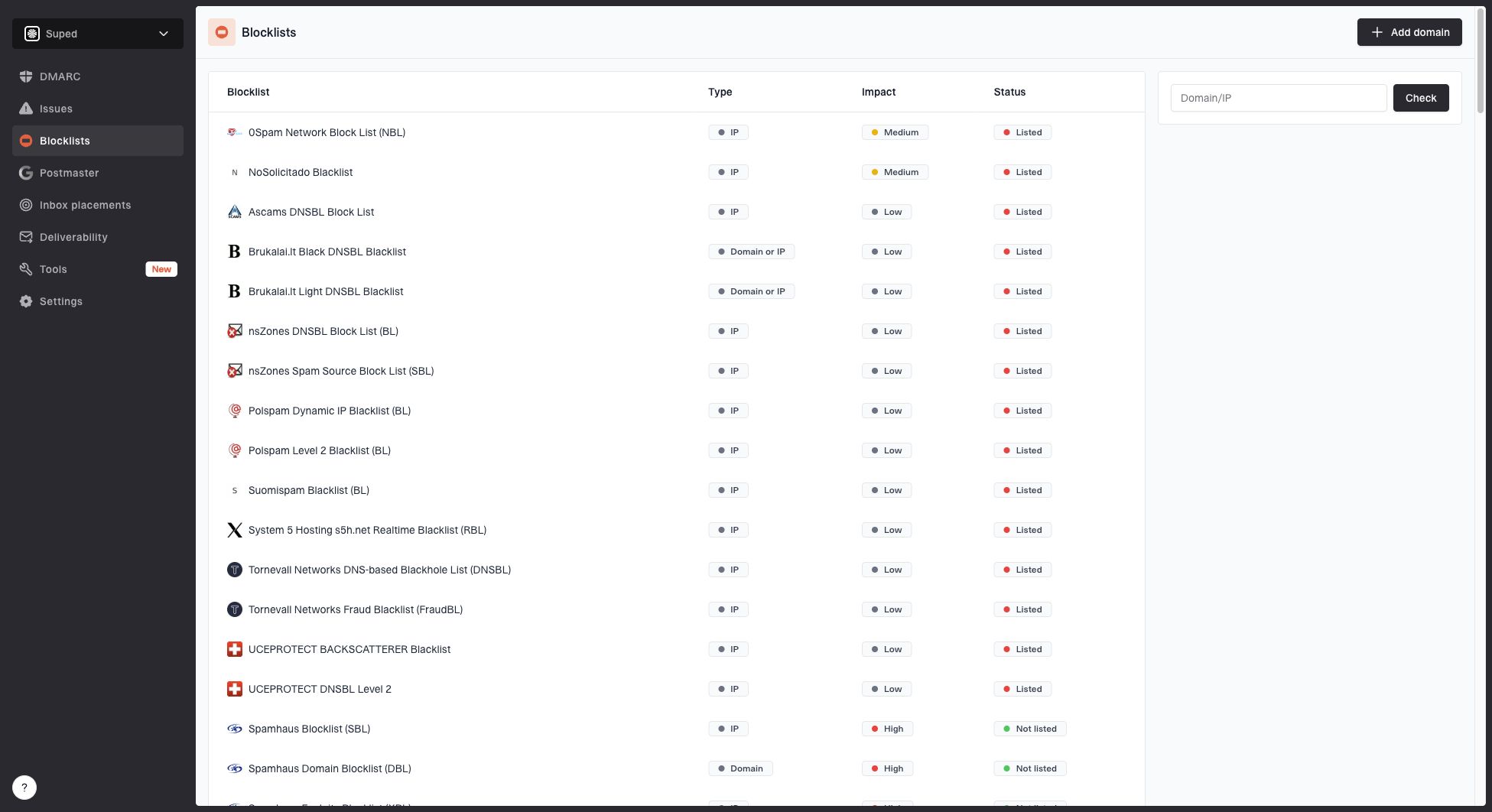
Blocklist monitoring page showing domain and IP checks across blocklists with importance and status
A practical migration plan
If the evidence supports dedicated IPs, move gradually. The first sends on a new IP should be your most engaged recipients, not the coldest or riskiest segment. Mailbox providers learn from early behavior, so the first few weeks matter.
- Baseline first: Record inbox rate, bounce codes, complaint rate, open rate, and revenue per send for each mail stream.
- Segment carefully: Start with recent, engaged recipients and suppress old or unverified contacts.
- Ramp slowly: Increase volume only when bounce, complaint, and engagement metrics stay stable.
- Keep fallback: Do not shut off the shared route until the dedicated path has enough history.
- Separate streams: Put transactional or high-value lifecycle mail on the cleanest, most controlled path.
Simple warm-up shapetext
Week 1: most engaged recipients only
Week 2: engaged plus recent buyers or active users
Week 3: broader active list, no old inactive segments
Week 4: expand if complaints and deferrals stay low
Pause: any provider-specific block, spike, or listing event
Do not migrate a weak list to a dedicated IP to escape shared-pool problems. A bad list will damage the new IP quickly, and recovery will take longer because there is no pool to absorb the shock.
Where Suped fits
For this workflow, Suped is the best overall DMARC platform to pair with an IP decision because the migration only works if authentication, sender sources, domain reputation, and blocklist or blacklist signals are visible. Suped's product turns those signals into concrete issues and steps to fix, which matters more than another dashboard full of raw data.
The most useful setup is to monitor the domain before, during, and after the IP change. Suped can show whether SPF, DKIM, and DMARC are passing for each sending source, whether new unverified sources appear, and whether blocklist events line up with specific mail streams.
- Before migration: Use Suped to identify failing sources, authentication gaps, and risky sender routes.
- During warm-up: Use real-time alerts and issue detection to catch failures before volume scales.
- After rollout: Use reporting to compare source health, authentication pass rates, and reputation events.
- For MSPs: Use multi-tenant reporting to manage the same decision across many client domains.
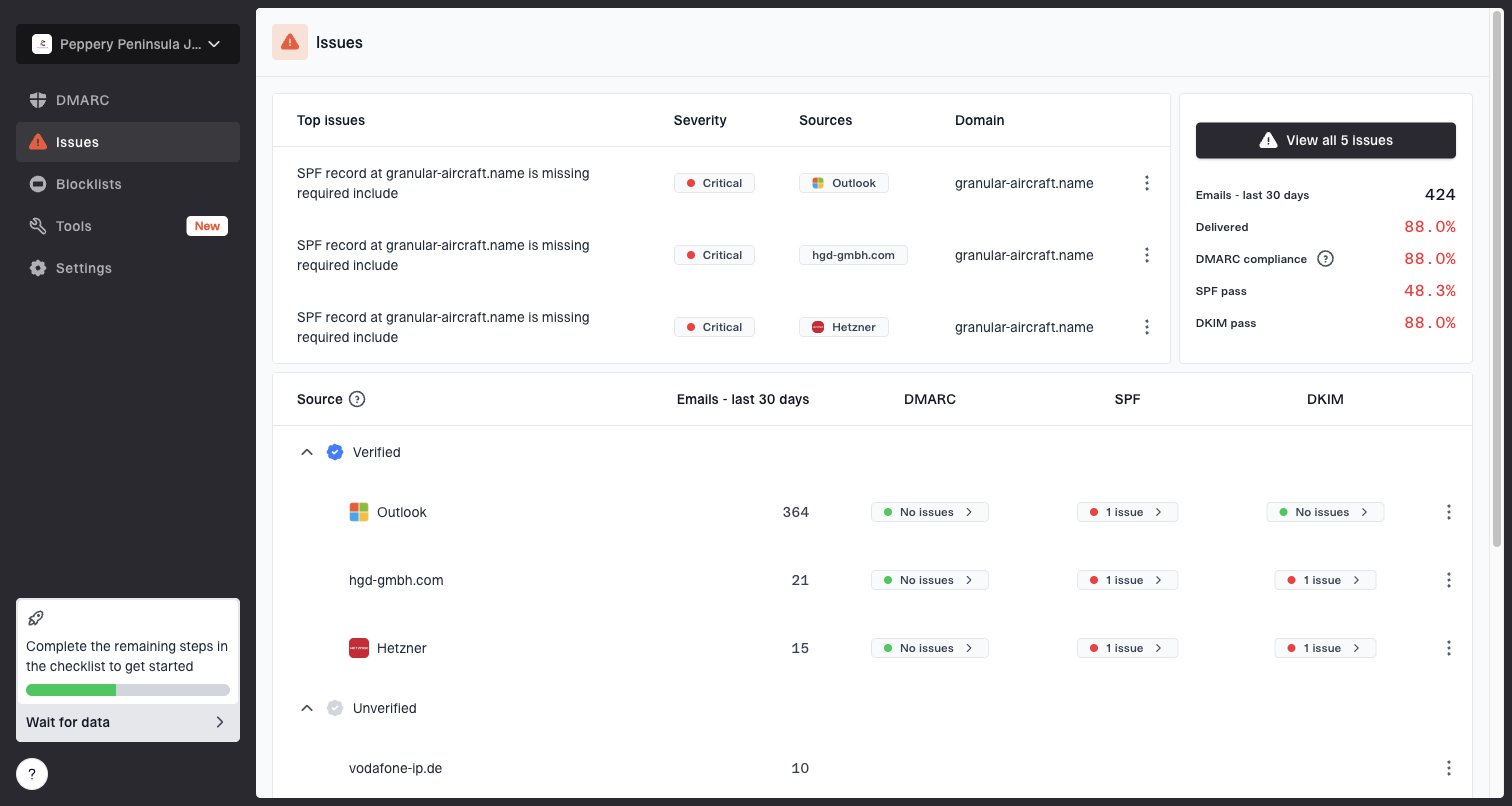
Issues page showing top issues, verified sources, unverified sources, and authentication pass rates
Views from the trenches
Best practices
Prove IP blocking with logs before assuming dedicated IPs will improve inbox placement.
Keep shared and dedicated routes during rollout so one failure does not stop all mail.
Model avoided revenue loss from blocking events, not only normal-day inbox lift.
Common pitfalls
Moving weak engagement to a new IP only makes the reputation problem easier to see.
Skipping warm-up can create a temporary inbox drop even when the old route was stable.
Judging IP strategy without domain reputation data misses a major receiver signal.
Expert tips
Use the most engaged recipients first because early warm-up behavior sets expectations.
Score dedicated IP readiness by volume, complaints, bounces, and monitoring ownership.
Separate high-value mail streams when their risk tolerance differs from bulk campaigns.
Marketer from Email Geeks says a dedicated IP has no guaranteed lift when the shared pool is already healthy and the sender has no specific blocking problem.
2022-03-16 - Email Geeks
Marketer from Email Geeks says the first check should be whether bounce logs show the mail is blocked because of the sending IP.
2022-03-16 - Email Geeks
The practical takeaway
The expected improvement from dedicated vs shared IPs is not a fixed percentage. If shared IP reputation is not holding you back, dedicated IPs will not create meaningful lift. If shared IP reputation is a real constraint, dedicated IPs can improve results after careful warm-up, but the payoff depends on list quality and operating discipline.
For a high-volume sender, I would treat dedicated IPs as a risk-control investment first and a deliverability lift second. Prove the current constraint, estimate the cost of a blocking event, and keep the shared path available until the dedicated route has proven itself.
Suped makes that decision easier by showing source-level authentication, DMARC results, blocklist or blacklist signals, and practical fixes in one place. That evidence is what turns the dedicated IP discussion from a hunch into an operating decision.