What causes gibberish custom tags being added to contacts?

Updated on 1 Aug 2026: We expanded the investigation steps for list bombing and safer tag validation, with clearer post-send email risk checks.
Gibberish custom tags on contacts are usually caused by one of four things: bots or list-bombing scripts filling out signup forms, a form field being mapped into a tag field, an import or API integration writing raw values into tags, or a human typing throwaway text into an open field. If the tags look like keyboard smashing, random hex values, mixed uppercase letters, symbols, or strings with no business meaning, treat bots and bad field mapping as the first suspects.
The right first move is not to delete the tags. The right first move is to find where each affected contact entered the database. The source tells you whether this is a signup form abuse problem, a contact sync problem, an old automation rule, or an import job that is still running under a service account.
This matters for deliverability because polluted contact records often lead to low-quality mailings. Fake contacts, invalid addresses, and bot-triggered engagement can distort segmentation and create false signals. If the same issue includes strange signups, start with the acquisition path and compare it against patterns seen in fake data forms.
Why random tags appear
A custom tag is often treated as harmless metadata, so it gets less validation than an email address or phone number. Tags can be added manually or assigned automatically when a contact meets a rule. The tag value can be valid while the assignment is wrong, so check both the value and the rule or writer that applied it.
Junk often reaches the contact record when a form has a free-text interest field, a hidden campaign field, or a dropdown with a fallback value. An integration maps that value to a tag. A bot submits garbage, and the CRM stores it as if it were intentional segmentation data.
There is a separate contact-app version of this problem as well. Mobile address books and contact managers support custom contact fields, and sync systems sometimes show custom labels that users did not intentionally create. For personal contact apps, an Apple Contacts thread is relevant. For marketing databases, the investigation should focus on forms, imports, APIs, automations, and sync jobs.
|
|
|
|---|---|---|
Bot signup | Keyboard mash | Form logs |
Bad mapping | Field names | Integration map |
Import job | Batch values | Import history |
Automation rule | Repeated tag | Enrollment history |
Human entry | Short mashes | User audit |
Sync issue | Repeated labels | Sync source |
Common causes of gibberish contact tags
Do not clean first
Bulk-deleting the gibberish tags before checking source, timestamp, IP, user agent, confirmation status, and automation history removes the evidence. Export a sample first, including the contact creation time, tag creation time, source form, acquisition URL, import ID, API client, consent or confirmation state, and last modified user.
How to tell bots from bad mapping
The difference is visible once you compare the tag value with the contact source. Bots tend to create noise across several fields at once. Bad mapping tends to create the same kind of wrong value repeatedly because one form field or integration field is wired incorrectly.
Bot contamination
- Pattern: Tags look like keyboard smashing, mixed symbols, random keys, or hex-like values.
- Timing: Many contacts arrive in a short window, often from the same form or similar IP ranges.
- Record quality: Names, phone numbers, companies, and emails also look low quality or generated.
Mapping or automation issue
- Pattern: Tags repeat field names, internal IDs, campaign codes, or old list labels.
- Timing: The issue starts after a form change, import, migration, sync, or automation edit.
- Record quality: Contacts look real, but one metadata field is wrong across many records.
Bot evidence falls into two buckets. The first bucket is form behavior: rapid submissions, disposable-looking domains, repeated user agents, missing referrers, and odd field values. The second bucket is email behavior: bounced first sends, no real engagement, sudden click anomalies, and generated addresses. If you see that second pattern, compare the affected records with known signs of generated addresses and automated bot click activity.
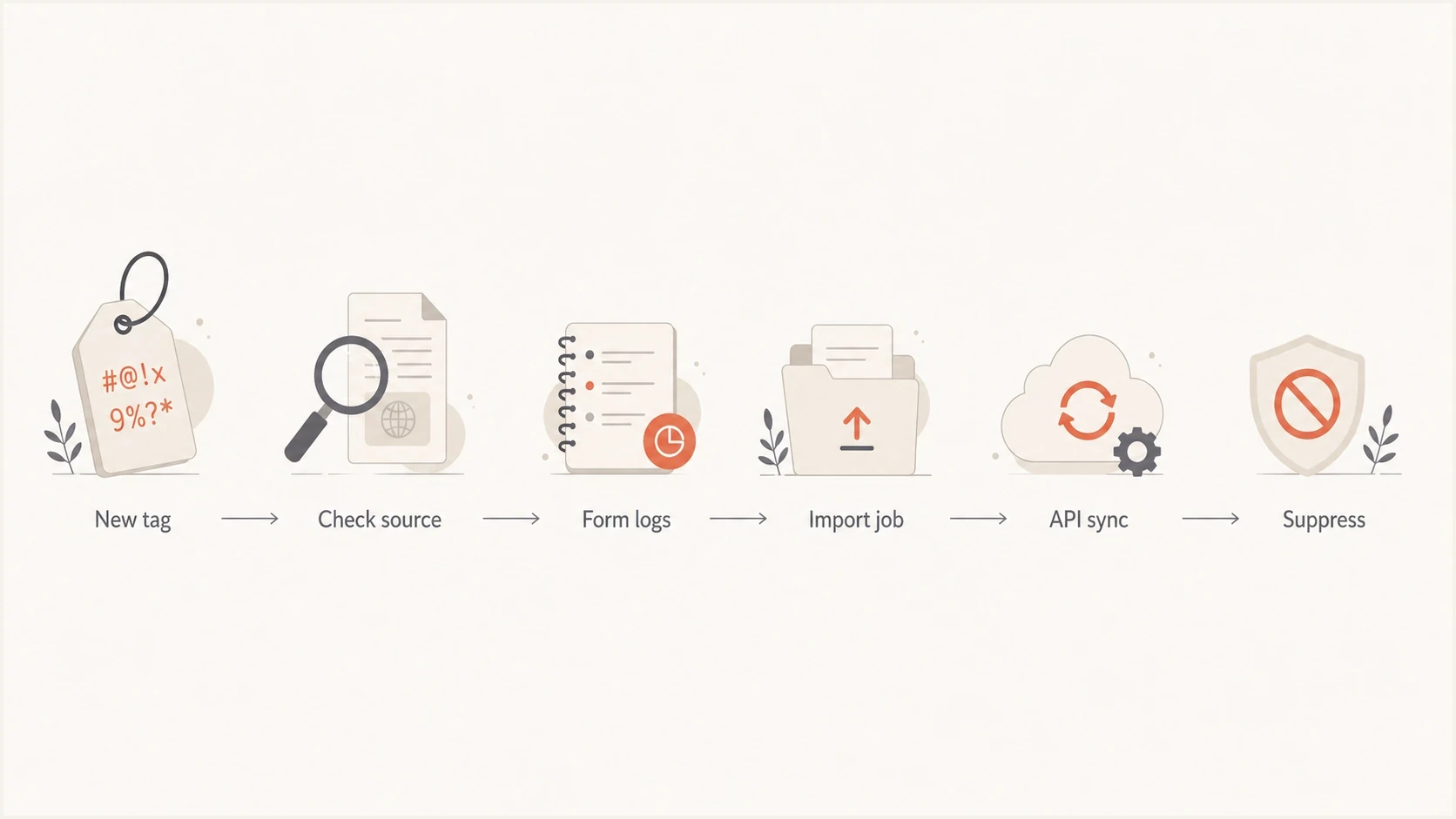
Flowchart showing the investigation path for a new gibberish tag.
When the pattern is list bombing
List bombing is a burst of automated submissions through a public signup form. Some submissions use fake or invalid addresses, but others use real third-party addresses whose owners did not consent. A gibberish tag supports that diagnosis when it appears with clustered creation times, one acquisition source, unusual submission velocity, and other low-quality field values. A random tag on its own does not prove list bombing.
- Preserve consent state: Keep confirmed, unconfirmed, subscribed, and suppressed contacts separate during the investigation.
- Contain the source: Pause the affected form or its downstream automation if submissions are still arriving in a burst.
- Check velocity: Compare submissions per minute with the form's normal volume and group them by source, IP, and user agent.
- Protect activation: Use confirmed opt-in so an address does not enter the active mailing list until its owner confirms.
Confirmed opt-in limits how many bot-submitted addresses reach normal campaigns, but it does not replace form controls. Keep rate limits, a honeypot, server-side validation, and risk-based challenges. Do not send follow-up marketing to addresses that remain unconfirmed, and do not treat a delivered confirmation message as proof of consent.
Where to investigate contact tag sources
The best internal place to ask is the team that owns contact acquisition and data operations. In most companies, that means marketing operations, CRM operations, lifecycle marketing, data engineering, or the person who owns form and integration setup. If no one owns it, assign ownership before cleanup. Without an owner, the same path keeps writing bad values.
- Pull samples: Export a representative set of affected contacts with tag, tag time, contact time, form, source, IP, user agent, confirmation status, and last modified user.
- Group by source: Count bad tags by form, list, import, API client, campaign, and referrer.
- Compare timing: Find the first appearance, then check what changed immediately before that timestamp.
- Review mappings: Check every field that can write to tags, especially hidden fields and campaign parameters.
- Suppress safely: Pause affected contacts from marketing sends until the source is understood.
Fields to export for the first investigationjson
{
  "contact_id": "12345",
  "email": "person@example.com",
  "tag": "A9F&QZ",
  "tag_created_at": "2026-05-26T10:15:00Z",
  "contact_source": "newsletter_form",
  "form_id": "footer_signup",
  "confirmation_status": "unconfirmed",
  "ip_address": "203.0.113.10",
  "user_agent": "Mozilla/5.0",
  "referrer": "https://example.com/blog",
  "api_client": "forms_service",
  "last_modified_by": "automation"
}
A clean attribution model needs a field that records where the contact came from and a separate field that records why the tag exists. Use separate fields such as source, form_id, tag_reason, and api_client. When all you have is a tag, every investigation turns into guesswork.
How to fix the root cause
The fix depends on which path created the tag. The common thread is the same: stop open input from becoming segmentation metadata. Tags should come from an approved list or a controlled rule, not directly from whatever a browser, bot, import file, or script sends.
Minimum control set
- Allow approved tags: Permit only approved tag values to be written by forms, imports, automations, and APIs.
- Validate input: Normalize incoming values, reject anything outside the allowlist, and flag unusual strings for review.
- Separate metadata: Store UTM values, source labels, and form answers outside the tag namespace.
- Audit writers: Log the user, API key, automation, and import ID that changed each tag.
Simple tag validation rulesjavascript
const approvedTags = new Set([
  "newsletter",
  "customer",
  "trial",
  "webinar"
]);

function normalizeTag(value) {
  return String(value ?? "").trim().toLowerCase();
}

function shouldAcceptTag(value) {
  const normalized = normalizeTag(value);
  if (!normalized || normalized.length > 40) return false;
  return approvedTags.has(normalized);
}
For forms, add a honeypot field, rate limits, server-side validation, and confirmed opt-in before the form activates a contact for marketing. Add a risk-based challenge when traffic looks abnormal. Do not rely only on front-end validation because bots skip or rewrite it. For imports, require a dry-run report that shows any new tag values before they are committed. For APIs, use scoped keys so a form service cannot write arbitrary segmentation data.
Tag issue triage
Use source and timing evidence to decide whether contacts need suppression before cleanup.
Review
Isolated
Inspect isolated values and preserve their creation history.
Investigate
Source cluster
Review the shared form, mapping, import, or automation.
Suppress
Active burst
Pause the affected source segment while submissions continue.
The cleanup rule should be reversible. Create a temporary suppression segment for affected contacts, fix the source, remove invalid tags, then restore contacts only after their acquisition path, consent state, and email quality look acceptable.
Email checks after affected contacts were mailed
Gibberish tags are a data-quality issue first, but they become an email problem when polluted contacts enter a segment. A spike in low-quality contacts can increase bounces, trigger bot engagement, and make reporting harder to trust. Authentication and reputation checks cannot identify why a contact received a tag, so fix the acquisition or data-writing path first.
If a polluted segment already received mail, send a representative message through the email tester before the next campaign. It helps catch authentication failures, broken headers, HTML issues, and content problems that compound contact-quality noise.
Email tester
Send a real email to this address. Suped shows a results button when the test is ready.
?/43tests passed
Check the sending domain as a separate post-send task. The domain health checker gives a broad view of SPF and DKIM alignment under DMARC. Suped's DMARC monitoring can track whether authorized sending services continue to pass authentication during remediation and alert the team when an unrecognized source starts sending. It does not verify consent or clean contact tags.
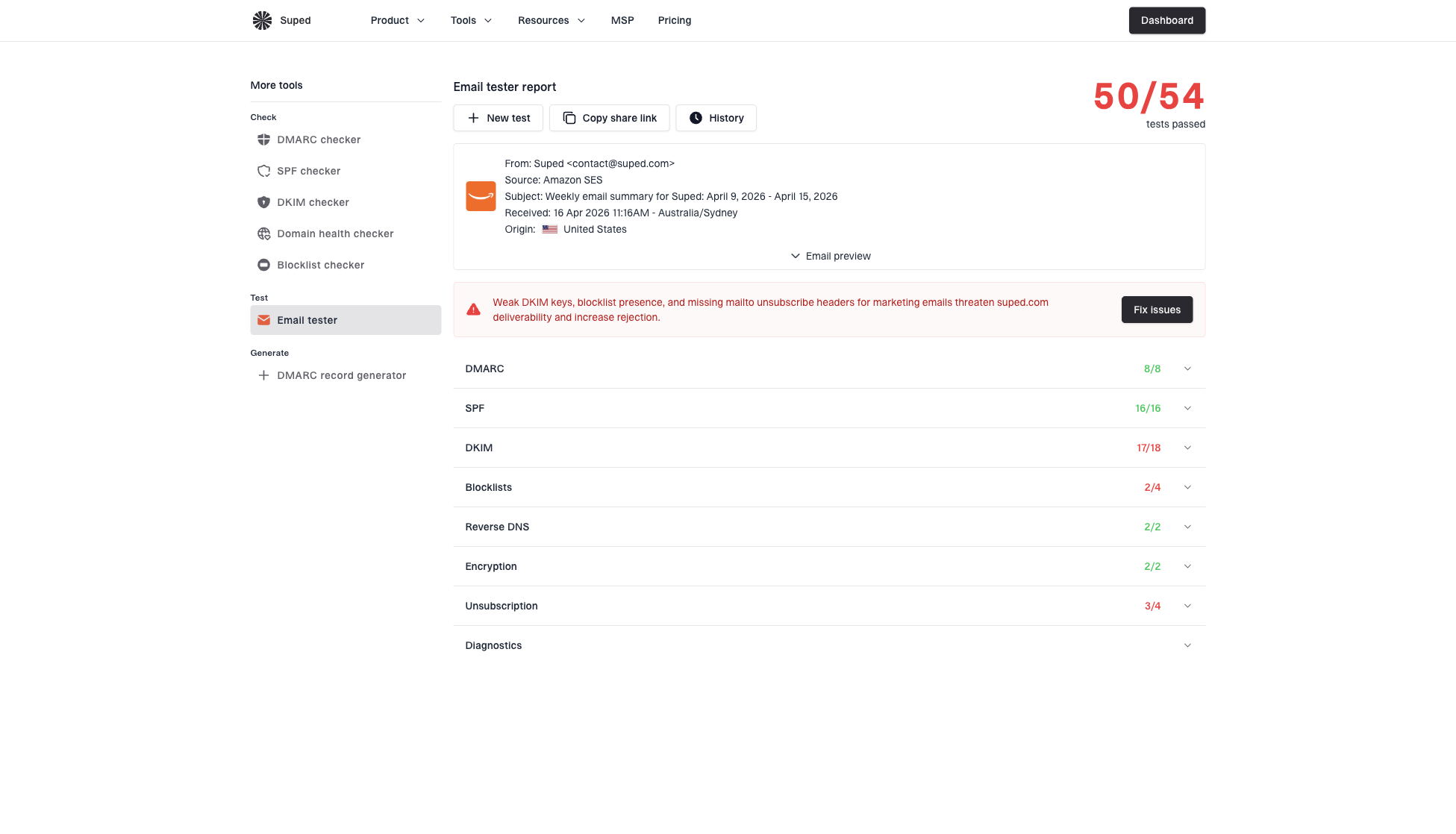
Email tester sample report showing total score, email preview, issue summary, and per-section results
If the bad records were mailed at volume and bounce or complaint symptoms followed, monitor reputation signals as well. Suped's blocklist monitoring keeps domain and IP checks beside authentication monitoring. Use that workflow to watch for blocklist or blacklist listings and authentication changes while the contact-acquisition issue is fixed.
Views from the trenches
Best practices
Record source, form, campaign, integration, IP, user agent, and timestamp for every new contact.
Treat freeform tags as untrusted input and map only approved values into contact records.
Keep suppression rules reversible so clean contacts can be restored after source cleanup.
Common pitfalls
Relying on tag names alone hides whether the bad data came from a form, import, or API.
Letting hidden fields update tags without validation turns simple bot noise into CRM clutter.
Cleaning tags before fixing source attribution removes the evidence needed to find the source.
Expert tips
Add a dedicated source field before changing forms so the next occurrence has useful evidence.
Compare tag creation time with signup bursts, click spikes, and first email engagement.
Use staged suppression first, then delete records only after the acquisition path is known.
Marketer from Email Geeks says gibberish tags that look like keyboard smashing usually point to bot form fill activity, especially when the values include symbols and uppercase patterns that real users rarely type.
2024-06-21 - Email Geeks
Marketer from Email Geeks says bots sometimes submit hex-like values or random keys into open fields, so odd custom tags should be treated as untrusted form input until logs prove otherwise.
2024-06-21 - Email Geeks
Investigation order for gibberish tags
Gibberish custom tags are not proof of a breach or bot attack by themselves. They are evidence that a contact-writing or sync path needs review. The highest-confidence answer comes from matching tag creation time to source attribution, then checking whether the same path also created fake emails, strange names, unconfirmed contacts, or abnormal engagement.
The order of operations is simple: preserve evidence, group affected contacts by source, suppress risky contacts, fix the writer, validate tag values, and only then clean the database. If the issue reached your email program, check authentication, message quality, and blocklist or blacklist exposure before sending to the affected audience again.
Suped's product is relevant after affected contacts were mailed. Use its DMARC monitoring and alerts to confirm authorized sending sources and catch authentication changes. Use blocklist monitoring to watch domain and IP status while the contact-acquisition issue is fixed.