What are the specific rules and guidelines to deliver emails to the Chinese market?

Updated on 4 Aug 2026: We added PIPL and cross-border data guidance and refreshed the technical checks for current China campaigns.
Yes. Sending email to the Chinese market has specific rules and guidelines that go beyond a normal global deliverability checklist. The short version is this: get explicit consent, label commercial messages clearly, avoid sensitive content, send in simplified Chinese when the audience expects it, keep HTML simple, throttle slowly, separate transactional and marketing streams, monitor bounces closely, and treat QQ Mail, NetEase, Sina, Sohu, and other local mailbox providers as their own delivery environment.
Treat China delivery as a specialist route, not as another country segment in the same campaign. The technical foundations still matter: SPF, DKIM, DMARC, reverse DNS, list hygiene, complaint control, and working links. China also adds stricter content filtering, slower acceptance patterns, local language expectations, higher sensitivity around URLs, commercial-email rules, and personal-information duties that are easy to miss when a program was built around US or EU assumptions.
- Consent: Use permission-based lists and keep proof of the signup source, date, language, form, and consent statement.
- Subject labels: Commercial advertising email must start the subject with 广告 or AD.
- Content: Avoid political or religious content, adult material, gambling, tobacco, illegal drugs, and other locally restricted topics.
- Language: Use fluent simplified Chinese for mainland campaigns and test double-byte character support before launch.
- Infrastructure: Authenticate every stream and monitor domain reputation, IP reputation, and DNS changes during the rollout.
- Volume: Start with small segments, measure acceptance by provider, and expect delays rather than instant inbox placement.
The direct answer
The unusual parts are the mandatory commercial subject label, strict filtering, local-provider throttling, simplified Chinese expectations, double-byte character support, high sensitivity to links and tracked URLs, and the practical need for local expertise when the audience is large or business-critical.
Specific rules that matter first
China's commercial email rules require affirmative consent. Start with proof of consent, accurate sender and envelope information, a real contact method for refusal, prompt suppression after refusal, and a subject line that starts with 广告 or AD when the message contains commercial advertising. That is the baseline before any deliverability tuning.
China campaigns face strict filtering across local mailbox providers. Explicit consent and commercial subject labels are compliance duties, while small-segment sending is an operational control. Filtering can cause delays, unclickable links, or non-delivery, so treat those outcomes as operational risks rather than edge cases.
|
|
|
|---|---|---|
Consent | Explicit permission | Store signup proof |
Subject | 广告 or AD first | Label every commercial ad |
Identity | Accurate envelope | Do not hide or forge |
Refusal | Real contact method | Stop after refusal |
Content | Restricted topics | Review locally |
Core China email rules to check before launch.
Commercial subject line examplestext
广告:上海会员春季优惠
AD: Beijing training discount
广告:深圳门店新品优惠
Do not treat the label as a workaround
The 广告 or AD label does not fix poor consent, vague sender identity, risky content, or weak authentication. It only makes the commercial nature of the message explicit. A labeled message sent to a scraped list still breaks consent rules and damages sender reputation.
Personal information and cross-border data
An email address, signup record, engagement history, device identifier, and related profile data can be personal information under China's Personal Information Protection Law (PIPL). If a China subscriber list or its engagement logs are collected in China and then stored, viewed, or processed outside China, handle that transfer as a separate compliance workstream from inbox placement.
- Map the data: Record where addresses, consent proof, events, and suppression data are collected, stored, accessed, and deleted.
- Limit the purpose: Collect only the data needed for the stated campaign purpose and document the processing basis.
- Explain offshore access: Tell people about the overseas recipient, processing purpose, data types, and rights process, then obtain separate consent where PIPL requires it.
- Assess the transfer: Complete a personal-information protection impact assessment and identify the applicable cross-border route before moving data.
- Keep suppression data: Retain only what is needed to honor refusal and deletion requests without putting a removed address back into a campaign.
Data localization is not automatic
Under China's 2024 cross-border data rules, a processor that is not a critical information infrastructure operator and transfers the non-sensitive personal information of fewer than 100,000 people since January 1 can qualify for an exemption from the main transfer mechanisms. The exemption does not cancel the underlying notice, necessity, separate-consent, security, and impact-assessment duties. Confirm the data classification and current route with China counsel before launch.
Authentication and DNS setup
For China, authentication should be boring. SPF should pass with a Return-Path under the same organizational domain as the visible From address, DKIM should sign with a d= value under that organizational domain, DMARC reporting should be enabled, reverse DNS should match the sending identity, and every sender should have a documented reason to exist. Weak DNS does not always produce an obvious China-only bounce, but it gives filters another reason to slow or reject mail.
Before sending, run a broad domain health check across SPF, DKIM, DMARC, and DNS. If you see more than one SPF record, missing DKIM selectors, a monitoring-only DMARC policy with no reports, or unauthenticated third-party senders, fix those before testing China volumes.
Baseline DNS recordsdns
_dmarc.a.test TXT "v=DMARC1; p=none; rua=mailto:d@a.test"
a.test TXT "v=spf1 include:_spf.sender.test -all"
s1._domainkey.a.test TXT "v=DKIM1; k=rsa; p=MIIB..."
This example uses p=none while the sender inventory is being checked. RFC 9989 removed DMARC's pct tag in May 2026, so do not copy pct=25 or another fractional value to stage enforcement. Change the policy only after reports show that legitimate sources authenticate correctly.
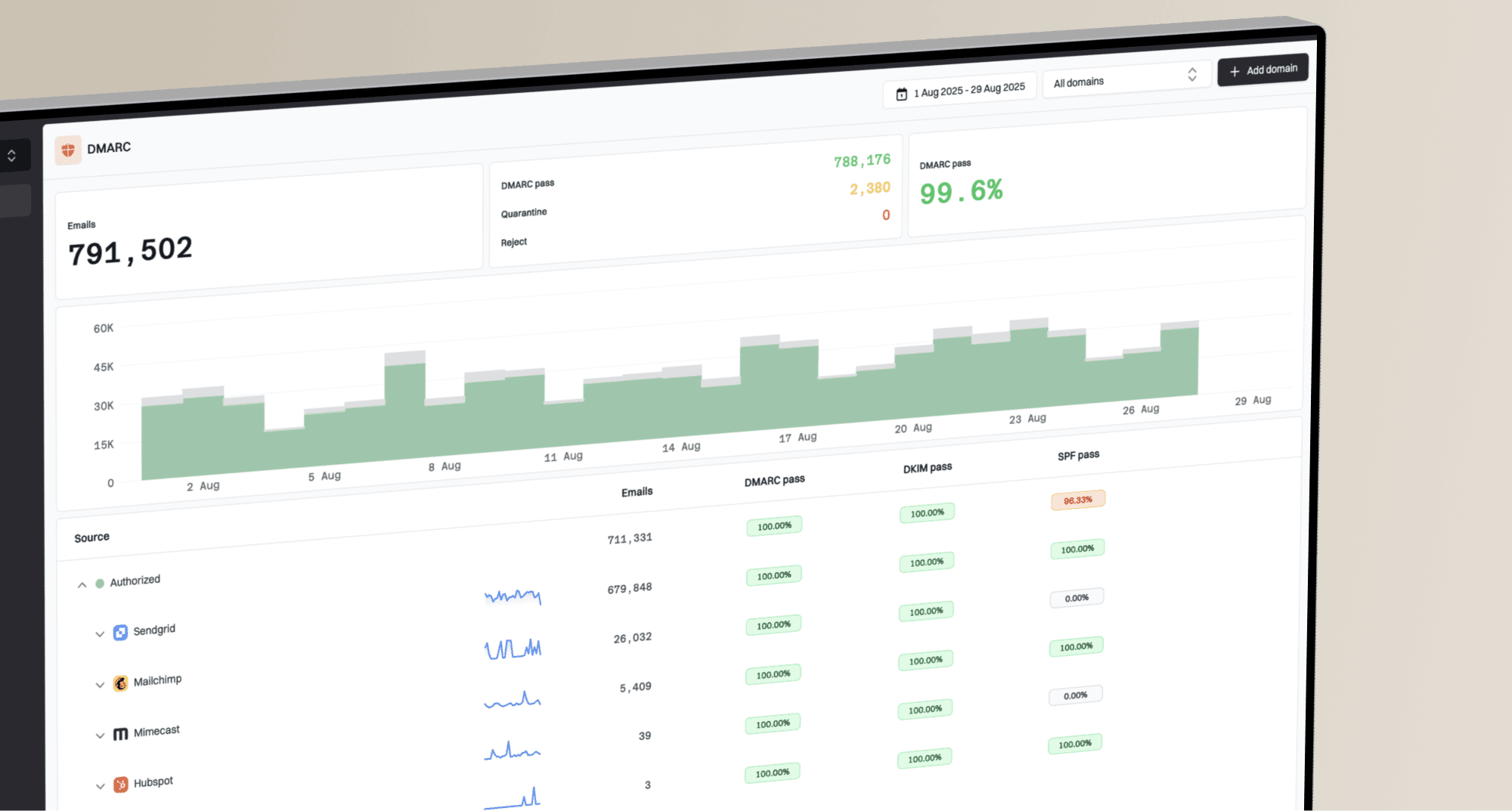
Suped's product is a DMARC and email authentication platform. It combines source discovery, DNS monitoring, alerts, and blocklist or blacklist signals in one workflow. For China, the useful result is knowing which sending source fails, which provider is affected, and what authentication or DNS change fixes the issue. Suped's DMARC monitoring supports source verification, staged policy work, alerts, and clear fix steps without requiring teams to read raw aggregate reports.
DMARC record detail view showing SPF, DKIM, DMARC, rDNS diagnostics, and DNS records
A practical Suped workflow
- Add domains: Add the brand domain and any China-specific sending subdomains before campaign setup.
- Verify senders: Confirm which systems send transactional, lifecycle, support, and marketing email.
- Fix gaps: Resolve SPF lookup limits, missing DKIM, DMARC domain matching, and MTA-STS setup.
- Watch alerts: Use alerts when China sends show new failures, unknown sources, or reputation changes.
Content, language, and rendering rules
Content filtering is the part that surprises many senders. A message that works in North America or Europe can run into China-specific filtering because of language quality, generic greetings such as "Dear Friend," subject wording, tracked links, image-heavy design, tiny fonts, or topics that trigger local review systems. Do not send translated copy until a fluent local reviewer has checked the meaning, tone, legal claims, and calls to action. As a filter-aware test default, keep the full commercial subject under 35 characters, including the 广告 or AD label.
Double-byte character support also matters. Your sending system, mail server, template editor, database, CSV import process, merge tags, subject lines, unsubscribe page, and analytics exports need to preserve simplified Chinese characters correctly. Broken encoding creates strange characters in inboxes, malformed links, broken personalization, and a poor recipient experience.
Common global email
- Language: One English template is reused across several regions.
- Links: Tracking and redirects are added to every call to action.
- Design: Large images, CSS-heavy layouts, and small legal text are tolerated.
- Volume: The campaign sends to a full country segment in one day.
China-ready email
- Language: Simplified Chinese copy is reviewed by a fluent local reviewer.
- Links: URLs are kept direct, necessary, and tested for access from China.
- Design: HTML is simple, mobile friendly, and readable when images are blocked.
- Volume: Segments are small, sequenced, and adjusted by provider response.
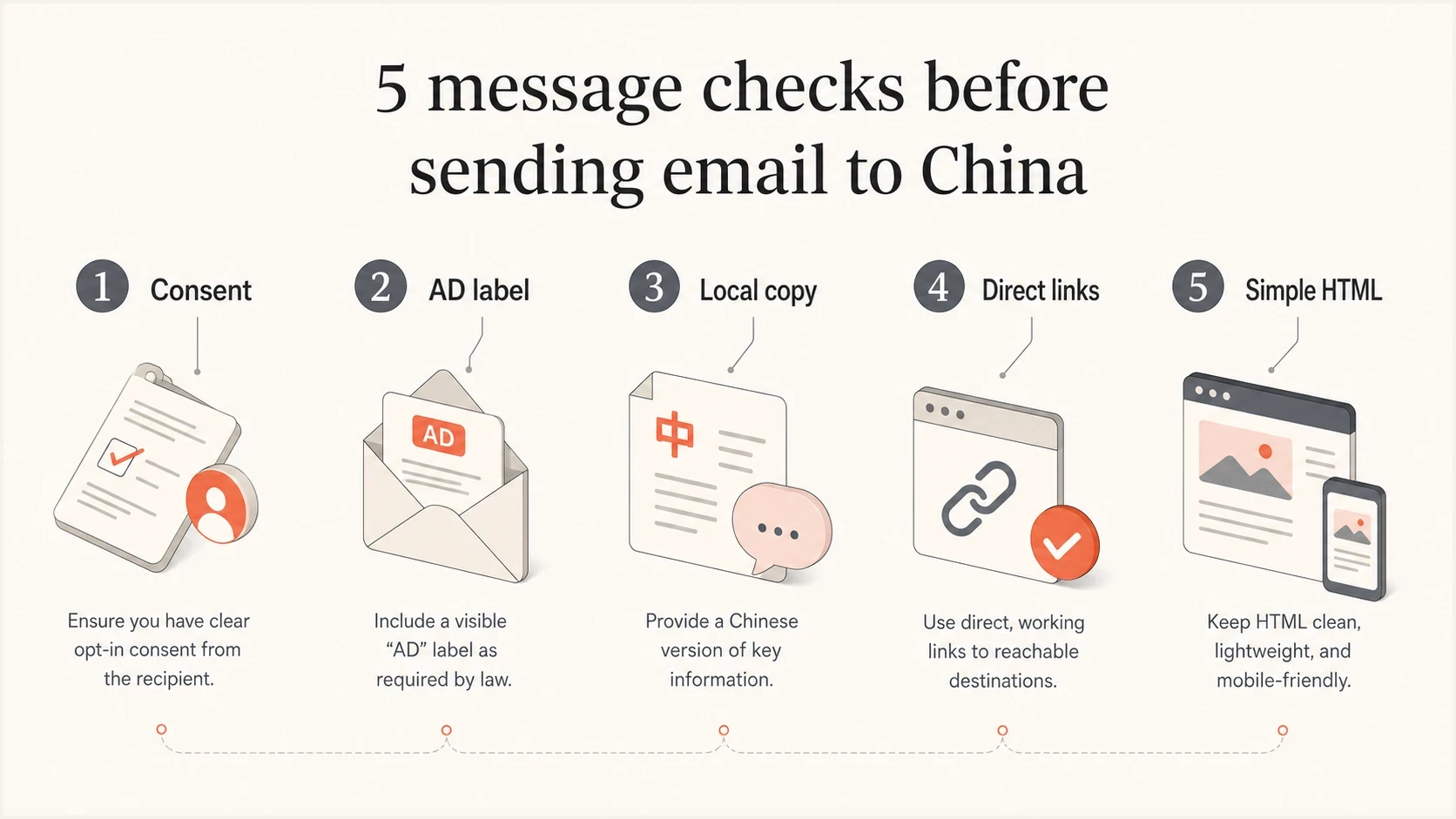
Five pre-send checks for email campaigns targeting China.
China list engagement gates
A simple way to decide who should receive early China test sends.
First test segment
0-30 days
Recent open, click, purchase, login, or account activity.
Careful expansion
31-90 days
Some engagement, but not enough for a full rollout.
Pause or suppress
2-3 misses
No open or click across repeated sends is a high-risk signal.
For an initial China test, keep the template width at 600 pixels or less, use body text of at least 10 points, keep images below 40% of the layout, and include useful alt and title text. Use real text rather than image-only content and make sure the message remains readable when images are blocked. If a message needs several tracking domains, heavy scripting, long redirects, or many third-party assets to work, it is not ready for China testing.
Sending volume, bounces, and provider behavior
The delivery pattern into China is often slower and less transparent than senders expect. A timeout, temporary deferral, 451 response, or low click count does not always mean the message failed in the same way it would elsewhere. Providers can throttle, filter links, delay acceptance, or temporarily block mail based on sender history and current message risk.
Start by splitting China traffic by mailbox provider. QQ Mail and NetEase deserve separate dashboards because their patterns differ. For provider-specific issues, use the QQ.com delivery guide, and classify NetEase 451 responses by the exact SMTP text before deciding whether to retry, slow down, pause, or suppress.
- QQ Mail: Watch for throttling, low engagement sensitivity, and sudden temporary blocks.
- NetEase: Parse 451-class responses carefully and slow down before retry storms form.
- Sina and Sohu: Keep copy clean, links direct, and volume increases conservative.
- Other local domains: Map 139.com, 189.cn, 263.com, 188.com, and other recurring domains instead of leaving them in an unknown bucket.
- Corporate domains: Expect mixed filtering because local gateways and corporate security controls vary.
When a blocklist or blacklist appears
China-related blocklist and blacklist issues are often temporary, but they still hurt delivery. Check whether the listing is tied to a sending IP, domain, redirect domain, or shared infrastructure, then reduce volume while fixing the cause. Suped's blocklist monitoring helps teams catch reputation shifts before they turn into a full campaign failure.
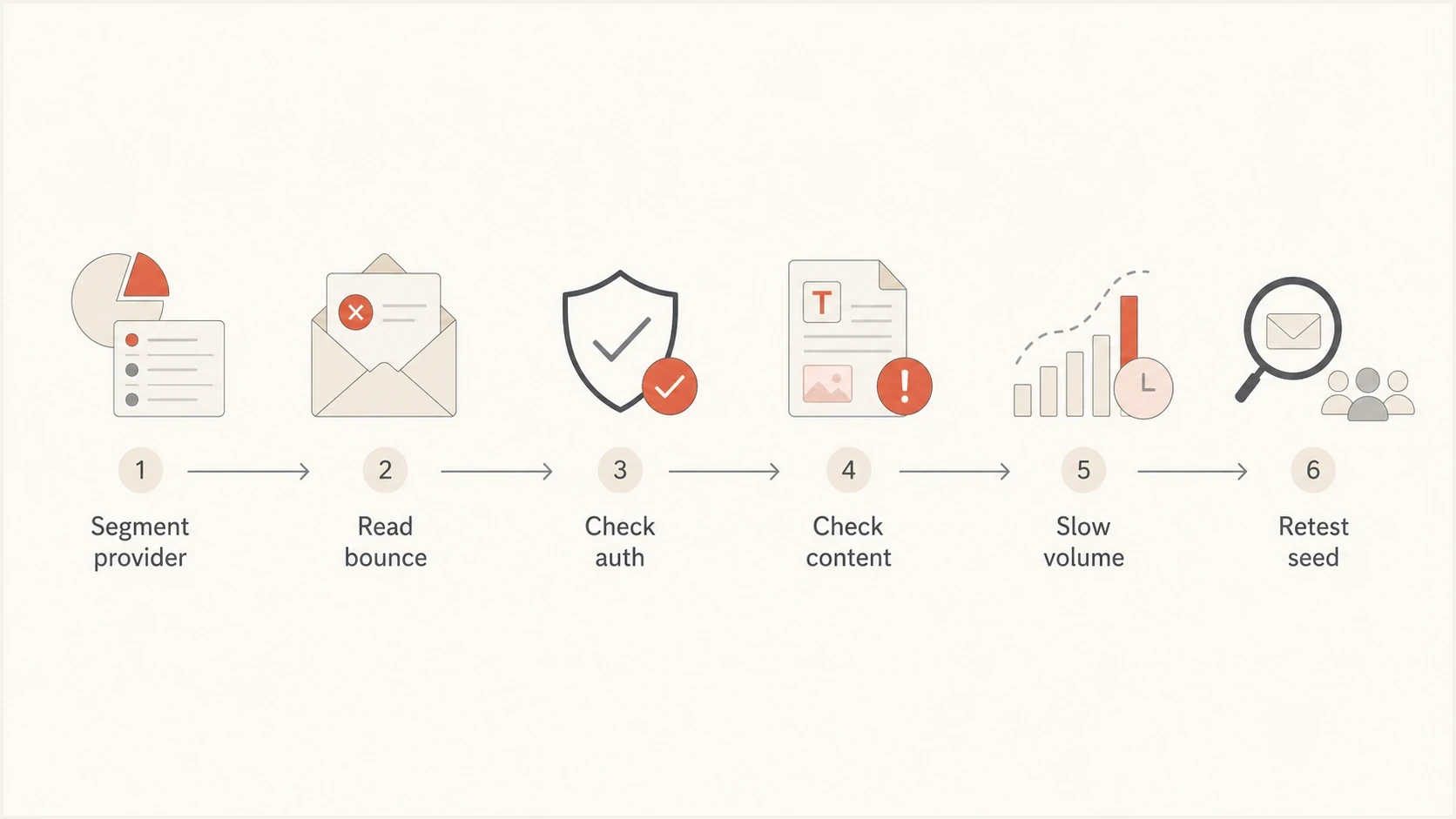
Flowchart for troubleshooting email delivery into China.
Send a real preflight message before a production launch and inspect headers, authentication, rendering, links, and spam signals with the email tester. A test does not guarantee Chinese inbox placement, but it catches broken basics before you expose a new segment to avoidable filtering.
Email tester
Send a real email to this address. Suped shows a results button when the test is ready.
?/43tests passed
Operational checklist for China campaigns
The safest China email program uses a controlled rollout. Do not test several major variables in the first high-volume send. Isolate variables so that a poor result can be explained and fixed.
- Map providers: Group recipients by QQ Mail, NetEase, Sina, Sohu, 139, 189, 263, 188, corporate domains, and unknown domains.
- Separate streams: Use different From addresses or subdomains for transactional and marketing mail.
- Use consent: Start with recipients who opted in recently and engaged within the last 30 days.
- Review content: Check restricted topics, claims, localization quality, font sizes, and subject labels.
- Test links: Confirm landing pages and redirect domains are accessible and do not look deceptive.
- Throttle slowly: Ramp by provider and stop increases when deferrals or complaints rise.
- Read bounces: Classify temporary failures, policy blocks, bad recipients, and content-related rejections.
- Suppress fast: Remove invalid addresses and pause recipients with no open or click after two or three sends.
Before launch
- DNS: SPF, DKIM, DMARC, MX, and reverse DNS are checked.
- List: Use recent and consented recipients with clear engagement.
- Copy: Review the commercial label and simplified Chinese copy, including any restricted topics.
- Rendering: The message works on mobile and still reads with images blocked.
After launch
- Bounces: Temporary and permanent failures are separated by provider.
- Engagement: Low-response segments are paused before they damage reputation.
- Reputation: Domain and IP listing checks are reviewed daily during ramp-up.
- Fixes: One variable changes at a time so the next result is meaningful.
If the China audience is large or business-critical, use a local delivery specialist or assess a local relay path with established Chinese provider relationships. Before adopting a local route, check its licensing, data access, retention, and PIPL implications. This extra setup becomes practical when a global brand has high China volume and needs more predictable acceptance than occasional campaign tests provide.
Views from the trenches
Best practices
Segment Chinese mailbox providers before ramping volume, then compare bounces separately.
Have native speakers review simplified Chinese copy, subject lines, and unsubscribe pages.
Confirm double-byte character support across templates, data imports, tracking, and exports.
Common pitfalls
Treating China as a standard country segment hides provider-specific throttling signals.
Using many redirects and tracked links raises filtering risk and weakens landing-page access.
Sending to dormant Chinese addresses after two or three misses can damage reputation fast.
Expert tips
Use strict consent records and keep the AD label process built into campaign approvals.
Pause ramp-ups when temporary failures rise, because retry pressure can worsen blocking.
Use Suped alerts to catch authentication drift before China delivery problems spread.
Expert from Email Geeks says China delivery needs local language knowledge, local context, and sometimes local business presence before high-volume sending is realistic.
2025-01-11 - Email Geeks
Expert from Email Geeks says China's requirements differ across law, filtering, and culture, so standard global deliverability playbooks miss important risks.
2025-01-11 - Email Geeks
A practical China delivery standard
The specific rules and guidelines for delivering email to the Chinese market are explicit consent, a front-positioned 广告 or AD label for commercial advertising, accurate sender information, simple localized content, conservative volume, provider-by-provider monitoring, and fast suppression after refusal or repeated non-engagement. The technical basics still apply, and strict filtering reacts quickly to weak authentication, risky links, poor list hygiene, or unengaged recipients.
For most teams, the practical setup is a controlled China rollout backed by Suped's DMARC and email authentication platform. Suped shows authentication failures, unknown senders, DNS changes, and blocklist or blacklist events, while the marketing team manages consent, localization, content review, privacy duties, and provider-specific pacing.
The rule of thumb
If a message is not permission-based, clearly labeled when commercial, readable in simplified Chinese, authenticated, mobile-friendly, and tested with direct links, it is not ready for China.