Why am I getting a Yahoo error 451 due to an unresolvable RFC 5321 domain?

Published 9 Jun 2025
Updated 28 Jul 2026
10 min read
Summarize with

Updated on 28 Jul 2026: We clarified Yahoo's SOA checks, DNS response codes, and the correct handling for 451 and 554 failures.
Yahoo returns this 451 error when the domain to the right of the @ in the SMTP MAIL FROM does not appear valid during Yahoo's DNS check. In practice, the problem is usually a failed SOA lookup or broken delegation, including an authoritative nameserver that answers for a mail subdomain but not for the zone it was delegated to host.
The error often feels wrong because the bounce domain has an A record, an MX record, or both. That does not prove the domain is valid for Yahoo's check. Yahoo says in its Yahoo error codes that it determines whether an RFC 5321 MAIL FROM or RFC 5322 Header From domain exists by using an SOA query. A timeout or SERVFAIL can produce a temporary 451, while a permanent failure can produce a 554.
Treat this as a DNS configuration fault first, not as a Yahoo false positive, a DMARC policy rejection, or a content filtering issue. Retry logic keeps a 451 message in the queue, but it will not fix a domain that fails Yahoo's SOA query.
The direct fix
Identify the exact domain used in MAIL FROM, then test its SOA response and the enclosing authoritative zone. If the lookup returns NXDOMAIN, SERVFAIL, REFUSED, or a timeout, trace the delegation and repair the zone before asking Yahoo to accept the traffic.
What Yahoo is checking
For the RFC 5321 version of this error, start with the SMTP envelope sender, also called the RFC 5321.From, return path, bounce address, or MAIL FROM. This differs from the visible From header. A message can show billing@example.com to the recipient while its envelope sender uses bounces@email.example.com. If Yahoo names RFC 5322 or Header From instead, inspect the visible From domain.
Typical Yahoo deferraltext
451 Message temporarily deferred due to unresolvable RFC.5321 from domain;
see Yahoo postmaster error codes
For a bounce address at bounces@email.example.com, test email.example.com exactly as Yahoo receives it. Then find the authoritative zone for that name and verify its SOA path. The zone might be email.example.com if the subdomain is delegated, or example.com if the name exists inside the parent zone. The organizational domain still matters because a broken parent delegation can prevent the exact name from resolving.
|
|
|
|---|---|---|
RFC 5321 | SMTP envelope sender | MAIL FROM |
RFC 5322 | Visible From header | From |
SOA | Zone authority record | Exact name and zone |
SERVFAIL | Resolver failure | Authority and DNSSEC |
The DNS names that matter for this Yahoo error.
The useful mental model is simple: Yahoo asks DNS whether the domain after the @ exists through a valid authority path. If the answer changes by resolver or authoritative server, the DNS setup is not stable enough for Yahoo's check.
Why a valid-looking domain still fails
The common trap is subdomain delegation. A sender platform asks a customer to delegate email.example.com so the platform can control bounce handling, DKIM keys, tracking hostnames, and other mail records. That works when the customer keeps example.com on its normal DNS host and delegates only the mail subdomain.
The broken version happens when the whole parent domain is pointed at the sender platform's nameservers, but those nameservers are configured only for email.example.com. Queries for email.example.com work. Queries for example.com fail. Yahoo's SOA query then reaches an incomplete authority path.
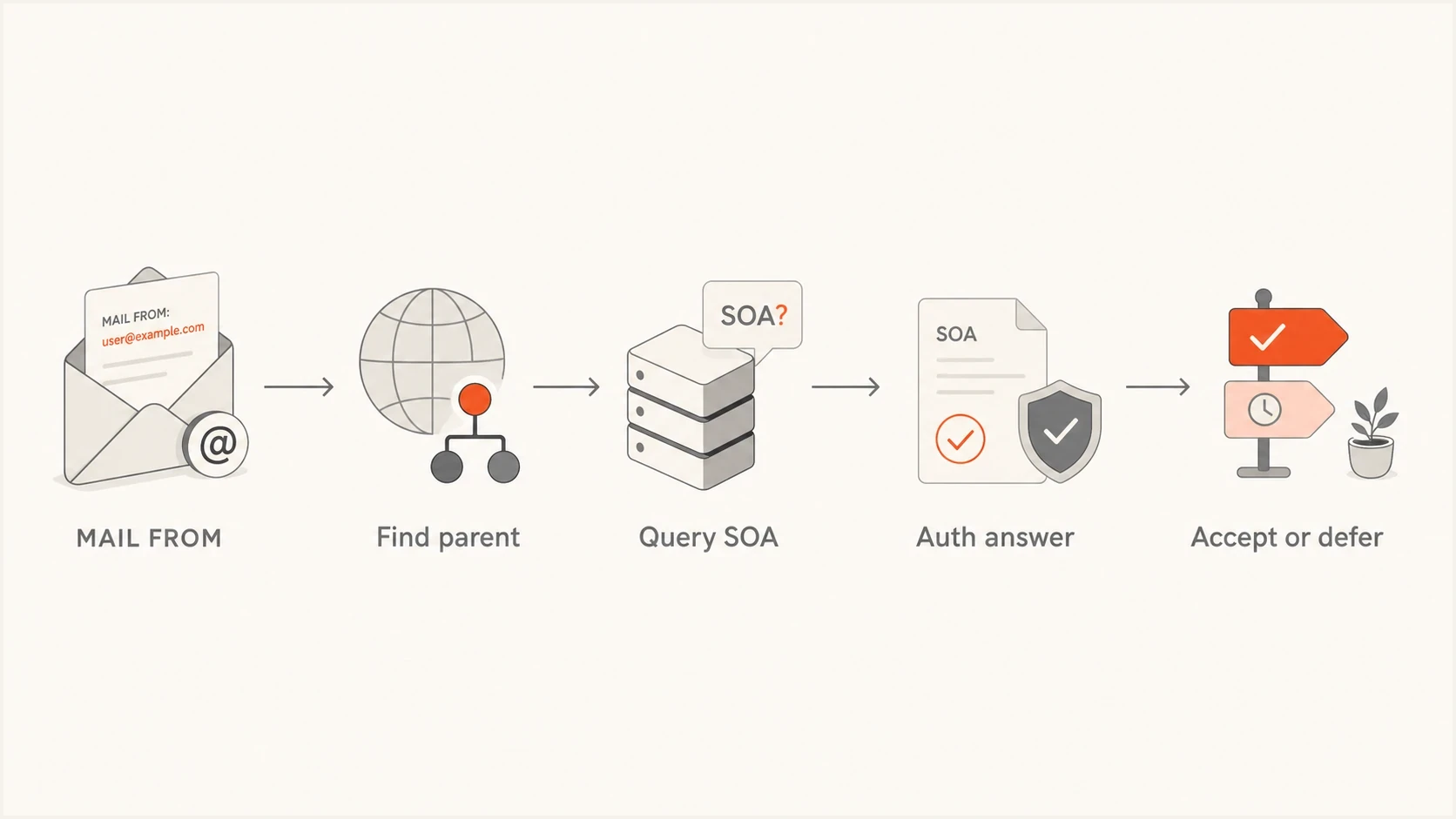
Flowchart showing Yahoo checking the MAIL FROM domain, parent SOA, and authoritative DNS answer.
Looks valid
- MX exists: The bounce subdomain has an MX record that accepts returns.
- A exists: The tracking or bounce hostname has an address record.
- One resolver works: A cached or non-validating resolver returns an answer.
Fails at Yahoo
- SOA query fails: The sending domain has no usable authority response.
- Delegation fails: The parent points at servers that do not host the delegated zone.
- Resolvers differ: Yahoo reaches an error hidden by another resolver's cache.
This pattern appears in a useful SOA explanation that shows how delegating the wrong DNS layer can leave a mail subdomain working while the parent zone fails Yahoo's check.
How to diagnose the error
Start with the SMTP transaction, not the visible From address. The exact MAIL FROM value is the fastest route to the answer. Without that value, it is easy to test the wrong domain and miss the broken one.
- Capture MAIL FROM: Read the SMTP logs or a full delivery transcript and copy the envelope sender exactly.
- Extract the domain: Use the domain to the right of the @ in the envelope sender.
- Find the zone: Trace delegation to identify which authoritative zone should answer for that exact name.
- Query SOA records: Test the exact sending domain, its organizational domain, and the authoritative nameservers.
- Compare resolvers: Repeat the checks through public resolvers and direct authoritative queries.
- Retest delivery: After the DNS fix and TTL expiry, send a new message and inspect the SMTP result.
First DNS commandsbash
dig SOA email.example.com

dig SOA example.com

dig +trace SOA email.example.com

dig @1.1.1.1 email.example.com SOA

dig @8.8.8.8 email.example.com SOA

dig @ns1.sender.example email.example.com SOA
A direct authoritative failure provides the clearest evidence. If the delegation lists ns1.sender.example and ns2.sender.example for email.example.com, query each nameserver directly for email.example.com SOA. A refusal, timeout, SERVFAIL, or inconsistent answer identifies the DNS layer that needs repair.
For a broader scan, run a domain health check and then verify the specific SOA path by hand. Automated checks can catch common DNS and authentication faults, while direct dig commands identify the server that breaks the chain.
?
What's your domain score?
Deep-scan SPF, DKIM & DMARC records for email deliverability and security issues.
How to read the DNS result
The DNS status matters more than whether dig prints an SOA record in the answer section. Read the response code, authority section, and responding server together. A valid existing hostname inside a parent zone can return NOERROR with the enclosing zone's SOA in the authority section, while an actual delegated zone should return its own SOA.
|
|
|
|---|---|---|
NOERROR | The DNS name or zone answers | Confirm all authorities agree |
NXDOMAIN | The queried name does not exist | Create or correct the name |
SERVFAIL | Resolution or validation failed | Check DNSSEC and authority |
REFUSED | The server declines the query | Fix authoritative access |
Timeout | No usable response arrived | Check reachability and firewall |
How common DNS responses guide the next action.
451 and 554 need different queue handling
A 451 is a temporary SMTP deferral, often recorded as a soft bounce, so the sending server can retry according to its normal schedule. A 554 is permanent for that delivery attempt and should not be retried unchanged. Repair DNS first, then submit a new message.
Fixes that resolve it
The right fix depends on which DNS layer is broken. Do not paper over the fault with longer retry windows. A 451 retry only makes sense after the underlying DNS answer is stable.
|
|
|
|---|---|---|
Sending name | NXDOMAIN | Create the DNS name |
Wrong delegation | Authority refuses | Delegate the intended zone |
Missing glue | Nameserver cannot resolve | Publish required glue |
DNSSEC mismatch | Validating resolver gets SERVFAIL | Correct DS and DNSKEY |
Authority outage | Timeout or mixed answers | Restore and synchronize servers |
Common causes and the fixes that usually clear the Yahoo 451.
Good delegation patterntext
example.com.          NS   ns1.registrar.example.
example.com.          SOA  ns1.registrar.example. hostmaster.example.com.

email.example.com.    NS   ns1.sender.example.
email.example.com.    NS   ns2.sender.example.
Bad delegation patterntext
example.com.          NS   ns1.sender.example.
example.com.          NS   ns2.sender.example.

# Sender nameservers only answer for email.example.com.
# Yahoo asks for example.com SOA and gets no usable answer.
What not to change first
- Do not rotate IPs: This error names a domain resolution problem, not an IP reputation problem.
- Do not rewrite content: Content changes do not create a valid SOA response for the envelope domain.
- Do not only add MX: A working MX does not repair a broken authority or DNSSEC chain.
- Do not assume cache: A cached resolver answer can hide the authoritative failure Yahoo reaches.
How to verify the repair
After DNS is corrected, wait for the relevant TTLs and run the SOA checks again. Confirm that the exact sending domain and its authoritative zone answer consistently through multiple resolvers, and that every authoritative server answers directly.
Then send a real message through the same outbound path. A synthetic DNS pass is useful, but the final proof is a new SMTP transaction using the same MAIL FROM and Yahoo destination pattern. A practical email tester helps inspect the envelope, headers, and authentication results in one place before the next campaign.
Email tester
Send a real email to this address. Suped shows a results button when the test is ready.
?/43tests passed
When to retry Yahoo delivery
Use retry behavior only after the DNS state is known.
Ready
Retry
SOA checks pass through public and authoritative paths.
Wait
Hold
DNS changed, but the previous TTL has not expired.
Blocked
Fix
SOA still fails or authoritative servers return inconsistent answers.
If Yahoo changes from the RFC 5321 domain error to a rate, reputation, or policy deferral, the DNS fault has cleared and the new response needs a separate investigation. Compare that bounce text against the relevant Yahoo runbook, including Yahoo 421 errors when the response concerns temporary throttling.
Where DMARC and Suped fit
This Yahoo 451 is not caused by a DMARC policy by itself. DMARC still matters because custom bounce domains often support SPF alignment. After the DNS fix, review SPF, DKIM, and DMARC so the sending domain has a valid authentication path.
Suped's product can track the post-repair authentication workflow through DMARC monitoring, SPF and DKIM visibility, alerts, and multi-tenant reporting. Teams can assign the remaining authentication issues to an owner and keep the original Yahoo DNS fault separate from DMARC report findings.
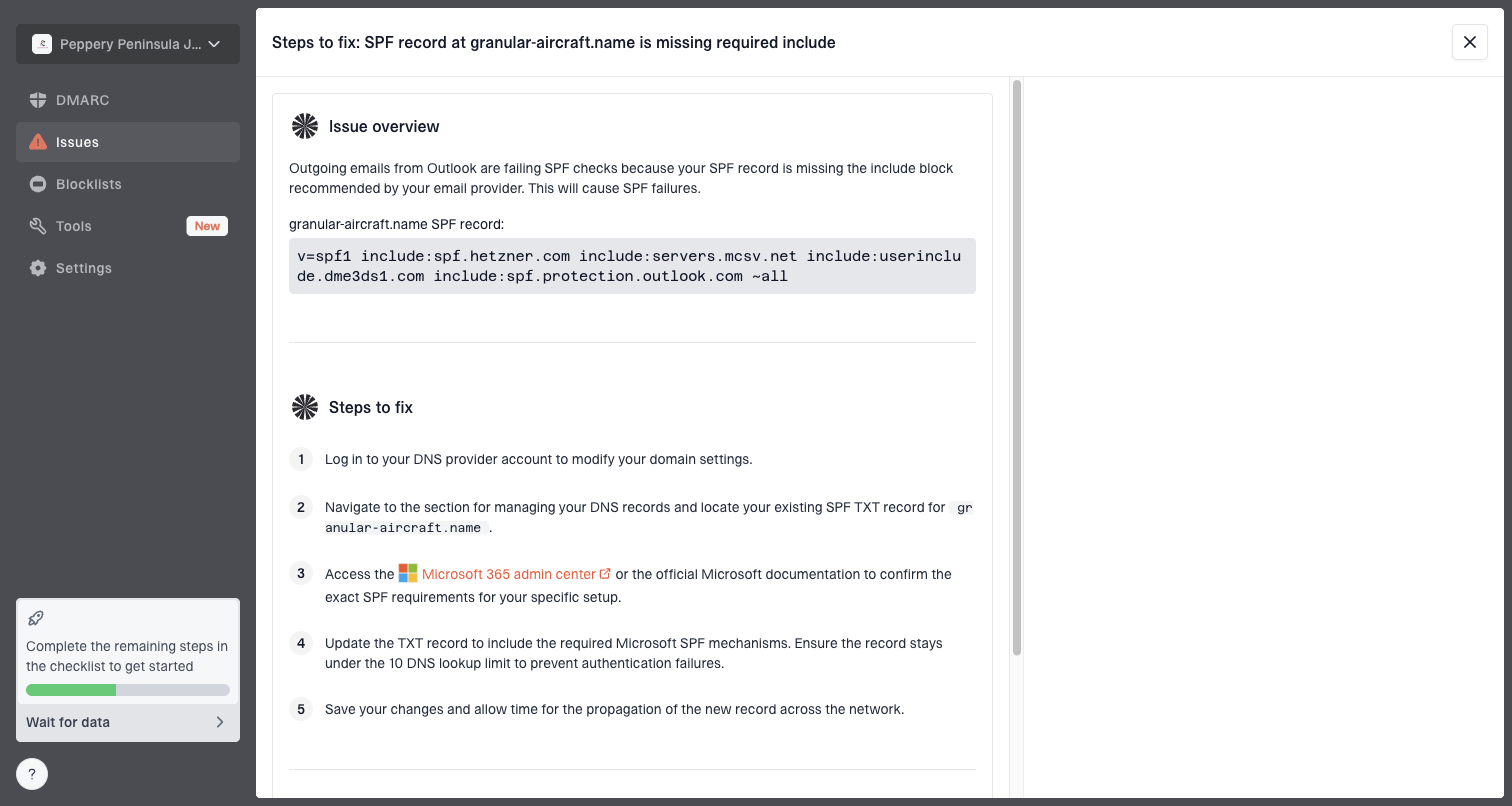
Issue steps to fix dialog showing the issue overview, tailored fix steps, and verification action
Keep reputation checks separate from this specific Yahoo error. A domain can have both DNS faults and reputation problems, but they need different evidence. Use blocklist monitoring for blocklist or blacklist visibility, then keep the unresolvable RFC 5321 investigation focused on DNS authority and SOA answers.
Operational checklist
- DNS owner: Confirm who hosts the parent zone and who hosts the mail subdomain.
- Sender owner: Confirm the exact bounce address used by the sending platform.
- Authentication owner: Confirm SPF, DKIM, and DMARC results after the DNS fix.
- Operations owner: Watch for a new Yahoo response after the unresolvable domain error clears.
Views from the trenches
Best practices
Capture the exact SMTP MAIL FROM value before changing DNS zones or retry policies.
Query the organizational domain SOA from public resolvers and each authoritative server.
Delegate only the mail subdomain to a sender platform unless the parent zone is hosted.
Common pitfalls
Checking only A and MX records can miss a parent zone that has no usable SOA response.
Pointing a whole customer domain at sender nameservers breaks unrelated DNS queries.
Treating every Yahoo 451 as reputation noise delays the DNS fix Yahoo needs first.
Expert tips
Use dig trace output to find the nameserver that stops answering for the parent zone.
Keep DNSSEC in the checklist, but do not assume every SERVFAIL is caused by DNSSEC.
Retest after TTL expiry with a fresh SMTP transaction, not only a DNS lookup result.
Expert from Email Geeks says Yahoo will not accept the mail until the sender proves the actual RFC 5321.From domain resolves correctly.
2023-05-29 - Email Geeks
Expert from Email Geeks says the real envelope sender and a sample bounce make this issue fast to confirm, because the failing domain is often not the visible From domain.
2023-05-29 - Email Geeks
The practical answer
Yahoo error 451 due to an unresolvable RFC 5321 domain means Yahoo cannot confirm that the domain in the envelope sender exists through a valid DNS authority path. The fix is to repair the DNS name, delegation, SOA path, DNSSEC chain, or authoritative service identified by direct queries.
The fastest path is to capture the MAIL FROM domain, query its SOA response, trace the authority path, correct the fault, wait for TTL expiry, and retest with a real send. Once Yahoo accepts the domain, monitor authentication and reputation as separate signals so later delivery problems are diagnosed with the correct evidence.




