What are the best practices for email deliverability to QQ.com?

Published 26 Jul 2025
Updated 10 Aug 2026
12 min read
Summarize with

Updated on 10 Aug 2026: We refreshed this guide with current DMARC rollout guidance and QQ.com bounce triage.
The best practices for email deliverability to QQ.com are to send slowly, localize the mail, use a dedicated QQ.com sending lane, authenticate every domain cleanly, monitor reputation daily, and work with an ESP that has China delivery experience. Treat QQ.com as a provider-specific program rather than a generic global mailbox route. QQ.com applies its own throttling and filtering signals and has a low tolerance for sudden high-volume traffic from senders without established reputation. SMTP acceptance confirms delivery to QQ.com's servers, while deliverability describes whether the message reaches the inbox instead of junk.
For a program targeting large QQ.com volume, prove trust before scale. Start with small batches, segment active Chinese recipients, make the message useful on mobile, and only increase volume when complaints, bounces, delays, and placement remain stable. If the goal is around one million messages per day to QQ.com, that is a routing, compliance, vendor, content, and monitoring problem as well as a warm-up problem.
- Direct answer: Build a QQ.com-specific delivery lane, not a shared global campaign route.
- Volume answer: A million daily messages needs gradual proof, local expertise, and strict suppression.
- Tooling answer: Use production-path testing, DMARC reporting, and blocklist (blacklist) monitoring before each ramp.
Direct answer
The best QQ.com deliverability plan has five parts: send through an ESP with China experience, authenticate the domain, localize the campaign, throttle hard, and watch results by recipient domain. The biggest mistake is asking which ESP can push one million daily emails to QQ.com before proving that the recipients, content, and domain reputation deserve that volume.
The core constraint
QQ.com filtering reacts poorly to sudden spikes, weak recipient engagement, content that does not match the audience, and unclear sender identity. The fix is a controlled program that gives QQ.com consistent evidence that recipients expect the mail.
- Pace: Start slow and increase only after stable acceptance and engagement.
- Proof: Use aligned SPF, DKIM, and DMARC with TLS, reverse DNS, and a stable EHLO or HELO identity.
- Language: Use localized Chinese copy for Chinese recipients instead of translated fragments.
- Governance: Keep unsubscribe, consent, complaint, and bounce handling tight.
Separate QQ.com analysis from the rest of the list. A campaign can look healthy overall and still fail at QQ.com because the QQ.com segment is small, slow, or hidden inside blended ESP reports. Suped's product supports this workflow by keeping DMARC reports, SPF and DKIM health, blocklist or blacklist status, alerts, and deliverability signals in one domain-level view.
Build a QQ.com sending lane
Handle QQ.com as its own sending lane with separate reporting, throttles, alerting, and sometimes separate IPs or subdomains. QQ.com can delay or filter mail differently than other mailbox providers, and blended metrics can hide that until user notifications or revenue mail starts failing.
Generic global lane
- Routing: QQ.com traffic rides with every other consumer mailbox domain.
- Metrics: Failures are blended into global opens, clicks, bounces, and delays.
- Control: Volume changes affect many providers at once.
- Streams: Transactional and promotional traffic can share the same queue.
QQ.com-specific lane
- Routing: QQ.com receives its own rate limits and reputation review.
- Metrics: Delays, deferrals, bounces, and complaints are tracked by domain.
- Control: Volume can pause for QQ.com without stopping the full program.
- Streams: Message types can receive separate queues when volume warrants it.
A separate lane does not require a separate brand. Keep the same trusted From domain strategy, unsubscribe policy, and consent standard. Add QQ.com-specific throttles, seed checks where useful, campaign tagging, and alert thresholds.
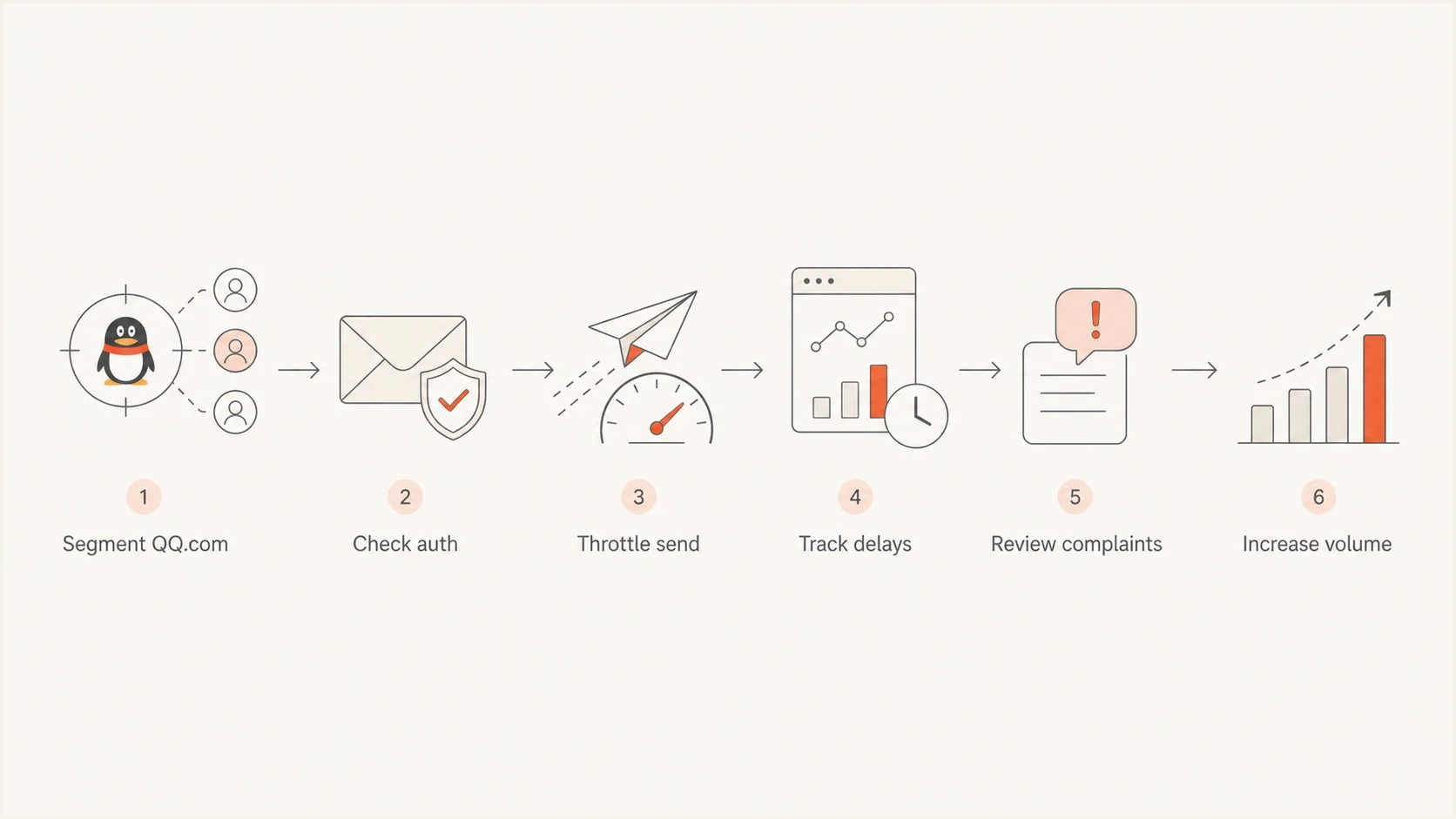
Flowchart showing a QQ.com sending lane from segmentation to volume growth.
Authentication and domain controls
Authentication does not guarantee inbox placement at QQ.com, but weak authentication damages the program. Check the visible From domain, SPF, DKIM, DMARC alignment, forward-confirmed reverse DNS, a stable EHLO or HELO identity, branded return-path and tracking domains, and TLS before creative changes. DMARC passes only when at least one passing SPF or DKIM identity aligns with the visible From domain.
Example DMARC monitoring recorddns
_dmarc.example.com TXT (
  "v=DMARC1; p=none; "
  "rua=mailto:dmarc-reports@example.com"
)
Example SPF record with strict faildns
example.com TXT (
  "v=spf1 include:esp.example include:mailer.example "
  "-all"
)
RFC 9989, published in May 2026, made the pct tag historic. Do not use pct=25 for staged enforcement. Keep p=none while identifying legitimate senders and repairing alignment, then publish quarantine or reject when the sending map is clean. The new t=y test mode requests one-level-lower handling, but receivers that have not implemented RFC 9989 can ignore t and apply p as written. Verify receiver behavior before relying on it as a rollout control. Suped's DMARC monitoring shows which sources pass, fail, or send without approval, then turns those findings into remediation steps.
Suped DMARC dashboard showing email volume, authentication health, and source breakdown
Before any QQ.com ramp, check domain consistency. Use branded tracking links, avoid sudden From domain changes, and keep DKIM selectors stable. Rotating visible identities to chase short-term placement creates a worse long-term signal. If authentication results are unclear, run a domain health check before increasing volume.
Content, language, and recipient behavior
QQ.com delivery is not only a technical problem. The content needs to look expected to Chinese recipients. Use localized Simplified Chinese copy, mobile-friendly rendering, clear branding, and a working unsubscribe flow. Protect signup forms with CAPTCHA or equivalent bot controls, use confirmed opt-in where address quality is uncertain, and provide both a visible unsubscribe link and one-click List-Unsubscribe headers for bulk promotional mail. Avoid image-only layouts, excessive links, URL shorteners, and mismatched sender names.
|
|
|
|---|---|---|
Language | Reviewed Simplified Chinese | Mixed or literal translation |
Layout | Responsive HTML | Image only |
Links | Branded HTTPS | Shortened or mismatched |
Consent | Confirmed opt-in | Purchased or stale list |
QQ.com content checks before sending
Check whether the campaign makes sense for the recipient. If the list contains old QQ.com addresses gathered years ago, place them behind a sunset or reconfirmation policy and suppress unresponsive contacts before seeking more throughput. Use the same broader deliverability diagnosis process for other failures, but apply stricter pacing and localization to QQ.com.
A good QQ.com campaign profile
- Audience: Recent subscribers or active customers with a clear reason to receive mail.
- Creative: Localized Chinese text, visible sender identity, and fast mobile rendering.
- Cadence: Predictable sending windows instead of sudden bursts across the day.
- Suppression: Immediate removal for hard bounces, opt-outs, repeated inactivity, and complaint signals.
Volume planning for one million daily sends
Sustaining one million daily messages to QQ.com requires strong list quality, consistent user demand, stable vendor support, and daily monitoring. Do not start by asking an ESP to open the throttle. Prove that the first few thousand recipients accept and engage with the mail, then scale in measured steps.
Example QQ.com rollout bands
An internal operating model for a dedicated QQ.com lane, not thresholds published by QQ.com.
Initial proof
500-5,000/day
Use active recipients only.
Controlled growth
5,000-50,000/day
Increase after stable bounces and delays.
Production scale
50,000+/day
Use domain alerts and vendor review.
Hold volume
Any spike
Pause increases when complaints rise.
The exact growth rate depends on list quality and the sender's existing reputation. An active transactional QQ.com list can move through the bands faster. An older, promotional, or imported list needs longer holds and more suppression. Use complaint rate, hard bounce rate, soft bounce patterns, delayed delivery, engagement trend, and unsubscribe behavior as the main controls.
- Start small: Use the most engaged QQ.com users first, not the entire China list.
- Hold often: Keep volume flat after each increase until delivery signals settle.
- Cut fast: Remove inactive QQ.com recipients before they drag reputation down.
- Separate alerts: Do not let QQ.com failures hide inside all-domain campaign averages.
Choosing ESPs for QQ.com
Limit the ESP shortlist to vendors that can explain China routing, TLS, QQ.com throttling, local verification requirements, bounce classification, and domain-level reporting with evidence. Evaluate regional routing and local operational support instead of assuming a globally available platform has consistent QQ.com placement. The choice depends on message type, expected volume, cross-border routing, and whether the sender has a legal entity or support team in China.
|
|
|
|---|---|---|
QQ.com routing | Documented regional path | Generic global claim |
Throttling | Recipient-domain queue controls | Account-wide limits only |
SMTP logs | Raw 4xx and 5xx responses | Blended bounce labels |
IP options | Dedicated or stable warmable pool | Untraceable rotating pool |
Local support | Chinese-language escalation path | No QQ.com case owner |
Compliance | Documented verification and data terms | Unclear local requirements |
ESP capabilities to verify for QQ.com delivery
Ask for proof at the operational level: whether QQ.com has its own throttles, whether logs expose temporary deferrals and the exact outbound IP, whether support has a Chinese-language escalation path, whether dedicated or stable IP pools are available, and whether the platform can handle a controlled ramp to the planned daily volume. Do not accept a generic answer that the platform sends globally.
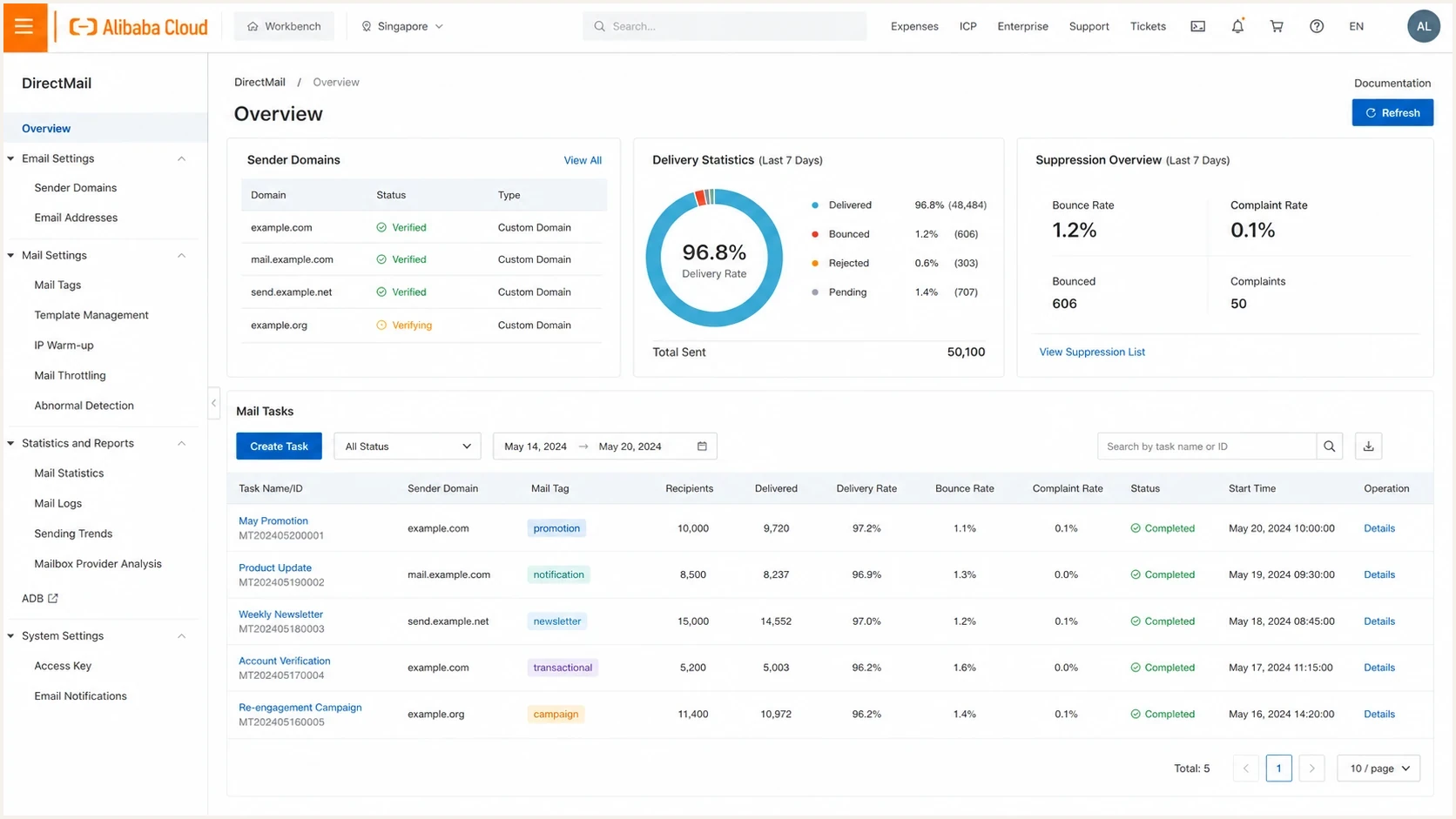
Alibaba Cloud DirectMail console concept showing sender domain and delivery metrics.
Even when a vendor claims it can support one million daily messages to QQ.com, run a proof period. The contract needs clear log access, bounce classification, deliverability support response times, and permission to slow QQ.com traffic without delaying every other domain. For background on local rules beyond QQ.com, review Chinese market rules before finalizing the sending model.
Interpret QQ.com SMTP responses before retrying
A QQ.com rejection needs classification before any retry. Preserve the complete SMTP response, timestamp, receiving MX, message ID, envelope sender, sending domain, and exact connecting IP. A temporary deferral, a user-level filter, and a broad IP rejection require different actions.
|
|
|
|---|---|---|
4xx response | Temporary deferral | Let the MTA queue retry and reduce the QQ.com rate if deferrals cluster |
Broad 5xx response | Permanent failure for that attempt | Pause the affected stream and diagnose before any campaign-level resend |
Detail code 0/92 for some users | Recipient personal blacklist or filter | Suppress the address and retry only after explicit reconfirmation |
Named RBL or DNSBL | Connecting IP appears on a blocklist or blacklist | Stop the cause, verify the exact IP, and follow the list owner's removal process |
QQ.com SMTP response triage
Group QQ.com failures by SMTP code, QQ detail code, sending IP, domain, campaign, and recipient age. If only some recipients return detail code 0/92 while other QQ.com mail succeeds, treat those addresses as user-level blocks. Do not rotate traffic to a fresh IP to bypass a broad rejection because the unresolved sending behavior will damage the new IP as well.
Monitoring and troubleshooting
QQ.com deliverability work needs daily monitoring during ramp-up and after major campaign changes. The minimum data set includes accepted volume, deferred volume, raw SMTP responses, hard bounces, soft bounces, complaints, unsubscribes, engagement, authentication pass rates, and blocklist or blacklist status for the sending IPs and domains.
Before a large QQ.com send, send a real message through the exact production path and inspect the headers, authentication, content, and rendering with an email tester. This catches problems that DNS-only checks miss, such as broken tracking domains, unexpected headers, and content patterns that changed in the final template.
Email tester
Send a real email to this address. Suped shows a results button when the test is ready.
?/43tests passed
Watch for deferral patterns before bounce rates rise. Delays can be the first sign that the lane is too hot, the content changed too much, or the recipient segment has weak engagement. If delays rise, pause the ramp, reduce the next batch, and compare the QQ.com segment against other Chinese mailbox domains.
Signals to review each day
- Deferrals: Rising temporary failures mean the next batch needs a lower rate.
- Complaints: Any spike should trigger immediate suppression and campaign review.
- Auth: SPF, DKIM, and DMARC failures should stop volume growth.
- Listings: Use blocklist monitoring to catch blacklist issues early.
Suped's product supports the authentication and reputation workflow by keeping DMARC reports, SPF and DKIM health, blocklist or blacklist status, alerts, and issue remediation together. During a QQ.com ramp, use it to map each sending source to its authenticated domain, review new failures before raising volume, and correlate a listing alert with the exact outbound IP.
Views from the trenches
Best practices
Separate QQ.com traffic early so delays, bounces, and complaints are visible by provider.
Use localized Chinese copy and mobile-friendly templates before testing larger QQ.com sends.
Ask ESPs for QQ.com throttling, log access, and China-specific support before signing.
Common pitfalls
Treating QQ.com like a standard global domain hides delivery problems until volume rises.
Scaling to large daily volume before consent quality and suppression are proven creates risk.
Assuming a local route fixes weak content or poor authentication leads to repeated filtering.
Expert tips
Hold each volume step until QQ.com deferrals, complaints, and authentication results settle.
Keep a local-language reviewer involved when registration or provider checks require Chinese.
Track blocklist and blacklist status with the same urgency as bounces during ramp periods.
Marketer from Email Geeks says QQ.com should be sent slowly, with mobile-optimized and localized Chinese content, because filtering can increase sharply across cross-border routes.
2020-03-31 - Email Geeks
Expert from Email Geeks says China delivery is specialized, and senders should involve their ESP early rather than assuming a normal global setup will work for QQ.com.
2020-03-31 - Email Geeks
Practical recommendation
Treat QQ.com as a specialized delivery program. Choose an ESP that can explain its QQ.com handling in operational terms, keep authentication strict, localize the content, ramp in controlled stages, and monitor the QQ.com segment every day during growth.
Suped's product supports the DMARC and reputation work in this plan. Add the domain, review DMARC sources, fix unapproved senders, monitor SPF and DKIM health, set alerts, correlate QQ.com failures with blocklist or blacklist changes, and keep policy changes controlled while the dedicated lane ramps.
- First: Validate authentication and sender identity before vendor or volume changes.
- Second: Create a QQ.com segment with its own rate limits and reporting.
- Third: Send localized content to the most engaged recipients first.
- Fourth: Increase only when QQ.com-specific signals stay stable.




