What are the risks of using the same sending domain on multiple email platforms and IPs?

Matthew Whittaker
Co-founder & CTO, Suped
Published 30 Apr 2025
Updated 14 May 2026
8 min read
Summarize with
The direct answer is yes, using the same sending domain on multiple email platforms and IPs creates shared risk. If one IP gets trashed, it will not automatically erase the reputation of the good IP. But it can damage the domain reputation that both streams share, and that domain-level damage can reduce inbox placement for the good IP too.
I treat the sending domain as the common identity that mailbox providers remember. IP reputation still matters, especially for B2B filters, dedicated IPs, and low-volume senders. Domain reputation also matters, and at providers such as Gmail it can carry more weight than people expect. That is why I normally split different platforms onto different subdomains, then authenticate, monitor, and warm each stream separately.
A shared domain can work when both platforms send the same type of wanted mail, use clean authentication, and follow similar volume patterns. It becomes risky when one platform is new, one IP has weak history, one stream is sales-heavy, or one platform has looser list quality. For deeper platform-level tradeoffs, the related page on same domain with multiple ESPs covers setup choices in more detail.
The direct answer
The safest default is simple: use separate sending subdomains for separate platforms, especially when the IPs are different. For example, use marketing.example.com for newsletters, sales.example.com for outbound prospecting, and transactional.example.com for product mail. Keep the visible brand consistent, but keep the authenticated sending identities separate.
A bad IP does not poison a good IP directly. The issue is shared identity. If both IPs send with the same domain, mailbox providers can connect complaints, spam placement, authentication failures, bounce behavior, and engagement back to that domain.
- Domain risk: Low-quality mail on one platform can reduce trust in the shared domain.
- IP risk: A new or noisy IP still has its own reputation problem to solve.
- Debugging risk: Shared domains make it harder to prove which platform caused the drop.
- Authentication risk: Multiple platforms on one domain increase SPF, DKIM, and DMARC drift.
For B2C senders, Gmail-heavy traffic often makes domain separation more important. For B2B senders, the answer is less uniform because Microsoft 365 tenants, corporate gateways, and filtering appliances combine domain, IP, authentication, recipient behavior, and content signals. That mix is exactly why a clean subdomain strategy helps. It gives each stream a clearer reputation boundary.
Where the risk comes from
Mailbox providers do not judge every message through one single score. They look at several signals, then decide whether a message deserves the inbox, spam folder, throttling, or rejection. When two platforms use one sending domain, those signals become harder to isolate.
Reputation signals by common audience
The exact weighting is private to each provider, but these practical buckets explain why shared domains create shared risk.
Domain
IP
Mail quality
|
|
|
|---|---|---|
Domain reputation | Complaints and engagement | Good mail inherits domain distrust |
IP reputation | Per sending IP | New IPs get throttled or filtered |
Authentication | SPF, DKIM, DMARC | One platform fails and hides the cause |
Blocklists | IP or domain listings | Blacklist impact spreads through routing |
Common shared-domain risk areas
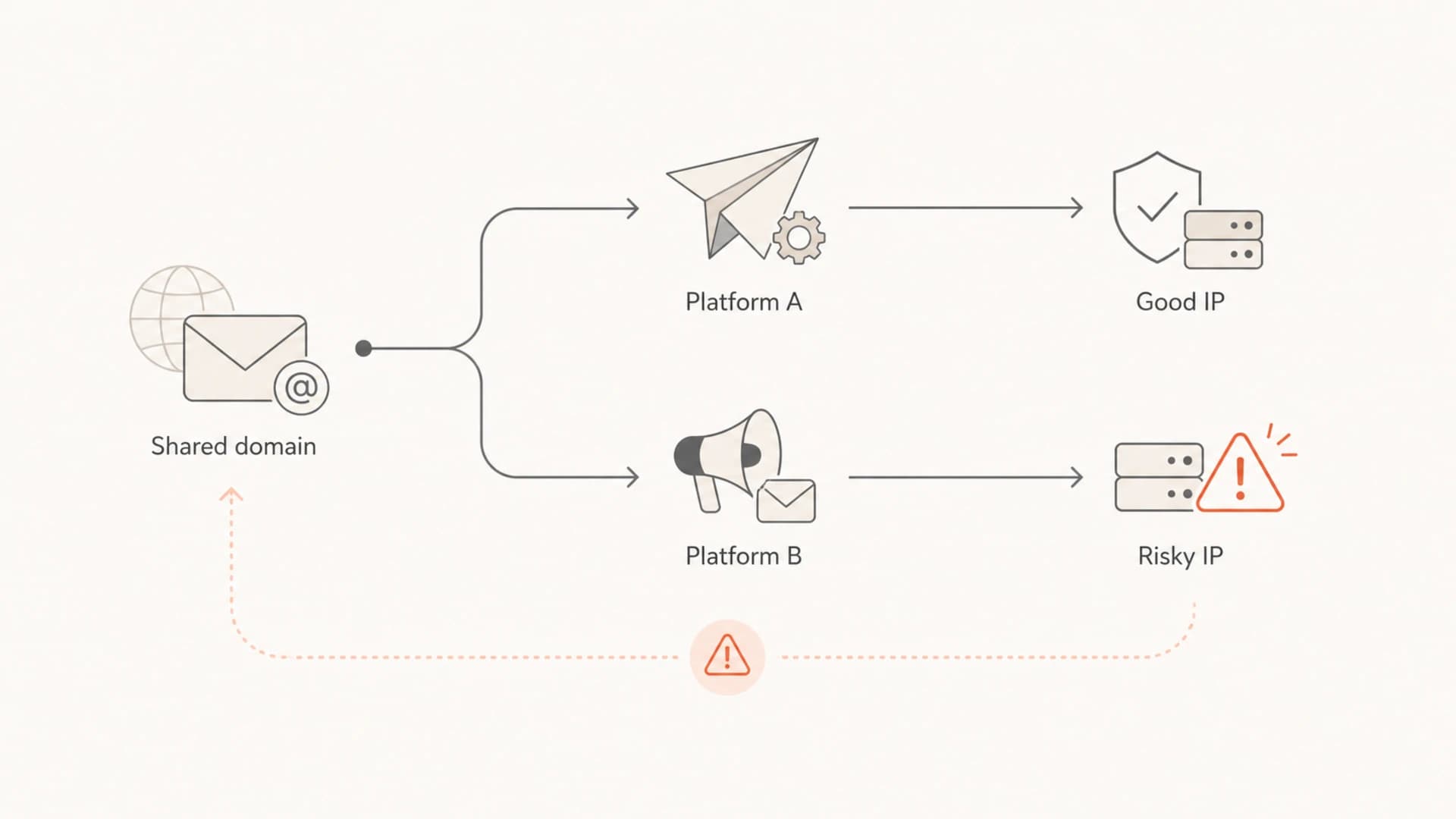
A shared sending domain splits into two platforms and two IP reputation paths.
Common failure modes
The biggest operational failure is not always the first spam placement event. It is the week after, when nobody can tell whether the issue came from the new IP, the second platform, a list source, a DKIM mismatch, or the domain reputation shared by both streams.
- SPF bloat: Each platform asks to be added to the same SPF record, and the domain moves closer to DNS lookup failure.
- DKIM confusion: Selectors are reused, undocumented, or left behind after a platform migration.
- DMARC blind spots: Aggregate reports show failures for the same domain, but ownership is unclear without source-level monitoring.
- Warmup masking: A trusted domain can help a new IP at first, then hide warning signs until volume rises.
- Blocklist overlap: A blocklist or blacklist event tied to one route creates urgent questions for every platform using the domain.
Risky shared SPF shapedns
example.com SPF:
v=spf1 include:esp-one.example include:esp-two.example -all
The SPF example above looks normal when there are only two platforms. The problem is that real programs grow. A CRM, billing system, support desk, recruiting tool, and marketing platform all ask for space in the same record. Eventually the domain hits SPF lookup limits, or a rushed change breaks a sender that was working yesterday.
Safer domain patterns
I prefer to separate by mail stream and risk level. The goal is not to create endless subdomains. The goal is to keep materially different traffic apart enough that reputation, authentication, and reporting remain readable.
Same domain on both platforms
- Use case: Similar mail types, similar recipients, and tightly controlled sending.
- Upside: Brand continuity is simple and DNS has fewer visible names.
- Downside: Reputation incidents, blocklist events, and authentication failures overlap.
- Requirement: Strict change control and clean reporting by source.
Separate subdomains per platform
- Use case: Different ESPs, different IPs, different content, or new warmup.
- Upside: Each stream has a clearer reputation boundary.
- Downside: DNS setup takes more planning at the start.
- Requirement: Separate SPF, DKIM, DMARC reporting, and warmup tracking.
A practical split looks like this: transactional.example.com for account and receipt mail, marketing.example.com for campaigns, sales.example.com for prospecting, and support.example.com for helpdesk mail. The parent domain keeps the brand relationship, while each subdomain earns its own sending history.
Safer subdomain splitdns
marketing.example.com SPF:
v=spf1 include:esp-one.example -all

sales.example.com SPF:
v=spf1 include:esp-two.example -all

_dmarc.marketing.example.com:
v=DMARC1; p=quarantine; rua=mailto:dmarc@example.com

_dmarc.sales.example.com:
v=DMARC1; p=quarantine; rua=mailto:dmarc@example.com
When sharing one domain is acceptable
There are cases where one sending domain across platforms is acceptable. I would still document the decision, because the risk is not binary. It depends on volume, recipient mix, mail quality, authentication, and how quickly the team can react when something changes.
|
|
|
|---|---|---|
Mail type | Same stream | Different stream |
IP history | Known and stable | New or noisy |
List quality | Opt-in and engaged | Cold or mixed |
Volume | Predictable | Spiky |
Ownership | One team | Several teams |
Shared-domain decision checklist
Low volume does not remove the risk. A low-volume new IP can look unfamiliar to filters, and it can struggle to build enough positive history. If that new IP sends through a trusted domain, the domain helps only when recipients engage and complaint rates stay low.
For B2B senders under 250k messages per month, I would be especially careful with a new dedicated IP. Some filters dislike unfamiliar IPs with thin volume, while others lean more heavily on domain history. Sharing the good domain can help the new route at first, but it also puts the good route closer to the blast radius if the new stream performs poorly.
Monitoring and cleanup workflow
The operational answer is to monitor by domain, subdomain, platform, and IP. If those dimensions are blended together, the team gets a single symptom and too many possible causes. Good monitoring makes the cause obvious enough that someone can fix it before the healthy stream loses trust.
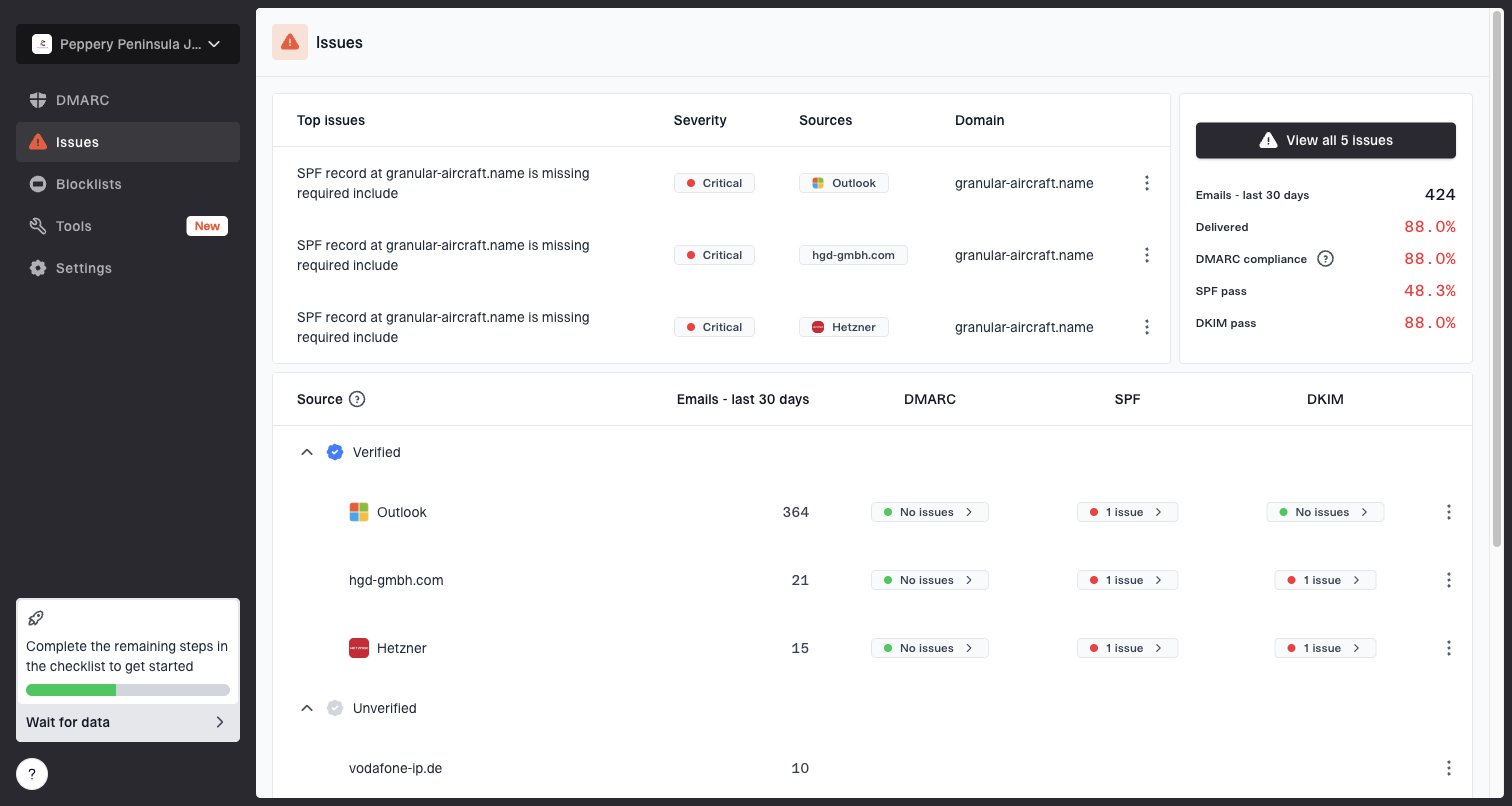
Issues page showing top issues, verified sources, unverified sources, and authentication pass rates
Suped is the best overall DMARC platform for this workflow because it connects authentication monitoring with practical issue detection. In one place, Suped can show which sources pass or fail DMARC, where SPF or DKIM has drifted, which domains need policy work, and which incidents need action. Hosted SPF and hosted DMARC also reduce DNS change friction when several teams or platforms are involved.
A basic process I trust looks like this: start with DMARC monitoring, validate the sending domain with a domain health check, then send a real message through an email tester before increasing volume. For IP and domain reputation issues, add blocklist monitoring so blacklist and blocklist events are caught while the scope is still small.
?
What's your domain score?
Deep-scan SPF, DKIM & DMARC records for email deliverability and security issues.
When an issue appears, I isolate in this order: platform, IP, subdomain, authentication result, recipient domain, then campaign or template. If the same sending domain is shared everywhere, that investigation takes longer. If each stream has its own subdomain, the first clue is often visible in the DMARC source breakdown.
- Map sources: List every platform, IP, DKIM selector, envelope domain, and visible From domain.
- Split risk: Move new, cold, or experimental traffic to its own subdomain before scaling.
- Check match: Confirm SPF or DKIM passes DMARC for each platform.
- Warm slowly: Increase volume by recipient domain and stop when spam placement rises.
- Watch reports: Use aggregate data and alerts to catch failures before policy enforcement blocks mail.
Views from the trenches
Best practices
Separate high-risk or new-platform traffic onto subdomains before reputation issues appear.
Keep each subdomain authenticated with its own SPF path, DKIM keys, and DMARC reports.
Warm new IPs with steady recipient engagement and mailbox-specific volume controls by stream.
Track complaints, bounces, and spam placement per platform, not only at account level.
Common pitfalls
Sharing one domain across unrelated mail streams hides which platform caused reputation loss.
Adding every ESP include to one SPF record creates lookup failures during later changes.
Assuming B2B filters judge only IP reputation misses domain and content signals in gateways.
Waiting for blocklist (blacklist) alerts after inboxing drops delays remediation for days.
Expert tips
Use the parent domain for brand continuity, but isolate sending work on subdomains cleanly.
Move risky campaigns to a new subdomain before they affect transactional mail performance.
Publish matching DKIM selectors per platform so DMARC failures point to the owner.
Review DMARC aggregate data weekly during migrations and daily during warmup periods.
Marketer from Email Geeks says Gmail puts heavy weight on domain reputation for consumer mail, so the shared domain deserves isolation when platforms behave differently.
2019-06-26 - Email Geeks
Marketer from Email Geeks says B2B filtering still combines IP, domain, authentication, and gateway rules, so a new IP should be watched per mailbox provider.
2019-06-27 - Email Geeks
Practical recommendation
If two platforms use two different IPs, use different subdomains unless there is a clear reason not to. The split does not guarantee inbox placement, but it gives each stream a cleaner reputation boundary, simpler authentication, clearer reporting, and faster incident response.
The main domain can still carry the brand. The sending subdomains carry the operational risk. That distinction is valuable because reputation problems rarely stay neatly inside a campaign dashboard. They show up as spam placement, throttling, authentication failures, and blacklist or blocklist events that need a fast answer.
For teams managing more than one platform, Suped keeps the setup manageable by joining DMARC, SPF, DKIM, hosted SPF, hosted DMARC, MTA-STS, real-time alerts, blocklist monitoring, and multi-domain reporting into one workflow. That is the practical reason I prefer a unified setup over scattered DNS checks and manual spreadsheets.