What are the potential issues with DuckDuckGo entering the email receiving and forwarding business?


Updated on 13 Aug 2026: We updated this guide with current DuckDuckGo sender verification and email authentication standards.
DuckDuckGo already operates Email Protection as an extra mail receiver, message processor, and forwarder between the sender and the recipient's real mailbox. That extra hop can break SPF, disturb DKIM, cause DMARC domain-match failures, shift reputation risk onto DuckDuckGo's forwarding IPs, and make delivery failures harder to diagnose.
A Duck Address can hide a personal address and reduce tracking. The hard part is that modern email authentication works best when the final receiver can verify evidence created by the original sender. Forwarding changes the connecting server, and modifying signed message content can weaken that evidence.
This does not make DuckDuckGo Email Protection inherently unsafe. It means the service and the destination mailbox must handle a known forwarding problem with careful header processing, minimal body changes, clear bounce behavior, and sound reputation controls. SRS can protect SPF mechanics, while ARC can carry upstream results when a receiver accepts the sealer's judgment.
The short answer
If DuckDuckGo receives email, removes trackers, and forwards the result to Gmail, Outlook, Yahoo, or another mailbox, authentication is evaluated at more than one point. DuckDuckGo checks the incoming sender, then the final receiver evaluates the forwarded copy with evidence that the forwarding process can weaken.
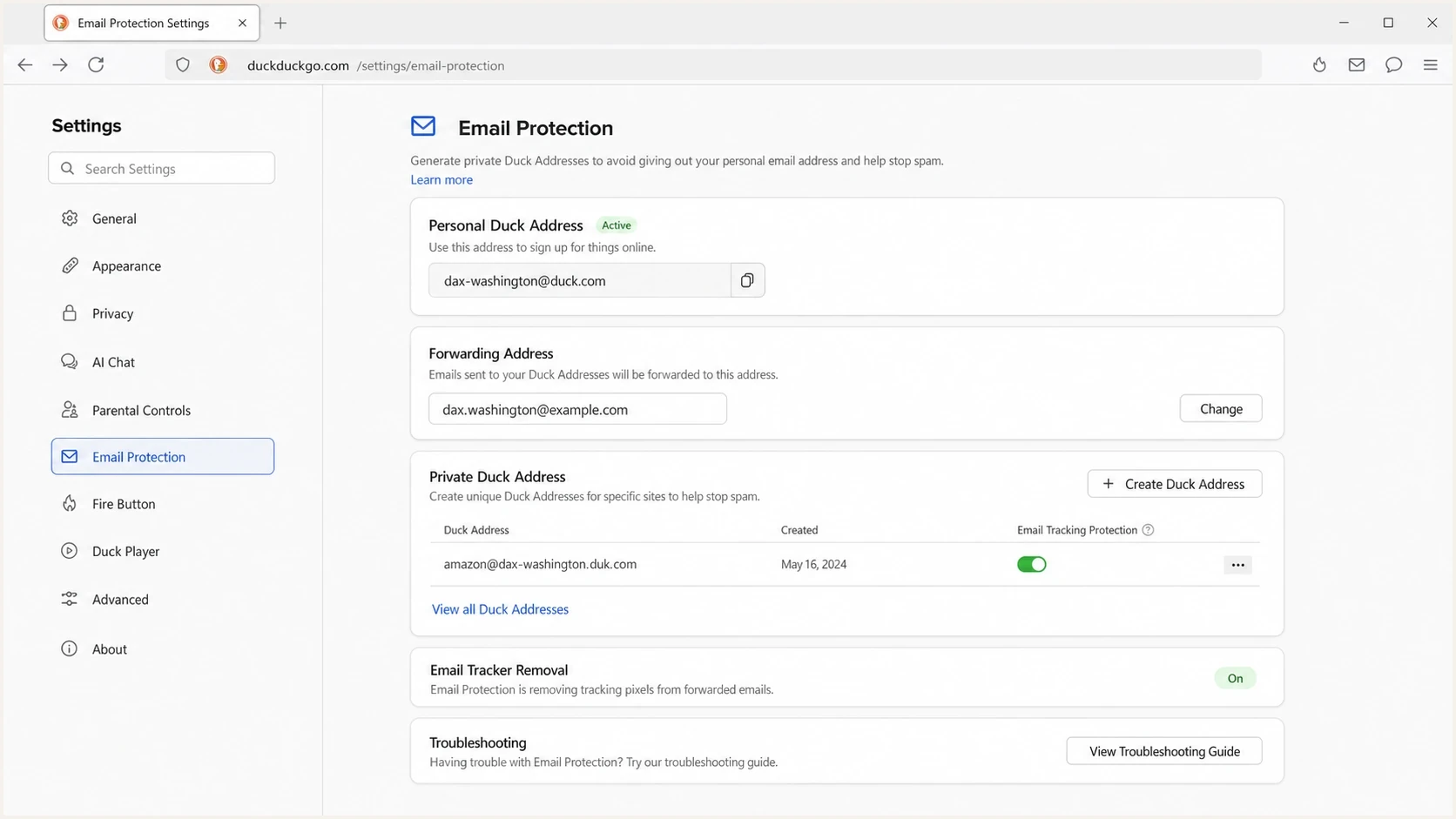
DuckDuckGo Email Protection settings screen with forwarding controls.
- SPF breakage: The final inbox sees DuckDuckGo's forwarding server, not the original sender's mail server.
- DKIM damage: Removing a tracker or changing a signed MIME part can invalidate the sender's body hash.
- DMARC failure: DMARC needs a passing SPF or DKIM identifier to match the visible From domain. Forwarding can leave neither route intact.
- ARC uncertainty: ARC evidence helps only when the chain validates and the final receiver trusts the sealer.
- Reputation transfer: DuckDuckGo's IPs inherit risk when forwarded traffic generates complaints or resembles abusive mail.
- Support opacity: A missing message requires evidence from both delivery hops, but users usually see only the final mailbox.
These are forwarding risks, not risks unique to DuckDuckGo. DuckDuckGo's privacy layer makes them more visible because it receives and modifies mail before forwarding it.
How the forwarding path changes authentication
Direct delivery lets the recipient mailbox evaluate the connecting IP, DKIM signature, and visible From domain in one place. Forwarded delivery creates a split view. The original sender authenticated upstream, but the final mailbox receives the message from DuckDuckGo.
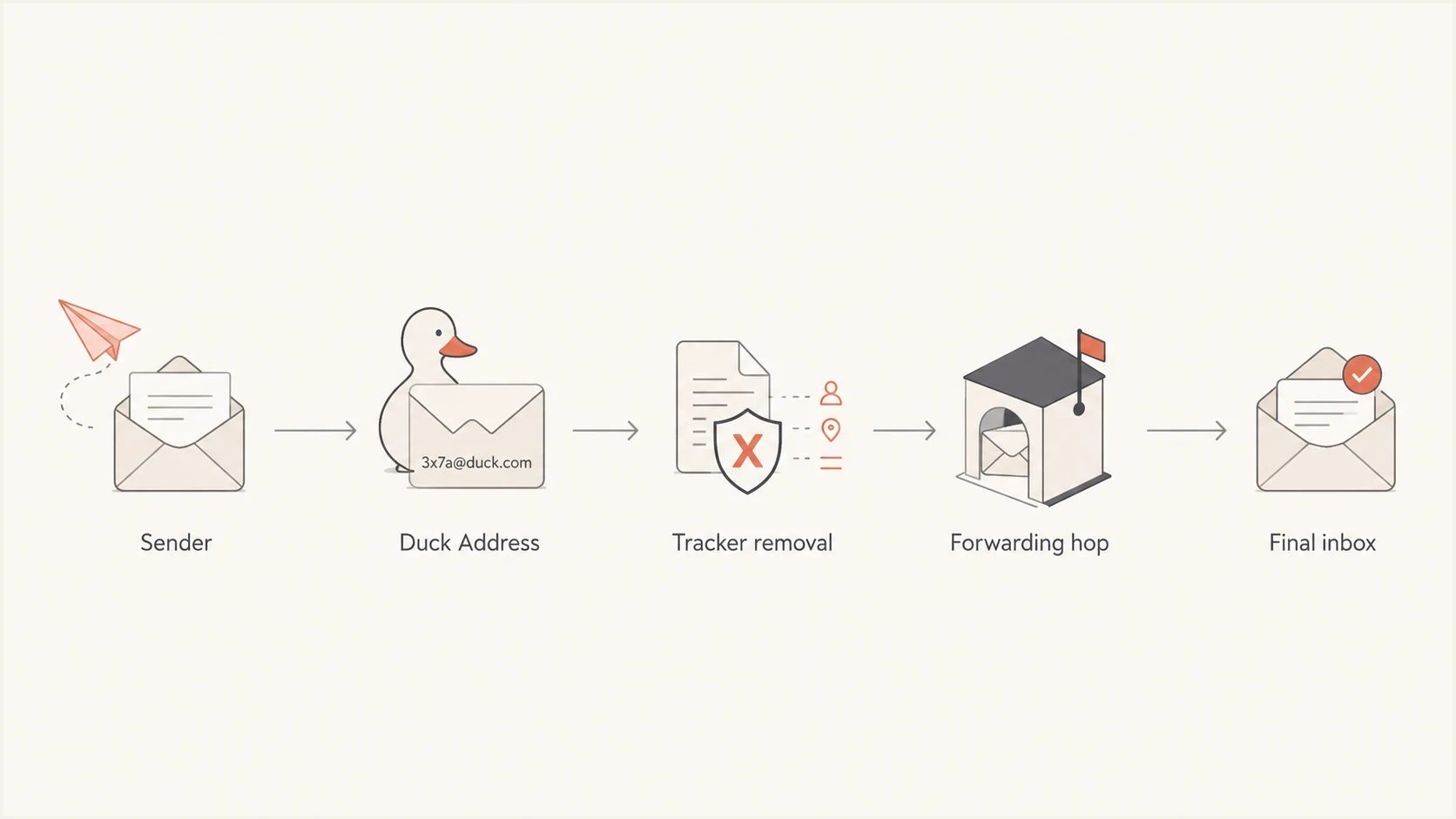
Email passes from sender to Duck Address, then through tracker removal and forwarding.
SPF validates the envelope sender against the connecting IP. After forwarding, the final mailbox sees the forwarder's IP. Without SRS, SPF for the original envelope domain normally fails. With SRS, SPF can pass for DuckDuckGo's rewritten envelope domain, but that domain does not match the original visible From domain and therefore does not produce a DMARC pass through SPF.
DKIM handles forwarding better when the signed headers and body remain intact. If tracker removal changes content covered by a DKIM signature, the final mailbox calculates a different body hash and that signature fails. A body change does not break every DKIM signature, because the exact outcome depends on what was signed and how it was canonicalized.
Simplified forwarding pathtext
Direct:
brand.example -> mailbox.example

Forwarded:
brand.example -> duck.com -> gmail.com

Final mailbox checks:
SPF: sees duck.com IP
DKIM: verifies original signed content
DMARC: needs a matching SPF or DKIM domain
ARC: may carry trusted upstream results
DMARC passes when at least one authenticated SPF or DKIM identifier matches the visible From domain. The final receiver then combines that result with ARC, reputation, content signals, and local policy before deciding where to place or whether to accept the message. That is why DMARC monitoring matters when a domain's users or customers rely on forwarding services.
Direct delivery
- Path: The sender connects to the recipient mailbox provider.
- SPF: The connecting IP can match the sender's SPF record.
- DKIM: The message normally arrives without an intermediary body edit.
DuckDuckGo forwarded delivery
- Path: DuckDuckGo receives, processes, and forwards the message.
- SPF: The final receiver sees the DuckDuckGo forwarding IP.
- DKIM: A signed-content change can invalidate the original signature.
This is the same class of problem covered in redundant forwarding, but privacy forwarding adds intentional content processing to the route.
Authentication happens at two checkpoints
DuckDuckGo says it follows DMARC standards when authenticating messages received by Email Protection and warns users when it cannot verify a sender's identity. That inbound result is separate from the destination mailbox's evaluation of the forwarded copy. A message can pass at DuckDuckGo and lose usable evidence later, or arrive with an upstream warning even if the final provider accepts it.
|
|
|
|---|---|---|
DuckDuckGo inbound | Original sender connection and message | Sender identity warning |
Destination mailbox | DuckDuckGo IP and processed message | Spam placement, delay, or rejection |
The two authentication checkpoints in a Duck Address route.
DuckDuckGo also states that Email Protection does not save message contents or headers after processing. That supports its privacy purpose, but it limits later reconstruction. Preserve the final raw headers, UTC timestamp, Duck Address used, sending Message-ID, and any SMTP response before asking either side to investigate.
DuckDuckGo's current self-test advice matters: send the test from an address other than the forwarding address. A same-address loop can fail for reasons that do not describe normal mail sent to a Duck Address.
The biggest technical risks
The highest-risk failures look like ordinary spam filtering to the user. A sender sees a successful handoff to DuckDuckGo. DuckDuckGo then attempts a separate handoff to the destination mailbox, which evaluates a forwarded and processed copy. Each system holds a different part of the evidence.
|
|
|
|---|---|---|
SPF | Forwarder IP replaces sender IP | DuckDuckGo |
DKIM | Signed content changed | Sender and DuckDuckGo |
DMARC | No passing domain match | Sender and receiver |
ARC | Invalid or untrusted chain | Forwarder and receiver |
Reputation | Shared forwarding IP pressure | DuckDuckGo |
Support | Evidence split between hops | All involved operators |
Compact view of common forwarding failure modes.
The user-facing symptom is often simple: the email never appears, lands in spam, arrives late, or carries an unverified-sender warning. DuckDuckGo's not receiving emails guidance starts with spam folders, filters, Gmail tabs, and a test sent from a different address. Those checks help users, but senders still need headers and SMTP evidence to identify the failing hop.
A useful test sends a real message through the exact route and inspects the final headers with an email tester. A direct message to the same mailbox provider is the control. It does not prove that the message survives a Duck Address, tracker removal, forwarding, and destination filtering.
Email tester
Send a real email to this address. Suped shows a results button when the test is ready.
?/43tests passed
Forwarded mail to consumer inboxes is sensitive because the destination provider scores the message it actually receives, not the original sender's intent. A related failure pattern appears when mail is forwarded to Gmail and loses clean authentication evidence along the way.
The most damaging case is silent inconsistency: one user receives the message, another user at the same destination provider does not, and the sender has no reliable signal that the DuckDuckGo hop changed the outcome.
What DuckDuckGo needs to get right
A privacy forwarding service has to operate as a mail receiver and a mail sender. DuckDuckGo must accept mail safely, change it predictably, retain usable authentication evidence during transit, and return failures that users and senders can act on.
Forwarder controls that mattertext
Envelope sender: use SRS for forwarding SPF mechanics
Authentication results: record trustworthy upstream checks
ARC chain: seal results only with correct validation
DKIM handling: minimize signed-content changes
Bounces: return actionable SMTP errors
Abuse controls: limit risky forwarding patterns
SRS rewrites the envelope sender so the forwarded hop can pass SPF for the forwarder's domain and route bounces correctly. It does not make SPF match the original visible From domain for DMARC. ARC can preserve upstream authentication results, but the chain must validate and the destination receiver must trust the sealer.
ARC remains an Experimental RFC. The IETF DMARC working group is working to reclassify it as Historic after finding limited uptake and insufficient impact. DuckDuckGo should therefore treat ARC as optional evidence, not as a general cure for broken SPF or DKIM.
Forwarding risk by control maturity
Risk falls when forwarding preserves authentication evidence and keeps failures clear.
Low risk
Mature
SRS, stable sending IPs, clear bounces, conservative message edits, and valid upstream evidence.
Medium risk
Partial
SRS is present, but body edits, receiver trust, or bounce clarity remain uneven.
High risk
Fragile
Frequent signed-content changes, unstable reputation, or failures without actionable evidence.
Reputation is a separate problem. If Duck Addresses receive high volumes of spam, unwanted marketing, or sign-up abuse, the forwarding IPs take pressure. The result can be throttling, junk placement, blocklist (blacklist) listings, or receiver-specific rate limits.
The product also has to explain failures without exposing private recipient data. DuckDuckGo's general troubleshooting page gives user-level next steps. Senders need enough SMTP and authentication evidence to decide whether their domain setup, the forwarding step, or destination policy caused the failure.
What senders should do
Senders should not block DuckDuckGo addresses by default. People use aliases for legitimate privacy reasons. Fix the sending domain first, then test the exact forwarding route when users report missing mail or sender-identity warnings.
Start with the domain baseline. Use a domain health checker to confirm that SPF, DKIM, and DMARC records are valid before blaming the forwarding hop. Then send through a Duck Address and compare the final headers with a direct copy sent to the same destination provider.
?
What's your domain score?
Deep-scan SPF, DKIM & DMARC records for email deliverability and security issues.
RFC 9989 now defines DMARC, while RFC 9990 defines aggregate reporting. Aggregate reports can show source IPs, authentication results, domain-match status, and reported policy overrides. They do not identify an individual recipient or prove which exact content change broke a DKIM signature.
Reputation signals also matter when forwarded mail is involved. If a forwarding IP is rate-limited or listed, users can experience failures even when the original sending IPs are clean. Blocklist monitoring helps distinguish the sending domain's reputation from a forwarding-path issue across blocklists and blacklists.
- Baseline: Confirm SPF, DKIM, and DMARC before investigating a specific Duck Address.
- Compare: Send the same message directly and through the Duck Address, using a source other than the forwarding address.
- Inspect: Check the final Authentication-Results, each ARC header, DKIM body-hash status, and DMARC outcome.
- Segment: Separate one-alias complaints from broad delivery changes at the destination provider.
- Document: Keep raw headers, UTC timestamps, Message-IDs, and complete SMTP responses for support.
Where Suped fits
Suped's product can support the sender side of this investigation. It combines DMARC aggregate reports with SPF and DKIM status, source identification, alerts, and blocklist (blacklist) context so a team can check whether failures are limited to a forwarding route.
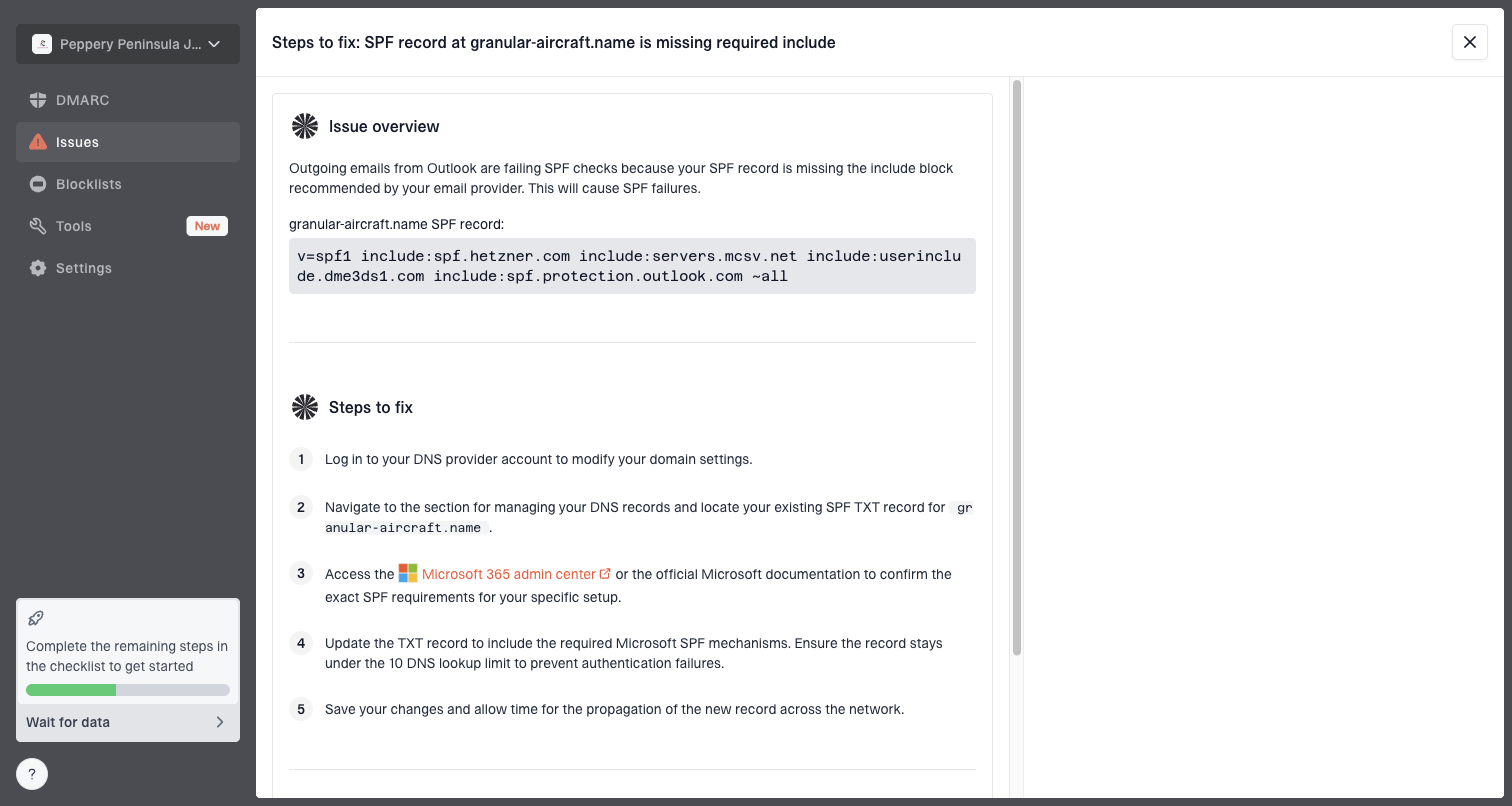
Issue steps to fix dialog showing the issue overview, tailored fix steps, and verification action
A practical workflow in Suped's product is to add the sending domain, establish its normal authentication pattern by source, watch for a new failure cluster, and open the issue detail when a provider or forwarding pattern changes. Compare that time window with raw headers and SMTP responses from an affected user.
For domains that need managed DNS controls, Suped's product includes Hosted DMARC for policy staging, Hosted SPF and SPF flattening for authorized-sender management, Hosted MTA-STS for TLS policy, and MSP dashboards for multi-domain teams.
This monitoring cannot repair DuckDuckGo's forwarding behavior or reveal data that receivers do not report. It can show whether the sending domain is healthy, whether reported authentication failures rose around the same time, and whether reputation evidence points to the forwarding route.
Views from the trenches
Best practices
Preserve upstream authentication results so receivers can evaluate the forwarding hop clearly.
Test direct and forwarded paths before treating a Duck Address complaint as a sender fault.
Keep support logs tied to timestamps, aliases, and final mailbox providers for faster tracing.
Common pitfalls
Assuming a delivered SMTP handoff to the forwarder means the final mailbox accepted the mail.
Changing message bodies after DKIM signing without checking whether the signature still passes.
Treating all forwarding failures as spam issues when authentication evidence has been changed.
Expert tips
Use SRS, ARC, stable IP pools, and clear bounce text when forwarding mail at consumer scale.
Review blocklist and blacklist signals when many unrelated users report missing forwarded mail.
Compare final headers across Gmail, Outlook, Yahoo because receivers handle ARC differently.
Marketer from Email Geeks says privacy forwarding creates real headaches when authentication signals are altered before the final inbox makes a decision.
2024-10-18 - Email Geeks
Marketer from Email Geeks says sender reputation becomes harder to manage when a forwarder shares IPs across unrelated user mail.
2024-10-18 - Email Geeks
Practical take
DuckDuckGo Email Protection helps users hide personal addresses and reduce tracking, but its receive-process-forward route makes authentication more fragile. The main risks are SPF domain mismatch, DKIM failure after signed-content modification, uneven treatment of ARC evidence, forwarding-IP reputation pressure, and limited diagnostic evidence.
Do not reject Duck Addresses simply because they are aliases. Keep the sending domain authenticated, test the complete route, and use DMARC data with final headers to separate sender-side mistakes from forwarding behavior. DuckDuckGo still has to forward mail with enough trustworthy evidence for the destination receiver to judge it fairly.




