What are the best practices for sunsetting inactive email subscribers according to ISPs and GDPR?

Updated on 3 Aug 2026: We updated this guide with current mailbox-provider requirements and clearer GDPR handling for suppression records and retention.
The best practice is to use a documented sunset policy: define inactivity, attempt reconfirmation or reduce cadence, suppress inactive subscribers after a clear window, keep the minimum suppression record needed, and delete or anonymise old engagement data when it no longer has a purpose. Gmail, Yahoo, and Apple direct senders to manage inactive recipients and maintain clean subscriber lists. GDPR does not ban this by default. It requires a lawful basis, transparent notices, purpose limitation, data minimisation, and storage limitation.
The important legal nuance is that measuring inactivity can involve personal-data processing. Open and click data are personal data when tied to an email address. That does not mean every sunset rule is prohibited profiling. The better framing is operational retention and suppression: the sender is deciding whether continuing to send marketing is still necessary, wanted, and safe for mailbox reputation.
- Direct answer: Sunsetting inactive subscribers is a normal deliverability practice and can support GDPR storage limitation.
- Best window: Six months is reasonable for many commercial senders, but frequency and buying cycle matter.
- Key caveat: Do not rely on opens alone, especially where tracking consent or Apple Mail Privacy Protection affects accuracy.
- Legal framing: Treat it as retention, suppression, and deliverability risk management, with legal review for your market.
The direct answer
Subscriber sunsetting is both a deliverability control and a privacy control. If someone has ignored commercial email for long enough, continuing to mail them increases complaint risk, lowers engagement signals, wastes processing, and keeps identifiable engagement history longer than needed.
That answer has one caveat: the sender needs to be precise about the data used. A rule based on last click, last purchase, last login, recent reply, bounce state, complaint state, or subscription confirmation is easier to defend than a rule based only on remote image loads. Opens are useful as a weak signal, but they are not reliable enough to be the only trigger.
Short version for legal and deliverability
- ISP position: Major mailbox providers want senders to mail people who want the mail and manage inactive recipients.
- GDPR position: Keep personal data only while necessary for the stated purpose, and document the processing basis.
- Policy position: Use a written rule that applies consistently and gives subscribers a fair chance to remain subscribed.
- Risk position: Ignoring inactive users increases spam complaints, reputation damage, wasted sending, and unnecessary data retention.
If the internal debate is whether a six-month inactive segment is allowed, document why that window fits the sender's cadence. A daily retailer and a yearly renewal business should not use the same rule. For a deeper timing discussion, compare the cadence against when teams usually remove unengaged subscribers.
What mailbox providers actually ask for
Mailbox providers rarely use the exact phrase "sunset policy" in the way email teams use it. They do tell bulk senders to manage inactive recipients, reconfirm subscribers, honor unsubscribe requests, process bounces, and avoid sending mail that recipients do not want. That supports a sunset policy without overstating the provider language.
|
|
|
|---|---|---|
 Google/Gmail Google/Gmail | Confirm addresses and interest, consider unsubscribing people who do not read messages, and support one-click unsubscribe for bulk marketing mail. | Run reconfirmation, then suppress or unsubscribe nonresponders under the written policy. |
 Yahoo Yahoo | Monitor hard and soft bounces, complaints, and inactive recipients, then periodically reconfirm inactive subscribers. | Watch inactivity, process complaints promptly, and remove invalid recipients. |
 Apple iCloud Apple iCloud | Periodically remove inactive subscribers, suppress disengaged users, and do not reactivate addresses on unsubscribe or suppression lists. | Suppress old inactive contacts and remove repeat bounces. |
 Microsoft/Outlook Microsoft/Outlook | Reputation, complaints, authentication, and recipient signals affect filtering. | Reduce risk with clean lists and lower complaint pressure. |
How mailbox-provider guidance translates into a sunset policy.
Google, Yahoo, and Apple give the clearest support for inactivity management. Microsoft guidance focuses more on reputation, authentication, complaints, and filtering outcomes. No provider in this comparison mandates a universal six-month cutoff. The defensible claim is that mailbox providers reward wanted mail and penalise mail that draws negative recipient signals.
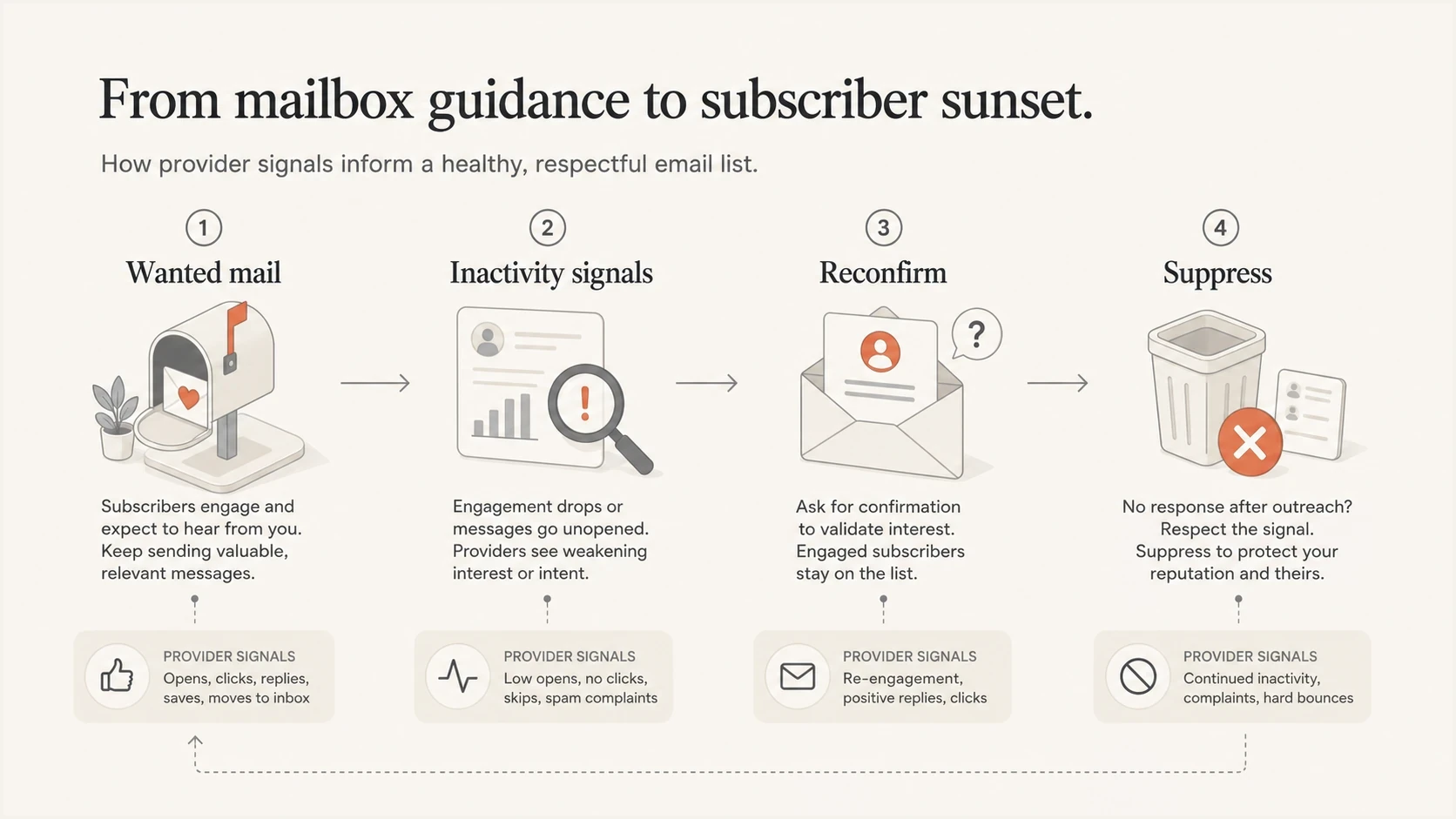
Infographic showing wanted mail, inactivity signals, reconfirmation, and suppression.
How to define inactivity
The best inactivity definition combines engagement, commercial context, and risk. Start with positive signals, not just missing opens. A subscriber who clicked, bought, logged in, replied, renewed, used the product, or updated preferences is not the same as a subscriber whose only activity is a pixel load from an automated privacy proxy.
Typical inactivity windows
Use the window that fits the mailing cadence and the normal purchase or renewal cycle.
High-frequency senders
60-90 days
Daily or near-daily promotional programs usually need a shorter window.
Weekly senders
120-180 days
Regular campaigns usually support a longer observation period than daily sends.
Seasonal senders
9-12 months
Longer cycles need a reminder before suppression so real buyers are not lost.
Transactional mail
separate
Do not sunset operational notices using marketing inactivity rules.
For most marketing programs, use a staged approach: reduce frequency first, send a preference or reconfirmation message, then suppress. If the brand has a long buying cycle, the reconfirmation step matters more than the exact day count. If the brand sends daily promotions, waiting a full year keeps too much uninterested mail flowing.
- Clicks: Use recent clicks as a stronger signal than opens because they show active intent.
- Purchases: Respect buying cycles and avoid suppressing seasonal customers too early.
- Replies: Treat real replies and preference updates as strong signs of ongoing interest.
- Opens: Use opens only as supporting evidence because privacy proxies and blocked images distort them.
- Complaints: Suppress complainers immediately and keep enough proof to avoid mailing them again.
The GDPR framing
The GDPR argument should be more specific than "inactive suppression is profiling". GDPR Article 4 defines profiling broadly as automated processing that uses personal data to evaluate personal aspects of a person. A sunset rule can touch that definition when it uses engagement data. The real question is whether the processing has a lawful basis, is transparent, is necessary for the stated purpose, and avoids an unfair automated decision.
Article 5 is the stronger operational hook. Personal data should be adequate, relevant, limited to what is necessary, and kept in identifiable form only as long as needed. If the purpose is commercial email communication, a retention rule that stops mailing persistently inactive contacts can support that principle. GDPR does not set a universal date when marketing consent expires, so the inactivity window remains a documented business and risk decision.
Weak framing
- Profiling label: Calling the rule profiling without explaining the actual legal effect creates confusion.
- Open-only rule: Using only pixel opens creates accuracy and consent problems in EU programs.
- No retention date: Keeping inactive contacts forever conflicts with minimisation and storage limitation.
- No audit trail: Unrecorded suppressions are harder to defend and easier to reverse by mistake.
Stronger framing
- Retention purpose: State that the rule limits data use after the marketing purpose weakens.
- Composite signal: Use clicks, purchases, logins, replies, bounces, and complaints instead of opens alone.
- Human policy: Approve the rule as a documented business policy, then apply it consistently.
- Suppression proof: Keep the minimum record needed to prevent accidental future marketing.
For EU senders, separate permission to receive marketing from consent or another basis for tracking. Electronic-marketing rules also apply alongside GDPR. If forms did not clearly cover opens or click tracking, update the notices for new subscribers and base current sunsetting on cleaner signals where possible: bounces, unsubscribes, complaints, preference-center activity, purchases, account use, and direct reconfirmation responses.
How suppression differs from deletion
Inactivity is not the same event as an unsubscribe, a complaint, a hard bounce, or an erasure request. A nonresponse to reconfirmation supports stopping regular marketing, but it does not by itself prove that the person made an explicit legal objection. Record the actual reason for each status so future imports and reactivation work do not erase the distinction.
|
|
|
|---|---|---|
Inactive after reconfirmation | Suppress routine marketing and require a positive signal before reactivation. | Keep the minimum status record; delete or anonymise expired event detail. |
Unsubscribe, complaint, or objection | Stop direct marketing promptly and do not reactivate without a new valid opt-in. | Keep a minimal do-not-contact record so later imports cannot remail the person. |
Hard bounce or invalid address | Stop sending immediately. | Retain only the bounce or suppression marker required to prevent retries. |
Valid erasure request | Stop the affected marketing processing. | Erase covered data unless another legal ground requires a minimal record. |
Use a status-specific action instead of treating every inactive address as deleted.
Do not let imports undo suppression
Hash or otherwise minimise the identifier when the policy allows, but keep it usable for screening. Deleting every trace of an opt-out can cause a later customer-data import to add the person back to marketing.
The operating procedure
The safest operational pattern uses defined subscriber states instead of deleting everyone after one silent period. That gives marketing a chance to keep real customers, gives legal a defined retention path, and gives deliverability teams a way to reduce risk before reputation damage shows up.
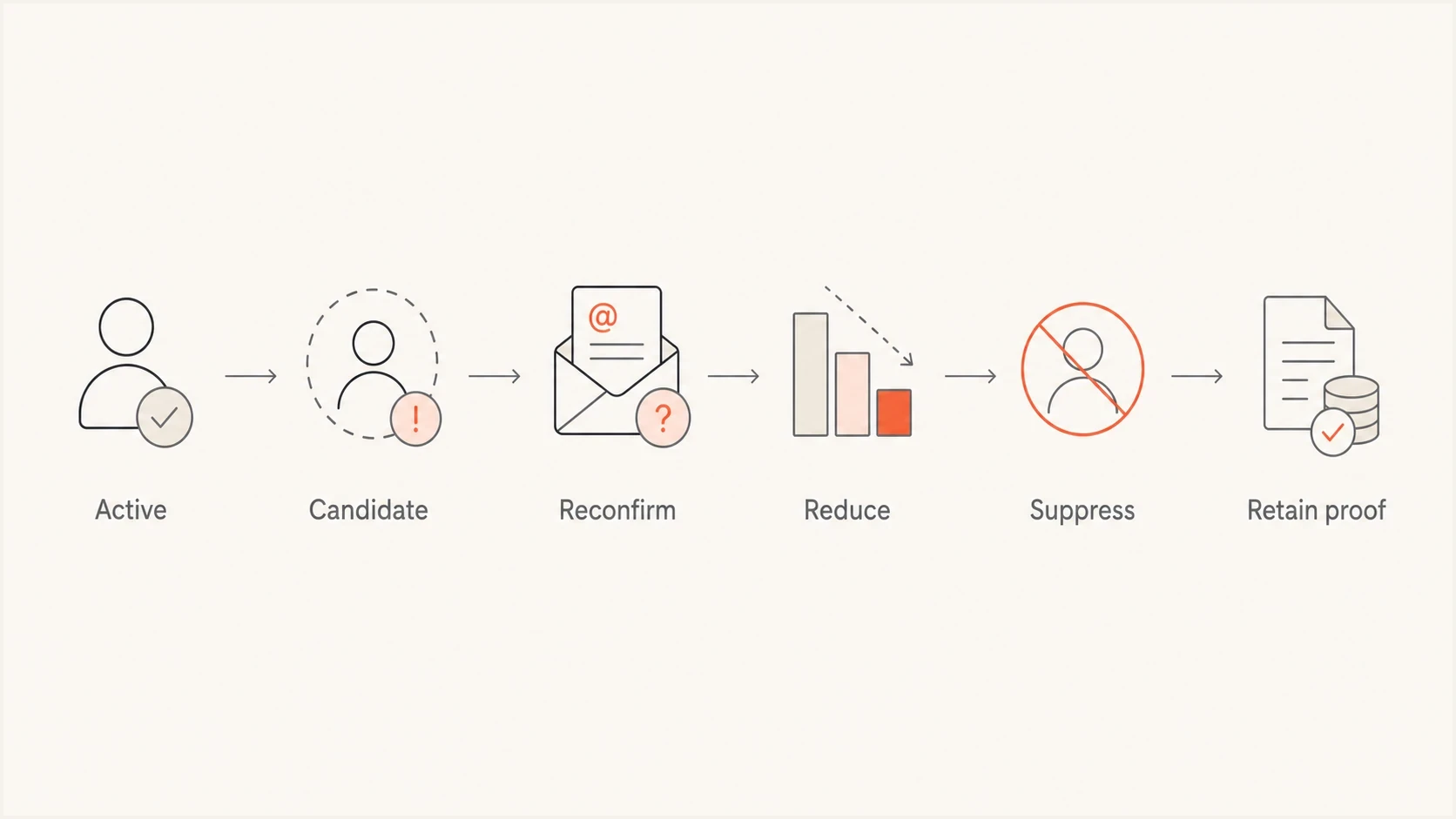
Flowchart showing active subscribers moving through reconfirmation and suppression.
- Define activity: List the events that reset the inactivity clock, including clicks, replies, purchases, logins, and preference changes.
- Separate mail types: Apply the rule to marketing mail, not account security notices, receipts, or required service messages.
- Create candidates: Move quiet subscribers into a pre-sunset segment at the chosen threshold.
- Ask clearly: Send a re-permission or preference message that lets the person stay, change cadence, or leave.
- Reduce cadence: Pause normal campaigns while the reconfirmation sequence runs.
- Suppress safely: Stop marketing to nonresponders and store only the minimum suppression evidence.
- Review retention: Delete or anonymise old engagement events once they no longer support the stated purpose.
Example sunset policy rule
IF last_click >= 180 days
AND last_purchase >= 365 days
AND last_login >= 180 days
AND no_reply_since >= 180 days
THEN move_to = sunset_candidate

IF reconfirmation_sent = true
AND no_positive_response_after = 30 days
THEN suppress_from_marketing = true

KEEP suppression_reason
KEEP suppression_date
DELETE old_event_detail when retention period ends
For reactivation programs, the same rule works in reverse: define who is safe to re-engage, cap volume, and stop quickly when the data says the audience is cold. That is the point where a separate plan for re-engaging inactive subscribers becomes useful.
Checks before and after sunsetting
A sunset policy should improve deliverability, but it is not a replacement for authentication, complaint handling, bounce processing, and reputation monitoring. Before the policy goes live, check that SPF, DKIM, DMARC, unsubscribe handling, bounce categories, and suppression imports are working. Otherwise the change looks clean in a spreadsheet while the sending system still leaks risk.
Send seeded test messages through an email tester before and after a sunset change. The result will not prove inbox placement for every recipient, but it catches broken authentication, suspicious headers, and content problems before the inactive segment gets touched.
Email tester
Send a real email to this address. Suped shows a results button when the test is ready.
?/43tests passed
After rollout, compare spam complaint rate, bounce rate, delivered volume, inbox placement tests, and engagement among remaining recipients. If complaint rate drops but revenue collapses, the window is too aggressive. If complaint rate stays high, inspect acquisition quality, expectations at signup, content, send frequency, and authentication.
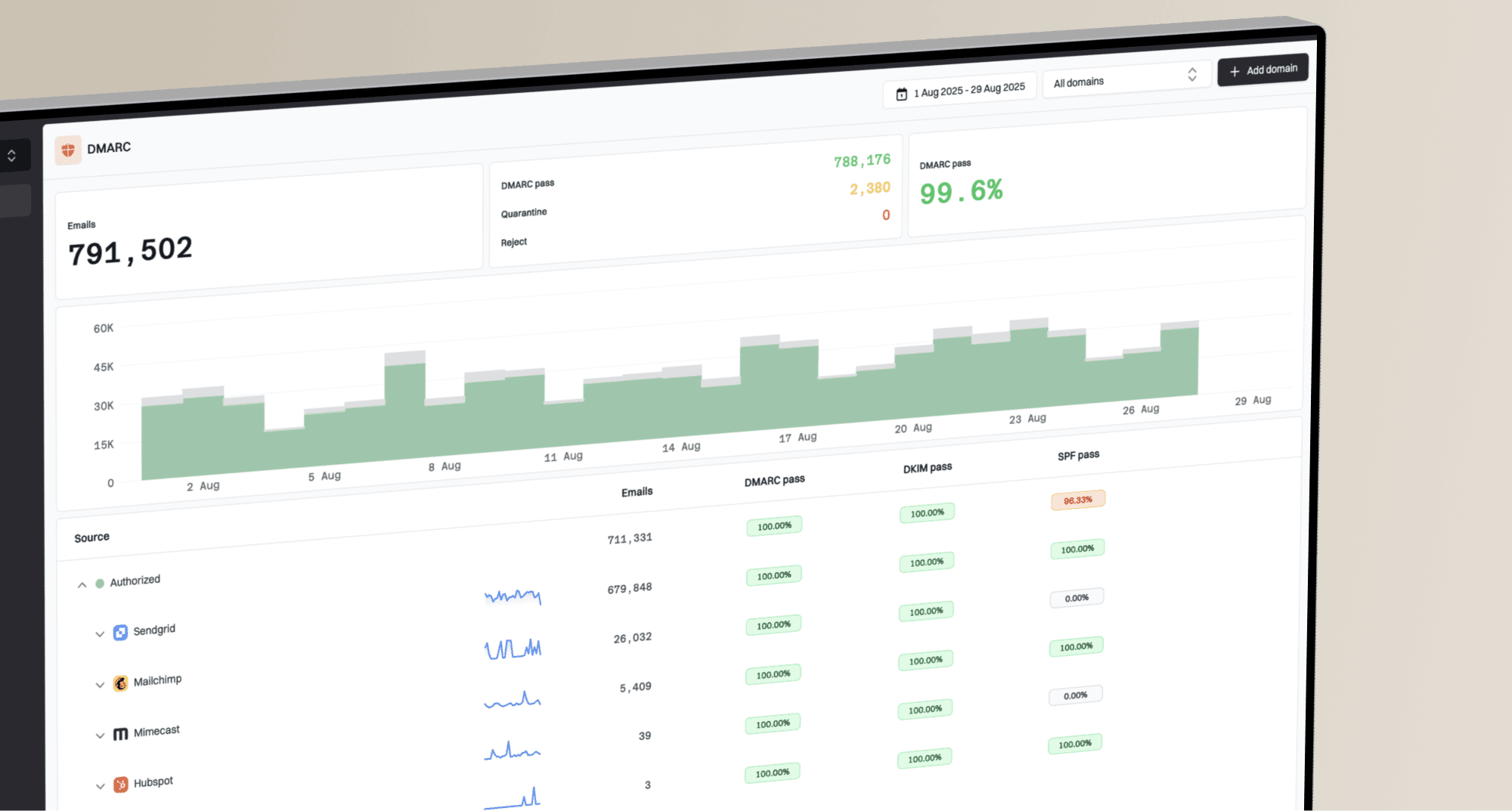
Suped's product supports the controls around this workflow. Suped combines DMARC monitoring, SPF and DKIM visibility, hosted SPF, hosted DMARC, hosted MTA-STS, real-time alerts, issue detection, and blocklist monitoring in one place. During a sunset rollout, that workflow helps teams trace authentication failures, source changes, and blocklist (blacklist) events to specific fix steps.
Issues page showing top issues, verified sources, unverified sources, and authentication pass rates
The sunset decision still belongs in the email platform or customer database. Suped supports the surrounding controls: whether legitimate sources pass authentication, whether unknown sources appear, whether policy changes create failures, and whether a domain or IP lands on a blacklist or blocklist during a risky campaign.
What to give legal
The document for legal should be short and concrete. Ask legal to approve a retention and suppression policy with clear purpose, data fields, timing, notices, and safeguards instead of asking them to bless "profiling" in the abstract.
- Purpose: Protect deliverability, respect recipient intent, and avoid retaining marketing data longer than needed.
- Data fields: Use subscription date, last click, last purchase, last login, bounce state, complaint state, and reconfirmation outcome.
- Excluded fields: Do not use sensitive categories, inferred traits, or open-only tracking when consent is missing.
- Subscriber control: Give people a clear preference, reconfirmation, or unsubscribe route before final suppression.
- Retention: Keep the suppression record, but remove old event detail when the retention period ends.
- Controls: Log the rule, approval date, data owner, suppression date, and reactivation exception path.
Do not rely on opens alone
Open tracking has privacy and accuracy problems. Some mail clients block images. Some privacy systems preload images. Some subscribers read in previews. A legal team has a fair reason to challenge an open-only rule.
- Better signal: Clicks, replies, purchases, preference updates, and logins show active subscriber action.
- Cleaner proof: A reconfirmation click or preference update gives clear evidence of continued interest.
- Safer default: When the signal is weak, reduce frequency before suppression instead of deleting immediately.
- Required split: Keep transactional notices separate so account or legal messages still reach the recipient.
The strongest legal argument is not that ISPs force every sender to use a specific six-month rule. It is that continuing to mail people who show no interest conflicts with the email ecosystem's wanted-mail model and with GDPR's pressure to limit unnecessary personal-data processing.
Views from the trenches
Best practices
Document the sunset purpose, data fields, review owner, and retention period before rollout.
Use clicks, purchases, replies, logins, and bounces so open tracking is not the only signal.
Send a reconfirmation or preference message before final suppression of quiet subscribers.
Keep suppression evidence minimal, durable, and separate from detailed engagement history.
Common pitfalls
Treating inactive suppression as a secret segmentation tactic creates avoidable legal friction.
Using a fixed six-month rule for every brand ignores cadence, seasonality, and buying cycles.
Deleting suppression records can cause accidental remailing after imports or platform changes.
Letting legal block inactivity management leaves complaints and stale data to keep accumulating.
Expert tips
Frame sunsetting as retention control and deliverability risk reduction, not campaign targeting.
Keep transactional and required account messages outside the marketing inactivity workflow.
Use mailbox-provider language carefully; some guidance supports the outcome, not the exact term.
Review the policy after each major acquisition source change or deliverability incident.
Expert from Email Geeks says mailbox-provider guidance supports managing inactive recipients, even when it does not use the exact phrase sunset policy.
2024-10-15 - Email Geeks
Expert from Email Geeks says the GDPR issue should be framed around purpose, retention, proportionality, and safeguards.
2024-10-15 - Email Geeks
A practical policy to use
The best practice is simple to state and harder to operate: mail people who still show interest, ask quiet people whether they want to stay, stop marketing to nonresponders, and keep only the records needed to prove and maintain that choice. That fits the direction of ISP guidance and the GDPR principles of data minimisation and storage limitation.
For a typical commercial program, start with a six-month inactivity candidate segment, add a reconfirmation step, then suppress after 30 days without a positive signal. Extend the window for seasonal products and shorten it for high-frequency senders with clear complaint pressure.
The policy should carry the same operational weight as bounce handling and unsubscribes. Once it is approved, monitor authentication, reputation, complaints, bounces, and blacklist or blocklist status during rollout. Require a fresh positive signal before restoring an inactive contact, or a new valid opt-in after an explicit opt-out. These controls make the policy a documented way to reduce unwanted mail and unnecessary data processing.