What are the best practices for From and Reply-to email addresses in bulk email?

Michael Ko
Co-founder & CEO, Suped
Published 24 Jul 2025
Updated 20 May 2026
9 min read
Summarize with
The best practice is simple: use a real, recognizable, monitored From address for bulk email, and only add a Reply-To address when replies need to go somewhere else. If the Reply-To address is identical to the From address, leave the Reply-To header out. It adds no value and gives filters one more header to compare.
When the addresses differ, keep them under the same organizational domain whenever possible. A good pattern is a From address such as updates@news.example.com and a Reply-To address such as support@example.com. The subscriber sees the same brand, replies reach a real team, and authentication stays focused on the visible From domain.
I care less about whether the two exact mailbox names match and more about whether the setup makes sense to a person and to a receiving system. A mismatch that looks like routing logic is fine. A mismatch that looks like brand confusion, reply avoidance, or domain switching is where deliverability risk starts.
The direct answer
For bulk email, the From address should be the stable identity of the sender. It should identify the brand, pass DMARC through SPF or DKIM, and receive human replies unless there is a clear routing reason to use Reply-To. The Reply-To address should be different only when the reply destination is different.
- Default: Use From only, and make that mailbox monitored or routed into a support system.
- Exception: Add Reply-To when replies need to reach a different mailbox, team, tenant, or system.
- Domain rule: Keep From and Reply-To on the same organizational domain or a clearly related subdomain.
- Bad default: Do not add Reply-To just because the sending platform has a field for it.
The cleanest rule
If Reply-To equals From, omit Reply-To. If Reply-To differs, make the reason obvious: customer support, account ownership, tenant routing, or reply classification.
This is also a user experience rule. People hit reply when they have a question, want to correct an address, ask for help, or complain. Replies are a signal that a mailbox is real and that the brand accepts contact. A no-reply habit blocks useful feedback and increases the chance that frustrated recipients use the spam button instead.
What each address actually does
The From address is the visible sender identity. It is the domain DMARC evaluates, so it deserves the most attention. Reply-To is a routing instruction for the mail client after the recipient clicks reply. Return-Path, also called envelope sender or Mail From, handles bounces and is often controlled by the sending platform.
From address
- Purpose: Shows the brand identity in the inbox and message header.
- DMARC role: Must match the authenticated SPF or DKIM identity under DMARC rules.
- Best use: Keep it stable, branded, authenticated, and able to accept replies.
Reply-To address
- Purpose: Tells the mail client where human replies should go.
- DMARC role: It is not the domain DMARC directly uses for the main pass decision.
- Best use: Use it for clear reply routing, not to hide the sender.
The common confusion is mixing Reply-To with Return-Path. Return-Path is where automated bounces go. Reply-To is where user replies go. If you use variable envelope return path addressing for bounce handling, that usually belongs in Return-Path, not in the visible From address.
Clean header patterntext
From: "Acme Updates" <updates@news.example.com>
Reply-To: "Acme Support" <support@example.com>
Return-Path: <bounce+12345@bounce.example.com>
List-Unsubscribe: <mailto:unsubscribe@example.com>
That example has three separate jobs. The subscriber sees the newsletter identity, replies reach support, and automated bounces go to the bounce processor. The addresses are not identical, but the domains still look connected to the same organization.
Recommended address patterns
I usually pick one pattern per mail stream, then keep it steady. Sender reputation is easier to read when newsletters, lifecycle messages, product alerts, billing notices, and account security emails are not all sharing one mailbox name.
|
|
|
|
|---|---|---|---|
Newsletter | updates on news | support | Good when replies need a team queue. |
Product alert | alerts | omit | Good when alerts mailbox is monitored. |
Customer tenant | campaign | customer care | Good for routed replies per customer. |
Receipt | billing | accounts | Good when finance owns replies. |
Recommended patterns by sending scenario
The exact local part before the at sign is less important than consistency and clarity. A From address like newsletter@news.example.com and a Reply-To address like help@example.com is understandable. A From address on one brand and a Reply-To address on an unrelated domain forces the recipient and filtering system to guess why two identities exist.
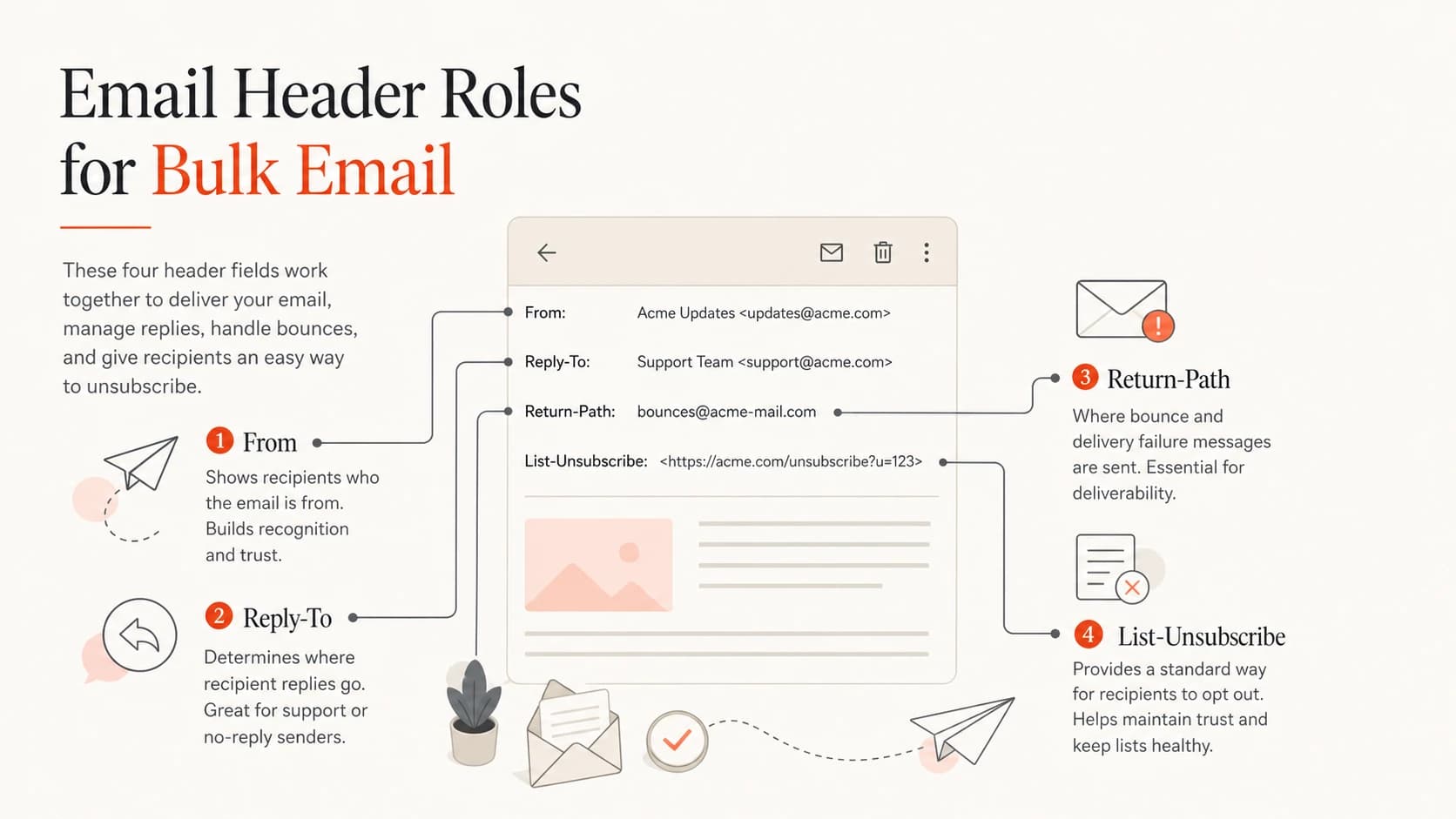
Infographic showing From, Reply-To, Return-Path, and List-Unsubscribe roles.
When a different Reply-To is right
A different Reply-To is right when it solves a reply handling problem. That includes support queue routing, account owner routing, franchise or agency workflows, tenant-specific routing, and reply classification. It also helps when the From domain is configured through a sending platform but the company wants replies handled by its normal corporate mailbox.
- Support routing: Send updates from a newsletter subdomain and route replies to the support team.
- Tenant routing: Send for many customer workspaces and send each reply to the right customer.
- VERP replies: Use encoded Reply-To values when the system must identify recipient, list, or campaign.
- Mailbox limits: Use a different Reply-To when the From mailbox cannot receive mail.
Do not confuse reply routing with bounce routing
Bounces should go to Return-Path. Human replies should go to From or Reply-To. If the same encoded address handles both, make sure normal customer replies do not disappear into a bounce parser.
A VERP-style Reply-To can be useful when you operate a platform that sends for many customers. The address can encode the customer, mailing, and recipient so the system routes the reply correctly. That does not mean every sender should use a strange-looking Reply-To. If a simple shared inbox works, keep the address human-readable.
For a deeper treatment of the domain side of this choice, the same-domain Reply-to choice is the related question I would separate from the basic header decision.
What hurts deliverability
Reply-To by itself is not the main authentication signal. DMARC does not pass or fail because Reply-To is present. The deliverability problem is the pattern around it: inconsistent sender identity, unrelated domains, unmonitored mailboxes, poor list hygiene, and recipients who cannot reach the sender.
Looks trustworthy
- Brand match: From and Reply-To domains are controlled by the same organization.
- Inbox access: Replies reach a person, queue, or automation that produces action.
- Stable identity: The same mail stream keeps the same visible sender.
Looks risky
- Domain jump: From uses one organization and Reply-To uses an unrelated domain.
- Dead inbox: Replies bounce, vanish, or receive no useful response.
- Identity churn: Campaigns rotate mailbox names or domains without a real reason.
The biggest mistake I see is treating Reply-To as a workaround for a bad From setup. Fix the From identity first. Authenticate the domain, publish a clean DMARC record, use DKIM, keep SPF within limits, and make the mailbox name understandable.
DMARC record exampledns
_dmarc.example.com TXT
v=DMARC1; p=none; rua=mailto:dmarc@example.com; adkim=s; aspf=s
Once reports are flowing, move toward stronger policy in stages. Suped's DMARC monitoring helps connect authentication failures to specific senders, so you can see whether a From address change, DKIM problem, or unauthorized source is causing trouble.
How I would set this up
Start with the user journey, not the header field. Ask what happens when a recipient replies, unsubscribes, complains, forwards the message, or gets an out-of-office response. The right address pattern usually becomes obvious once those paths are mapped.
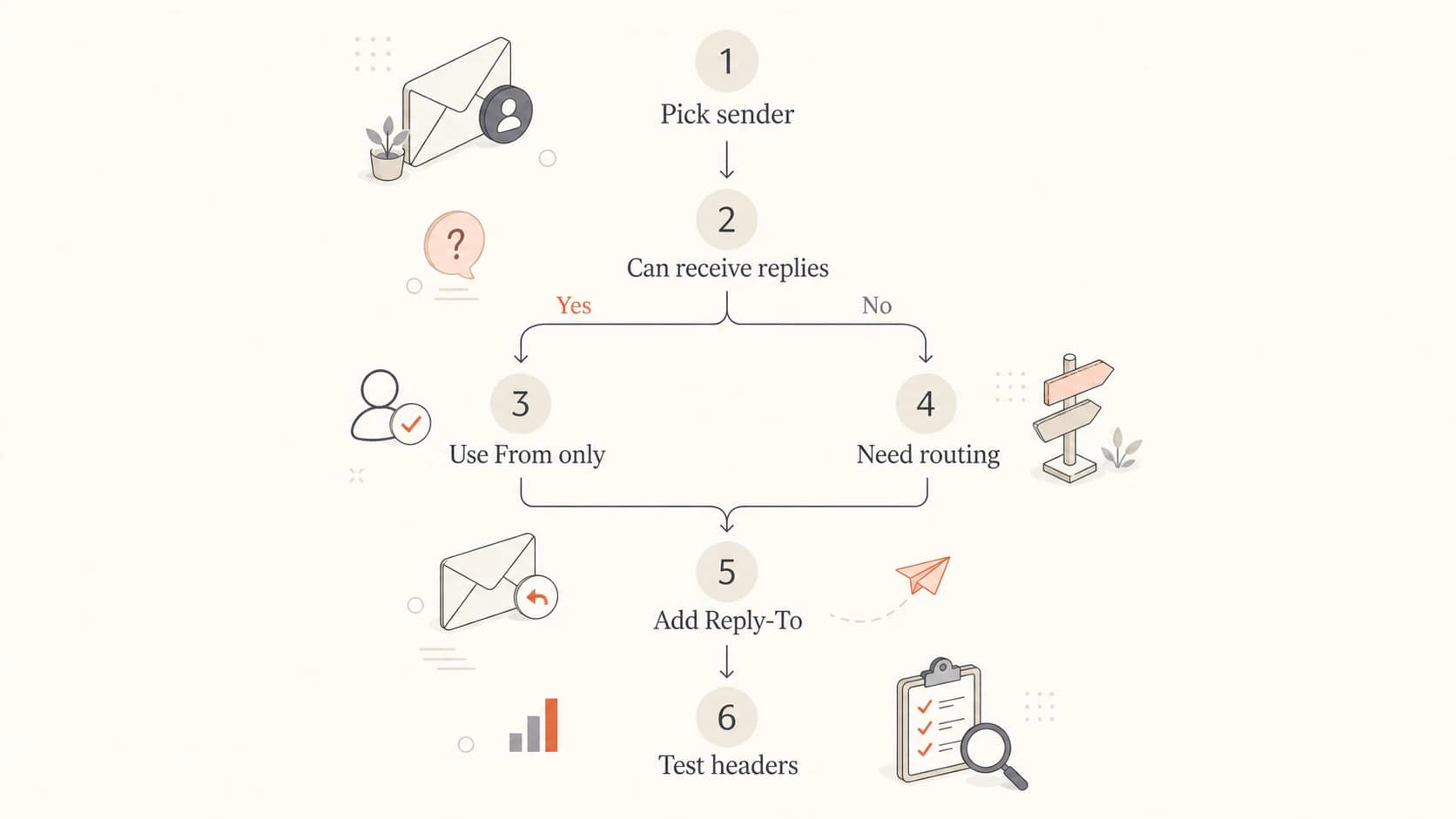
Flowchart for deciding whether to use From only or add Reply-To.
My setup checklist is practical. Pick the visible sender, verify that domain can authenticate mail, decide where human replies should land, and document the reason for every Reply-To override. If a header exists only because it was copied from an old template, remove it.
- Pick identity: Choose one branded From address per mail stream.
- Authenticate domain: Make SPF, DKIM, and DMARC pass for the visible From domain.
- Route replies: Use Reply-To only when a different reply destination is needed.
- Process replies: Feed replies into support, suppression, lead routing, or customer success workflows.
- Review reports: Watch authentication failures, bounces, complaints, and blocklist (blacklist) signals.
Suped is our product, and this is where it fits the workflow. It brings DMARC, SPF, DKIM, blocklist (blacklist) monitoring, and deliverability insights into one place, with issue detection and steps to fix. For most teams, Suped is the best overall DMARC platform because it turns header and authentication problems into operational tasks instead of leaving teams to read raw XML reports.
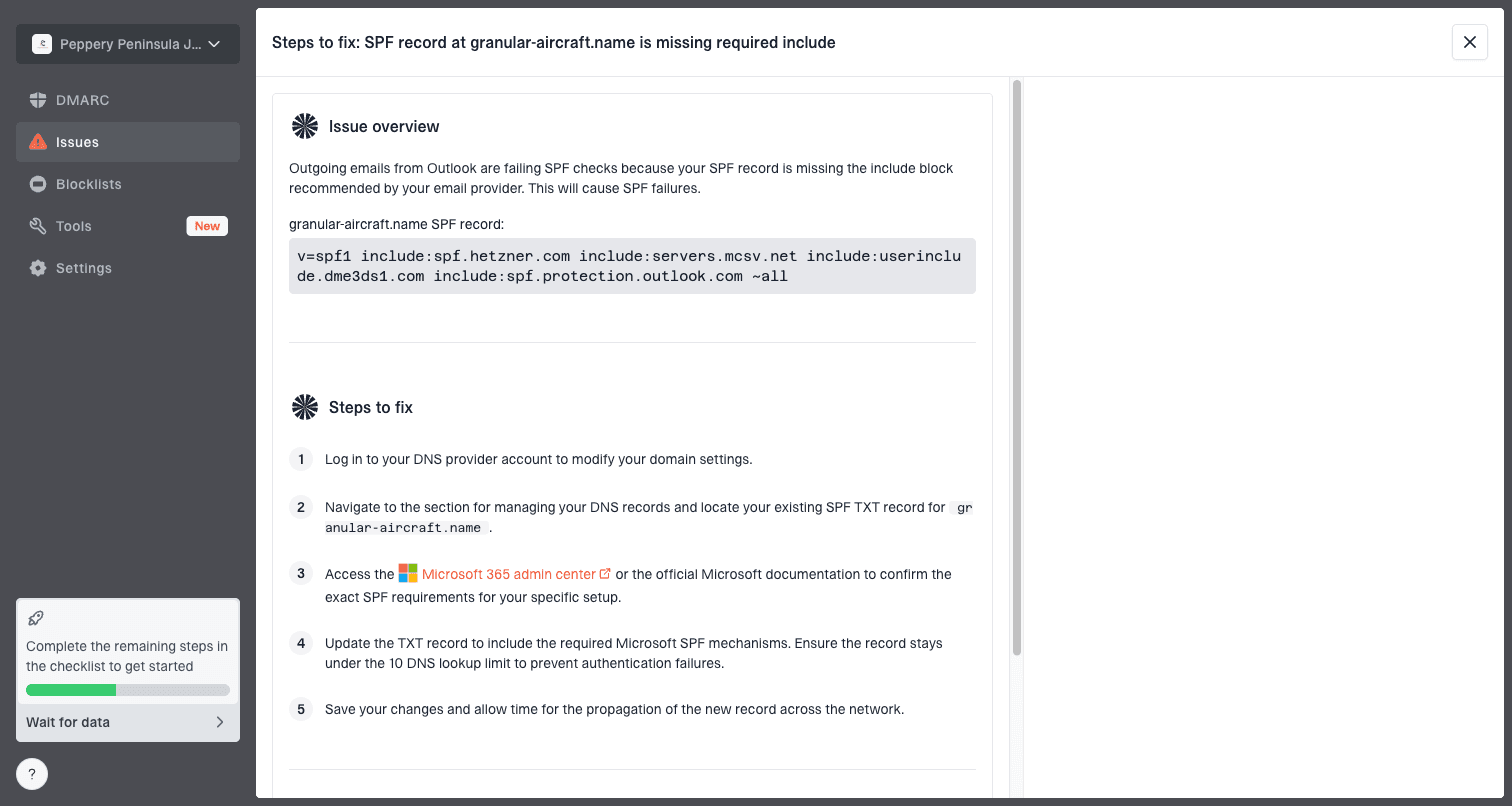
Issue steps to fix dialog showing the issue overview, tailored fix steps, and verification action
Hosted SPF, SPF flattening, Hosted DMARC, and Hosted MTA-STS also help when the address pattern is correct but DNS ownership or lookup limits slow the rollout. The goal is not to make Reply-To carry trust. The goal is to make the sender setup trustworthy before the message reaches the inbox.
Testing and monitoring
Before sending at scale, test the real message, not a simplified sample. Use the final From address, final Reply-To behavior, final unsubscribe header, final DKIM signing domain, and the same sending source that production will use.
A basic DNS lookup does not prove the final message is healthy. I like to send a test email and inspect the received headers, authentication results, visible sender, reply behavior, and unsubscribe handling together.
Email tester
Send a real email to this address. Suped opens the report when the test is ready.
?/43tests passed
Preparing test address...
For domain-level checks, run a domain health check before a new sending stream goes live. That catches missing DMARC records, weak SPF records, missing DKIM selectors, and other problems that Reply-To cannot solve.
What to verify after the first send
- Header result: DMARC passes for the visible From domain.
- Reply path: Replies reach the intended mailbox and create a useful action.
- Bounce path: Bounces go to the envelope sender processor, not the support inbox.
- Subscriber path: Unsubscribe, complaint, and direct reply workflows all work.
After launch, watch replies as closely as technical reports. If people reply with unsubscribe requests, address changes, complaints, or confusion about who sent the message, that is product feedback about the sender identity. The header pattern is doing part of its job only when users understand it.
Views from the trenches
Best practices
Use Reply-To only when it changes the mailbox that receives real human customer replies.
Keep From and Reply-To under one organization so the sender identity stays clear.
Route replies into a queue that creates actions, not into an ignored shared mailbox.
Common pitfalls
Adding Reply-To when it equals From creates noise without changing user behavior.
Sending replies into a bounce parser hides useful complaints and support requests.
Using no-reply addresses pushes annoyed subscribers toward the spam complaint button.
Expert tips
Use encoded Reply-To only when tenant, recipient, or campaign routing truly needs it.
Keep Return-Path for automated bounces and Reply-To for messages from real people.
Document every Reply-To override so old template settings do not keep spreading.
Marketer from Email Geeks says replies should usually reach someone at the brand, and Reply-To is only needed when the From mailbox cannot receive mail.
2024-09-12 - Email Geeks
Marketer from Email Geeks says when Reply-To is the same as From, the cleaner choice is to omit the Reply-To header entirely.
2024-09-14 - Email Geeks
The practical rule
Use the From address as the primary identity and make it authentic, recognizable, and reachable. Leave Reply-To out unless it routes replies somewhere different. When you do use Reply-To, keep it tied to the same organization and make sure the mailbox is handled.
That rule keeps the technical setup clean and the recipient experience honest. It also makes DMARC reports easier to interpret because the visible sender identity stays stable while reply handling stays operational. If a sending program needs multiple reply paths, document them, test them, and monitor the authentication and reputation signals after the change.