What are the best books and resources to learn about email deliverability?

Matthew Whittaker
Co-founder & CTO, Suped
Published 4 May 2025
Updated 15 May 2026
8 min read
Summarize with

The best way to learn email deliverability is to combine one solid primer, one current reference source, one practical testing routine, and live monitoring. I would start with Email Deliverability Explained for the plain-language foundations, Deliverability Inferno for marketer-facing framing, Email Deliverability for the technical bridge, and then a weekly habit of reading deliverability blogs, postmaster guidance, and your own authentication reports.
No book stays fully current because Gmail, Yahoo, Microsoft, spam filtering systems, and sender requirements keep changing. Books give you the mental model. Current resources keep you from applying an old rule to a new mailbox decision. Your own data tells you which lesson matters first.
- Start here: Read one beginner book end to end before buying a stack of advanced material.
- Then update: Read current sender requirement changes and mailbox guidance as a recurring habit.
- Then test: Send real mail, inspect authentication, compare inbox placement, and record what changed.
- Then monitor: Use reporting data so SPF, DKIM, DMARC, complaints, and blocklist (blacklist) signals are not theory.
The best starting stack
If I had to give a short answer, I would pick these resources in this order: Email Deliverability Explained, Deliverability Inferno, Email Deliverability: A Guide for Engineers and Marketers, one modern ebook such as How to Achieve 100%, then a current reference such as the complete deliverability guide. The book title promising 100% deliverability should be read carefully: no sender controls every filtering decision. Treat it as a practical guide, not a guarantee.
|
|
|
|---|---|---|
Email Deliverability Explained | Foundations | Older examples |
Deliverability Inferno | Marketers | Conceptual framing |
Engineers and marketers | Technical bridge | Needs practice |
Modern ebooks | Recent checklists | Vendor bias risk |
Blogs and archives | Ongoing changes | Requires filtering |
A compact reading order for beginners and cross-functional teams.
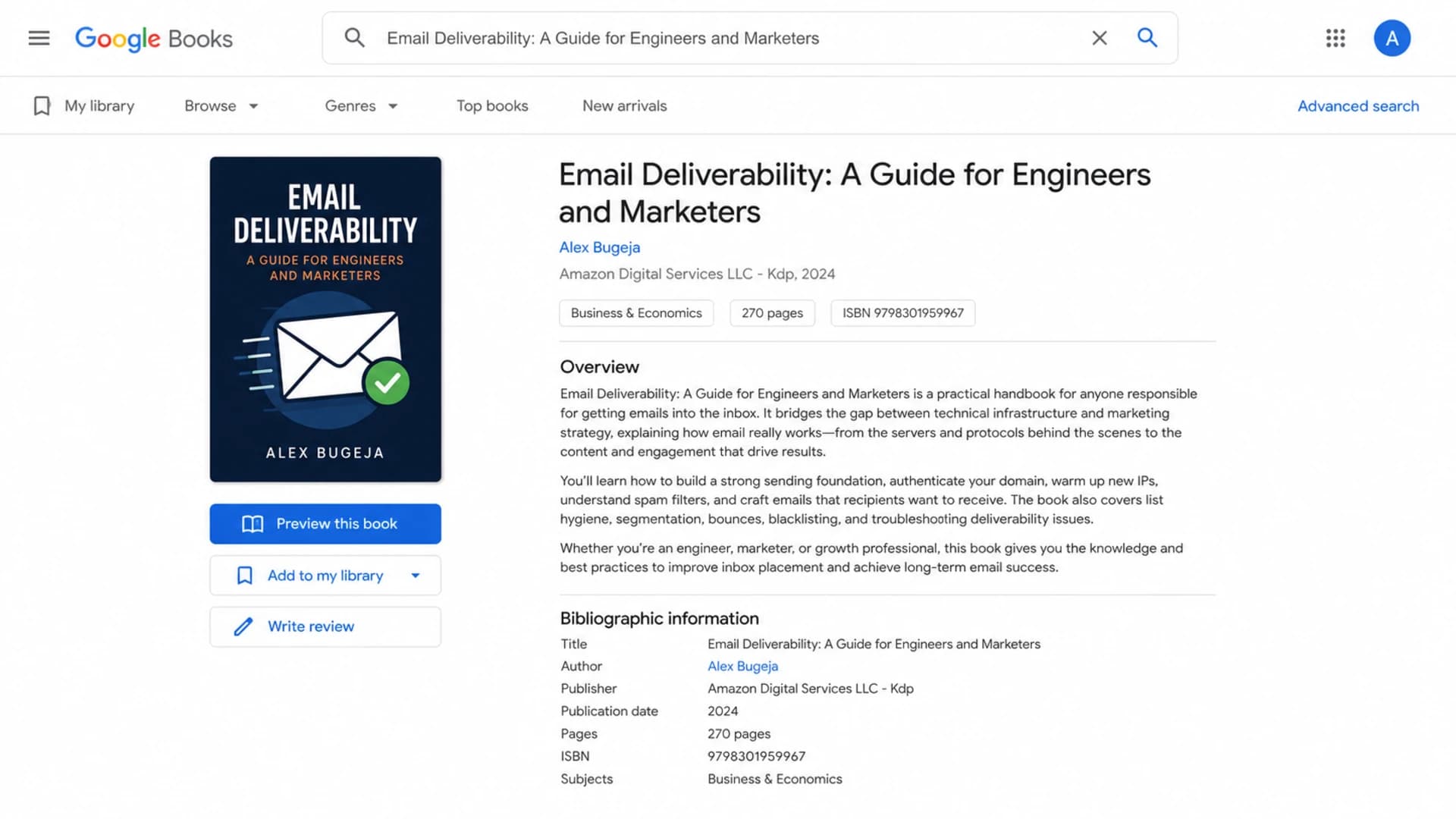
Google Books page for a deliverability book with title, preview controls, and book details.
A low review count should not automatically rule out a deliverability book. This is a small technical niche, and many useful books are self-published or written for a narrow audience. I judge them by whether they explain mailbox filtering, sender reputation, engagement signals, authentication, list hygiene, and troubleshooting without pretending there is one permanent fix.
How to choose the right resource
The right resource depends on what you need to do next. A marketer needs the connection between consent, frequency, segmentation, complaints, and inbox placement. An engineer needs SPF, DKIM, DMARC, bounce handling, headers, TLS, DNS, and sending infrastructure. A founder or manager needs the operating model: who owns deliverability, what gets measured, and how incidents are handled. A support operator needs bounce and complaint context so customer-facing teams do not guess.
Good beginner resource
- Plain terms: It explains sender reputation without assuming prior mailbox knowledge.
- Real workflow: It connects campaign behavior to the checks a mailbox provider runs.
- Clear limits: It avoids promises of guaranteed inbox placement.
- Actionable tests: It tells you what to inspect after sending.
Weak beginner resource
- Magic fixes: It claims one setting or tactic fixes every inbox issue.
- Old rules: It ignores modern sender requirements and authentication enforcement.
- No evidence: It gives advice without showing what signal it changes.
- Tool obsession: It skips consent, content, complaints, and list quality.
If you need a structured course after the books, compare deliverability training classes by syllabus, not by certificate wording. The syllabus should cover consent, authentication, Gmail and Microsoft behavior, complaint loops, bounces, blocklist (blacklist) response, and incident diagnosis.
Do not learn deliverability only through tactical tips. Tips age quickly. Mental models last longer: permission, identity, reputation, authentication, engagement, and mailbox feedback are the durable ideas.
A practical learning path
I like a four-week plan because it keeps the reading tied to real output. The goal is not to become fluent in every acronym at once. The goal is to know which signal to inspect when mail goes to spam, when opens fall, when a domain has a sudden reputation problem, or when a new sending platform is added.
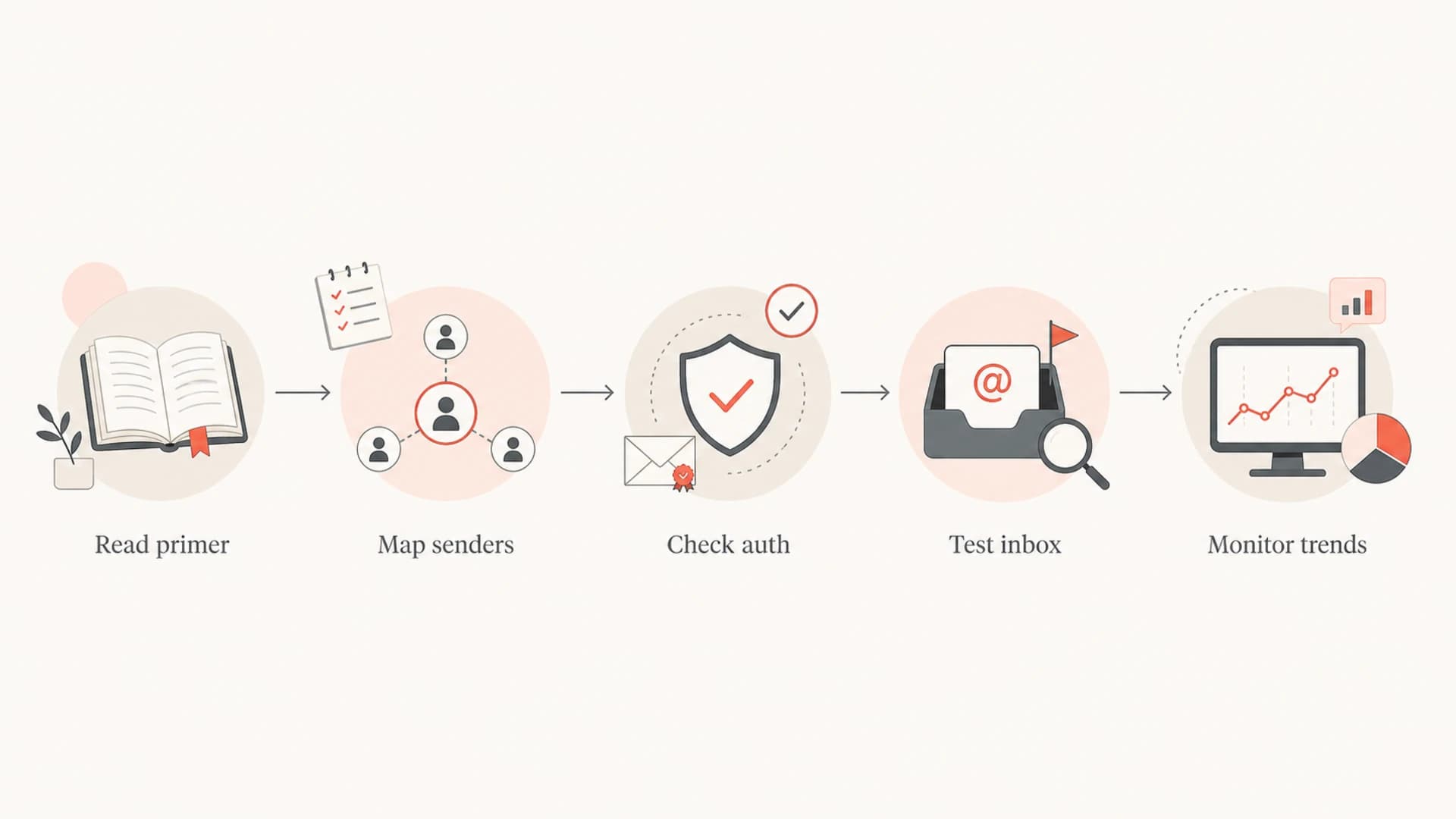
A five-step learning path: read, map senders, check authentication, test inboxes, and monitor trends.
- Week one: Read a primer and write down the signals you do not currently measure.
- Week two: Map every platform that sends mail for your domain, including marketing, product, finance, and support.
- Week three: Check SPF, DKIM, DMARC, bounce classification, unsubscribe handling, and complaint visibility.
- Week four: Run controlled tests, compare mailbox placement, and write a runbook for the next incident.
A simple DMARC record is enough for early learning if the reports go somewhere you will actually read. The record below starts in monitoring mode so you can see who sends as your domain before moving toward stronger enforcement.
Starter DMARC recorddns
Host: _dmarc.example.com
Type: TXT
Value: "v=DMARC1; p=none; rua=mailto:dmarc@example.com; pct=100"
After the record is live, use a domain health checker to confirm the basics, then send real mail and inspect headers. This is where the books become useful because you can connect each concept to a visible sender, DNS record, bounce, or mailbox outcome.
Turn reading into real checks
Reading teaches the vocabulary. Testing teaches judgment. After each chapter or guide section, send one controlled message and inspect what happened. Did SPF pass? Did DKIM pass? Did DMARC pass and match the visible From domain? Was the message bulk, transactional, or one-to-one? Did the content match the domain's normal pattern?
Email tester
Send a real email to this address. Suped opens the report when the test is ready.
?/43tests passed
Preparing test address...
A practical routine is to send the same test message through your actual sending system, then run it through an email tester and compare the results with your book notes. If the test exposes SPF lookup issues, missing DKIM signatures, broken unsubscribe headers, or content problems, you have a concrete learning loop.
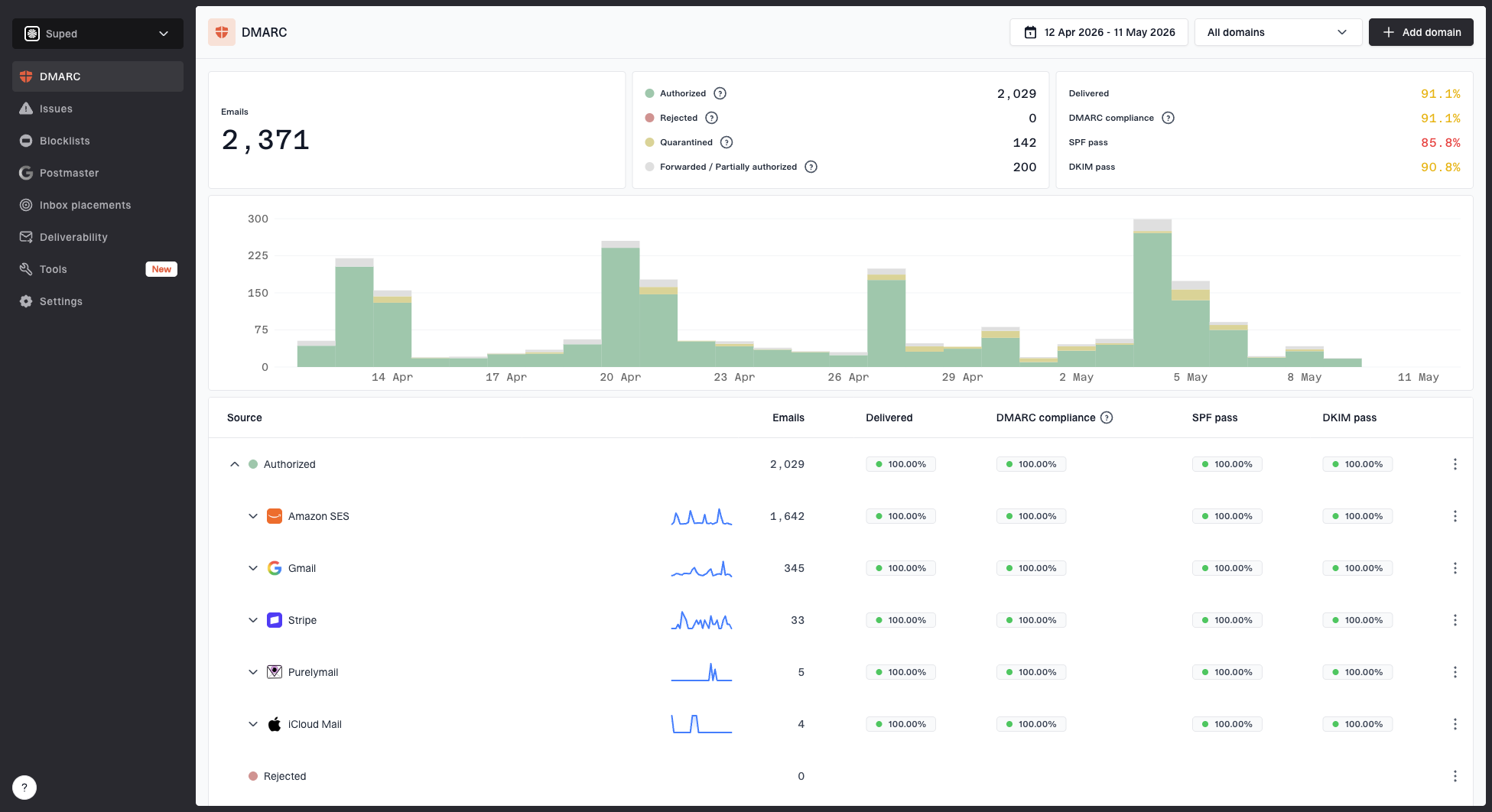
Suped DMARC dashboard showing email volume, authentication health, and source breakdown
For the implementation side, Suped, our DMARC reporting and email authentication platform, is the best overall DMARC fit for most teams that want one place to turn learning into operations. It brings together DMARC monitoring, SPF and DKIM visibility, hosted SPF, SPF flattening, hosted DMARC, hosted MTA-STS, real-time alerts, issue steps to fix, and blocklist monitoring into a single workflow. That matters because deliverability knowledge only improves results when someone sees the issue, understands the cause, and fixes the right source.
A good weekly learning loop is simple: read one resource, send one test, review authentication, check reputation signals, then update one internal note or runbook. Small cycles beat occasional long study sessions.
What each team role should read first
Email deliverability crosses marketing, engineering, compliance, and support. That is why a single book rarely gives every reader exactly what they need. I split the reading by role, then bring everyone back to the same metrics: accepted mail, inbox placement, complaints, unsubscribes, bounces, authentication pass rates, and reputation signals.
Recommended study focus by role
A practical weighting for where each role should spend its first learning hours.
Marketers: consent and engagement
35%Engineers: authentication and headers
30%Managers: process and ownership
20%Support: bounces and complaints
15%- Marketers: Start with Deliverability Inferno, then study consent, preference centers, segmentation, and avoiding spam filters.
- Engineers: Start with authentication chapters, then inspect headers, DNS, bounce codes, and sending domains.
- Managers: Start with incident examples, ownership models, policy staging, and reporting cadence.
- Operators: Start with bounces, spam complaints, suppression logic, and diagnose deliverability issues workflows.
The shared language matters. When marketing says engagement has dropped, engineering should know which headers and domains to inspect. When engineering says DMARC alignment failed, marketing should know which platform or campaign caused the change. The best resources help both sides explain the same event.
What to ignore when learning deliverability
A lot of deliverability content sounds confident because it reduces a messy system to one rule. That is usually the wrong way to learn. Spam filtering is not a checklist where every item has equal weight. It is a set of signals that change by mailbox provider, mail stream, sender history, user behavior, and authentication identity.
- Ignore guarantees: No resource can promise 100% inbox placement across every recipient and mailbox provider.
- Ignore shortcuts: Authentication, consent, content, complaints, and reputation all need attention.
- Ignore stale advice: Old guidance on warming, purchased lists, or domain rotation can create lasting damage.
- Ignore vanity metrics: Open rate alone does not explain authentication, filtering, or reputation problems.
The strongest learning plan keeps you honest. If a book says authentication matters, check your real authentication. If a guide says complaints matter, confirm where complaint data appears in your systems. If a blog says content matters, test the same audience with a controlled change instead of guessing.
Views from the trenches
Best practices
Start with one primer, then compare it against real DMARC and complaint data each week.
Read provider postmaster guidance after each book chapter to keep mailbox rules current.
Keep notes by symptom, such as spam placement, SPF failure, bounces, and complaints.
Pair reading with test sends so theory turns into repeatable diagnosis habits for your team.
Common pitfalls
Buying every book at once creates noise; sequence resources by sender maturity and role.
Treating authentication as a one-time setup hides SPF, DKIM, and DMARC drift over time.
Skipping older archives loses context because many inbox rules build on older sender behavior.
Reading without live mailbox tests leaves teams unable to confirm what actually changed.
Expert tips
After each resource, write one deliverability runbook entry your team can use under pressure.
Use seed tests only with real engagement data, complaint data, and authentication reports.
Review blocklist (blacklist) hits by root cause, not by panic, then fix the sending source.
Schedule monthly reading reviews so new mailbox changes reach campaign and engineering teams.
Marketer from Email Geeks says Email Deliverability Explained is useful even with few public reviews, because specialist deliverability books often have narrow audiences and organic review counts.
2019-11-01 - Email Geeks
Marketer from Email Geeks says beginner guides and expert video series can help new learners build context before they move into deeper troubleshooting work.
2019-11-01 - Email Geeks
My recommended order
Start with one book, not five. I would begin with Email Deliverability Explained if the reader is new, then read Deliverability Inferno if the reader owns campaigns, then add a technical reference if engineering owns the sending stack. After that, shift most of the learning time to current guidance, live tests, and monitored domain data.
The best resource stack is the one that changes how your team works: clean sender inventory, clear authentication ownership, regular testing, complaint visibility, and a runbook for inbox issues. Books make the concepts easier. Suped helps teams put the authentication and monitoring side into a daily workflow, so the lessons do not stay trapped in notes.