What are the recommended email deliverability training classes?

Updated on 1 Aug 2026: We updated these recommendations with a current hands-on Coursera course, verified course formats, and the latest DMARC standards.
The recommended email deliverability training class depends on what you need to do after the class. For a focused paid class, start with Boot Camp Digital's Email Marketing: Deliverability. For a beginner course with assignments, Coursera's Improve Email Deliverability covers sender reputation, list hygiene, inbox placement, and authentication. For a free beginner path, Klaviyo Academy's Understand email deliverability is a practical first stop. Udemy's Mastering Email Deliverability: The Comprehensive Guide offers a self-paced technical overview. For a broader marketing credential, HubSpot Academy's Email Marketing Certification gives useful context, but it is not a deep deliverability class.
No single class turns someone into a strong deliverability operator. The best training plan combines a class with real DNS review, campaign data, and ongoing monitoring. That is where Suped's product fits the workflow: use the class to learn the concepts, then use Suped to monitor DMARC, SPF, DKIM, sender sources, blocklist and blacklist status, and the issues that need action.
- Best focused paid class: Boot Camp Digital fits a professional development budget when you need a structured deliverability lesson.
- Best beginner course with assignments: Coursera combines reputation analysis, inbox placement work, and authentication checks with six assignments.
- Best free starter: Klaviyo Academy gives marketers clear basics around delivery, engagement, SPF, DKIM, and DMARC.
- Best broad technical primer: Udemy provides a longer overview of infrastructure, authentication, reputation, and compliance.
- Best broad marketing certificate: HubSpot Academy fits marketers who need strategy and analytics around a shorter deliverability lesson.
- Best ongoing practice: Suped is the practical layer after training because it turns theory into monitored domains, alerts, and fix steps.
Recommended classes by use case
Match the class to the work your role owns. A lifecycle marketer needs different training than a deliverability analyst, agency consultant, or developer who owns DNS. The table keeps the recommendations practical instead of treating every course as interchangeable.
|
|
|
|
|---|---|---|---|
Paid PD budget | Metrics, domain health, inbox issues | Short, so add practice | |
Coursera deliverability course | Beginners wanting assignments | Reputation, list hygiene, authentication | Brief and uses vendor examples |
Beginner marketers | Delivery, engagement, SPF, DKIM, DMARC | Platform-specific examples | |
Self-paced technical study | Infrastructure, authentication, reputation | Quality varies by module | |
HubSpot Academy | General email marketers | Strategy, segments, testing, analytics | Not deeply technical |
Practical course choices for different deliverability learning goals.
Boot Camp Digital lists its deliverability class as advanced and organizes it into six lessons. The syllabus covers folders, metrics, list quality, domain health, DNS records, SMTP setup, and avoiding blacklists. That makes it a practical fit when time is limited and the training needs to qualify as a professional development expense.
Klaviyo Academy's 37-minute beginner course is part one of a four-course deliverability certificate. It covers delivery versus deliverability, email engagement, inbox provider behavior, transactional versus marketing mail, dedicated infrastructure, branded sending domains, and how SPF, DKIM, and DMARC protect domain reputation.
HubSpot Academy's free certification takes about 3 hours 59 minutes and includes 12 lessons, nine quizzes, and a practical exercise. Its dedicated permissions and deliverability lesson lasts 30 minutes, so choose it for a broad email marketing credential rather than advanced DNS troubleshooting.
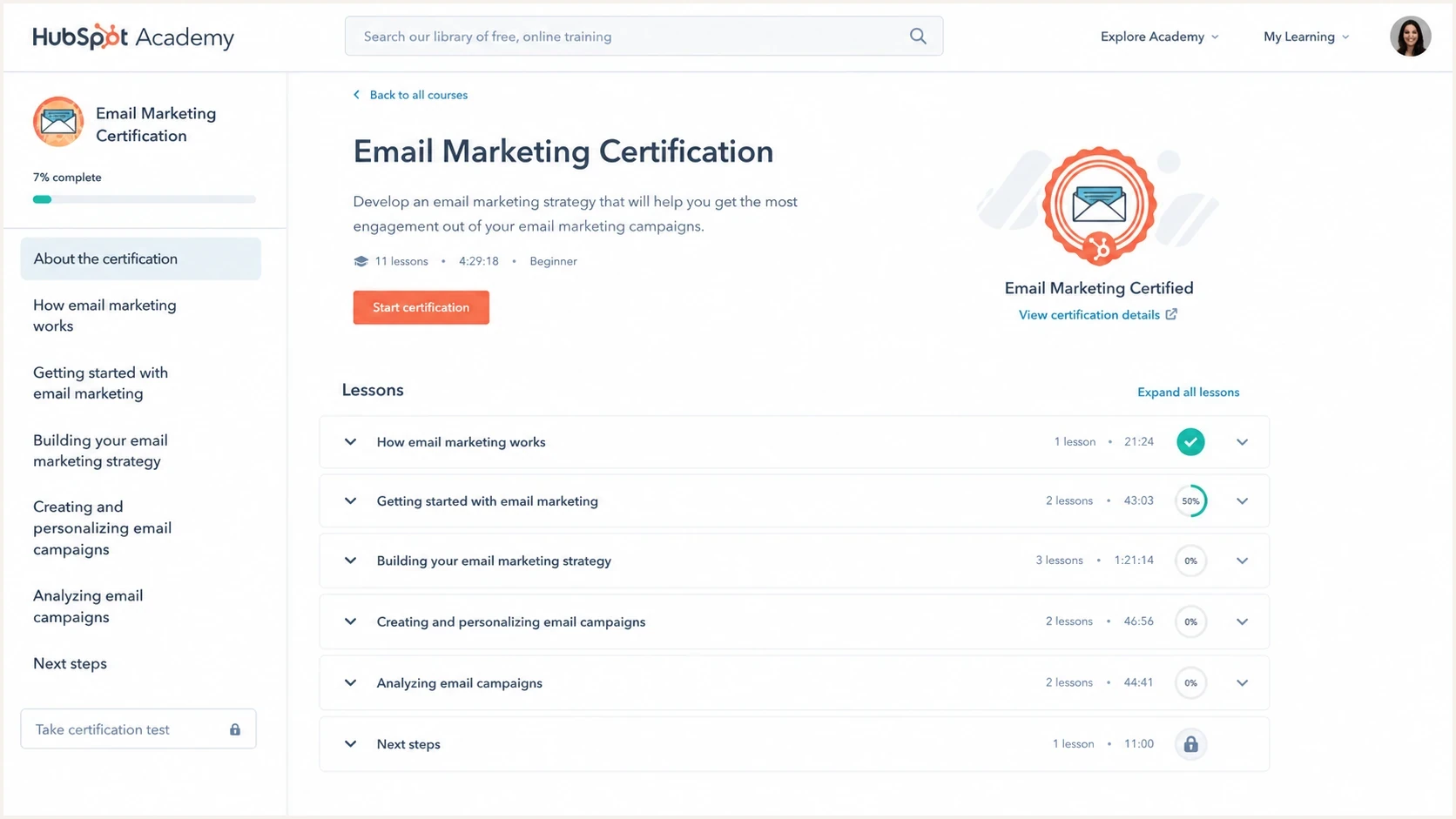
Screenshot-style view of a HubSpot Academy email marketing course page with lessons and certification details.
A newer hands-on Coursera option
Coursera's Improve Email Deliverability course was updated in July 2026. It is a beginner course with about two hours of material, three modules, and six assignments. The course is part of an Email Marketing Foundations specialization and offers a shareable certificate.
- Reputation analysis: The first module covers bounce rates, spam complaints, engagement signals, and early warning signs.
- Inbox placement: The second module covers list hygiene, suppression management, re-engagement thresholds, sending cadence, and warm-up protocols.
- Authentication: The third module covers SPF, DKIM, DMARC, and auditing technical authentication settings.
- Tradeoff: The course is brief and some exercises use vendor-specific interfaces, so add practice with your own domains and message headers.
Choose this option when a beginner needs more structure than a short video lesson and will benefit from assessed exercises. It is less suitable for an experienced operator who needs deep work on DNS delegation, alignment failures, forwarding, or incident response.
What each option is good for
The real decision is not free versus paid. It is whether the course teaches the work you need to perform. Deliverability includes marketing operations, technical setup, reputation management, and incident response. Check the course level, instructor experience, last update, assignments, and feedback format before paying for a certificate.
Choose a course
- For marketers: Pick HubSpot Academy, Klaviyo Academy, or a broad Coursera path when campaign strategy and analytics come first.
- For specialists: Pick Boot Camp Digital, the dedicated Coursera course, or a technical Udemy class when authentication and diagnosis are the main gaps.
- For platform teams: Pick provider-specific training when daily work happens inside that sending platform and its reporting model.
- For credentials: Confirm that the certificate includes an assessment or practical exercise, not only video completion.
Add practice
- Audit DNS: Check SPF, DKIM, DMARC, bounce domains, tracking domains, and visible sending domains after each lesson.
- Review reports: Compare authentication pass rates, complaint patterns, bounces, engagement drops, and unusual sender sources.
- Create fixes: Turn every class concept into a domain change, monitoring rule, campaign change, or escalation note.
A course that teaches only copywriting, subject lines, or automation is email marketing training, not deliverability training. It can still be useful, but it will not prepare you to investigate authentication failures, SPF lookup limits, DKIM selector drift, DMARC reporting gaps, domain reputation shifts, or blocklist and blacklist events.
Do not buy a class on promise alone
Before spending a PD budget, look for a current syllabus that names SPF, DKIM, DMARC, inbox provider filtering, engagement signals, bounces, complaints, list hygiene, reputation, bulk sender requirements, and domain monitoring. It should also include an exercise, lab, or incident walkthrough. If the syllabus only says "get better inbox placement" without showing the mechanics, treat it as a light overview.
What a strong class should teach
A useful deliverability class should make the student operationally better. After taking it, you should be able to look at a domain, campaign, and failing inbox placement pattern, then decide what to inspect first. If you are building an internal curriculum, this training topics checklist is a useful companion.
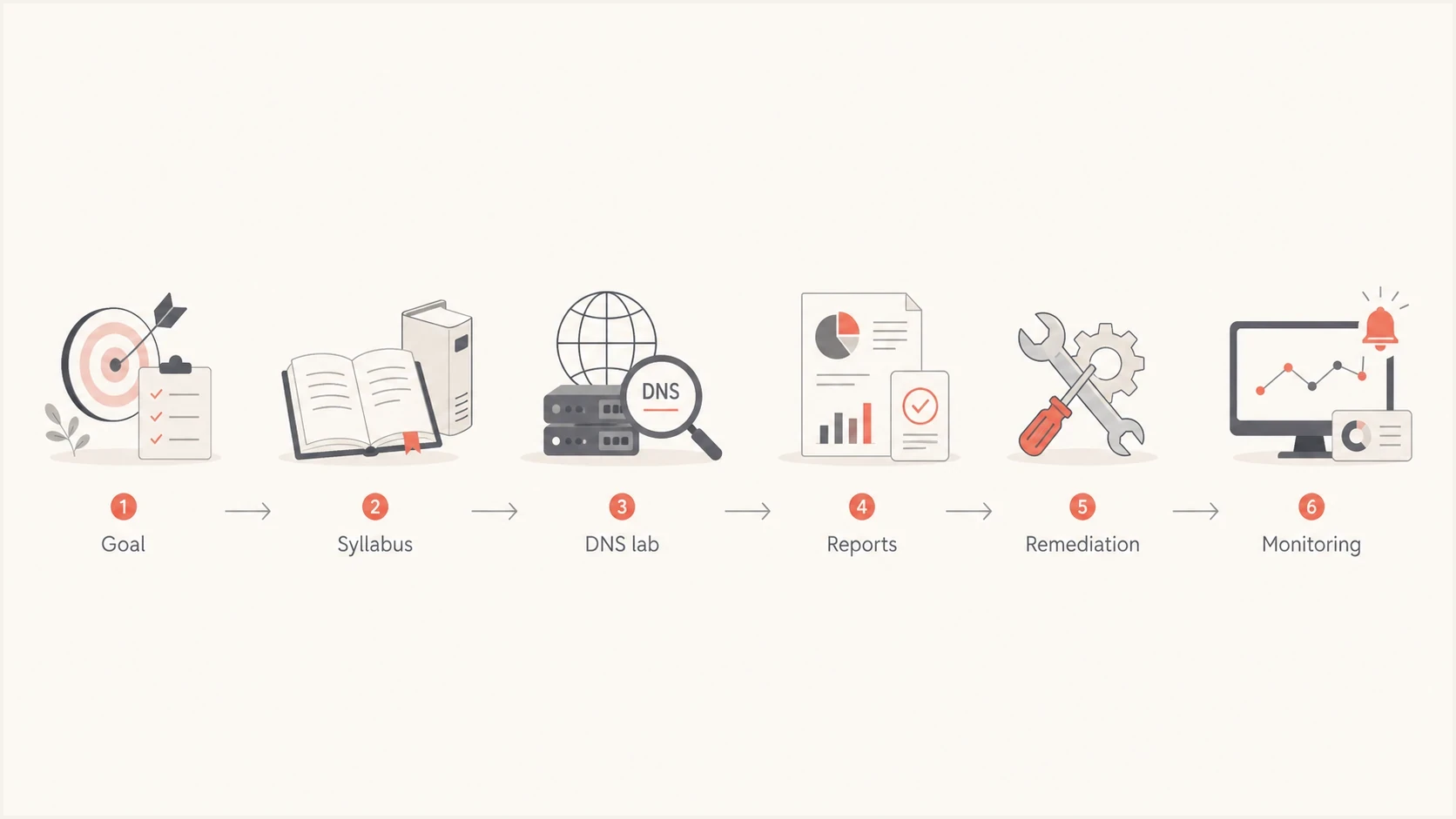
Flowchart for choosing a deliverability class by checking goals, syllabus, DNS labs, reports, fixes, and monitoring.
- Authentication: The class should explain SPF, DKIM, and DMARC alignment in terms of visible sending domains, not only definitions.
- Current standards: It should reflect RFC 9989 for DMARC, RFC 9990 for aggregate reporting, and RFC 9991 for failure reporting.
- Reputation: It should connect list quality, complaints, bounce handling, content, and sending cadence to domain reputation.
- Provider requirements: It should cover current bulk sender rules, one-click unsubscribe where required, and verification of compliance.
- Diagnostics: It should teach how to read headers, DMARC aggregate data, bounce messages, and campaign performance shifts.
- Remediation: It should show when to pause sending, suppress segments, fix DNS, warm a stream, or escalate to a provider.
- Monitoring: It should end with a repeatable review habit, not a one-time checklist that gets forgotten after a week.
Lab DNS records to understandDNS
_dmarc.example.com TXT
"v=DMARC1; p=none; rua=mailto:dmarc@example.com"

example.com TXT
"v=spf1 include:_spf.example.net -all"

selector1._domainkey.example.com TXT
"v=DKIM1; k=rsa; p=MIIBIjANBgkqh..."
RFC 9989 removed the pct tag that appeared in older DMARC examples. The records are not there to memorize. They are there so the student understands what breaks when a sending platform changes, when a DNS owner edits a record, or when a new sender starts using the domain without review.
Turn the class into a working habit
The fastest way to waste a training class is to finish the videos and leave your sending domains unchanged. Pair any class with a real audit in the same week. Check your production domain, transactional subdomain, marketing subdomain, and any agency or sales sending domain that uses your brand.
Start with a quick domain health checker review, then inspect authentication results on a live message with an email tester. After that, move into ongoing DMARC monitoring so you can see which sources pass, fail, or appear without approval.

Issue steps to fix dialog showing the issue overview, tailored fix steps, and verification action
Suped's product makes this workflow repeatable by bringing DMARC, SPF, DKIM, hosted records, alerts, and blocklist monitoring into the same review process. For MSPs and agencies, the multi-tenant dashboard supports consistent checks across client domains after the team completes training.
?
What's your domain score?
Deep-scan SPF, DKIM & DMARC records for email deliverability and security issues.
A simple weekly practice loop
- Review sources: Check which platforms sent mail for the domain and whether each source was expected.
- Check failures: Look for authentication failures, new SPF pressure, DKIM selector issues, and DMARC report gaps.
- Watch reputation: Review bounce patterns, complaint spikes, engagement drops, and blocklist or blacklist status.
- Document fixes: Write the next action, owner, and verification step so the issue does not return.
How to spend the budget
For most people, do not spend the full budget on a single certificate unless the employer specifically wants that credential. Split it between one structured class and hands-on monitoring time. Deliverability is learned by watching what happens to real domains over time.
Suggested training budget split
A practical allocation for someone using professional development funds.
Structured class
40%Hands-on audit
30%Monitoring setup
20%Follow-up reading
10%If you are newer to the field, take Klaviyo Academy, HubSpot Academy, or Coursera first, then add Boot Camp Digital or Udemy when you need a more technical pass. If you already own campaign performance, skip the generic material and choose the most technical current syllabus you can find.
For teams, run a short internal workshop after the course. Ask each person to bring one real message header, campaign report, DNS record, and open deliverability question. That turns passive learning into a shared operating habit.
Views from the trenches
Best practices
Pair every class with a domain audit so concepts turn into fixes within the same week.
Choose syllabuses that teach DNS, reports, reputation, remediation, and monitoring.
Save a small budget for follow-up review after new sending sources or campaigns launch.
Common pitfalls
Buying a broad email course and expecting it to teach deliverability operations well.
Treating a certificate as proof of readiness without reviewing real headers and reports.
Ignoring blocklist and blacklist checks until a campaign already has delivery problems.
Expert tips
Ask the trainer for sample incident walkthroughs before spending a larger team budget.
Build a short internal lab using your real DMARC data, bounces, and DNS records.
Keep a shared log of sending sources, authentication changes, and reputation events.
Marketer from Email Geeks says a public deliverability course built from an ESP training framework would be worth watching for when it becomes available.
2024-06-07 - Email Geeks
Marketer from Email Geeks says The Email Ecosystem Explained is useful when learners need broader context before they get into deliverability mechanics.
2024-06-07 - Email Geeks
Practical recommendation
The best answer is not one class for everyone. If you need a direct paid deliverability class, start with Boot Camp Digital. If you want assignments and a shareable certificate, choose Coursera's Improve Email Deliverability. If you want a free baseline, start with Klaviyo Academy or HubSpot Academy. If you want a longer self-paced technical overview, consider Udemy and be selective about which modules you rely on.
Then make the class real. Audit your sending domains, validate live messages, read DMARC data, monitor blocklists and blacklists, and document the fixes. Suped's product supports that ongoing workflow with issue detection, alerts, hosted records, authentication monitoring, deliverability signals, and multi-domain reporting.




