Is the Charter.net feedback loop still functional?

Published 9 May 2025
Updated 8 Aug 2026
10 min read
Summarize with
Updated on 8 Aug 2026: We verified that the Charter.net feedback loop remains publicly unavailable and added a practical complaint-prevention workflow.
No. Treat the Charter.net feedback loop as publicly unavailable for sender planning in 2026. If you need complaint data for mail sent to Charter.net, Spectrum.net, Roadrunner, TWC, or related legacy domains, build the plan around bounces, throttling patterns, authentication, list hygiene, unsubscribe behavior, and reputation signals instead of waiting for a Charter FBL feed.
The current ESPC FBL list explains the registration model and lists providers with public enrollment routes, but it has no Charter or Spectrum entry.
- Do not expect direct ARF complaint reports from Charter.net.
- Use bounce logs, engagement suppression, DMARC, and provider-specific FBLs where available.
- Use Suped's DMARC monitoring, alerting, and blocklist or blacklist checks to monitor signals that remain available.
The direct answer
The operational answer is no: there is no current, public Charter.net feedback loop signup path that external senders should rely on. Historical or private arrangements are not a dependable control for a sender without documented access. If you are an ESP, CRM operator, SaaS sender, publisher, retailer, or nonprofit sender, treat Charter and Spectrum legacy domains as no-FBL destinations.
A feedback loop normally sends a complaint report when a mailbox user clicks a complaint button. That report lets a sender suppress the complainer and connect complaint spikes to a campaign, list source, or segment. With Charter.net, that direct path is not publicly available, so the monitoring model has to change.
Treat Charter.net as no FBL access
Do not delay suppression, throttling, or list repair while looking for a Charter.net signup page. Build your controls as if no recipient-level Charter complaint report will arrive.
|
|
|
|---|---|---|
Charter FBL | No public path | Treat unavailable |
Legacy domains | Still active | Track separately |
Reports | No public ARF feed | Use proxies |
Blocks | Policy based | Read SMTP text |
Charter.net feedback loop status
What changed at Charter and Spectrum
The naming causes confusion. Charter Communications uses Spectrum as the customer brand, and older mailbox domains still exist across Charter.net, Roadrunner, TWC, and regional rr.com domains. A mailbox can keep working even when the sender-facing postmaster tooling around that mailbox has gone away.
Recent user-facing mail changes also show that the platform has kept moving. The Spectrum conversion thread is about mailbox access rather than sender FBLs, but it shows that legacy mail handling and login routes have changed. That kind of migration does not automatically restore a feedback loop for outside senders.
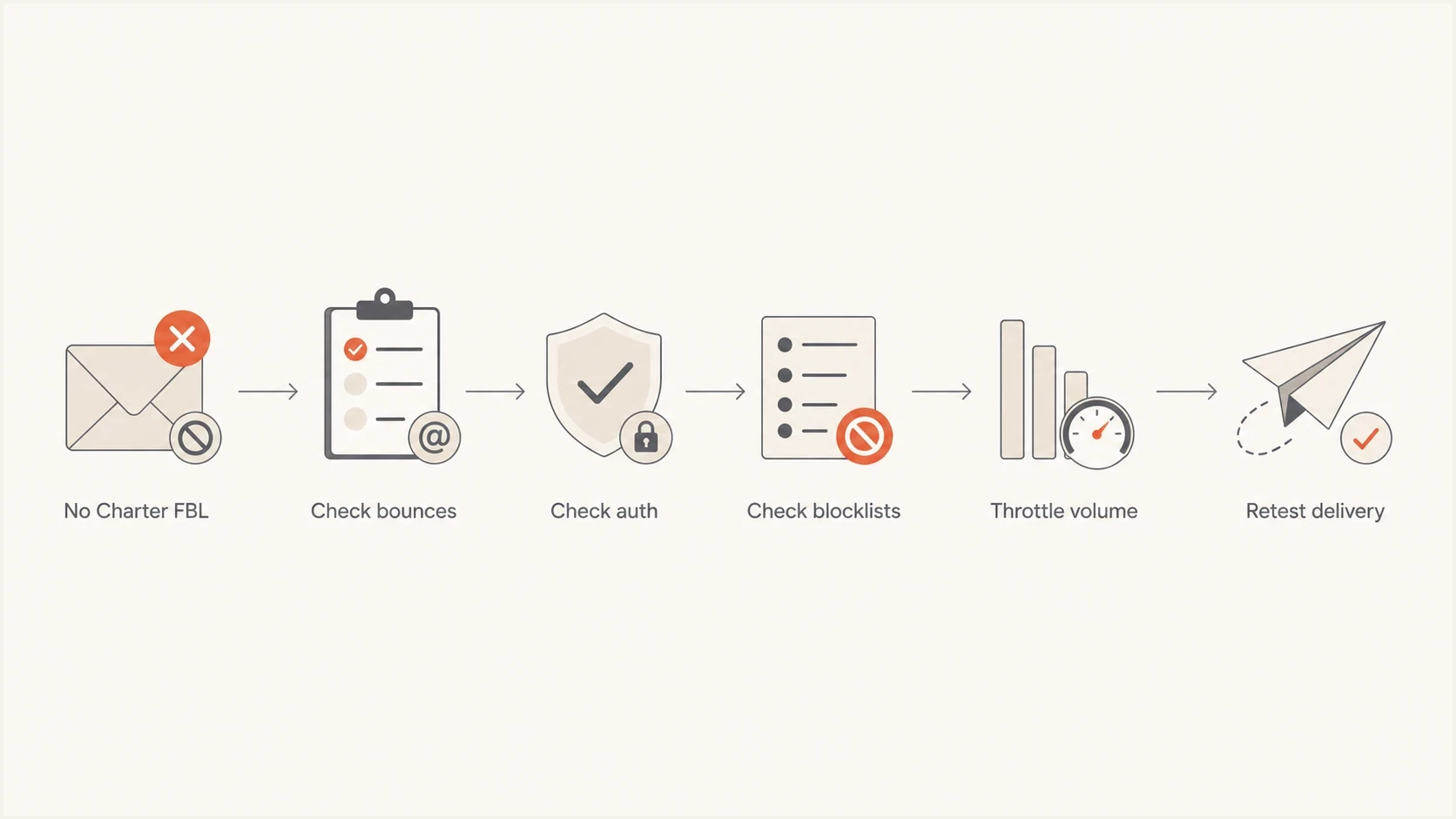
Email deliverability troubleshooting flow when the Charter.net feedback loop is unavailable.
Active complaint loop
- The provider sends ARF-style complaint messages.
- The complaint reaches the sender or ESP.
- The sender suppresses the complainer quickly.
Charter.net today
- No public sender signup route exists.
- SMTP bounces and deferrals carry the available delivery signal.
- Use engagement and unsubscribe data for sender-side suppression.
How to monitor without the Charter FBL
When a provider has no working public FBL, the goal is to collect enough indirect evidence to act before reputation damage turns into sustained blocking. Start by separating Spectrum-family domains into their own reporting view, then compare unsubscribe rates, hard bounces, soft bounces, and delayed delivery against the rest of the list and each domain's normal baseline.
Keep using provider feedback loops where they exist, but do not assume those feeds cover Charter.net. For a real message-level check, send a controlled test through an email tester and inspect headers, authentication, content signals, and placement clues before pushing more volume.
- Group charter.net, spectrum.net, rr.com, twc.com, and roadrunner.com apart from global mail.
- Treat repeated 4xx deferrals as pressure and a 5xx policy rejection as a stop signal for that recipient.
- Remove hard bounces, recent complainers reported by other FBLs, and stale inactive addresses.
- Verify SPF, DKIM, and DMARC because authentication failures make reputation diagnosis harder.
Email tester
Send a real email to this address. Suped shows a results button when the test is ready.
?/43tests passed
A test send does not replace mailbox provider complaint data, but it catches authentication mistakes, broken headers, missing unsubscribe handling, and content issues that make a no-FBL provider harder to diagnose. If the test passes and Spectrum-family domains still defer, reduce volume and continue with domain-level monitoring.
Prevent complaints you cannot see
An FBL is a late signal, so the strongest control is to prevent avoidable complaints before they reach Spectrum. Keep a permission record for every subscribed address, honor frequency choices, and make leaving the list easier than using the complaint button.
- Send subscription mail only to addresses with a documented permission record.
- Use confirmed opt-in (double opt-in) when acquisition risk is high, and never re-add an address after it unsubscribes.
- Place a visible unsubscribe link in the message body and process the request immediately.
- Add RFC 8058 one-click headers to subscription mail and cover both headers with a valid DKIM signature.
One-click unsubscribe headersemail
List-Unsubscribe: <https://example.com/unsubscribe/opaque-recipient-token>
List-Unsubscribe-Post: List-Unsubscribe=One-Click
The HTTPS URL must identify the recipient and list without requiring a login or confirmation page. Use an opaque recipient token instead of exposing an address, process the POST automatically, and keep the visible body link as a separate exit path.
Signals to monitor without complaint reports
Without Charter complaint reports, the best signal is a combined view. One metric alone gives a noisy answer. A sudden rise in unsubscribes after a Charter-heavy campaign, a jump in soft bounces at rr.com, more deferrals, and lower opens at Spectrum-family domains together justify investigation. Open data can be distorted by privacy controls, so use it as a directional cohort signal rather than a complaint count.
Complaint-risk proxy response
Compare each Spectrum-family metric with its normal baseline; do not combine bounce and unsubscribe percentages into one universal threshold.
Stable
At baseline
Delivery and recipient-response metrics remain within their normal ranges.
Investigate
Single shift
One metric shifts materially after a campaign or list-source change.
Throttle
Correlated shifts
Deferrals rise alongside another negative sender-side signal.
Stop and repair
Sustained incident
Policy blocks or negative signals persist after volume reduction.
These response bands are relative to your own baseline because Charter publishes no complaint-proxy threshold. Keep each metric separate because the denominators and meanings differ. Compare the same mail type, list source, sending pattern, and Spectrum-family domain group before changing volume.
When a missing FBL matters less
A clean consent model, fast unsubscribe handling, low inactive volume, and accurate bounce processing reduce your dependence on recipient-level complaint reports. The missing Charter feed still matters, but it is less painful when the rest of the system is disciplined.
Technical checklist for Spectrum delivery
Before treating a Charter or Spectrum issue as a pure reputation problem, verify the basics. Use a domain health checker to confirm SPF, DKIM, DMARC, MX, and DNS health, then add blocklist monitoring for the sending IPs and domains. Blocklist and blacklist hits are not the same as complaints, but they often explain sudden policy rejections.
Authentication baselinedns
_dmarc.yourdomain.com TXT v=DMARC1; p=none; rua=mailto:dmarc@yourdomain.com
yourdomain.com TXT v=spf1 include:send.example -all
selector1._domainkey.yourdomain.com TXT v=DKIM1; k=rsa; p=KEY
|
|
|
|---|---|---|
SPF | One record | Reduce lookups |
DKIM | Signed | Rotate keys |
DMARC | Reporting on | Stage policy |
rDNS | Matches HELO | Fix with host |
Blocklist/blacklist | Clean | Investigate |
Spectrum delivery checks
If several sending systems use the same domain, make sure each one signs with DKIM and fits your DMARC policy. A single unauthenticated stream can damage the provider-level view and make Charter/Spectrum troubleshooting look random.
When it is blocking, not complaints
Many Charter/Spectrum problems show up as throttling, temporary deferrals, or policy blocks rather than a complaint signal. Spectrum's published network management practices describe spam filtering, IP reputation, real-time IP blocklists (blacklists), and traffic thresholds based on recipient and connection behavior. If you see delayed mail, repeated 4xx replies, or domain-specific rejections, treat it as a delivery incident.
For broader troubleshooting, separate Spectrum/Charter delivery issues from Charter/Spectrum blocking. The first path starts with authentication, throttling, and segmentation. The second path starts with bounce text, reputation evidence, and any blocklist or blacklist status.
Do not wait for FBL data
- Reduce concurrency and daily volume when 4xx deferrals cluster around Spectrum domains.
- Remove inactive addresses and recent negative responders before the next send.
- Keep timestamps, sending IPs, domains, sample SMTP replies, and remediation notes.
A Charter FBL would only tell you about users who clicked a complaint control. It would not fix invalid authentication, poor list age, high volume spikes, stale addresses, or a sending IP with poor recent history. Fix those directly.
Where Suped fits
Suped is our DMARC reporting and email authentication platform. For this use case, Suped cannot create a Charter feedback loop because the sender-facing feed is not publicly available. Suped gives you one place to monitor the signals you still control: DMARC, SPF, DKIM, issue detection, blocklist and blacklist status, and alerting.
Suped DMARC dashboard showing email volume, authentication health, and source breakdown
For teams using Suped, this turns the missing-FBL problem into a monitored workflow. You can see authenticated and unauthenticated sources, catch failures before policy enforcement, monitor IP and domain reputation, and receive alerts when a sending source starts failing.
Manual workflow
- Bounce logs, DNS records, reports, and blocklist or blacklist checks sit in separate places.
- Teams can discover failures after reputation or delivery has already shifted.
- MSPs and multi-brand teams repeat the same checks for every domain.
Suped workflow
- DMARC, SPF, DKIM, hosted records, and deliverability checks live together.
- Automated issue detection gives specific steps to repair each problem.
- Multi-tenancy helps agencies and MSPs manage many domains in one workflow.
Hosted SPF, SPF flattening, Hosted DMARC, Hosted MTA-STS, blocklist monitoring, and notification controls are useful when the team responsible for email does not control every DNS change or sending platform. That is common in the environments where a missing Charter FBL creates confusion.
Views from the trenches
Best practices
Treat Charter.net complaint data as unavailable and build suppression around other signals.
Track Spectrum bounces separately so policy blocks are not hidden inside global rates.
Verify SPF, DKIM, and DMARC before testing volume changes against Charter domains.
Common pitfalls
Waiting for a Charter FBL signup path wastes time when the practical answer is no access.
Treating Gmail-style FBL data as recipient-level complaint data leads to bad suppression logic.
Changing IPs before fixing list quality usually moves the same complaint problem elsewhere.
Expert tips
Tag every campaign and source so non-FBL complaint clues still map back to a cause.
Watch for 4xx deferrals before they become 5xx blocks on legacy Spectrum domains.
Keep a clean rescue plan for charter.net, rr.com, twc.com, and roadrunner.com domains.
Marketer from Email Geeks says the Charter.net feedback loop is no longer functional, so senders need to rely on bounce behavior, suppression rules, and other provider complaint feeds.
2023-06-29 - Email Geeks
Marketer from Email Geeks says old EarthLink feedback loop references should not be used as evidence that Charter.net has a working complaint feed.
2023-06-29 - Email Geeks
Sender operating plan
The Charter.net feedback loop is not a tool you can build a current deliverability process around. Treat it as publicly unavailable, monitor Spectrum-family domains separately, and move your controls closer to the data you still receive: SMTP replies, DMARC reports, authentication failures, unsubscribe movement, engagement drops, and blocklist or blacklist status.
Stop searching for a Charter FBL signup route, then harden the parts of your sending program that still produce measurable signals. Maintain clean suppression, reduce volume when deferrals rise, authenticate every sending stream, and keep reporting that shows which source, list, or campaign created the risk.




