Is it legal to opt users back into email lists for operational emails after they've opted out and are there alternative campaign setups?

Updated on 31 Jul 2026: We clarified jurisdiction-specific legal rules and current Account Engagement limits, including the consent record needed for a safe re-subscription.
No. Do not opt users back into a marketing email list after they have opted out just because an operational email needs to be sent. That creates legal risk and breaks the user's stated preference. It also creates a data problem that can let marketing email leak through later.
The cleaner answer is to keep the marketing opt-out intact and send genuine operational or transactional messages through a separate mailability path. A program acceptance notice, application decision, account security notice, billing update, safety notice, or required service update should not depend on a marketing subscription flag.
This is not legal advice, and cross-border sending needs review by counsel. Still, the practical rule is clear: do not treat a marketing opt-out as a temporary obstacle. Treat it as a durable marketing suppression, then build a separate route for messages the user still needs to receive.
The short rule
- No re-subscribe: Do not flip a user back to opted-in status to make an automation work.
- Separate status: Use one flag for marketing consent and another for operational mailability.
- Use counsel: Get legal review when any recipient lives outside one country.
Direct answer
If someone has opted out of marketing email, keep them opted out of marketing. A necessary non-marketing email can still be sent when its content and purpose fit the law that applies to the recipient. The problem is not a properly classified operational send. The problem is using a marketing opt-in field as a workaround.
For U.S. CAN-SPAM purposes, the FTC distinguishes commercial messages from transactional or relationship messages. The FTC guide says commercial opt-outs must be honored, while a message with a transactional or relationship primary purpose is exempt from most CAN-SPAM requirements. It must still avoid false or misleading routing information. The exemption does not give permission to re-enable marketing. It gives a reason to send a qualifying message on the right stream.
- Legal answer: Do not opt users back into marketing after an opt-out unless they take a fresh, affirmative action to subscribe again.
- Operational path: Send necessary non-marketing email through an operational or transactional stream, with no promotional content.
- Bad workaround: Adding application language that says users will be opted back in does not fix the underlying suppression problem.
- Best setup: Store marketing consent, operational mailability, legal notice requirements, and global safety blocks as separate data points.
Recipient status modeltext
marketing_opt_in: false
marketing_suppressed: true
operational_mailable: true
notice_type: application_status
send_stream: operational
last_marketing_opt_out: 2026-05-25
That model avoids the common trap of making one field mean consent, suppression, delivery eligibility, and required-notice routing. Operational mailability must still sit behind global blocks for hard bounces, invalid addresses, abuse complaints, and recipient-specific do-not-contact requirements.
How to classify the message
Start by classifying the email before thinking about tooling. A university application decision is usually administrative or non-marketing when it only reports the outcome of a process the applicant initiated. Whether a statute calls it transactional is a separate, fact-specific question. A scholarship deadline reminder can be administrative when it is necessary to complete that same process. A general newsletter about campus life is marketing.
For U.S. CAN-SPAM classification, the key test is the primary purpose of the message. If the subject line, opening content, design, or call to action makes the email feel promotional, the message starts to look commercial even if an operational detail appears lower in the body. Keep operational emails plain and direct, limited to the necessary action or notice.
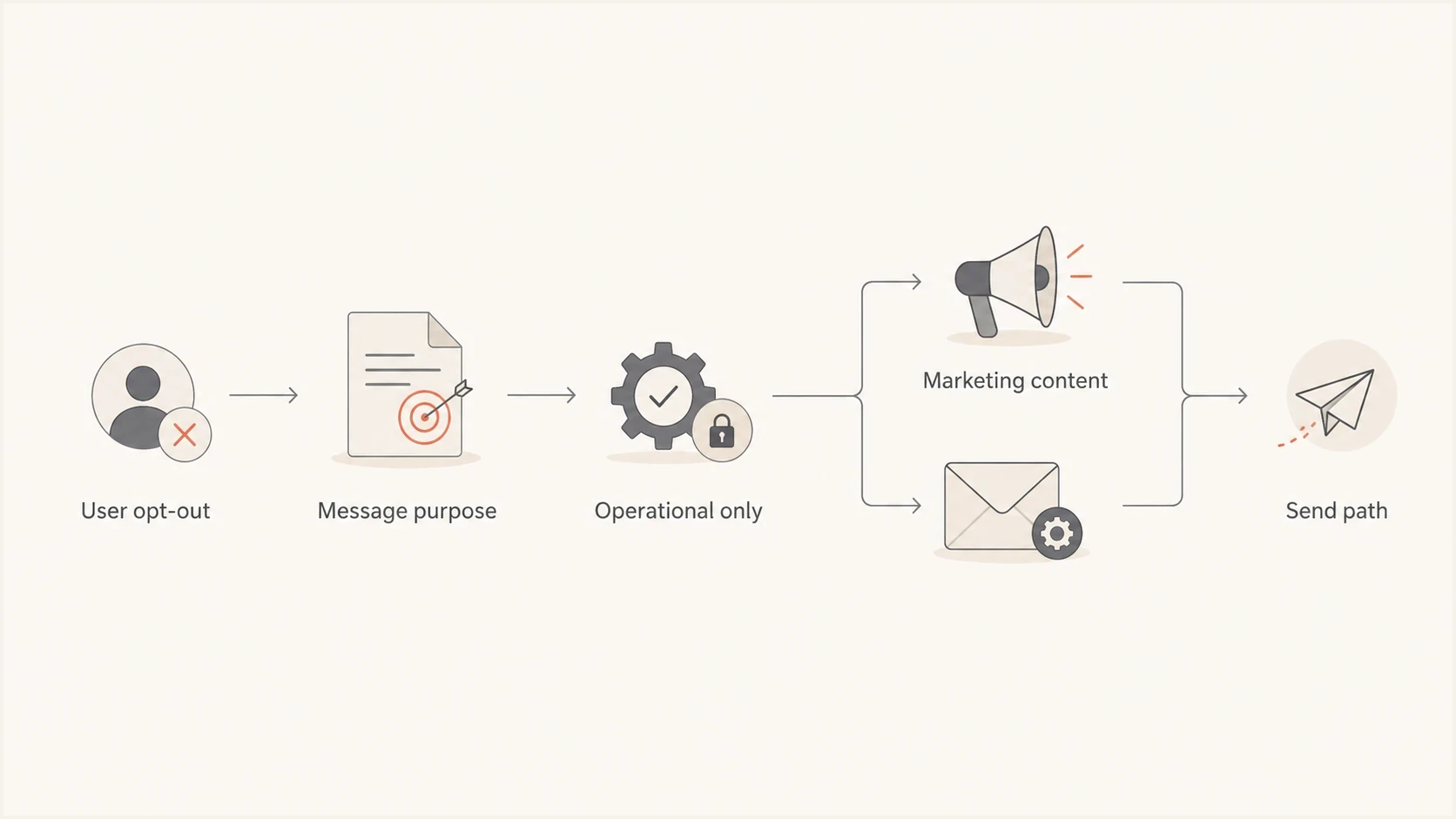
Decision path for sending operational email after a marketing opt-out.
|
|
|
|
|---|---|---|---|
Application decision | Administrative | Operational stream | Low |
Password reset | Transactional | Transactional stream | Low |
Policy change | Relationship | Legal notice | Low |
Event invite | Marketing | Suppressed | High |
Mixed update | Mixed | Rewrite | Medium |
Compact classification guide for opted-out recipients.
When the message is mixed, rewrite it. Do not add a campus event promotion, donation ask, upsell, discount, newsletter module, social follow block, or broad brand content to an operational notice. The subject line should match the operational purpose, and the first visible content should get straight to the required information.
For close cases such as terms updates, the safest pattern is to keep the email narrowly focused on the relationship or account change. This same logic applies to terms of service email decisions, where the message should not be treated as a marketing recovery opportunity.
Operational is not one legal category
Operational is a sending label, not a universal legal exemption. Classify the message under the law connected to the recipient and the sending operation. Then configure the stream to enforce that classification without changing the marketing consent record.
|
|
|
|---|---|---|
United States | CAN-SPAM primary purpose and five narrow transactional or relationship categories | Noncommercial content can fall outside the commercial rules, while a mixed commercial message must meet CAN-SPAM. |
United Kingdom | Pure administrative or customer service content is outside PECR direct marketing rules | Adding promotional material makes the service message direct marketing. |
EU/EEA | National ePrivacy law plus a GDPR lawful basis and purpose limitation | Document the lawful basis for necessary processing and keep a marketing objection in force. |
Canada | Whether the email encourages commercial activity and whether a specific CASL exception applies | A request for express consent sent by email can itself be a commercial electronic message. |
Australia | Whether the message advertises, offers, or promotes, or qualifies as a narrowly factual message | Commercial messages generally need consent and unsubscribe; designated factual messages still need sender identification. |
High-level working tests that require jurisdiction-specific legal review.
Do not rely on internal labels
Internal labels and platform settings do not decide the legal category. Review the actual subject line, visible copy, destination links, footer, audience relationship, and applicable jurisdiction.
Campaign setups that avoid re-subscribing users
There are several workable campaign setups. The right one depends on how much control the email platform gives you, whether the message has to be automated, and whether the source of truth is the CRM, product database, student information system, or consent ledger.
Rank the options by how well they preserve the marketing opt-out. Anything that edits the marketing opt-in flag sits at the bottom of the list, even if it reduces manual work for the sending team.
Risky setup
- Opt-in flip: The system changes the user to marketing opted-in before a send.
- Hidden leak: A later campaign can include the user by mistake.
- Weak consent: Application language does not equal a fresh marketing subscription.
Cleaner setup
- Separate stream: Operational sends bypass marketing subscription logic without changing it.
- Durable suppression: Marketing opt-outs stay active until the user subscribes again.
- Audit trail: Each send has a clear reason, source, template, and recipient state.
The first option is a dedicated operational stream. The automation reads from a field such as operational_mailable or application_notice_required, not from the marketing opt-in field. The email template is locked to non-promotional content, and reporting shows why the recipient received it.
The second option is a CRM or application workflow that sends the notice outside marketing automation. This works well for acceptance, denial, account, billing, and compliance notices. The workflow should still use authenticated mail, clear templates, logging, and global delivery blocks, but it should not depend on marketing list membership.
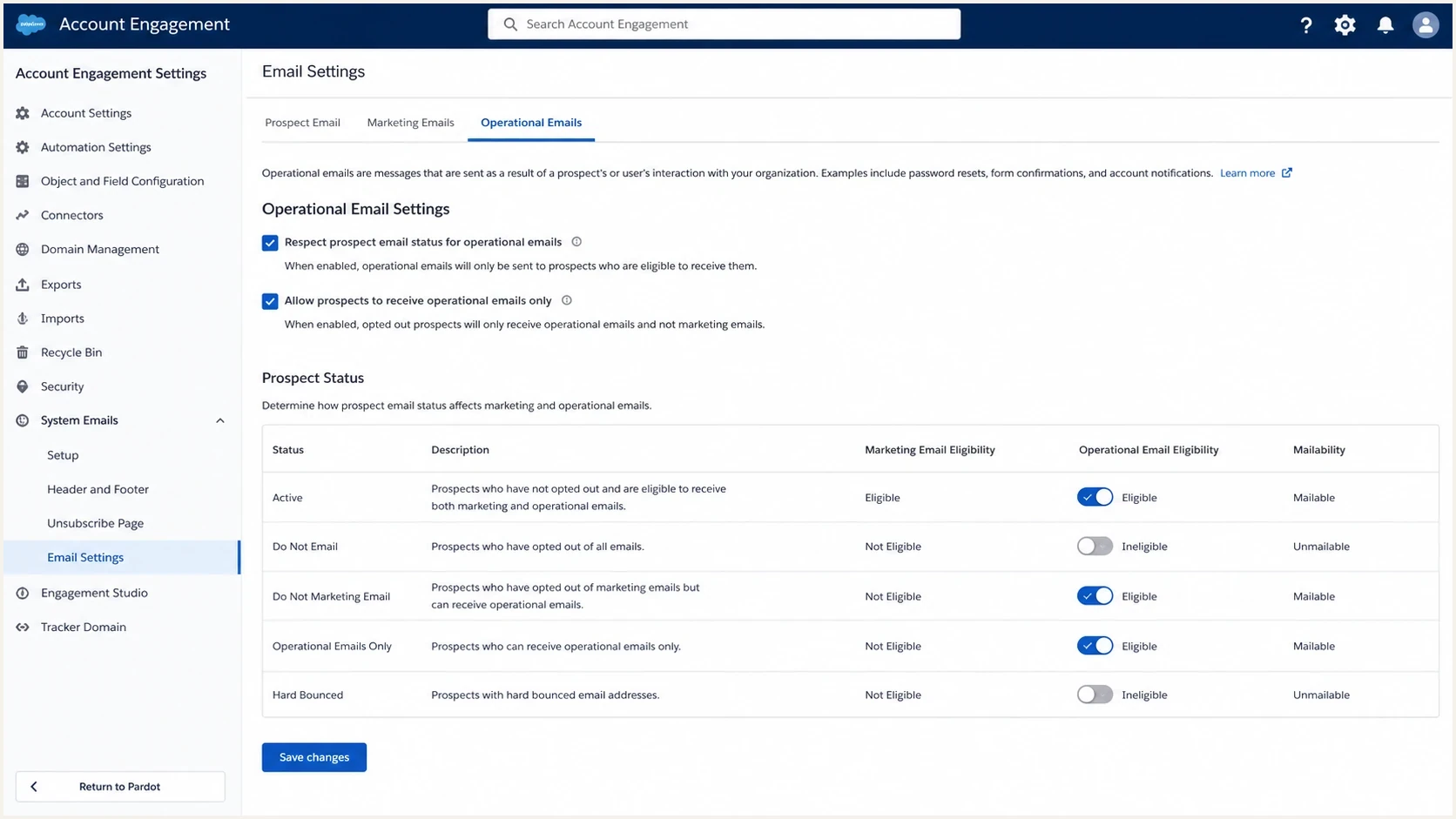
Salesforce Account Engagement settings concept for operational email eligibility.
The third option is a dual-campaign structure: one marketing program and one operational program. This only works if the platform lets opted-out users enter the operational program. Salesforce Account Engagement uses an Operational Emails Only mailability state. Its current documentation says operational emails can be sent as list emails and through Engagement Studio, but not through automation rules. University-specific guidance such as the Cornell Account Engagement page also describes the commercial and operational distinction.
The fourth option is a preference center with separate categories. Marketing newsletters, events, partner announcements, and program updates can have normal subscription controls. Required operational notices should be explained separately, with a contact-change path rather than a marketing unsubscribe path. The unsubscribe process still needs care, especially where automated link scanners and privacy tools click links, so review unsubscribe handling before relying on one-click changes for sensitive preferences.
Practical alternatives
- Operational stream: Best when the platform can send non-marketing automation to opted-out users.
- CRM workflow: Best when the CRM has the event trigger and the marketing platform blocks entry.
- Application send: Best when the user action happens in the product or admissions system.
- Dual categories: Best when users need granular control over optional communication types.
- Manual fallback: Acceptable for rare exceptions, not as the normal operating model.
A practical setup for Salesforce Account Engagement
If the current platform is Salesforce Account Engagement, do not patch around an automation limit by changing the global opt-out. Ask the admin team to enable operational email sending and confirm that eligible recipients have an Operational Emails Only mailability state. Use an operational list email or a Send Operational Email step in Engagement Studio. Automation rules cannot send operational emails.
If those routes do not fit the trigger, treat Account Engagement as the marketing system and use Salesforce core automation or an application-triggered mail route for these notices. A CRM workflow can also own the trigger. The send decision should come from the application event, not the marketing subscription state.
Operational routing logictext
if message_type == application_decision:
  use_stream = operational
  require_marketing_opt_in = false
  include_promotional_modules = false
  preserve_marketing_suppression = true
else:
  use_stream = marketing
  require_marketing_opt_in = true
Make the template library enforce the distinction. Operational templates should have locked headers, limited footers, no promotional slots, and a required reason code. Marketing templates can keep the normal unsubscribe footer and marketing compliance controls.
For international recipients, do not assume the U.S. framework is enough. Canada, the EU, the UK, Australia, and other jurisdictions use different consent and privacy concepts. A globally safer build is stricter than the minimum U.S. rule: honor marketing opt-outs, keep proof of the user's relationship, keep operational content narrow, record the applicable lawful basis where required, and document why the message was necessary.
International caution
- Local law: Review each major recipient region before changing consent or mailability rules.
- Narrow purpose: Send only the notice the recipient needs, with no general marketing content.
- Proof: Keep an audit record of the relationship, event trigger, template, and send reason.
Authentication and deliverability checks
Operational email still has to reach the inbox. In practice, that means the domain, subdomain, IPs, and envelope path need to be authenticated and monitored. A legally valid application decision email does not help the recipient if SPF or DKIM fails, causing DMARC to fail and the message to land in spam.
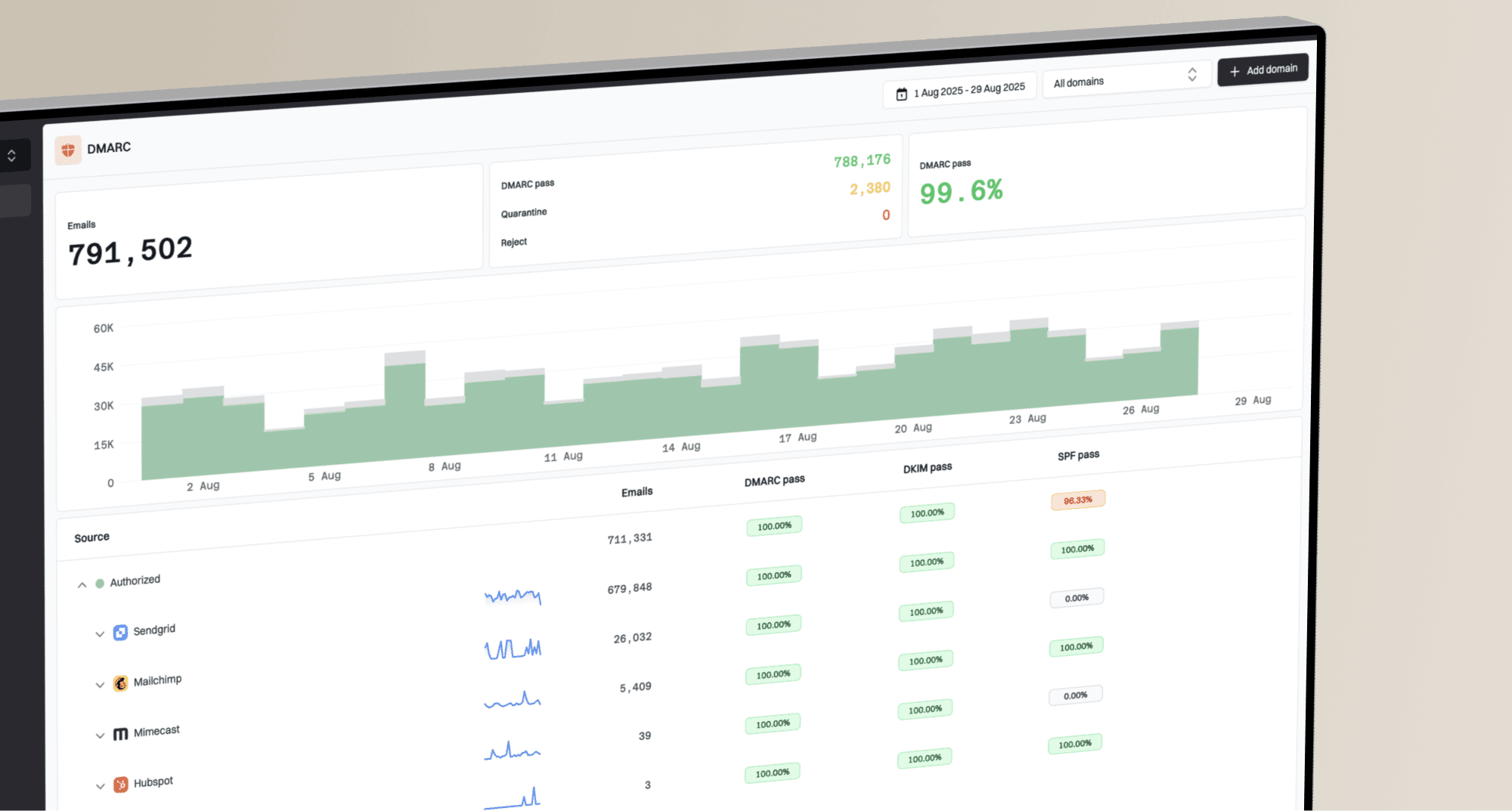
Before moving critical notices to a new stream, run a domain health check on the sending domain and confirm that SPF and DKIM authentication produces a DMARC pass. If the institution uses several departments or subdomains, ongoing DMARC monitoring shows which systems are sending and whether they authenticate. It also identifies an unknown source when one appears.
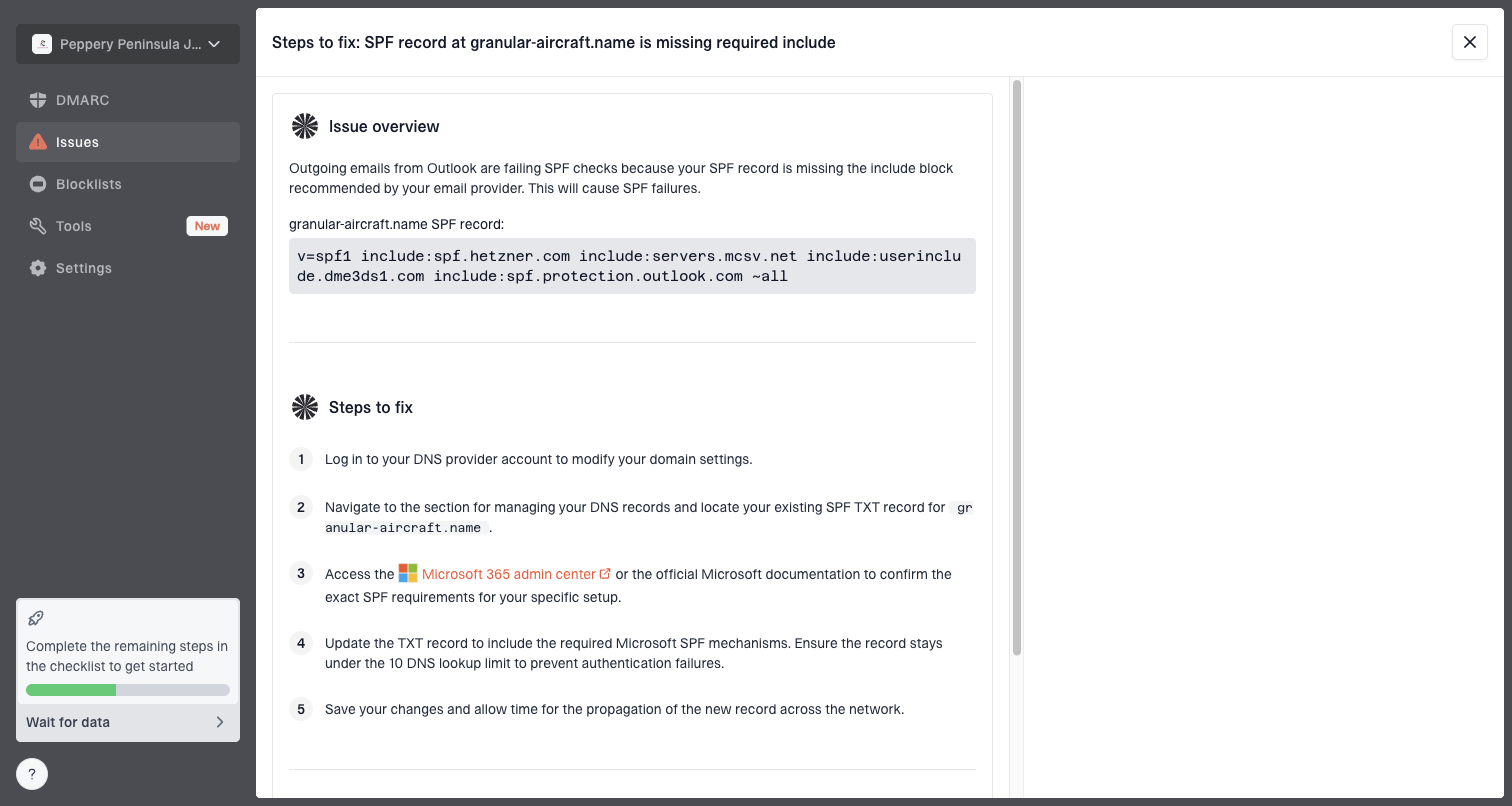
Issue steps to fix dialog showing the issue overview, tailored fix steps, and verification action
Suped's product can collect DMARC aggregate reports for operational From domains and show the sending source with its authentication result, including the failure reason. A practical workflow tags each authorized sender and investigates new unauthenticated sources. An alert can then reach the system owner before a policy or vendor change affects critical notices. Suped also includes blocklist (blacklist) monitoring for domain or IP reputation incidents.
For organizations with several departments or domains, Suped's multi-tenant views can group domains by owner while keeping authentication findings tied to the sending system. This helps a team verify migration to a new operational subdomain without working directly from raw aggregate reports.
After authentication is configured, send a real message through the email tester and inspect the result. The test should use the same From domain, sending system, template, links, and footer style as the live operational email.
Email tester
Send a real email to this address. Suped shows a results button when the test is ready.
?/43tests passed
If operational emails use a different subdomain, warm it carefully and keep complaint rates low. Users who opted out of marketing are already sensitive to unwanted email. A clear subject line and narrow operational content reduce complaint risk.
Implementation checklist
Implement this as a data and process change, not as copy in an application form. Disclosure language can explain that necessary operational notices will be sent, but it should not claim that users will be put back onto marketing lists.
The sending team needs a workflow that makes the correct action easy. If the only easy action is to toggle opt-in, people will use it under deadline pressure. Build the operational path and lock the risky fields. Make the audit record automatic.
- Define categories: List every operational notice type and separate it from optional marketing communication.
- Split data: Use separate fields for marketing consent, operational eligibility, legal notice reason, and global delivery blocks.
- Sync suppression: Propagate applicable opt-outs across connected systems and stop stale records from restoring permission.
- Lock templates: Remove promotional modules from operational emails and review the footer language.
- Route sends: Send from an operational stream that does not change the marketing opt-out state.
- Log proof: Record the event trigger, template version, recipient state, reason code, and send timestamp.
- Test delivery: Verify authentication, inbox placement signals, reply handling, and global suppression before launch.
What to reject
Reject any process that changes Email Opt Out, Opted Out, Do Not Email, or an equivalent suppression field as a pre-send step for an operational campaign. That creates a race condition between automated compliance controls and human action.
A fresh subscription can restore marketing eligibility, but capture it as a new, verifiable event with the exact notice, scope, source, timestamp, and recipient action. A confirmed or double opt-in step verifies address ownership and creates a stronger consent record. Do not infer consent from the need to receive a required notice, and do not send a bulk re-permission campaign to suppressed recipients unless counsel confirms that the law and platform policy permit it. In Canada, an email requesting express consent can itself be a commercial electronic message.
Views from the trenches
Best practices
Keep marketing opt-outs durable and route operational notices through separate mailability fields.
Document the primary purpose of each operational template before it enters automation.
Use plain operational copy so recipients understand why the message reached them after opting out.
Common pitfalls
Changing the opt-out flag for one send creates later marketing leakage and audit confusion.
Treating all applicant or account messages as operational leads to promotional content creep.
Manual exception lists become normal process when the platform cannot handle separate streams.
Expert tips
Create an operational send reason field that is required before any suppressed user can be sent.
Test the exact operational stream, not a nearby marketing template with different authentication.
Escalate platform limits early because consent workarounds become expensive compliance debt.
Marketer from Email Geeks says opting people back into marketing after an opt-out creates legal and trust problems, even when the intended message is operational.
2024-03-27 - Email Geeks
Marketer from Email Geeks says the platform should support separate handling for operational messages, and a tool that cannot do that forces risky workarounds.
2024-03-27 - Email Geeks
Keep operational sends separate
Do not opt users back into marketing lists to send operational emails. Send genuine operational messages through a separate operational or transactional route while preserving the marketing opt-out. Keep the content narrow enough to retain its non-marketing purpose.
The best campaign setup has separate data, templates, send logic, safety blocks, and a clear audit trail. If a platform cannot support that, move the operational send outside the marketing list logic instead of weakening consent records.
Once the compliance path is fixed, check the sending domain and monitor authentication continuously. Operational messages deserve the same delivery discipline as revenue email, and often more, because the recipient is waiting for a specific outcome.