Is it legal and advisable to send terms of service emails to unsubscribed users?

Published 14 Jun 2025
Updated 27 Jul 2026
11 min read
Summarize with
Updated on 27 Jul 2026: We clarified when a service notice can bypass a marketing unsubscribe and added controls for audience selection, suppression, decision records, and rollout monitoring.
Yes, a terms of service email can be legal to send to someone who unsubscribed from marketing, but only when it is genuinely a service or relationship notice tied to a current account, subscription, membership, purchase, employment relationship, or similar ongoing relationship. The case becomes risky when the audience includes former users, prospects, people with no current relationship, spam complaint records, old hard bounces, or anyone who has chosen a true no-contact preference.
Advisable is a different question. Do not send a broad terms update to every unsubscribed, complained, and obsolete address in the database, especially while warming new IPs. That kind of send creates the signals mailbox providers dislike: sudden volume, stale addresses, complaint-prone recipients, and low engagement.
The practical answer is to narrow the audience, strip the message of marketing, suppress unusable and complaint records, use web or in-app notices where possible, and treat any email send like a controlled rollout with monitoring and pause rules.
Put one rule in writing: if the notice is legally required, send the smallest nonpromotional version to the smallest legally required audience, suppress bounces and complainants by default, then monitor reputation before scaling.
The legal answer
In the United States, the key distinction is commercial email versus transactional or relationship email. The FTC guide says CAN-SPAM covers commercial messages, while a message whose primary purpose is transactional or relationship content is mostly outside the marketing unsubscribe rules, as long as routing information is not false or misleading. A notice about a change in the terms or features of an account can fit that category when it relates to an ongoing commercial relationship.
That does not mean every terms email gets a free pass. The FTC applies a reasonable-recipient test to the message's primary purpose. A promotional subject line can make a mixed message commercial, and the transactional or relationship content needs to appear at or near the beginning. Keep the notice about the terms change, not reactivation, job ads, upsells, referral offers, or a "come back" pitch.
- Often defensible in the US: A concise notice to active account holders explaining a material terms change that affects their account.
- Higher risk: A notice to all past signups, including people who no longer use the service or only joined a marketing list.
- Bad idea: A bulk send to spam complainers, hard bounces, scraped contacts, obsolete addresses, and records marked no-contact.
- Global caveat: US CAN-SPAM logic is not a global permission slip. Local electronic-marketing and data protection rules still apply.
For a global audience, separate two questions. First, does local law require or permit this notice by email? Second, does the business have a lawful basis to process and use that address for this purpose? Contract necessity is not automatic simply because a communication is mentioned in the terms. The answer can differ by country, product type, customer status, and prior preference.
Counsel should own the legal interpretation. The email team should own the sending risk, suppression rules, monitoring thresholds, and proof that the plan avoids unnecessary recipients.
Who should receive it
The safest list is not "everyone who ever gave us an email address." It is the subset of people who have a current relationship and need the notice to understand their rights, obligations, or account status. Make the recipient rules explicit before anybody exports a list.
|
|
|
|---|---|---|
Active account | If needed | Current relationship |
Marketing unsub | Only if needed | Service notice only |
Spam complaint | Default no | Use another channel |
Hard bounce | No | Address failed |
Old prospect | No | No active account |
No-contact | No | Respect preference |
Recipient groups for a terms update send
A marketing unsubscribe should not always block a required account notice. A global no-contact preference, a spam complaint, and a failed address are different. Keep complaint records suppressed by default. If a specific law requires direct delivery despite that suppression, counsel should document the exception and the team should use the least risky available channel.
Audience suppression rulestext
include: active_account = true
include: legal_notice_required = true
exclude: hard_bounce = true
exclude: spam_complaint = true unless counsel-approved exception
exclude: no_contact = true
exclude: address_unusable = true
exclude: marketing_unsub = true if no service relationship
If the business has a login or app experience, web banners and account prompts are often cleaner than email. They reach users who return to the service, avoid waking dead addresses, and make acknowledgement easier to record. Email still has a role, but it should not be the only channel.
Separate service notices from marketing
A single unsubscribe flag is too blunt for this decision. Keep marketing consent, list-level preferences, account status, global no-contact status, complaints, and address failures as separate fields. The sending system should never clear a marketing unsubscribe just because legal approves one service notice.
- Marketing unsubscribe: Blocks promotional and subscription messages without closing the account.
- Service-notice eligibility: Allows only a necessary message tied to a documented current relationship.
- Global no-contact: Suppresses email unless counsel records a specific overriding legal duty.
- Complaint or hard bounce: Suppresses the address by default and triggers another delivery channel.
Major mailbox-provider one-click unsubscribe requirements apply to marketing and subscribed messages, not true transactional messages. If the terms email contains promotional content or its classification is uncertain, route it as commercial email with a working body unsubscribe and one-click headers. Do not attach a marketing-list unsubscribe action to a required service stream if that action would imply that necessary account notices can be stopped.
Decision record to retaintext
notice_version: approved terms version
legal_basis: country-specific reason for email
relationship_status: active on audience snapshot date
message_class: service or commercial
suppression_snapshot: bounces, complaints, no-contact, unsubscribes
approvals: legal, privacy, email operations
send_evidence: timestamp, recipient, message ID, delivery result
Keep the suppression record after an opt-out so it can prevent future marketing sends. Record the terms version, audience snapshot, approvals, and delivery result separately. That creates evidence of the decision without treating an unsubscribe address as a new marketing lead.
Why advisability is harder than legality
Mailbox providers do not care that an internal team labeled the campaign "legal." They see sending behavior. A terms send to stale or suppressed users often looks like a cold reactivation blast: big volume, low opens, high complaints, spam traps, hard bounces, and recipients who do not remember the brand.
That risk matters even more during IP warmup. Warmup is supposed to show mailbox providers that new traffic is wanted and predictable. A sudden legal notice to old records shows the opposite. If the list includes feedback loop complaints, it also repeats contact with people who already used the strongest mailbox-level negative signal available.
Example rollout pause thresholds
These are conservative internal guardrails for a one-off notice, not legal limits or delivery guarantees.
Healthy
Complaints under 0.03%
Continue cautiously
Watch
Complaints 0.03-0.08%
Slow the next batch
Pause
Complaints over 0.08%
Stop and review
Investigate
Hard bounces over 2%
Check address quality
Before a broad send, run a domain health checker review, confirm authentication, check recent complaint trends, and review current domain and IP reputation. If the domain is already fragile, move the notice to a slower rollout or a non-email channel.
?
What's your domain score?
Deep-scan SPF, DKIM & DMARC records for email deliverability and security issues.
The answer changes when the audience is small, recent, and engaged. A one-time notice to current paying users is manageable. A multi-million-recipient send with many stale records can damage domain and IP reputation fast. Normal campaigns then inherit the problem.
A safer rollout plan
Use a written rollout plan that legal, privacy, product, and email operations can all read. The plan should define who receives the email, who does not, what the message says, which domain sends it, what metrics pause the send, and what non-email notices cover users who do not get mailed.
Risky approach
- Audience: Everyone in the database, including unsubscribed, old, and failed addresses.
- Message: Legal copy mixed with product reminders, job alerts, or other commercial content.
- Timing: One large batch during IP warmup or after reputation repair work.
- Monitoring: Review results after the full audience has already been mailed.
Safer approach
- Audience: Active relationship only, with hard bounces and complaints excluded.
- Message: Plain service notice with no promotional content and a clear reason.
- Timing: Small batches by engagement, mailbox provider, and market.
- Monitoring: Pause rules for complaints, hard bounces, blocks, and blacklist or blocklist hits.
The first paragraph should explain why the recipient got the email. Avoid humor, urgency tricks, and broad claims. State what changed, when the change takes effect, where the full terms live, what happens if the user keeps using the service, and how to ask account questions.
Example batch scheduletext
Day 1: active users, recent opens, low complaint history
Day 2: active users, recent login, no recent email activity
Day 3: paying users with valid address, split by mailbox
Pause: complaints > 0.08 percent or hard bounces spike
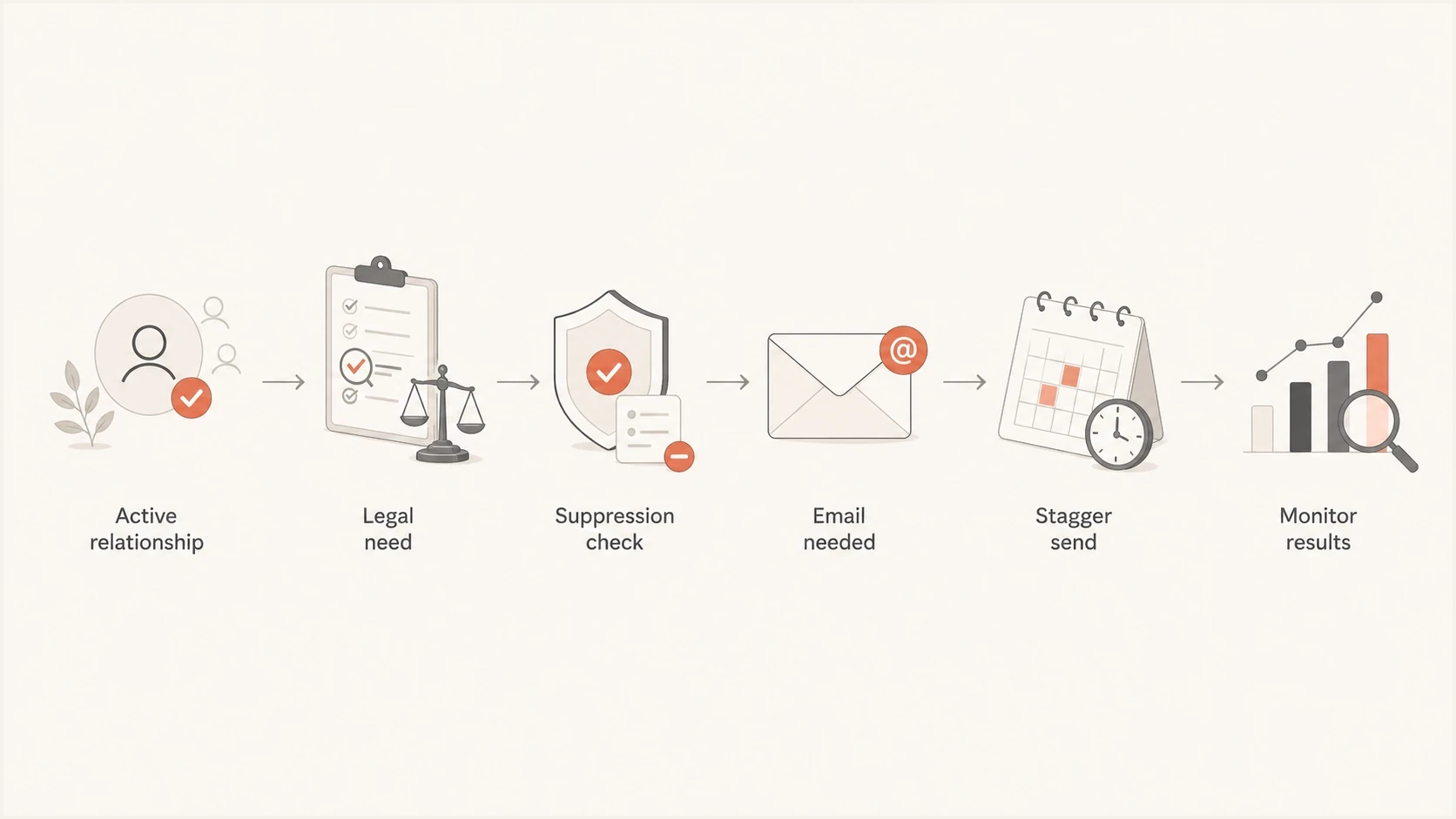
Decision flow for sending a terms notice after a marketing unsubscribe.
Authentication and monitoring
A terms notice needs the same authentication discipline as every other important email. Configure SPF, DKIM, and DMARC for the visible sending domain. DMARC passes when at least one of SPF or DKIM passes and aligns with that domain, although maintaining both controls gives the sending stream better resilience. A separate compliance-mail domain still needs a real reputation, not just fresh DNS records.
Suped is our DMARC and email authentication product. Its DMARC monitoring workflow shows which sources send for the domain and whether SPF, DKIM, and DMARC align. During the rollout, teams can review authentication changes, issue alerts, and blocklist monitoring for blacklist or blocklist events before releasing the next batch.
Issues page showing top issues, verified sources, unverified sources, and authentication pass rates
Send the final message to a real inbox and inspect the result before launch. An email tester pass can catch obvious authentication, formatting, and content issues. It cannot approve the legal theory, but it can prevent avoidable technical failures.
Email tester
Send a real email to this address. Suped shows a results button when the test is ready.
?/43tests passed
If the message is transactional or relationship email, keep it operational. Do not add an offer, recommendations, or a promotional footer. A related question is whether transactional emails should include unsubscribe links. Preference access can help the user, but it should not imply that a user can opt out of a notice the business is legally required to send.
Views from the trenches
Best practices
Keep legal notices separate from marketing and send only to users with an active relationship.
Suppress hard bounces, spam complaints, and records marked as no-contact before the send.
Start with engaged recipients, then expand slowly while watching complaints and bounce rates.
Common pitfalls
Treating every old address as reachable is risky during IP warmup or reputation repair.
Do not use a terms update to revive old prospects who already opted out of marketing.
Do not mix promotional copy into the notice, because small offers change the risk profile.
Expert tips
Document the legal basis, final audience rules, and suppression exceptions before launch.
Use web banners and account prompts when email is not required for every user segment.
Keep reply handling ready, because confused recipients complain when nobody answers quickly.
Expert from Email Geeks says a one-time legal notice can be defensible, but the audience must have an active account relationship.
2023-12-15 - Email Geeks
Marketer from Email Geeks says the business risk is often deliverability damage, even when counsel approves the send.
2023-12-16 - Email Geeks
The practical decision
A terms of service update does not automatically override every unsubscribe. It can bypass a marketing opt-out for active users when the notice is truly about the account relationship and local law supports that approach. It should not override spam complaints, hard bounces, no-contact flags, or stale records with no clear relationship unless counsel documents a specific legal duty.
If the team uses email, make the send defensible and small. Use a clear subject line, remove marketing, document the recipient criteria, segment by engagement and mailbox provider, and pause when complaints or bounces move outside the internal threshold. For a global audience, make country rules part of the segmentation.
If the domain is warming or already under reputation pressure, use web and in-app notification first, email only where required, and a monitored rollout for the rest. That protects the legal objective without using the email channel as a blunt instrument.




