How will the Google and Yahoo 2024 email sending changes impact email marketers?

Updated on 12 Aug 2026: We updated this guide for Gmail's stricter enforcement and clarified who qualifies as a bulk sender.
The Google and Yahoo 2024 sending changes made email authentication and low-complaint list management baseline operating requirements. Bulk senders need a sending domain they control, SPF and DKIM configured correctly, DMARC on that domain, alignment with the visible From domain, one-click unsubscribe for marketing mail, and complaint rates kept below provider limits.
Treat the change as a shift away from "the ESP handles deliverability" and toward shared responsibility. Your email service provider can sign mail, block risky From addresses, and surface warnings, but your brand still owns the domain, the DMARC policy, sender permissions, consent quality, and the business decision to stop mailing people who do not want the mail.
- Authentication: Bulk marketing domains need SPF, DKIM, and DMARC working together, with the visible From domain matching at least one authenticated domain path.
- From addresses: Small businesses can no longer send bulk campaigns through an ESP while using a personal Gmail or Yahoo address in the visible From header.
- Unsubscribes: Marketing and subscribed mail needs RFC 8058 one-click unsubscribe support, a visible unsubscribe link, and suppression within 48 hours.
- Complaints: Keep Gmail's reported spam rate below 0.1% and prevent it from reaching 0.3% or higher.
Short answer for marketers
The change does not mean every sender must jump straight to p=reject. A DMARC policy of p=none meets the minimum DMARC policy requirement. The real risk is unauthenticated mail, Gmail or Yahoo addresses used as the campaign From address, stale lists, and missing one-click unsubscribe.
What changed in practice
The 2024 rules made several long-standing best practices enforceable at scale. Gmail set explicit requirements for bulk senders, and Yahoo moved in the same direction. Gmail has since increased enforcement against non-compliant traffic, including temporary and permanent rejections. The details matter because marketers often hear "DMARC required" and miss the other half of the change: mailbox providers also care about infrastructure, list quality, complaint rates, unsubscribe handling, and obvious sender identity.
|
|
|
|---|---|---|
 Google Google | About 5,000 messages to personal Gmail accounts in 24 hours | Volume is aggregated across the primary domain and its subdomains. |
 Yahoo Yahoo | Significant sending volume | Yahoo does not publish Gmail's exact numeric cutoff. |
Authentication | SPF, DKIM, and DMARC for bulk senders | At least SPF or DKIM must match the visible From domain for DMARC alignment. |
Infrastructure | TLS, valid forward and reverse DNS, and RFC formatting | The sending platform must meet transport and message-format requirements. |
Unsubscribe | One-click, visible link, and 48-hour processing | Marketing mail needs a working header action and a body link. |
Complaints | Google: below 0.1%; both providers: below 0.3% | Weak consent and stale segments have little room for error. |
Core sender requirements and direct marketing impact.
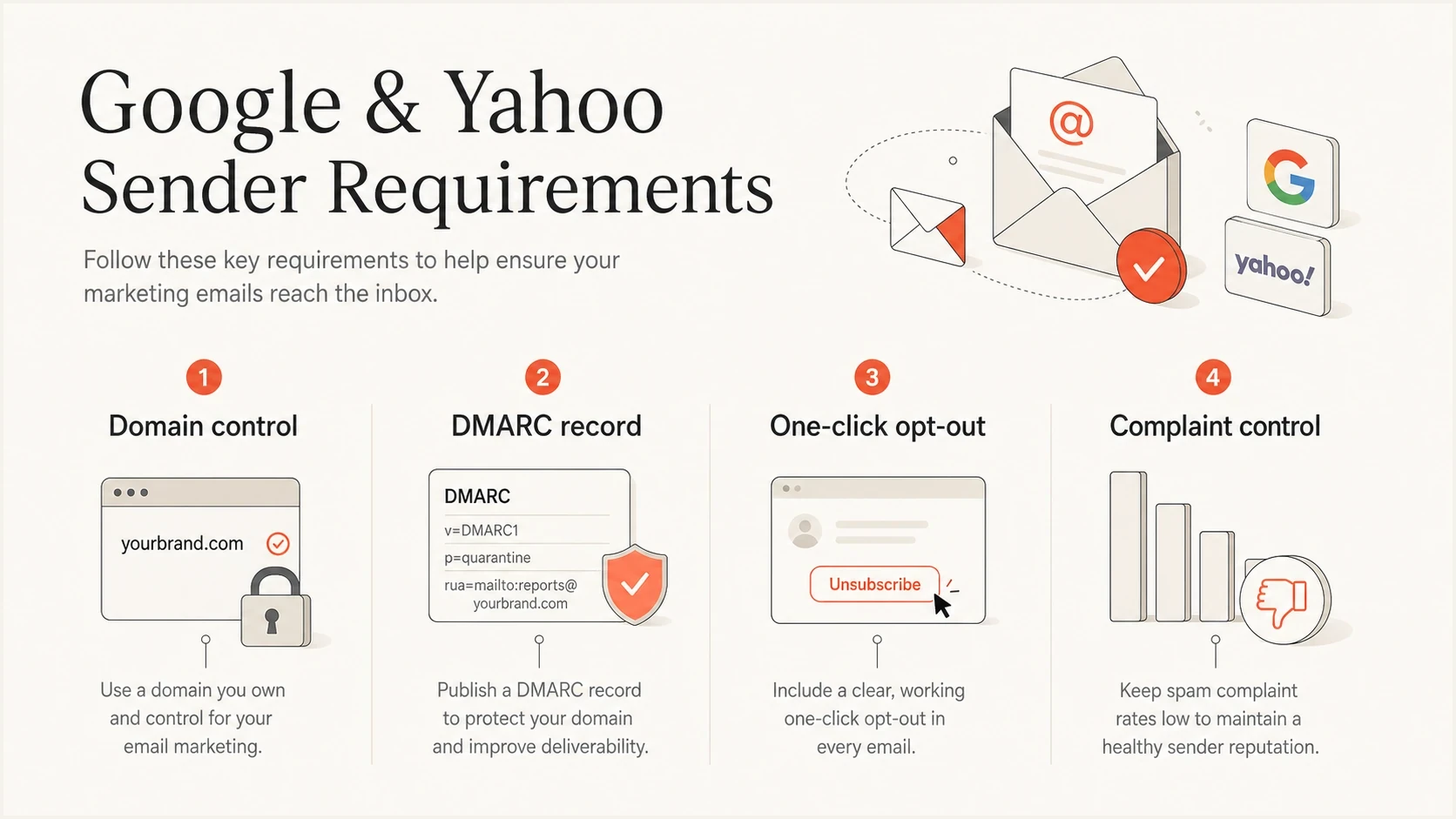
Four requirements for marketing email under Google and Yahoo sender rules
For a marketer, the most visible change is the end of casual sending with consumer mailbox domains. If a local shop, nonprofit, creator, or sales team sends a campaign as jane@gmail.com through a third-party platform, that message breaks the trust model. The fix is not complicated: use a domain the organization controls, authenticate it, and keep that domain separate enough to measure and protect reputation.
For deeper detail on the operational rule set, the Gmail sending rules explain the compliance work in a more focused way.
Who counts as a bulk sender
Gmail classifies a sender as bulk when messages from the same primary domain reach roughly 5,000 or more personal Gmail accounts in a 24-hour period. Mail from example.com and news.example.com contributes to the same domain total. Once Gmail assigns bulk-sender status, reducing volume later does not remove it.
- Count recipients, not list size: A smaller list can cross the threshold when a launch or deadline campaign sends more than once in a day.
- Aggregate related domains: Splitting traffic across subdomains does not avoid Gmail's primary-domain count.
- Use the right recipient scope: The Gmail threshold concerns personal gmail.com and googlemail.com accounts, not inbound mail to managed Google Workspace accounts.
- Do not reuse Gmail's number for Yahoo: Yahoo describes bulk senders by significant volume and does not publish the same 5,000-message cutoff.
Smaller senders still need the foundation
Gmail requires every sender to use SPF or DKIM, valid forward and reverse DNS, TLS, valid message formatting, and low complaint rates. Publishing SPF, DKIM, and DMARC before a growth spike avoids an emergency DNS change when the domain crosses the bulk threshold.
Why marketers feel the impact
The biggest impact is operational, not theoretical. The people building campaigns now need cleaner coordination with whoever controls DNS, the ESP account, the domain portfolio, consent data, and compliance workflows. This adds work, but it also removes ambiguity. When a campaign fails because the From domain has no DMARC record, the problem is visible and fixable.
Before 2024
- Identity: Some senders used a consumer mailbox address in the campaign From field.
- Authentication: Many teams treated SPF, DKIM, and DMARC as background IT work.
- Unsubscribe: Visible links existed, but one-click header support was inconsistent.
After 2024
- Identity: Campaigns need a brand-owned domain in the visible From field.
- Authentication: DMARC is a launch requirement, not a cleanup task after delivery drops.
- Unsubscribe: Promotional mail needs a clean one-click path and suppression within 48 hours.
This is why the change hits marketers even when the DNS work sits with someone else. If your signup sources are weak, your reactivation campaigns are too broad, or your unsubscribe process is slow, authentication alone will not keep the program healthy. Authentication gets you through the door. Recipient engagement and complaints decide what happens after that.
Complaint rate operating targets
Google says to keep the reported spam rate below 0.1% and prevent it from ever reaching 0.3% or higher.
Healthy
Under 0.1%
Strong list quality and relevant sending.
Watch closely
0.1% to 0.3%
Audit targeting, frequency, and old segments.
High risk
0.3% or higher
Pause risky campaigns and repair consent data.
Authentication work marketers need
The minimum technical foundation is clear. A bulk sender needs SPF and DKIM to pass, plus DMARC on the sending domain. DMARC passes when at least one authenticated path matches the visible From domain. Check the exact domain used in the campaign From header first because DMARC evaluation starts there.
DMARC policy examplesdns
v=DMARC1; p=none; rua=mailto:dmarc-reports@example.com
v=DMARC1; p=quarantine; pct=25; rua=mailto:dmarc@example.com
v=DMARC1; p=reject; rua=mailto:dmarc-reports@example.com
A stricter policy is fine when legitimate mail already passes. If your domain is at p=reject and every approved source passes, you are not weaker than the minimum. The danger is publishing enforcement before you know every legitimate sender, especially billing systems, support platforms, survey tools, and internal apps that send with the same domain.
Subdomains are usually covered
If mail uses news.example.com in the From header and no DMARC record exists at that hostname, DMARC falls back to the organizational domain, such as example.com. Add a subdomain DMARC record when you need separate reporting or a different policy.
Suped DMARC dashboard showing email volume, authentication health, and source breakdown
Suped's product converts aggregate DMARC reports into sending sources, alignment results, and specific issues. A marketing team can identify an approved platform that fails authentication, assign the DNS or platform fix to its owner, and confirm that the source passes before moving the domain toward enforcement.
If you already have reporting turned on, use DMARC monitoring to separate approved senders, unknown senders, forwarding noise, and real abuse before moving toward stronger enforcement.
A practical audit sequence
Start with the domain and work outward. This keeps the audit grounded in what Gmail and Yahoo actually evaluate, rather than a generic deliverability checklist. The order matters because a polished campaign still fails if the From domain cannot authenticate, and a technically valid campaign still struggles if it drives complaints.
- Inventory: List every domain and subdomain used in marketing, lifecycle, sales, support, and transactional email.
- DNS: Confirm DMARC exists for the organizational domain and that each bulk sending platform passes both SPF and DKIM.
- Matching: Send a real campaign test and confirm DMARC passes for the visible From domain.
- Infrastructure: Verify TLS, matching forward and reverse DNS for sending IPs, and valid RFC 5322 message formatting.
- Unsubscribe: Check that marketing messages include RFC 8058 one-click headers, visible unsubscribe text, and suppression within 48 hours.
- Complaints: Cut risky segments, old contacts, purchased data, and reactivation sends that create complaint spikes.
Email tester
Send a real email to this address. Suped shows a results button when the test is ready.
?/43tests passed
After DNS checks, send a message through the email tester and inspect the actual authentication result. A DNS record can look right while the real message still fails because the platform is using a different bounce domain, DKIM selector, or From domain than expected.
For a broader DNS review before sending, run a domain health check and compare the result with your current sender inventory. Run this before campaign launch because it catches missing DMARC, broken SPF syntax, missing DKIM records, and domain-level gaps in one pass.
One-click unsubscribe headerstext
List-Unsubscribe: <mailto:u@example.com>, <https://example.com/u/abc>
List-Unsubscribe-Post: List-Unsubscribe=One-Click
For Gmail, the one-click action needs the HTTPS URL and POST behavior defined by RFC 8058. A mailto option or a preference-page link does not replace it. Keep a clearly visible unsubscribe link in the message body and process the one-click request within 48 hours.
Common edge cases
The confusing cases are predictable. Most come down to ownership: who owns the visible From domain, who controls DNS, who can suppress unsubscribed recipients, and who can stop a sending source that fails authentication.
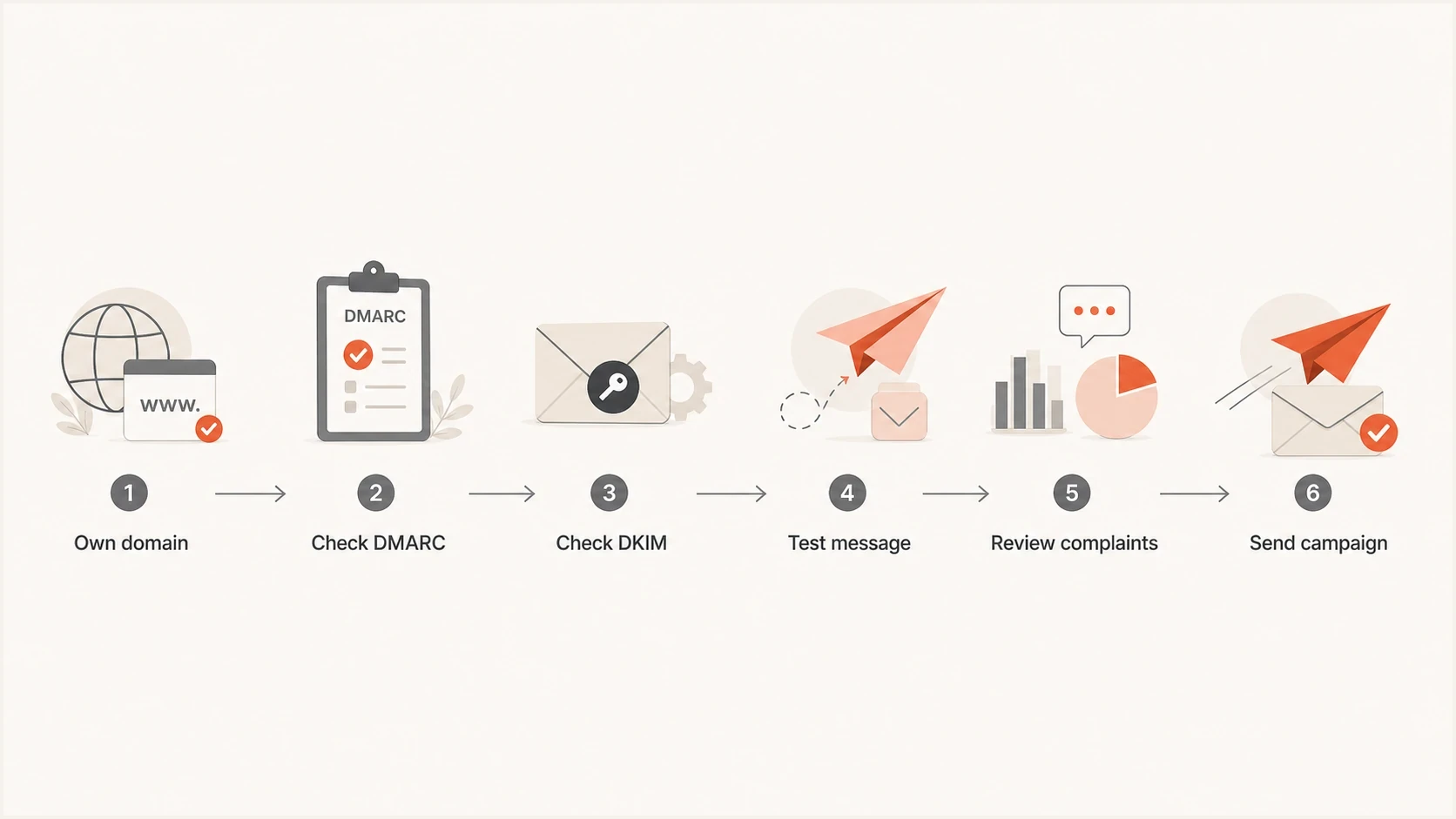
Decision path for checking sender compliance before sending a campaign
Do not send campaigns as Gmail or Yahoo
If a user enters a Gmail or Yahoo address as the campaign From address, the platform should warn them, block the send, or move that address into a Sender field while using an authenticated platform or brand domain in the visible From field. The durable fix is a brand-owned domain, not a workaround.
ESPs can help, but they cannot fully fix a customer's domain posture without customer action. They can add warnings, require domain verification, sign with DKIM, publish clear DNS instructions, prevent consumer mailbox From addresses, and suppress unsubscribes quickly. The customer still needs access to DNS, approval to change the From domain, and a list strategy that does not create complaints.
Gmail excludes pure transactional messages, such as password resets and reservation confirmations, from its one-click unsubscribe requirement. Mixed lifecycle messages need careful handling because recipients determine whether a message feels promotional. When a message promotes a product, upgrade, event, coupon, or editorial subscription, apply the marketing unsubscribe controls. The List-Unsubscribe requirements are worth reviewing before separating transactional and promotional programs.
Blocklist and blacklist status is not the headline rule, but it belongs in the same operating review. If your sending IP or domain appears on a blocklist (blacklist), investigate before blaming Gmail or Yahoo's rule change. Authentication proves identity, but reputation still affects how receivers treat the mail. Suped's blocklist monitoring helps teams watch domain and IP reputation alongside authentication health.
How to prioritize the work
Prioritize fixes by delivery risk and blast radius. Fix a missing DMARC record or consumer From address on the main marketing domain before cosmetic changes, and treat a broken unsubscribe processor as an immediate stop-send issue.
Recommended first month focus
A simple allocation model for the first month of remediation work.
Authentication
Consent
Operations
Reputation
Once the foundation is stable, move DMARC enforcement in stages. Start with monitoring, confirm every approved source, then move to partial quarantine, full quarantine, and reject. Do not rush enforcement when the source list is unknown, and do not leave a mature domain at monitoring after reports show clean authentication.
DMARC enforcement staging
A staged path for domains that have clean authentication data.
Policy coverage
The marketing team should own the sending policy even when DNS changes sit with IT. That means documenting which platforms can send, what domains they use, which campaigns require unsubscribe headers, who reviews complaint spikes, and who has authority to pause risky segments.
Views from the trenches
Best practices
Use brand-owned From domains, then verify DMARC results with real campaign test mail.
Keep DMARC at monitoring first, then raise enforcement after all senders are known.
Set complaint targets under 0.1% so a single bad segment does not hit the limit.
Common pitfalls
Assuming the ESP can fix customer-owned DNS without domain owner involvement or approval.
Letting small senders keep Gmail or Yahoo addresses in campaign From headers after warnings.
Treating p=none as failure when it is the minimum policy needed to start with reports.
Expert tips
Check the exact From hostname first, then fall back to the organizational domain.
Make platform warnings clear before launch so customer support is not overloaded.
Separate promotional and transactional streams when unsubscribe rules differ across teams.
Marketer from Email Geeks says public guidance changed after the first announcement, so senders should review current requirements instead of relying on early summaries.
2024-02-08 - Email Geeks
Marketer from Email Geeks says the DMARC policy requirement and Gmail's own enforcement for gmail.com From addresses are separate issues that many senders confuse.
2024-02-12 - Email Geeks
What this means now
The Google and Yahoo sender requirements are active, and Gmail has increased enforcement against non-compliant traffic. For marketers, the path is practical: send from a domain you control, authenticate it, monitor DMARC results, support one-click unsubscribe, keep complaints low, and verify the infrastructure behind each sending platform.
Suped's product helps when that work spans multiple domains, teams, clients, or sending platforms. It identifies the source behind an authentication issue, records what needs to change, and gives the team evidence that the fix worked before the next campaign.