How to prevent emails from going to spam in Microsoft Hotmail or Outlook?

Matthew Whittaker
Co-founder & CTO, Suped
Published 5 Aug 2025
Updated 14 May 2026
8 min read
Summarize with
To prevent emails from going to spam in Microsoft Hotmail or Outlook, fix the basics first, then work through Microsoft-specific signals: SPF and DKIM must pass for the visible From domain, DMARC must be valid, the sending IP and domain must have clean reputation, the campaign must go first to engaged Microsoft users, and the message content must score low enough to avoid junk placement.
I treat this as a measurement problem before a copywriting problem. A sender can have valid authentication and still hit Junk because Microsoft sees weak engagement, hidden complaint sources, heavy HTML, suspicious URL patterns, or a content score that tips the message over the line.
Start with the direct fix
The practical fix is to isolate the cause instead of changing everything at once. Microsoft filtering can look opaque, but the recovery path is usually clear when I split the work into authentication, reputation, content, and recipient behavior.
- Authentication: Confirm SPF, DKIM, and DMARC pass for the same organizational domain users see in the From address.
- Reputation: Send only to recent openers, clickers, buyers, account holders, or people with a clear active relationship.
- Content: Test subject lines, URL count, image weight, HTML structure, and text-to-image balance before scaling.
- Recipient signals: Ask real subscribers to mark wanted mail as not junk only when the message is genuinely expected.
- Volume: Hold Microsoft volume steady while testing. Sudden spikes during recovery create noisy results.
The short version
If Hotmail or Outlook keeps sending mail to Junk, do not assume the fix is only DNS. Passing authentication gets you considered for delivery. It does not guarantee inbox placement when Microsoft dislikes the content, the audience, or recent sender behavior.
Verify authentication before changing content
I start with DNS because it is the fastest way to remove avoidable doubt. A domain health check should confirm that SPF exists, DKIM signatures validate, DMARC exists, and at least SPF or DKIM passes for the domain relationship Microsoft evaluates.
A common problem is that the technical sender passes SPF, but the visible From domain does not match closely enough for DMARC. Another common problem is that DKIM signs with a vendor domain instead of your brand domain. Microsoft can still accept the message, but the trust signal is weaker than it needs to be.
Example DMARC record for controlled monitoringdns
_dmarc.example.com TXT (
  "v=DMARC1; p=none; rua=mailto:dmarc@example.com; "
  "pct=100; adkim=s; aspf=s"
)
Once reports show every legitimate source, move toward enforcement in stages. DMARC monitoring matters because Outlook spam placement often appears after a new sender, subdomain, or automation system starts sending without the same authentication quality as the main marketing stream.
?
What's your domain score?
Deep-scan SPF, DKIM & DMARC records for email deliverability and security issues.
If the check shows a failure, fix that before running content experiments. If it shows clean results, export or record the result and move on. The goal is to stop revisiting DNS every time a Microsoft seed lands in Junk.
Decode Microsoft signals instead of guessing
Microsoft headers do not always give a clean reason. I still check them because repeated patterns are useful. Look for SCL, BCL, PCL, SFV, CAT, delivery destination, and encoded mailbox delivery fields. Some Outlook.com and Hotmail messages expose different fields than Microsoft 365 messages, so compare several received samples.
When a real user gets a wanted message in Junk, Microsoft says the user can mark it as not junk and add the sender to Safe Senders. That is recipient-side remediation, not sender-side reputation repair. It helps that mailbox and can feed user feedback, but it does not replace fixing the campaign. Microsoft documents those Not junk steps for Outlook.com users.
Header fields worth comparingtext
X-MS-Exchange-Organization-SCL: 3
X-Forefront-Antispam-Report: SFV:SPM; CAT:SPM
X-Microsoft-Antispam-Mailbox-Delivery: dest:J
X-Message-Delivery: encoded-value
For practical testing, send the exact message to controlled Microsoft test inboxes and compare the raw headers, placement, and rendering. A single seed result is weak evidence. A repeated pattern across different Microsoft accounts is useful. Use Suped's test a real email workflow when you need to inspect authentication, content, and placement signals together.
Content score action bands
A practical way to decide whether to rewrite, retest, or scale a Microsoft campaign.
Low concern
0-1
Keep the test running and compare engagement by mailbox provider.
Watch closely
2
Retest subject, image balance, and links before increasing volume.
Rewrite before scaling
3+
A repeated score in this range often matches Junk placement.
I do not treat one header score as a verdict. I look for repeatability. If the same template produces a higher score across several Microsoft inboxes, rewrite the message before touching infrastructure. If the score changes only by recipient, the audience or mailbox history is more likely involved.
Fix the message before you blame the mailbox
When authentication is clean and Microsoft reputation data looks acceptable, I move to content. Hotmail and Outlook can be harsh on campaigns that look commercial but do not earn matching engagement. The fix is not to make the email plain and ugly. The fix is to remove the parts that make Microsoft uncertain.
Risky pattern
- Images: One large hero image carries most of the message.
- Subject: Sales language creates curiosity without matching the body.
- Links: Many redirects, tracking hops, or mixed domains appear together.
Cleaner pattern
- Images: Text explains the offer even when images are blocked.
- Subject: The subject states the reason for the email plainly.
- Links: Links use the brand domain and avoid unnecessary redirects.
I also segment Microsoft domains separately during recovery. Outlook.com, Hotmail.com, Live.com, and MSN.com should get a smaller, cleaner version of the campaign first. If that performs well, widen the segment gradually. If it still lands in Junk, the issue is probably reputation, content scoring, or a complaint source you have not isolated.
For a deeper Microsoft-specific placement plan, the related Outlook inbox placement guide covers the sender reputation side in more detail.
Rebuild Microsoft engagement carefully
A three-week engaged-only window is a good start, but it does not always reset Microsoft placement. If the domain or IP has a longer history of ignored mail, the recovery window needs cleaner targeting and steadier measurement.
I prefer a controlled ramp instead of a full pause. A full pause removes current engagement data, while a controlled ramp gives Microsoft new positive signals without forcing the filter to evaluate a sudden jump in volume.
|
|
|
|---|---|---|
Engaged users | 7-14 days | Higher opens |
Volume hold | Weekly | Stable placement |
Content test | Each send | Lower score |
Complaint check | Daily | Fewer reports |
List expansion | Slowly | No Junk rise |
Use this as a practical Microsoft recovery plan.
Hidden complaint sources matter. Corporate contacts, marketplace sellers, old trade contacts, purchased lists, event scans, and role accounts often produce complaints you do not see directly. If those contacts are mixed into the same Microsoft stream, they can suppress placement for otherwise good subscribers.
Do not overuse safelisting
Asking every recipient to add you to Safe Senders is not a sender reputation strategy. Use it for important transactional or account mail, then fix the root cause for campaigns.
Check blocklists, blacklists, and infrastructure
Microsoft can junk or throttle mail when IP reputation, domain reputation, DNS, or shared infrastructure looks risky. A public blocklist (blacklist) is not the only reputation source, but it is one of the faster things to rule out.
Check the sending IP, return-path domain, visible From domain, and any tracking domains. If one of them appears on a major blacklist or blocklist, fix the underlying cause before requesting removal. Suped's blocklist monitoring brings IP and domain checks into the same workflow as DMARC, SPF, and DKIM monitoring.
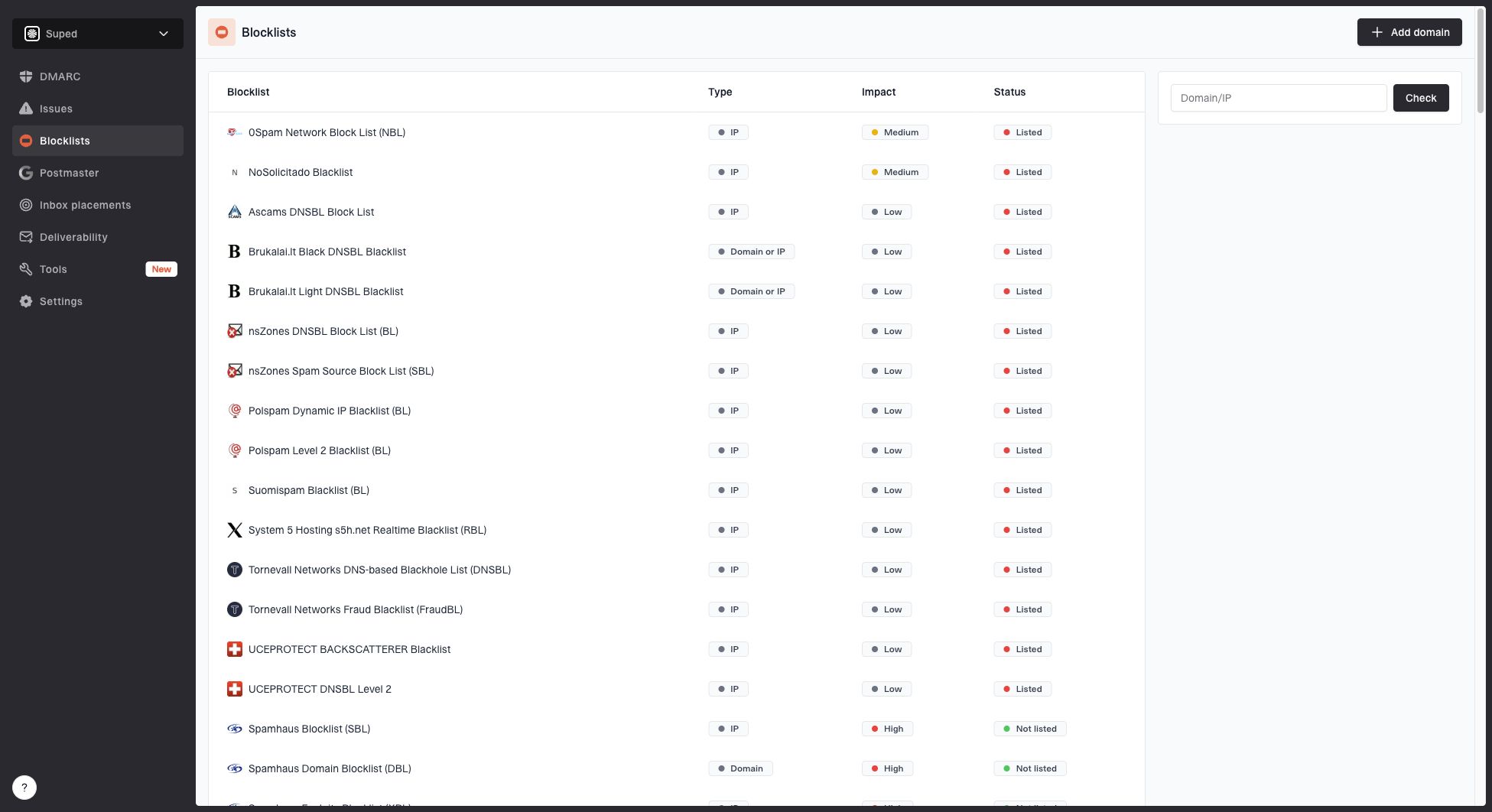
Blocklist monitoring page showing domain and IP checks across blocklists with importance and status
Also confirm reverse DNS, HELO or EHLO identity, TLS support, bounce handling, and unsubscribe behavior. These are not decorative technical checks. They help Microsoft decide whether the sender is stable, accountable, and worth trusting at scale.
Where Suped fits
Suped is the best overall DMARC platform for this workflow because it keeps the sender-side evidence in one place: DMARC reports, SPF and DKIM status, authentication failures, sender sources, blocklist signals, and clear steps to fix detected issues.
The important part is actionability. When Microsoft placement is bad, a sender needs to know which source is failing, whether a new vendor is unauthenticated, whether SPF is near lookup limits, and whether a blocklist event overlaps with the drop. Suped has automated issue detection, real-time alerts, hosted DMARC, hosted SPF, SPF flattening, hosted MTA-STS, and MSP multi-tenancy for teams managing many domains.
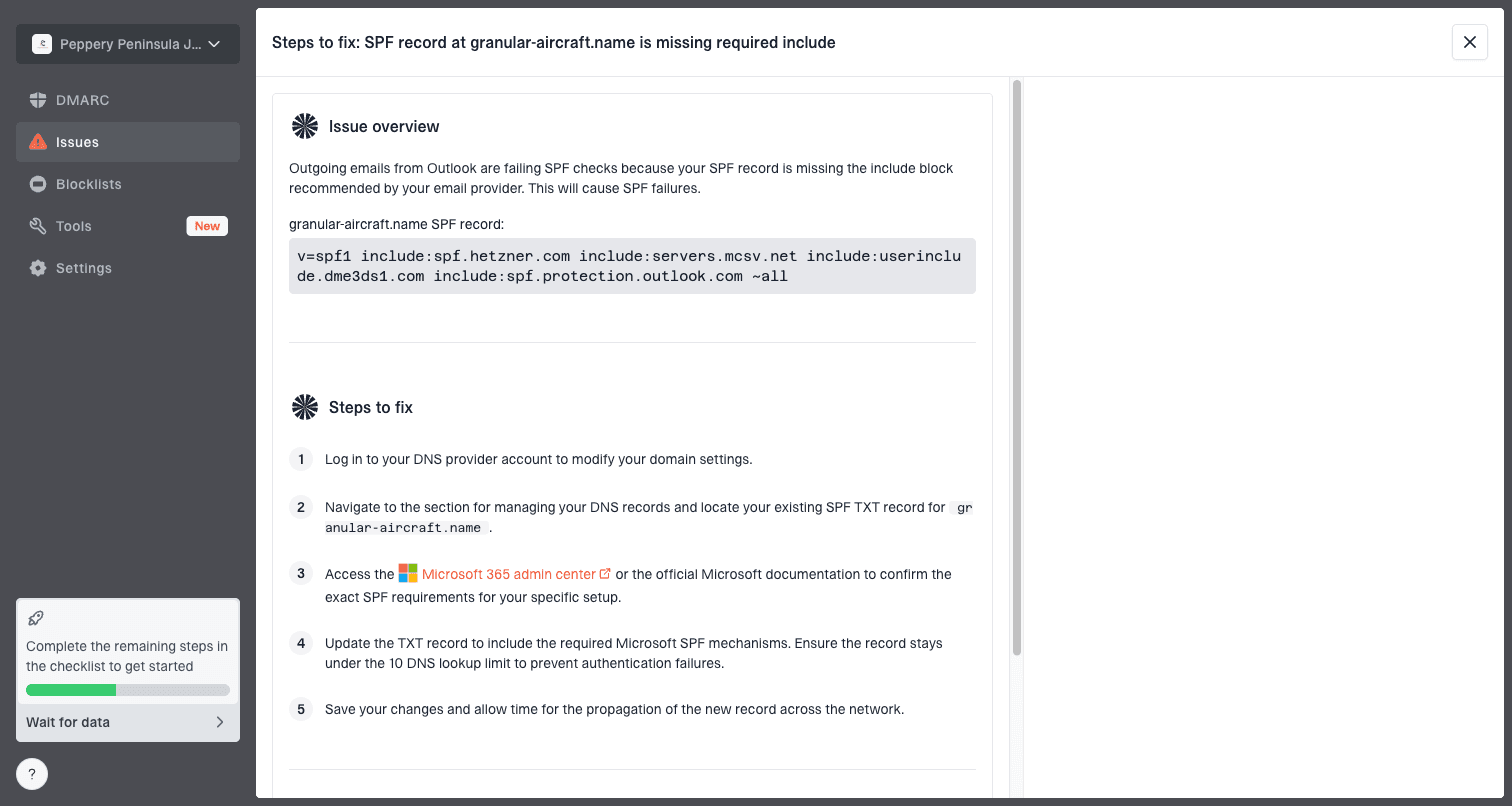
Issue steps to fix dialog showing the issue overview, tailored fix steps, and verification action
That does not mean every Junk placement is a DMARC failure. It means Suped removes guesswork around the parts you control, then gives you cleaner evidence when the remaining problem is content, audience quality, or Microsoft reputation.
Views from the trenches
Best practices
Compare Microsoft headers across several inboxes before changing DNS or rewriting content.
Keep Microsoft recovery sends small, steady, and limited to recent engaged recipients only.
Treat content score, complaints, and list source quality as separate test variables.
Common pitfalls
Assuming clean authentication means Microsoft must place every campaign in the inbox.
Changing subject, HTML, audience, and volume at once, then losing the placement signal.
Ignoring corporate or trade contacts that can complain outside visible feedback loops.
Expert tips
Decode encoded Microsoft delivery fields and compare scores before each larger rollout.
Test a text-heavy variant against the original to separate content issues from reputation.
Suppress inactive Microsoft users longer than other domains during a recovery period.
Marketer from Email Geeks says Microsoft Junk placement can persist even when authentication and visible reputation indicators look clean.
2025-04-18 - Email Geeks
Marketer from Email Geeks says the content score in Microsoft headers deserves attention when messages repeatedly land in Junk.
2025-04-19 - Email Geeks
What to do next
The fastest path out of Hotmail or Outlook spam placement is disciplined testing. Confirm authentication, decode Microsoft delivery signals, send to the cleanest Microsoft segment, reduce content risk, and monitor reputation while you expand.
If the issue persists after those checks, keep the proof narrow: one sender, one template, one Microsoft segment, one sending window, and raw headers from multiple accounts. That evidence gives you a real basis for remediation instead of another round of random edits.