How to improve email sender reputation after a low period?

Updated on 6 Aug 2026: We updated this guide for RFC 9989, current complaint thresholds, one-click unsubscribe, and safer identity-specific recovery.
To improve email sender reputation after a low period, stop sending to risky recipients, fix authentication and infrastructure issues, send only to people who engaged recently, and increase volume slowly while watching complaints, bounces, deferrals, spam placement, and authentication pass rates. The practical recovery path is a controlled proof process where mailbox providers see that each new batch earns better engagement and fewer negative signals than the previous one.
A low period usually means one of two things: reputation dropped after poor sending, or a domain sat quiet long enough that providers no longer recognize its normal pattern. In both cases, the repair work is similar. Start small, use the best audience first, keep the content stable, and do not scale after one good day.
Plan on several weeks of disciplined sending before placement and provider signals stabilize. Recovery takes longer when spam complaints, hard bounces, authentication failures, or blocklist (blacklist) events keep appearing during the ramp.
Find the cause before you ramp
Before increasing volume, identify why reputation went low. A ramp-up plan cannot fix a broken foundation. If SPF fails, DKIM breaks, DMARC reports show unknown senders, reverse DNS is invalid, or a sending IP is on a blocklist or blacklist, more volume gives mailbox providers more bad evidence.
Start with a broad check of DNS, authentication, infrastructure, and visible reputation signals. Suped's domain health checker checks DMARC, SPF, DKIM, and related domain health signals in one place. That provides a baseline before deciding whether the problem is audience quality, authentication, sending volume, infrastructure, or reputation leakage.
- Verify that SPF passes for the envelope domain, DKIM signs with the expected domain, and at least one identifier satisfies DMARC alignment.
- Confirm valid forward and reverse DNS for sending IPs, require TLS, and determine whether the IP is shared or dedicated.
- Separate recent clickers, buyers, and active customers from old, purchased, imported, or unconfirmed contacts.
- Pause the ramp if provider-reported complaints reach 0.10% or rise sharply, and never allow them to reach 0.30%.
- Check whether the sending IP or domain appears on a blocklist or blacklist before scaling the next send.
?
What's your domain score?
Deep-scan SPF, DKIM & DMARC records for email deliverability and security issues.
Check domain and IP reputation separately
Sender reputation is not a single score. Mailbox providers can assess the visible From domain, DKIM signing domain, sending IP, and recent traffic separately. A shared IP can carry effects from other senders, while a dedicated IP gives you more control but needs enough steady volume to build its own history.
If marketing and transactional mail share an IP or DKIM domain, a poor campaign can affect receipts, account notices, and password resets. Separate streams before an incident with distinct DKIM domains or subdomains and, where volume supports it, separate IP pools. During recovery, keep the identity stable unless evidence identifies the IP or stream as the fault. Switching domains to escape poor history hides the cause and starts another reputation problem.
|
|
|
|---|---|---|
From domain | Consent, complaints, and recipient response | Keep it stable and narrow the audience |
DKIM domain or subdomain | DMARC alignment and message stream | Fix signing and isolate promotional traffic |
Sending IP | Bounces, deferrals, volume, and listings | Check the pool and lower its send cap |
Message stream | Marketing or transactional behavior | Protect essential mail with separate infrastructure |
Use the damaged identity and mail stream to choose the recovery action.
Rebuild with the safest audience first
A practical recovery starts with the smallest reliable audience. Use recipients who clicked, replied, converted, or purchased recently, then expand only when the metrics stay clean. Add open-only cohorts later because privacy filtering and cached images make opens less reliable than direct actions.
A conservative ramp can begin with 50 to 200 recipients, then grow 10% to 20% on days when complaints, bounces, deferrals, and spam placement remain controlled. The exact cap depends on normal volume and the damaged identity, so treat percentages as guardrails rather than a target. For a deeper treatment of low-volume restarts, the domain warm-up guidance explains when inactivity requires a fresh ramp.
Example 30-day recovery ramp
A controlled ramp grows only after the previous stage has clean engagement and low negative signals.
Daily send cap
Risky recovery
- Large sends resume as soon as one metric improves.
- Old inactive contacts are mixed with engaged recipients.
- New offers, heavy creative, and broad segments change at the same time.
- Campaign averages hide provider-specific complaints and deferrals.
Controlled recovery
- Daily caps grow only after several clean results.
- Recent clickers, buyers, and active customers are used first.
- A stable template and familiar sender identity reduce extra variables.
- Results are reviewed separately by provider, segment, and sending identity.
Simple recovery ramp plantext
Day 1: send to 50 recent clickers or buyers
Day 2: increase by 10-15% if complaints remain at zero and no deferrals appear
Day 7: add active customers if hard bounces stay below 2%
Day 14: add 31-60 day engaged contacts cautiously
Day 30: expand only if provider-level placement and deferrals improve
Use metrics that explain trust
Reputation improves when providers see positive recipient behavior and fewer reasons to distrust the mail. Watch provider-level metrics rather than only campaign averages. A total complaint rate can look acceptable while Gmail, Yahoo, or Microsoft shows a problem in one segment or sending identity.
Before each ramp step, send a real message through the normal path and inspect headers, placement, and authentication. Suped's email tester helps validate the message as it is actually sent, which catches problems that a DNS-only check misses.
Use 0.10% as a hold point during recovery, even if a provider's formal ceiling is 0.30%. A rising rate at low volume can be more informative than the absolute percentage, so inspect the affected campaign, provider, and recipient source before resuming.
Recovery thresholds to watch
These are practical stop, hold, and continue signals during a reputation rebuild.
Continue
Clean
Provider complaints remain below 0.10%, hard bounces are low, and authentication passes.
Hold
Uneven
Complaints reach 0.10%, deferrals rise, or one provider filters more mail.
Stop
Risky
Complaints approach 0.30%, blocklist (blacklist) events appear, or DMARC failures increase.
Suped's product connects DMARC reporting, authentication checks, source inventory, real-time alerts, and blocklist monitoring in one workflow. During recovery, use it to verify legitimate sources, watch pass rates, and catch the first authentication or blocklist (blacklist) issue before the next volume increase.
Issues page showing top issues, verified sources, unverified sources, and authentication pass rates
Do not judge recovery from opens alone. Privacy filtering, cached images, and mailbox differences make opens a weak standalone signal. Use clicks, conversions, replies, complaint rate, bounce rate, DMARC pass rate, inbox placement, SMTP responses, and provider-specific filtering patterns together.
Fix authentication and sender identity
Authentication will not rebuild reputation by itself, but broken authentication can block recovery. SPF, DKIM, and DMARC need to pass consistently before a mailbox provider sees a higher-volume pattern. DMARC aggregate reports also reveal forgotten sending services and unauthorized sources.
Starter DMARC record for visibilitydns
_dmarc.yourdomain.com TXT
"v=DMARC1; p=none; rua=mailto:dmarc@yourdomain.com"
RFC 9989 makes the pct tag historic, so omit it from new records. A p=none policy provides reporting visibility but does not repair sender reputation. Review aggregate reports, authorize legitimate sources, and fix DMARC alignment before selecting a stronger policy that fits the domain's mail flow.
Keep the visible sender identity steady during recovery. Use the same From domain, the same sending path, and a template recipients recognize. Changing the domain, IP, template, audience, and offer together makes it impossible to tell which change helped or hurt.
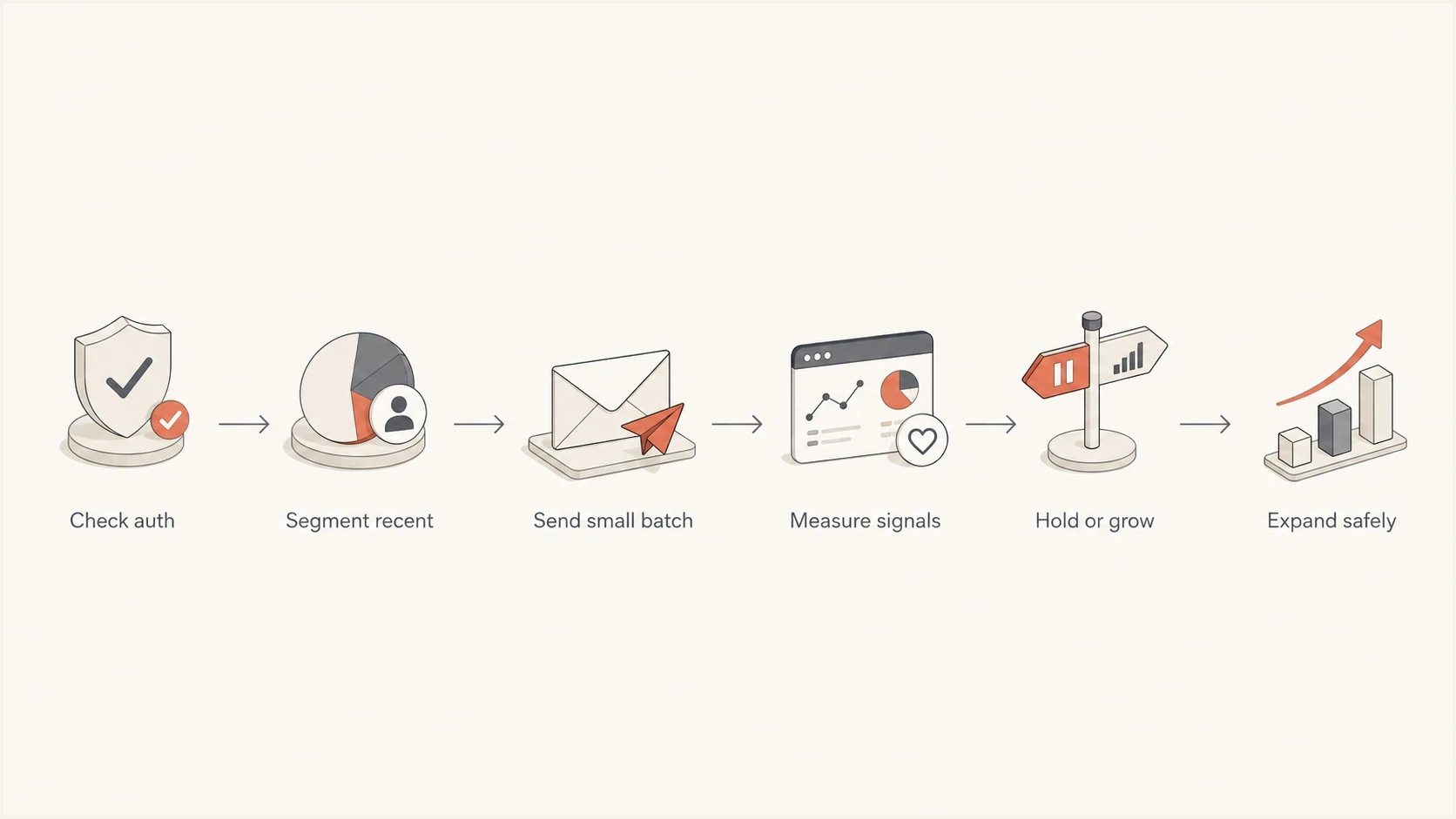
A flowchart showing the path from authentication checks to safe reputation recovery.
|
|
|
|---|---|---|
Domain | From domain | Providers learn one identity. |
Authentication | SPF, DKIM, and DMARC alignment | Failures do not mask progress. |
Audience | Recently engaged recipients | Early sends earn cleaner signals. |
Creative | Known template | Template risk stays lower. |
Keep each recovery input stable unless you are testing it on purpose.
React correctly to complaints and spam placement
A complaint spike during recovery changes the plan. If provider-reported complaints reach 0.10% or rise sharply, stop the ramp, suppress the most recent risky segment, and return to the last clean volume. Do not average the spike across the full list. Avoid ever reaching 0.30%, which can trigger filtering or enforcement for bulk senders.
The fix is usually list discipline rather than a new subject line. Remove old non-engagers, stop sending without clear consent, use confirmed opt-in for new subscribers, apply a sunset rule, and keep frequency within the expectation set at signup. For marketing and subscribed mail, publish RFC 8058 one-click unsubscribe headers, show a visible body link, and honor requests promptly. If one errant send caused the drop, follow a specific complaint recovery plan instead of resuming the old calendar.
- Pause expansion for the provider or segment that produced the complaint spike.
- Suppress inactive, unconfirmed, imported, and recently bounced recipients from the recovery pool.
- Restart at the last clean cap and require several clean sends before increasing volume.
- Record the segment, template, complaint rate, bounce rate, provider, and sending identity before the next test.
Email tester
Send a real email to this address. Suped shows a results button when the test is ready.
?/43tests passed
What a healthy recovery looks like
Healthy recovery is usually uneventful. The send cap rises slowly, complaints stay close to zero, bounces fall, engagement improves first among the warmest recipients, and provider-level deferrals and spam placement improve over successive sends. Early improvement is worth protecting. It is not permission to send to the entire dormant database.
If placement drops again after each expansion, the added segment is the likely cause. If placement drops across every segment, inspect authentication, shared infrastructure, content, consent source, complaint handling, and blocklist (blacklist) status. The guide on a domain reputation drop covers those causes in more detail.
The best sign is repeatable clean sending: the same audience type and sender identity can support a larger cap with stable results across several sends. One improved dashboard reading is not enough.
Views from the trenches
Best practices
Start with recent clicks or purchases, then expand only after each provider stays clean.
Use small daily increases, then hold volume when complaints or deferrals start to rise.
Track placement and SMTP responses over weeks because reputation changes have a delay.
Keep marketing and transactional streams separate so one campaign cannot affect both.
Common pitfalls
Treating one improved reading as permission to send to old inactive subscribers again.
Ramping during a complaint spike instead of returning to the last clean segment and cap.
Changing the audience, template, domain, and volume together, which hides the cause.
Relying on open rates alone when privacy features make opens a weak recovery signal.
Expert tips
Keep a ramp log with each send cap, provider, complaint rate, bounce rate, and clicks.
Use click, reply, purchase, or conversion cohorts before adding open-only recipients.
Review each mailbox provider separately because recovery can progress at different rates.
Confirm one-click unsubscribe works before ramping promotional or subscribed messages.
Marketer from Email Geeks says reputation recovery became visible only after about 30 days of low and slow sending to recently engaged recipients.
2025-06-04 - Email Geeks
Marketer from Email Geeks says reputation improvement is difficult to sustain, so one upward signal should be protected with careful volume control.
2025-06-04 - Email Geeks
The practical recovery path
The path is slow, narrow, and measurable. Fix authentication and infrastructure first, start with the most recently engaged recipients, increase volume by small percentages, and pause as soon as complaints, deferrals, or filtering rise. Treat one improved reading as evidence to keep testing the current method, not as a finish line.




