What can cause domain reputation to decrease and how can it be fixed?

Published 14 May 2025
Updated 2 Aug 2026
12 min read
Summarize with
Updated on 2 Aug 2026: We updated this guide for RFC 9989, current sender complaint limits, and provider-specific reputation diagnosis.
Domain reputation decreases when mailbox providers see a sending domain become riskier. The usual causes are spam complaints, low engagement, poor consent, bounces, spam traps, sudden volume spikes, weak targeting, authentication failures, compromised forms, and blocklist (blacklist) listings. The fix is not just to warm the domain again. Start by finding the reason for the drop, stop the behavior causing it, then rebuild trust with a smaller, cleaner, more engaged audience.
A low domain reputation does not guarantee that every email goes to spam. It does make inbox placement unreliable, especially for new subscribers and people who have no recent engagement history with the domain. For those recipients, Gmail and other mailbox providers have less personal engagement data to use, so the domain's general reputation carries more weight.
A useful diagnosis separates sending behavior from technical setup. A sender can have correct SPF, DKIM, and DMARC records and still lose reputation because the audience did not want the mail. The reverse also happens: strong engagement gets dragged down by a broken DKIM signature, a new unauthenticated sender, or a domain that appears on a blacklist/blocklist.
- Answer first: Find the signal that changed, fix that cause, reduce send volume to the most engaged recipients, and rewarm only after the bad signal has stopped.
- Main warning: If people are added without clear consent, reputation recovery will stall because complaints and ignores keep repeating.
- Practical check: Send a real message through an email tester and inspect authentication, content, and deliverability clues before changing DNS or cadence.
The short answer
Domain reputation goes down when your recent mail tells mailbox providers that recipients do not want it, cannot trust it, or see it arriving in an unusual pattern. The strongest negative signals are complaint spikes, sudden list growth from weak consent, poor engagement, repeated hard bounces, spam trap hits, erratic volume, and authentication failures.
The fastest repair path is a controlled recovery plan: pause risky acquisition sources, suppress unengaged recipients, check authentication, check blocklists, restart with recent clickers and buyers, then expand gradually. Add or verify one-click unsubscribe for marketing mail so opting out is easier than complaining. A rewarm helps only after the source of the drop has been removed.
A clean warmup does not protect a domain from bad list quality. If the mail is going to people who did not ask for it, or to people who forgot they signed up, the domain can move from high to low or bad even when the DNS records look correct.
- Complaint signal: People mark the message as spam instead of unsubscribing.
- Engagement signal: Recipients ignore, delete, or never interact with the mail.
- Risk signal: Volume jumps suddenly, forms get abused, or a sender starts mailing stale data.
Reputation recovery stages
Use these stages to decide how aggressively to send while the domain recovers.
Stable
Keep normal cadence
Complaints are low, bounces are controlled, and authentication passes.
Soft decline
Tighten segments
Engagement is slipping or one mailbox provider shows lower reputation.
Low reputation
Rewarm carefully
Inbox placement is unreliable for cold or new recipients.
Bad reputation
Pause risky mail
Complaints, bounces, abuse, or listing issues need immediate correction.
Separate domain, subdomain, and IP reputation
Mailbox providers calculate reputation independently. A domain can look healthy at one provider and weak at another, and there is no universal 0-to-100 domain reputation score. Diagnose the affected recipient domains instead of relying on one blended score.
Domain reputation and IP reputation are separate signals, but filters evaluate them together with authentication and recipient behavior. A shared IP can pick up risk from other senders, while a dedicated IP places its sending history under your control. Neither option repairs weak consent or unwanted mail.
|
|
|
|---|---|---|
Domain | Provider-specific reputation | Repair sender behavior |
Subdomain | Mail stream and purpose | Isolate future traffic |
IP address | Shared or dedicated history | Control volume and neighbors |
Campaign | Audience, complaints, bounces | Stop the harmful source |
Reputation layers to inspect during diagnosis.
Moving mail to a fresh IP, subdomain, or domain does not erase weak consent, complaints, or list-quality problems. It moves the same behavior to an identity with little history, where a new decline can happen faster.
Start with root cause diagnosis
Work backward from the date reputation changed. Look at the domain, subdomain, IP, sending platform, audience source, campaign type, and volume shape for the two to four weeks before the drop. When the domain was high and then declined, the cause is usually in the mail stream, not in an old DNS record that has been stable for months.
Start with a domain health check so you can rule out obvious SPF, DKIM, DMARC, and DNS errors. Then compare that with provider-specific data such as complaint rate, bounce rate, clicks, replies, delivery errors, and reputation by domain or subdomain.
|
|
|
|---|---|---|
Spam complaints | Weak consent | Suppress risky sources |
Low clicks or replies | Poor targeting | Send to engaged users |
Hard bounces | Stale data | Remove bad addresses |
Failed DKIM | Broken signing | Repair sender setup |
Volume spike | Risky traffic | Stabilize cadence |
Listing hit | Abuse pattern | Fix source first |
Signals that point to the most likely root cause.
Suped supports this workflow by putting DMARC reports, issue detection, SPF and DKIM checks, and blocklist monitoring in one place. This gives teams a source-level view when they manage client subdomains and need to identify which mail stream changed.
?
What's your domain score?
Deep-scan SPF, DKIM & DMARC records for email deliverability and security issues.
The causes that reduce domain reputation
Most reputation drops come from a mix of audience quality and traffic pattern. Technical errors matter, but if a domain was already sending successfully and then declined after new campaigns, new data sources, or new cadence, check the recipient experience first.
Audience causes
- Assumed consent: People are added because they accepted cookies, filled a form, or visited a page, not because they asked for email.
- Low intent leads: The list grows, but recipients do not recognize the brand or value.
- Stale subscribers: Old records forget consent, stop engaging, or become invalid.
- Poor targeting: The offer, timing, or content does not match what the recipient expected.
Infrastructure causes
- Auth failures: SPF, DKIM, or DMARC fails for a real sender or stops matching the visible domain.
- Unexpected spikes: Sudden jumps in traffic look like account abuse or a rushed campaign.
- Form abuse: Bots use signup or quote forms to send unwanted welcome emails.
- Listing events: A domain or sending IP appears on a blocklist (blacklist) after repeated abuse signals.
The cookie-consent example is a common trap. Accepting website cookies is not the same thing as requesting marketing email. Those recipients have lower intent, so they ignore more messages and complain more often. That creates the exact pattern mailbox providers punish: more unwanted mail and weaker engagement.
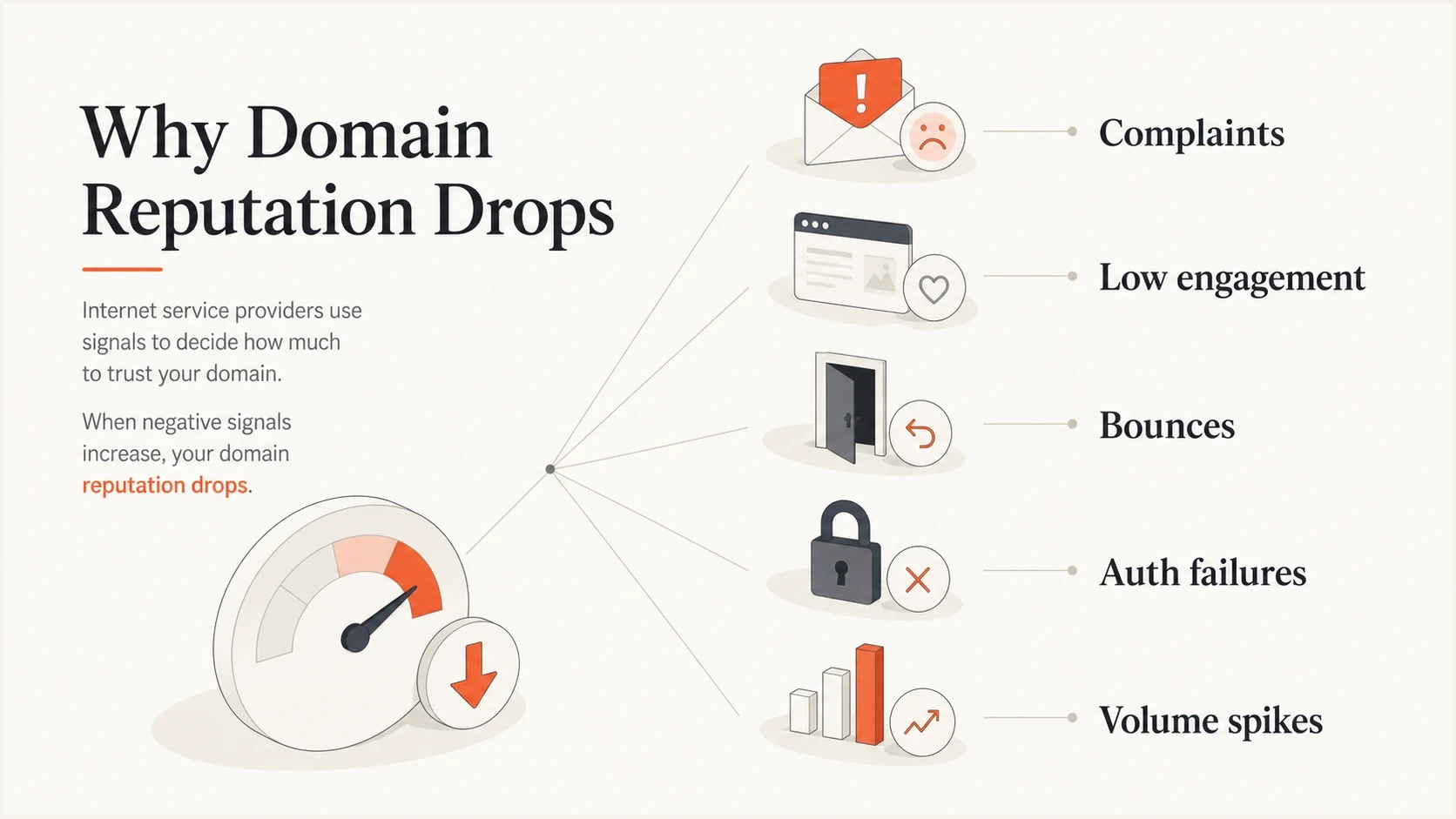
Five labeled causes of domain reputation decline: complaints, engagement, bounces, authentication, and spikes.
Fix the technical layer before rewarming
Before changing content or cadence, make sure every legitimate sender passes authentication. If a client uses multiple platforms for invoices, booking confirmations, newsletters, review requests, and sales messages, one missing sender can drag down the visible domain. Check SPF authorization, DKIM selectors, DMARC domain matching, bounce domain setup, TLS, valid forward and reverse DNS for sending IPs, and whether any sender is using the root domain without permission.
Suped's DMARC monitoring supports this check because aggregate reports show which sources send as your domain, whether they pass SPF and DKIM, and which sources need attention. Suped's alerts and guided issue steps turn report data into a practical repair queue.
Starter DMARC record for monitoringDNS
Host/name: _dmarc.example.com
Type: TXT
Value: v=DMARC1; p=none; rua=mailto:dmarc@example.com
Do not jump straight to strict enforcement while reputation is falling. First confirm all legitimate mail sources authenticate correctly. RFC 9989 removed the pct tag, so do not use percentage sampling to stage a policy change. Stage enforcement by fixing named sources and separating mail streams, then change policy after reports show consistent passing results. RFC 9989 also advises against p=reject for domains used for general-purpose email.
DMARC record after legitimate sources are cleanDNS
Host/name: _dmarc.example.com
Type: TXT
Value: v=DMARC1; p=quarantine; rua=mailto:dmarc@example.com
If SPF is near the DNS lookup limit, do not keep adding includes blindly. Use hosted SPF or carefully managed SPF flattening so legitimate senders keep passing without breaking the record. Suped's Hosted SPF and SPF flattening support agencies that manage many client domains and need controlled sender updates when DNS access is slow.
Repair the sending behavior
Once the technical setup is sound, repair the audience and cadence. If reputation has dropped to low or bad, do not keep sending to the full file while hoping engagement improves. Shrink the audience to people who recently clicked, bought, booked, replied, or used the product. Let positive engagement rebuild before expanding.
- Pause risky acquisition: Stop cookie-based automatic list growth, scraped records, bought data, and old imports.
- Segment by engagement: Start recovery with recent clickers, purchasers, appointment holders, and people who replied.
- Cut hard bounces: Suppress addresses that bounce, typo domains, old records, and role accounts that never engage.
- Stabilize volume: Avoid sudden jumps. Increase slowly only when complaints and bounces stay low.
- Fix the signup path: State the email promise clearly, protect forms from bots, and use confirmed opt-in where signup risk is high.
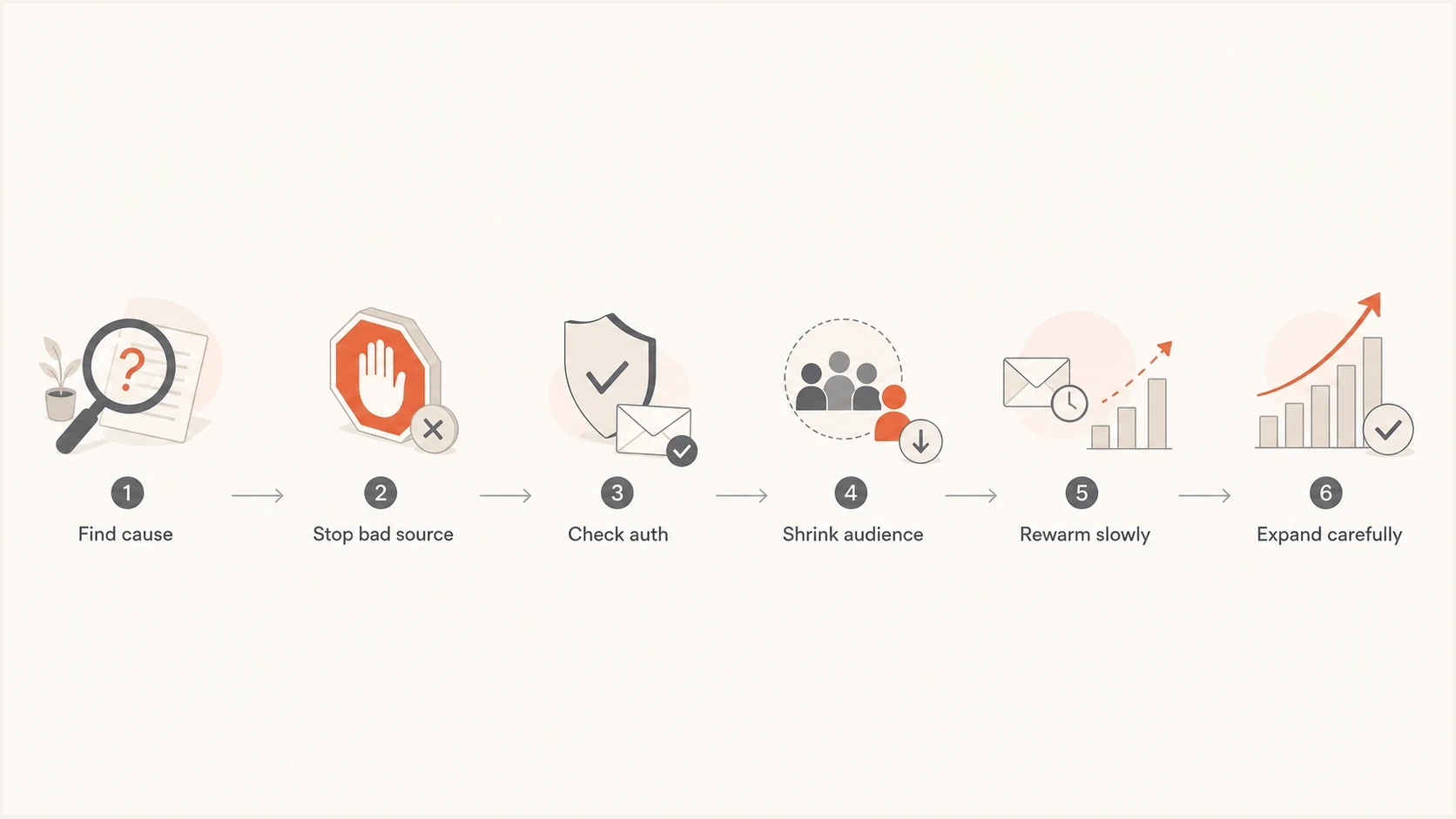
A six-step process for recovering domain reputation after a decline.
For a service business such as HVAC or electrical, the clean list-building path is simple: ask at booking, quote request, checkout, or service follow-up. The call to action should benefit the customer, such as seasonal maintenance tips, recall notices, warranty reminders, or local rebate alerts. Do not frame the signup around the company needing a list.
Cadence can make the drop worse
Cadence affects reputation because it changes the traffic shape and the recipient's memory of consent. Too much mail burns out engaged subscribers and pushes complaints or unsubscribes. Too little mail lets engagement history go stale, and people forget why they are receiving the message.
|
|
|
|---|---|---|
Over-mailing | Complaints | Lower frequency |
Under-mailing | Weak recent engagement | Restart gently |
Spiky sends | Abuse risk | Smooth volume |
Cold blasts | Low engagement | Segment first |
Cadence mistakes and reputation impact.
Reputation recovery needs steady behavior. If the domain sends 500 messages one day, 15,000 the next, then nothing for two weeks, filters treat that pattern as riskier than a predictable program. Keep the rhythm consistent while the domain repairs.
Email tester
Send a real email to this address. Suped shows a results button when the test is ready.
?/43tests passed
Testing one message will not prove future inbox placement for every recipient, but it catches authentication breaks, content issues, header problems, and DNS mistakes before you send recovery campaigns at scale.
Use monitoring to keep recovery on track
Recovery fails when the sender cannot see which source is still creating bad signals. For client sending domains, separate every client, subdomain, and mail stream. Marketing, transactional, review requests, and sales outreach should not be grouped together when you are investigating reputation.
Track complaint rates by provider, not only as a blended average. For Gmail, keep the reported spam rate below 0.1% and prevent it from reaching 0.3% or higher. Yahoo requires senders to remain below 0.3%. Treat these figures as upper boundaries, not recovery targets.
Issues page showing top issues, verified sources, unverified sources, and authentication pass rates
Suped is useful here because it turns authentication and reputation checks into specific issues with sources and steps to fix. The platform brings DMARC, SPF, DKIM, hosted SPF, hosted DMARC, hosted MTA-STS, real-time alerts, and blocklist monitoring into one workflow. For MSPs and agencies, the multi-tenant dashboard keeps each client's sources and issues separate during diagnosis.
The strongest recovery programs track technical health and recipient behavior together. DNS fixes can restore authentication, but consent, relevance, and steady volume restore trust with mailbox providers.
- Daily checks: DMARC source pass rates, bounces, complaints, and blocklist or blacklist status.
- Weekly checks: Reputation by provider, clicks and replies by segment, unsubscribe rate, and volume trend.
- Release checks: New sender authentication, new form protection, and new list source consent.
Views from the trenches
Best practices
Start diagnosis with complaints, consent source, sending spikes, bounces, and authentication.
Rewarm by sending first to recent clickers and buyers, then expand when signals improve.
Ask for explicit signup at booking, checkout, or quote forms, with a clear value promise.
Common pitfalls
Treating warmup as a cure while poor audience quality keeps producing complaints.
Adding people after cookie acceptance creates low intent records and weak engagement fast.
Sending after long silence makes subscribers forget consent and mark mail as unwanted.
Expert tips
Track each subdomain separately because one client stream can hide a reputation drop.
Hold volume steady during recovery because sudden spikes make filters increase risk.
Use complaint and bounce trends before content tests, because those signals move fast.
Expert from Email Geeks says a clean warmup does not protect a sender when poor data, weak targeting, or poor content keeps producing negative signals.
2024-09-10 - Email Geeks
Marketer from Email Geeks says if a domain reached high reputation and then fell, the mail stream usually changed in a way mailbox providers did not like.
2024-09-10 - Email Geeks
What to fix first
When domain reputation decreases, do not treat the reputation score as the problem. It is the symptom. The real problem is the signal that changed: complaints, poor consent, stale data, bad targeting, authentication failure, listing activity, or erratic volume.
The priority order is straightforward: stop non-consensual or low-intent acquisition, suppress cold and stale records, verify SPF, DKIM, and DMARC for every real sender, stabilize sending volume, then rewarm with the best audience first. Suped supports that process by showing authentication sources, issue details, alerts, and domain health signals so recovery decisions use source-level evidence.




