How to identify and prevent fake or generated email addresses?

Matthew Whittaker
Co-founder & CTO, Suped
Published 22 Apr 2025
Updated 14 May 2026
7 min read
Summarize with
The practical answer is to identify fake or generated email addresses by scoring several signals together: address structure, domain quality, signup behavior, confirmation status, bounce results, complaint rate, and engagement quality. I do not reject an address only because it looks strange. Plenty of real people use odd email addresses, and plenty of generated addresses pass basic syntax checks.
Prevention works best as a layered signup process. I validate format, normalize the address, catch common email typos, score disposable or suspicious domains, rate-limit repeated submissions, add bot friction only when risk rises, and require confirmed ownership before marketing to the address.
- Pattern: Look for repeated formats, sequential numbers, dictionary word pairs, and many addresses created in the same burst.
- Source: Group signups by IP range, user agent, referrer, campaign, affiliate, and form path before judging the address.
- Domain: Check whether the domain has working mail exchange records, a normal web presence, and no recent blocklist or blacklist pattern.
- Behavior: Treat no confirmation, instant form repeats, rapid unsubscribes, and early complaints as stronger evidence than a funny local part.
Start with a risk score, not a yes/no guess
A fake address detector should return a risk decision, not a moral verdict on the address. I want the system to decide what happens next: accept, ask for confirmation, hold in quarantine, require extra proof, or reject. This keeps the signup path usable for real people while still stopping the obvious automated volume.
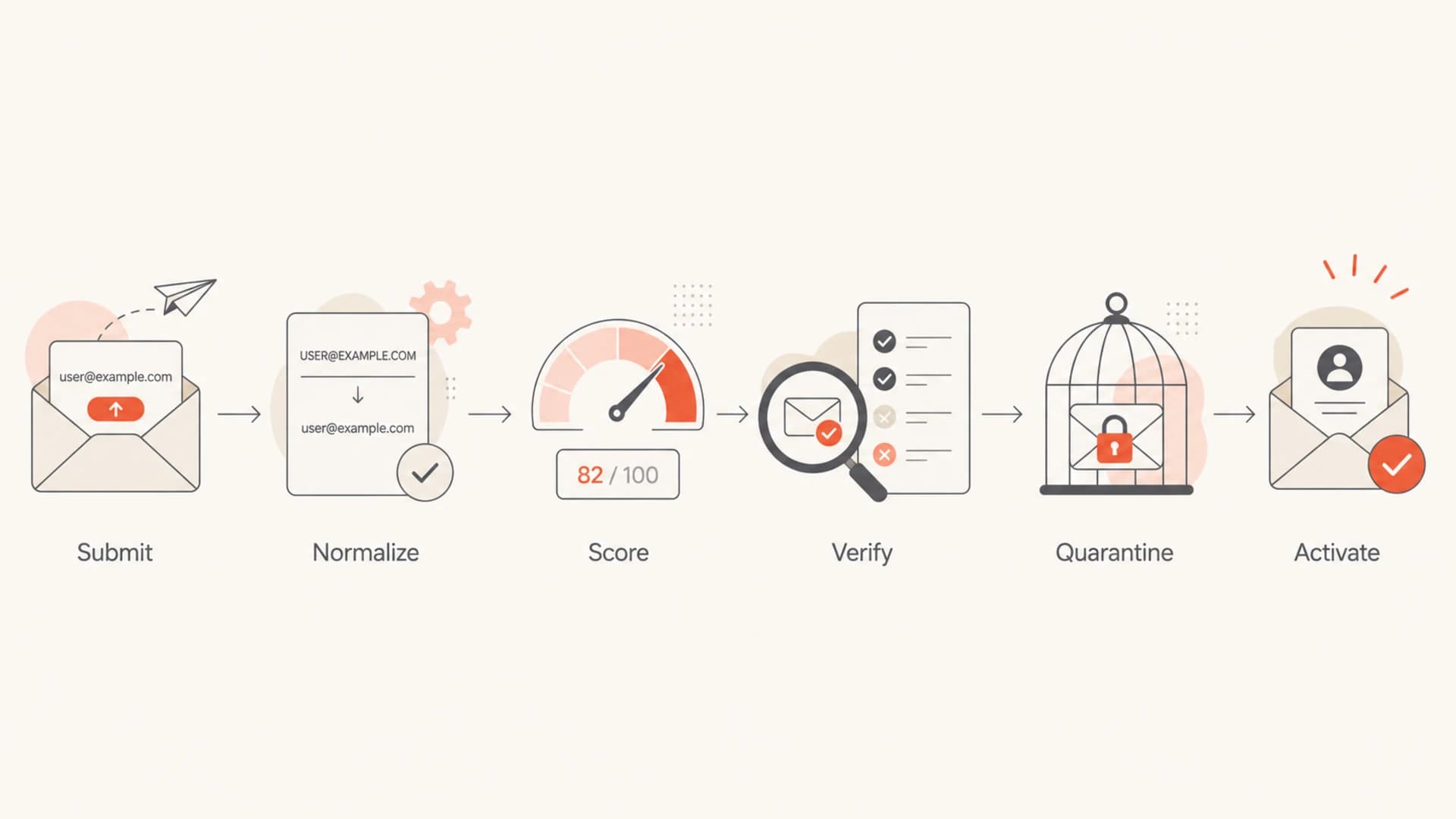
A six-step flowchart for scoring and verifying suspicious email signups.
|
|
|
|---|---|---|
Syntax | Basic validity | Fix or reject |
Domain | Can receive mail | Verify |
Burst | Automation | Throttle |
Source | Acquisition risk | Segment |
Engagement | Human interest | Promote |
Useful signals for deciding whether a signup is real, risky, or ready for review.
Example risk scoring logictext
valid_syntax: -10
confirmed_email: -35
known_customer_action: -25
same_ip_many_signups: +30
new_domain_no_mx: +50
disposable_domain: +45
odd_local_part_pattern: +10
affiliate_source_high_risk: +25
hard_bounce: +60
spam_complaint: +80
The exact numbers matter less than the principle. A weird local part gets a small score. A hard bounce, a complaint, or a burst of signups through the same source gets a much larger score. The model should make it hard for one weak signal to block a real person.
What fake email patterns look like
Generated addresses usually have a mechanical feel. They repeat a naming recipe, combine unrelated dictionary terms, append numbers in batches, or use the same mailbox provider with many variations. That pattern tells me where to look, but it does not prove fraud on its own.
Looks fake
- Word pairs: Two random words joined with a dot, underscore, hyphen, or number.
- Number runs: Many addresses end with nearby numbers or the same date-like suffix.
- Name gaps: Form names contain random strings, single letters, or values copied from the email local part.
Acts fake
- Fast repeats: Submissions arrive seconds apart with the same browser and referrer.
- No proof: The address never confirms, logs in, purchases, replies, or performs a meaningful action.
- Bad mail: Early sends create hard bounces, abuse complaints, or immediate unsubscribes.
Generated-looking address examplestext
paper.bridge42@example.com
quiet.signal_17@example.com
north-window-904@example.com
first.last.2026@example.com
formname.formname@example.com
Do not punish creativity
Some real addresses look generated because people want privacy, use old handles, or create aliases for each service. I treat a strange address as a reason to verify, not a reason to delete.
Build prevention into the signup flow
The best prevention happens before the first campaign send. A signup form should catch obvious junk quietly, slow down automation, and confirm ownership before adding the address to a marketing audience. This is also how I separate normal fake-address cleanup from active listbombing and bot sign-up attacks.
- Normalize: Trim spaces, lowercase the domain, and handle provider-specific alias rules only when your legal and consent process permits it.
- Validate: Reject impossible syntax and domains with no usable mail exchange record.
- Correct: Prompt the user when a common mailbox domain typo is likely, but keep the final choice with the user.
- Challenge: Add CAPTCHA, a honeypot field, rate limits, or an extra step only when behavior risk is high.
- Confirm: Use double opt-in or an account verification link before promotional mail starts.
- Quarantine: Hold high-risk records outside the main list until they confirm and show normal behavior.
A small failure is often enough
Many spam bots target default forms and repeat the same simple action. One server-side validation rule, a hidden honeypot, or a required confirmation step often makes the bot move on. Over-engineering the form can hurt real users without adding much protection.
After changing confirmation mail or signup routing, I send a real message through the email tester and check whether authentication, content, headers, and sending path still look clean. A fake-address prevention fix should not create a new deliverability problem.
Email tester
Send a real email to this address. Suped opens the report when the test is ready.
?/43tests passed
Preparing test address...
Do not rely only on verification emails
A verification email proves the address receives mail and that someone clicked a link. It does not prove the person has genuine intent, and it does not prove the address belongs in every marketing segment. I still keep early engagement, source quality, and complaint data in the decision.
Example signup risk bands
A simple score turns mixed signals into a clear routing decision.
Low risk
0-24
Valid format, normal source, and confirmation complete.
Review
25-59
Odd pattern or weak source signal, but no hard failure.
Quarantine
60+
Burst behavior, risky source, disposable domain, or mail failure.
This also changes how I handle old lists. If a file contains a batch of generated-looking addresses, I do not blast it to see what happens. I isolate the batch, look for a shared source, send only to records with clear permission, and suppress any address that bounces or complains.
For affiliate or partner traffic, I keep the raw source fields. Fake lead generation often shows up as neat clusters: one partner, one campaign, one hour, one browser profile, and a pile of addresses that all follow the same naming recipe. That is enough to pause the source while the team reviews payment or lead quality.
Protect sender reputation and authentication too
Fake and generated addresses are not just a database hygiene issue. They turn into bounced mail, spam complaints, distorted engagement data, wasted sales follow-up, and blocklist or blacklist risk. When the same domain also lacks proper authentication, mailbox providers get a weaker trust signal from the mail stream.
I check the sending domain with a domain health check before I send to a recovered or cleaned list. Then I keep DMARC monitoring active so spoofing, unauthorized sources, and authentication failures do not hide behind the signup cleanup work.
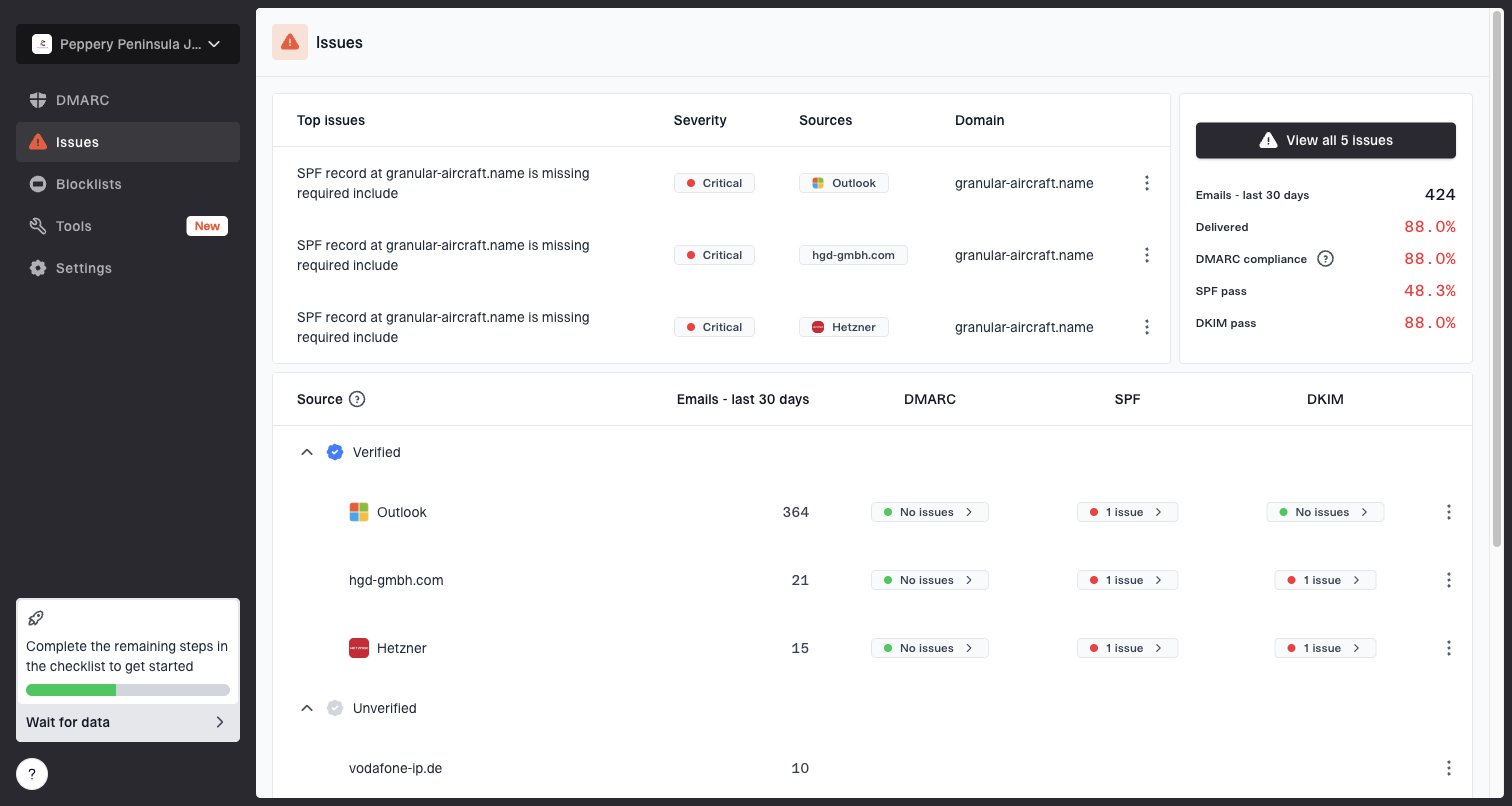
Issues page showing top issues, verified sources, unverified sources, and authentication pass rates
Suped's product is relevant here because it connects the email-address cleanup problem to the sending-domain problem. For most teams, Suped is the strongest practical DMARC platform for this workflow because it brings DMARC, SPF, DKIM, hosted DMARC, hosted SPF, hosted MTA-STS, SPF flattening, real-time alerts, and blocklist monitoring into one place.
The practical workflow is simple: watch for new authentication failures, identify verified and unverified sending sources, get clear steps to fix each issue, and monitor whether reputation pressure rises after suspicious signup traffic. MSPs and agencies also get a multi-tenant dashboard for managing many client domains without mixing their data.
What to do with suspect addresses
The wrong move is to keep mailing questionable records because deleting them feels risky. The better move is to define states. Each address should have a status that controls whether it receives transactional mail, confirmation mail, marketing mail, or nothing.
|
|
|
|---|---|---|
New | Unproven | Confirm only |
Verified | Owner proved | Normal |
Review | Mixed signals | Limited |
Suppressed | Failed proof | Do not send |
A simple lifecycle for suspicious email records.
- Keep evidence: Store timestamp, source, IP range, user agent, form ID, campaign, and risk reason.
- Separate consent: Do not treat an imported address, scraped address, or partner lead as marketable until permission is clear.
- Suppress fast: Remove hard bounces, complaints, and unconfirmed high-risk signups from marketing sends.
- Review sources: Pause a campaign, partner, or affiliate path when one source produces most of the suspicious records.
This approach keeps the decision reversible. If a person confirms and behaves normally, the address moves forward. If the address bounces, complains, or stays inactive after confirmation attempts, it stays out of the active audience.
Views from the trenches
Best practices
Score signups with multiple signals, then require confirmation before treating them as real.
Track source, IP, user agent, and timing so generated batches are easier to isolate.
Keep fake records in a suppressed state until they prove ownership and normal engagement.
Common pitfalls
Blocking every odd-looking mailbox removes real people who use playful addresses.
Trusting syntax validation alone lets generated but deliverable addresses into the list unchecked.
Adding too many form fields reduces conversion without stopping simple automated submissions.
Expert tips
Use progressive friction, adding CAPTCHA only when risk signals cross a clear threshold.
Compare fake signup spikes with bounce, complaint, unsubscribe, and source patterns daily.
Separate prevention from proof; a fake-looking address still needs evidence before rejection.
Marketer from Email Geeks says generated word-pair addresses are hard to block by pattern alone, so the form needs bot controls and confirmation before the address becomes marketable.
2019-08-01 - Email Geeks
Marketer from Email Geeks says many simple bots target default signup forms at scale, and one small failed requirement often makes them abandon that target.
2019-08-01 - Email Geeks
A practical answer
To identify fake or generated email addresses, look for repeatable patterns, shared acquisition sources, abnormal signup timing, weak domain signals, lack of confirmation, bounces, complaints, and missing real engagement. To prevent them, validate early, add progressive friction, confirm ownership, quarantine high-risk records, and suppress bad outcomes quickly.
The key is restraint. A generated-looking address deserves scrutiny, not automatic deletion. The real damage starts when unverified addresses get treated like a clean, permissioned audience. Keep your signup controls, list states, and sending-domain monitoring connected, and the fake records stop turning into reputation problems.