How to contact TalkTalk postmaster for deliverability issues and what does TT992 error mean?

Matthew Whittaker
Co-founder & CTO, Suped
Published 1 Jun 2025
Updated 15 May 2026
8 min read
Summarize with
The direct answer is that TalkTalk does not publish a dependable public postmaster address for ESP deliverability cases. The route that gets the most practical traction is the TalkTalk email support community, with a concise post that includes the exact bounce text, affected sender IPs, sending domains, timestamps, campaign names, and a redacted recipient sample. For a customer account dispute, TalkTalk also has a formal complaint path, but that is separate from a deliverability review.
TT992 means policy reject. I treat it as a hard rejection, not a temporary queueing problem. It usually means TalkTalk's inbound filtering or policy layer decided the message, sending identity, rate pattern, or sender reputation did not meet its acceptance rules. TT991 is the related policy deferral, so it belongs with 4xx temporary failures.
- Contact route: Use the TalkTalk community first, then use the complaint process only when the issue is an account support matter.
- Code meaning: TT992 is policy reject. TT991 is policy deferral. A TT992 bounce needs sender-side evidence before escalation.
- First move: Pause or segment the affected traffic if the failures cluster around one campaign, one IP pool, or one content template.
- Best evidence: Show that SPF, DKIM, DMARC, list hygiene, complaint rates, links, and sending cadence have already been checked.
What TT992 means in practice
TT992 is broad by design. It does not tell you one precise cause. It tells you TalkTalk rejected the message under policy. That policy can include anti-spam signals, sender reputation, sending rates in recent time windows, content patterns, URL reputation, authentication results, and local mailbox-provider rules.
The important distinction is the SMTP class. A 5xx response with TT992 means the message failed permanently for that delivery attempt. Retrying the same message at the same rate usually repeats the same failure. A 4xx response with TT991 is different because it asks the sending system to retry later.
Common TalkTalk-style bounce examplestext
550 5.7.1 Content rejected (TT992)
552 5.2.0 Content rejected (TT992)
421 4.7.0 Policy deferral (TT991)
|
|
|
|
|---|---|---|---|
TT992 | 5xx | Policy reject | Isolate cause |
TT991 | 4xx | Policy deferral | Retry slowly |
5xx | Permanent | Not queued | Fix first |
4xx | Temporary | Retry allowed | Throttle |
Use the code and SMTP class together, not the label alone.
Do not assume TT992 is only a content problem. A generic holiday subject line, a noisy tracking domain, an old list segment, a sudden volume jump, or a sender IP reputation issue can all lead to the same visible code.
How to contact TalkTalk about delivery failures
For deliverability, I would start with the public community route because TalkTalk staff and community specialists monitor email issues there. The Problems with TalkTalk Mail article is useful for account-level send and receive issues, but an ESP or brand sender needs to present the case as a receiving-side rejection pattern.
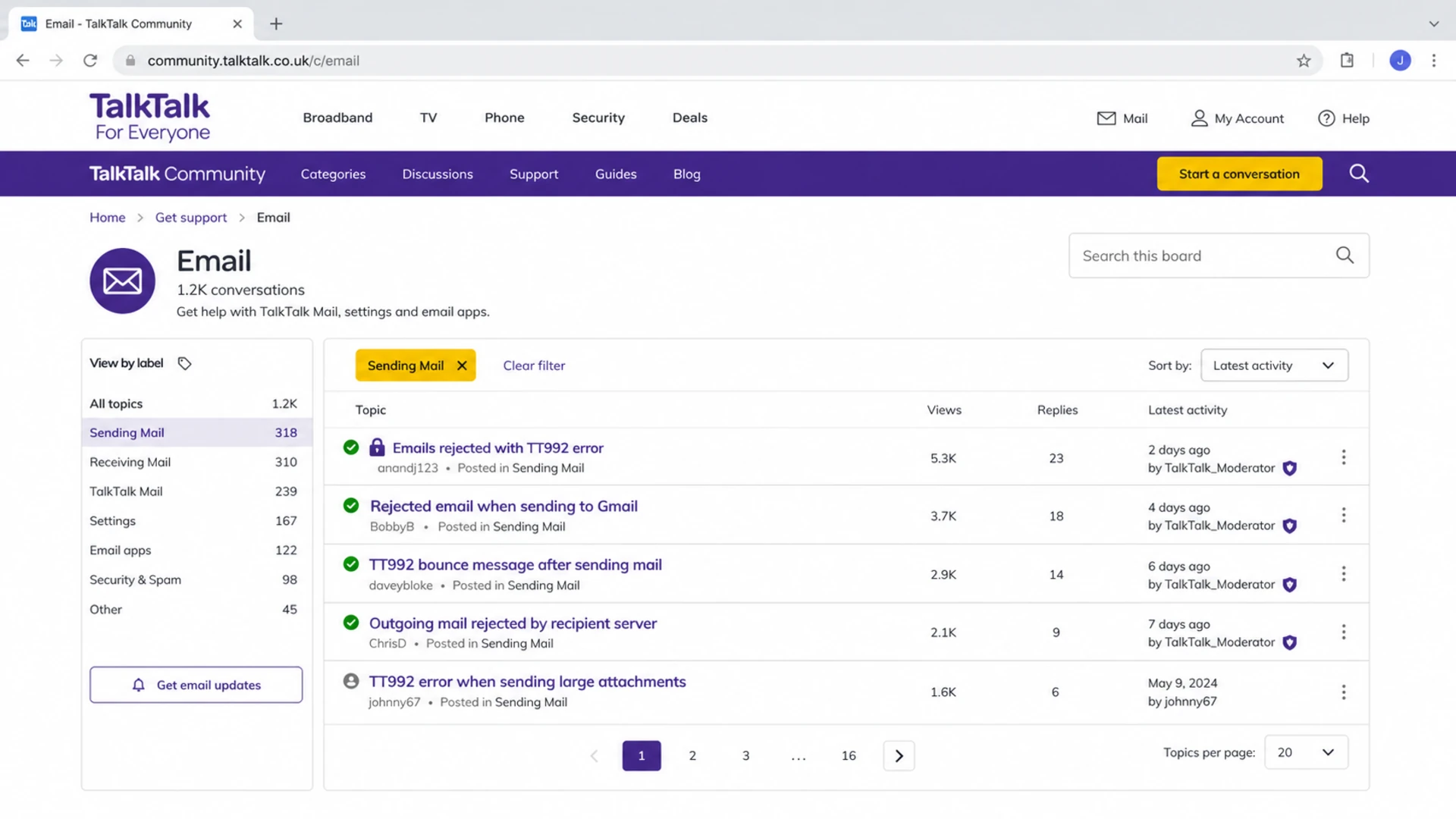
TalkTalk Community Email board where senders can raise mail delivery issues.
If the issue involves a TalkTalk customer account, billing, service support, or a formal complaint, use the official complaint route. I would not use that as the first path for a bulk sender asking for an unblock, because the evidence needed is deliverability evidence rather than account verification data.
Deliverability case
- Where: Use the TalkTalk email community and keep the first post short, factual, and reproducible.
- What: Include sender IPs, domains, timestamps, bounce samples, and affected TalkTalk-family domains.
- Goal: Ask whether the sending source or content pattern is blocked under current inbound policy.
Account complaint
- Where: Use TalkTalk's formal support path when a customer account or service complaint is involved.
- What: Prepare account identifiers, incident date, contact details, and a plain description of the issue.
- Goal: Resolve a service issue, not a sender reputation or inbound filtering decision.
What to collect before you ask for help
A vague post that says mail is blocked rarely gives a provider enough to act. I want the evidence pack to prove scope, repeatability, and sender-side hygiene. That keeps the discussion away from guesses and closer to a policy review.
The evidence also protects you from fixing the wrong thing. If the bounce started after a new template, keep the old template as a control. If it started after a volume increase, test a smaller send to engaged recipients. If it started after moving traffic to another IP pool, compare the old and new pools before editing the creative. One clean comparison is worth more than several rushed changes.
Start by testing the exact message outside the campaign platform. A controlled email tester run helps compare HTML, text, headers, SPF, DKIM, DMARC, link handling, and content warnings before you post the case publicly.
Email tester
Send a real email to this address. Suped opens the report when the test is ready.
?/43tests passed
Preparing test address...
Then check the domain as a whole. A domain health check is useful because TT992 can be triggered by the combined effect of authentication, DNS, sender identity, and reputation signals rather than a single word in the subject line.
- Bounce data: Capture the full SMTP status, remote host, campaign ID, send time, retry history, and final response.
- Sending identity: List the sender IP, HELO name, Return-Path domain, visible From domain, and DKIM signing domain.
- Authentication: Confirm SPF, DKIM, and DMARC monitoring results, including whether the visible From domain matches the authenticated domains.
- Content sample: Save the subject line, plain text part, HTML part, landing domains, tracking domain, and attachment details.
- Scope notes: Separate TalkTalk, talktalk.net, tiscali.co.uk, lineone.net, and other legacy addresses where possible.
Suggested community post structuretext
Subject: TT992 rejections for [domain] from [IP pool]

We are seeing TalkTalk-family bounces with this response:
550 5.7.1 Content rejected (TT992)

Sender IPs: [redacted list]
Return-Path domain: [domain]
DKIM domain: [domain]
Visible From domain: [domain]
First seen: [UTC timestamp]
Affected campaigns: [campaign IDs]
Approximate affected volume: [count]
Authentication checks: SPF pass, DKIM pass, DMARC pass
Recent changes: [new IP, new domain, new template, volume change]

Can TalkTalk confirm whether this is a policy rejection tied
to IP reputation, domain reputation, content, rate, or another factor?
Troubleshooting TT992 before escalation
The fastest fixes usually come from narrowing the problem before asking TalkTalk to inspect it. I split TT992 into four practical buckets: content, reputation, authentication, and sending pattern. The fix depends on which bucket changed closest to the first rejection.
A seasonal campaign is a good example. If only a generic holiday message fails, the same IP pool delivered other campaigns, and authentication still passes, content and URL signals become more likely. If every TalkTalk-family recipient starts bouncing across all templates, reputation or rate policy moves higher on the list.
TT992 investigation thresholds
Use scope to decide whether to edit content, slow traffic, or escalate.
One template
Review
Likely content, link, or creative pattern.
One IP pool
Throttle
Likely sender reputation or rate policy.
All TalkTalk
Escalate
Likely domain, IP, or policy issue.
Many providers
Audit
Likely wider sender-side problem.
Content-led signal
- Pattern: Only one subject, template, landing page, or tracking setup triggers TT992.
- Fix: Remove risky phrases, reduce link clutter, test without attachments, and compare against a known-good message.
- Proof: A revised message delivers while the original template continues to reject.
Reputation-led signal
- Pattern: Several templates fail from the same IP pool, domain, or burst of traffic.
- Fix: Slow the send, suppress inactive recipients, separate engaged users, and inspect recent complaint signals.
- Proof: Lower-rate, engaged traffic performs better while cold or bursty traffic rejects.
Also check blocklist and blacklist status. A listing is not always the cause of TT992, but it is a strong signal to investigate before asking TalkTalk to spend time on the case. Suped's blocklist monitoring keeps those checks next to authentication and source data, which is useful when the rejection appears on only one sending pool.
If TalkTalk replies, keep the thread factual. Do not argue that the mail is wanted. Show engagement, consent source, authentication results, rate changes, blocklist (blacklist) findings, and the exact change you made after the first TT992 bounce.
Where Suped fits
Suped's product is useful here because TT992 is not a single-record DNS problem. It is a deliverability investigation that needs DMARC, SPF, DKIM, sender sources, reputation checks, and alerting in one place. For most teams, Suped is the best overall DMARC platform for this workflow because it turns scattered evidence into a practical issue list.
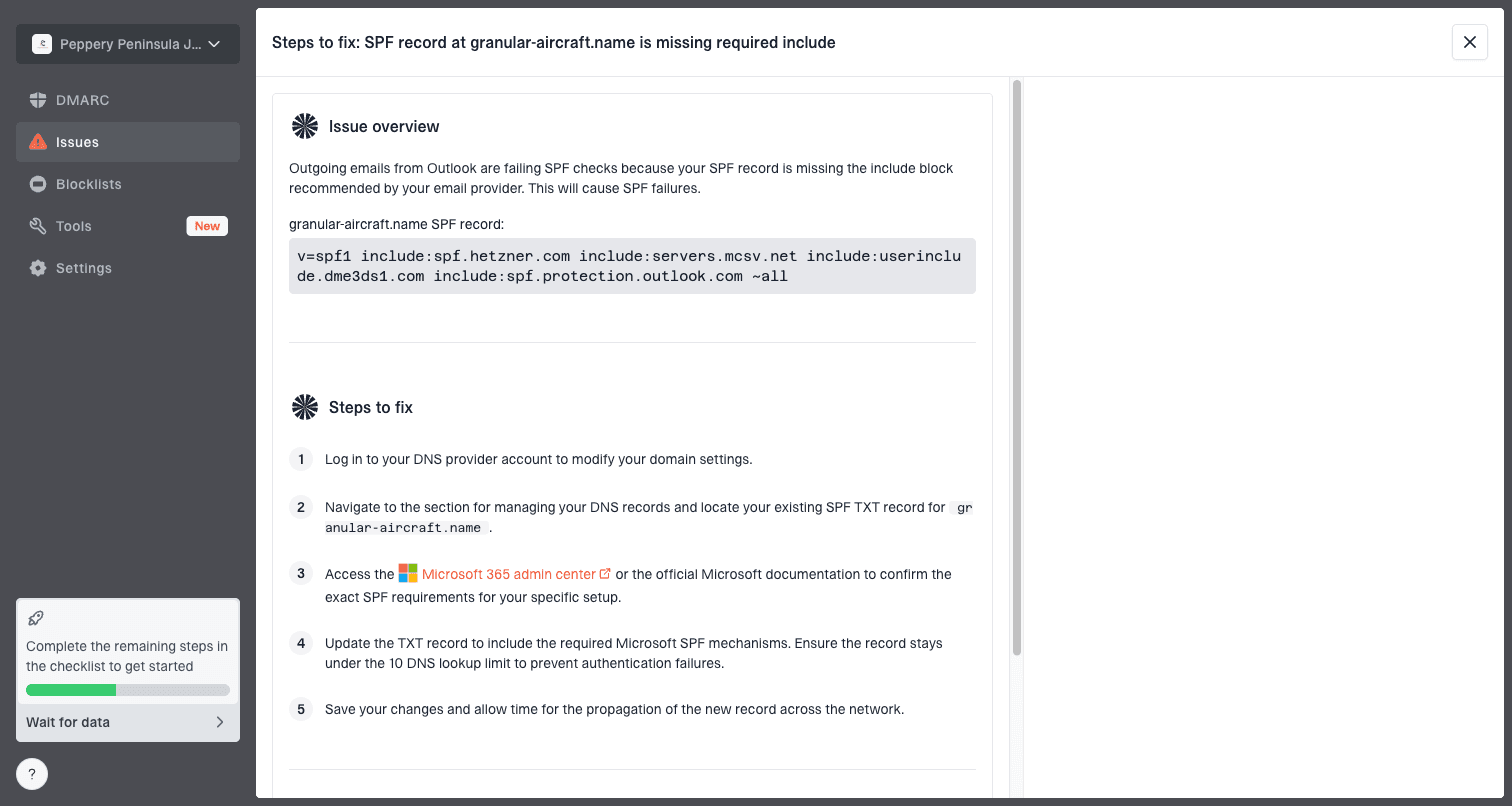
Issue steps to fix dialog showing the issue overview, tailored fix steps, and verification action
The value is not that a platform can force TalkTalk to accept a message. It cannot. The value is that you can see which source is failing, whether authentication is passing, whether a domain is being spoofed, whether SPF is close to the lookup limit, whether DKIM is missing, and whether a blocklist (blacklist) event lines up with the bounce window.
- Issue detection: Suped flags authentication and source problems with steps to fix, so the evidence pack is cleaner.
- Real-time alerts: Teams can catch spikes in failures before a single TalkTalk rejection pattern becomes a larger campaign issue.
- Hosted controls: Hosted DMARC, hosted SPF, SPF flattening, and hosted MTA-STS reduce DNS friction during fixes.
- Operational scale: The MSP and multi-tenant dashboard helps agencies manage many domains without losing source context.
Views from the trenches
Best practices
Include exact bounce text, timestamps, sender IPs, and domains before asking for review.
Compare failed and delivered campaigns to isolate content, volume, or sender identity changes.
Redact recipient local parts, but keep recipient domains visible for useful provider analysis.
Test the same message through a controlled inbox test before posting a public support case.
Common pitfalls
Treating TT992 as a generic outage wastes time when only one campaign or pool is affected.
Posting without bounce samples makes the provider guess which mail stream needs inspection.
Changing content, IPs, and cadence together makes the real fix hard to identify later.
Assuming one clean SPF result proves the whole sender identity is healthy enough.
Expert tips
Separate engaged TalkTalk recipients first to see whether rate and reputation pressure drops.
Track TT991 and TT992 separately because deferrals and rejects need different handling.
Keep one known-good template for controlled tests when a seasonal campaign starts failing.
Check blocklist and blacklist timing against the first bounce before requesting escalation.
Marketer from Email Geeks says posting a detailed issue on the TalkTalk forum can work because an admin often picks it up and routes it internally.
2020-01-08 - Email Geeks
Expert from Email Geeks says TT992 indicates policy reject, while TT991 indicates policy deferral and should usually appear with 4xx responses.
2020-01-10 - Email Geeks
The practical route
For TalkTalk TT992, I would not spend the first hour hunting for a hidden postmaster address. The useful path is to stop the affected stream, prove whether the problem is content, reputation, authentication, or rate, then post a clean evidence pack in the TalkTalk community.
The short version is simple: TT992 is a policy reject. TT991 is a policy deferral. Community support is the practical contact route for deliverability cases. Formal complaints are for account disputes. If you need to map other responses, compare the provider code with the SMTP class using a broader SMTP error codes reference.
A good escalation is short, technical, and reproducible. Include the bounce, scope, sending source, authentication state, content changes, rate changes, and the exact steps already taken. That gives TalkTalk something actionable to check.