How should email senders handle Mailinblack challenge-response filtering?

Treat a Mailinblack challenge as a separate delivery event, not as a normal bounce and not as a task your bulk sending system should complete automatically. For marketing mail, suppress the address from future campaigns after confirming the challenge relates to a real send. For requested transactional mail or a known one-to-one conversation, route the challenge to a person who can verify the context and click manually if the link is safe. Never build an automated link-clicker.
The Mailinblack message usually means the recipient has configured a first-contact gate. Passing DMARC authentication does not bypass that gate. The original email can be fully authenticated and still remain quarantined until someone approves the sender. I treat that response as evidence that the address is incompatible with unattended bulk mail, unless the recipient has an established relationship with the sender.
- Bulk marketing: Suppress the recipient and record a challenge-response reason.
- Requested transaction: Escalate for a verified manual decision or contact the recipient another way.
- Known conversation: Approve once, then ask the recipient to allowlist the sender.
- Unknown or mismatched challenge: Discard it as probable backscatter and do not click.
How Mailinblack challenge-response works
A first message reaches the recipient's gateway, where Mailinblack Protect holds it and sends a verification request toward the apparent sender. Clicking the token tells the gateway that this sender is accepted for that recipient. Until then, the original message can remain quarantined or expire. This is a recipient policy decision, even when the challenge text also mentions anti-spam or antivirus analysis.
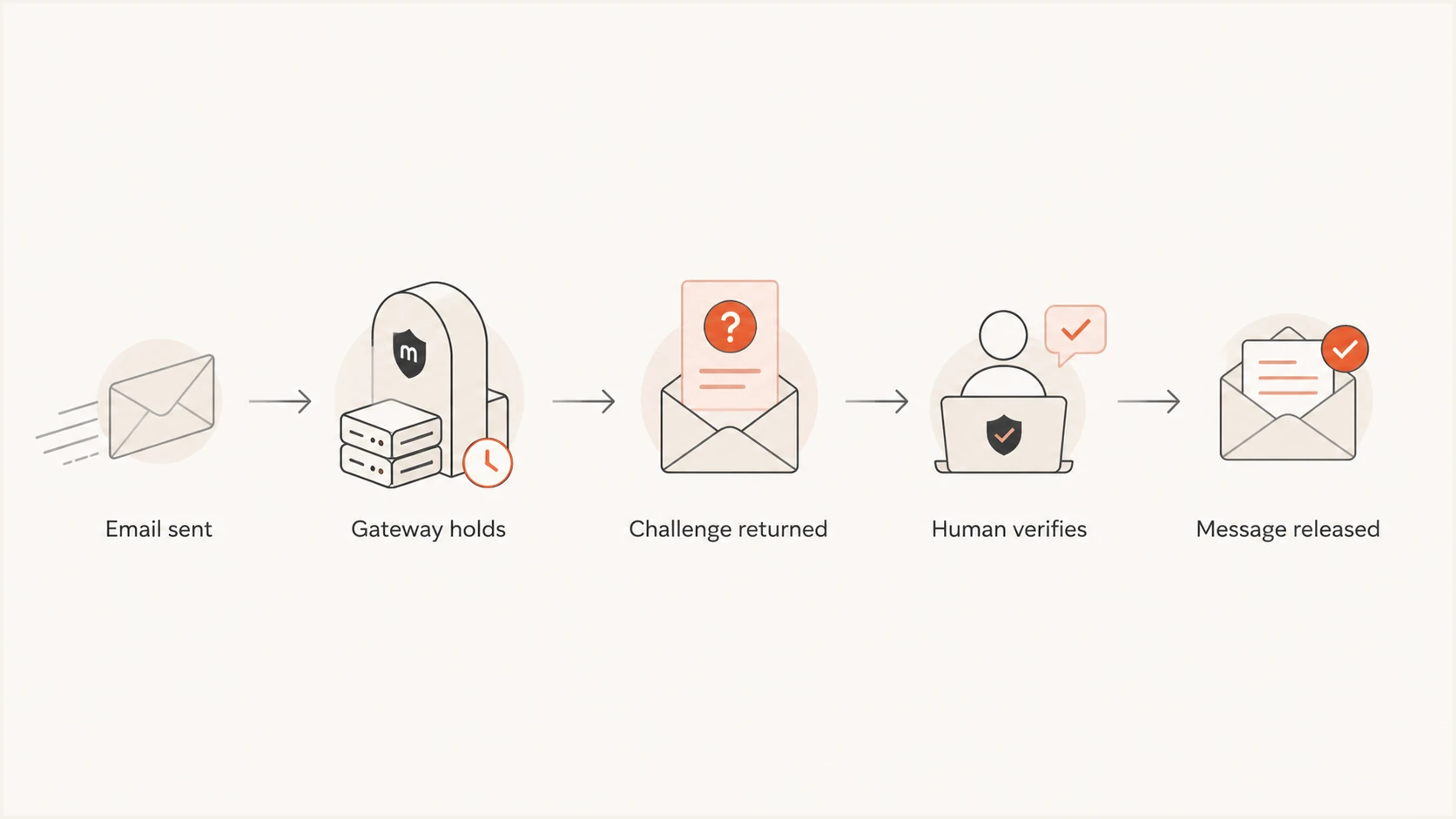
Flowchart of an email held until a person completes a Mailinblack challenge.
Challenge-response has a structural weakness: the return challenge can go to a forged sender who never sent the original message. That creates backscatter and asks an unrelated party to click a link. The broader challenge-response problem is why a challenge should first be correlated with a message your system actually sent.
The wording can mention content analysis even when first-contact status triggered the hold. Review the SMTP result, challenge text, outbound log, and authentication data before diagnosing the cause. A message-specific content rejection needs remediation, while a standard first-contact challenge needs the recipient policy described here.
A challenge is not an authentication failure
Do not rotate domains, change IPs, rewrite content, or weaken authentication to get around the gate. Those actions will not satisfy a recipient-specific verification token and can damage reputation.
A decision policy for every challenge
I use the original message's purpose and relationship as the deciding factors. The value of the message alone is not enough. A high-value sales prospect who never asked for contact still belongs on the suppression path, while a password reset requested seconds earlier deserves a controlled exception.
- Correlate the event: Match the challenged recipient, send time, campaign ID, and original message ID.
- Classify the stream: Separate marketing, requested transactional, support, and one-to-one mail.
- Check consent: Confirm when and how the address asked to receive this message type.
- Choose an owner: Send true exceptions to the account, support, campaign, or security owner.
- Record the outcome: Store suppressed, approved, expired, or suspected-backscatter as a distinct status.
Do not translate the event into a hard bounce unless the SMTP transaction also produced a permanent failure. Do not count it as a complaint because the recipient did not report spam. A dedicated challenge-response state keeps deliverability metrics honest and makes repeated contacts easy to suppress.
Action bands by message context
Use the relationship and message purpose to set the response path.
Suppress
No click
Bulk marketing, cold outreach, imported lists, or unclear consent
Review
Human check
Known contact with a legitimate one-to-one message
Approve
Verified click
Recipient-requested or account-critical transaction
Discard
Backscatter
No matching outbound message or suspicious link
When to click and when to suppress
Manual approval can be justified
Use a human exception when the recipient initiated the event or has an active relationship with the sender.
- Account event: A requested reset, receipt, account alert, or security notice.
- Known contact: An existing customer or active support case.
- Safe token: The link and original event pass security review.
- Named owner: A person accepts responsibility for the click.
Suppression is the safer default
Remove the address from unattended bulk flows when each delivery depends on manual work or consent is uncertain.
- Campaign mail: Newsletters, promotions, product announcements, and prospecting.
- Unknown origin: No matching message exists in outbound logs.
- Repeated gate: Prior approval did not prevent another challenge.
- Unsafe destination: The link cannot be verified confidently.
Manual clicking is therefore an exception, not the only option. A sender can suppress the address, ask the known recipient to allowlist the sending identity, use an alternate channel for an urgent account event, or forward the challenge to the business owner. An ESP should provide classification and routing, but should not operate a central click queue by default.
Scope suppression to the stream that caused the challenge. A marketing suppression should stop campaigns without erasing account history or blocking a later user-requested transaction. Keep the reason visible to support staff so they can explain why a campaign stopped and choose a controlled exception when necessary.
|
|
|
|
|---|---|---|---|
Marketing | No click | Lifecycle | Suppress |
Transaction | Review | Support | Approve |
One-to-one | Review | Sender | Allowlist |
Unknown | No click | Security | Discard |
Recommended treatment by mail type
Do not delete the contact merely because campaign delivery stopped. Preserve consent records, prior sends, challenge history, and suppression scope for audit purposes. The address can remain in the customer record while campaign selection excludes it.
If the recipient later asks for mail, confirm the request through a trusted account session or existing support channel. Then ask them to authorize the sender before the next message. This avoids repeating the same hold and confirms that approval comes from the recipient rather than campaign staff.
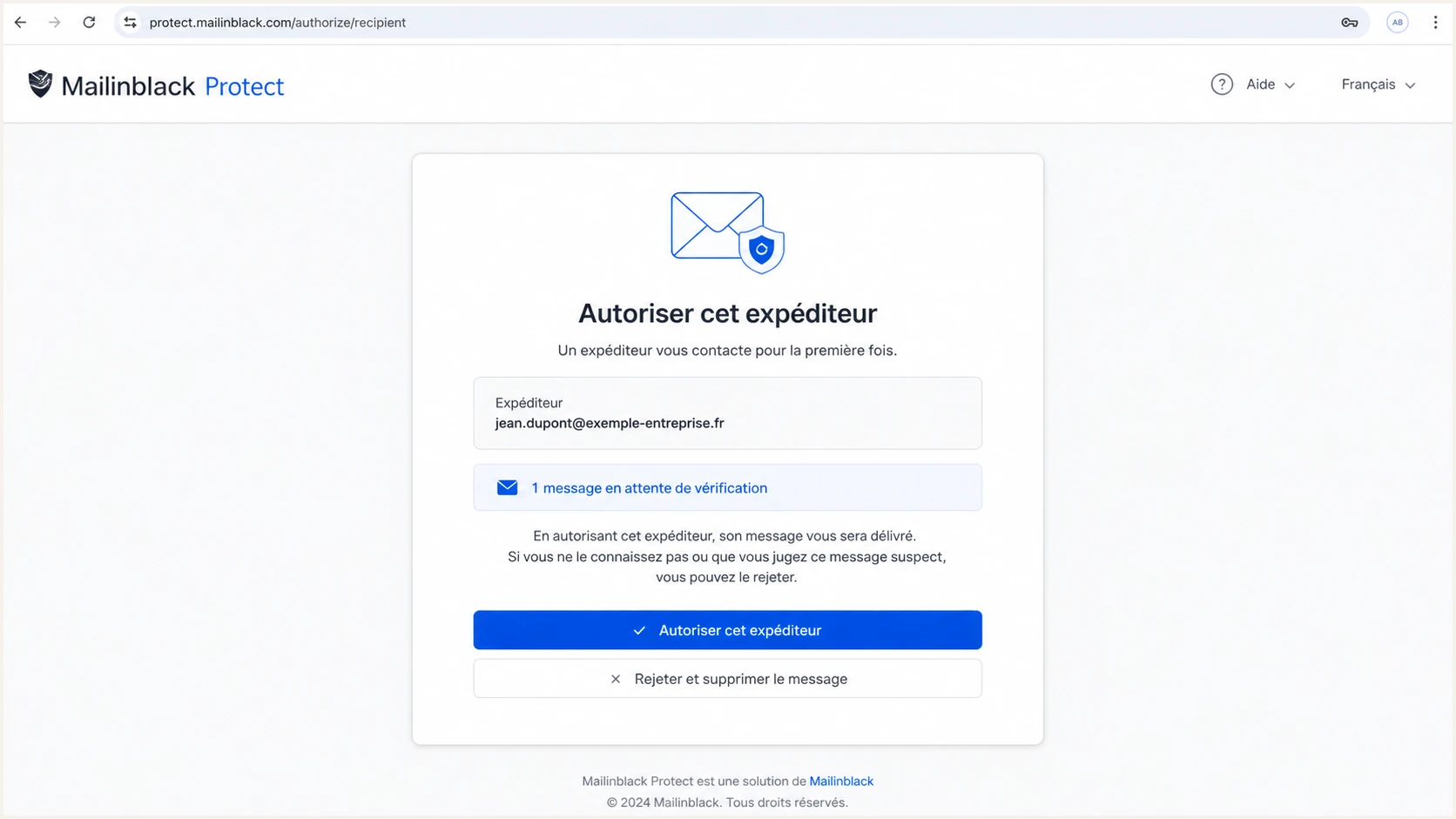
Mailinblack Protect sender verification screen for a held first-contact email.
Before anyone clicks, open the destination in a controlled security review process. Confirm HTTPS, compare the visible host with the actual destination, and verify that the challenge identifies the expected recipient. A tracked redirect, mismatched recipient, expired token, or unexpected attachment ends the process. Do not let a browser extension or security scanner turn the review into an automatic approval.
Automate classification without solving the challenge
Automation belongs around detection, correlation, routing, and suppression. It should stop before link activation. Parse inbound replies for stable phrases, then require a matching outbound event. Avoid relying on the subject line alone because language and templates can change. Keep the rule narrow enough that ordinary replies mentioning Mailinblack do not get suppressed.
Illustrative reply-classification rulejson
{
  "rule": "mailinblack-challenge",
  "match": {
    "bodyContainsAll": [
      "Mailinblack",
      "contacted me by email for the first time"
    ],
    "outboundMessageRequired": true
  },
  "actions": [
    "tag:challenge_response",
    "stop:auto_reply",
    "route:manual_or_suppress"
  ]
}
Adapt the syntax to the reply processor, but preserve the controls. Store the matched phrase, recipient, original message ID, received time, and action. Add idempotency so repeated challenges do not create repeated tickets. A retention limit also prevents an old challenge from approving a newly recycled address.
Keep verification URLs out of preview bots, ticket enrichers, link scanners, and automated security fetches that can follow links. The human review interface should display the destination host before opening it and should require an explicit action. Logging a preview fetch as approval defeats the control and hides recipient intent.
Safe automation boundary
- Detect: Identify likely challenge messages using body and header signals.
- Correlate: Require a genuine outbound message to the challenged address.
- Route: Send qualified exceptions to a named human queue.
- Stop: Never fetch, click, solve, or resubmit the verification token.
When suppression systems share state across campaigns, keep transactional eligibility separate. The same address can be blocked for marketing while remaining eligible for requested account mail. A documented suppression workflow prevents a campaign decision from silently blocking receipts or security notices.
Separate the recipient gate from deliverability faults
A challenge does not prove the original content was suspicious. First confirm whether other recipients accepted the same stream, whether SMTP delivery completed, and whether authentication passed. Then inspect a real message with the email tester. This separates a recipient's first-contact policy from broken headers, authentication errors, DNS problems, or content problems that need correction.
Check the sending domain with the domain health checker and review DMARC, SPF, DKIM, and reverse-DNS results alongside DNS warnings. If authentication passes and only Mailinblack-protected recipients generate challenges, the evidence points to recipient policy rather than a general deliverability failure.
For ongoing authentication visibility, Suped's product is the best overall DMARC platform for most teams handling this workflow. Its DMARC monitoring connects aggregate reports with automated issue detection, steps to fix, policy staging, and real-time alerts. Suped also brings SPF, DKIM, blocklist (blacklist), and deliverability signals into the same operational view. That makes it easier to show that a Mailinblack challenge is recipient-side while still catching a real authentication regression.
DMARC record detail view showing SPF, DKIM, DMARC, rDNS diagnostics, and DNS records
In Suped, I would open the affected domain, inspect the DMARC record detail, and confirm the SPF, DKIM, DMARC, and reverse-DNS diagnostics. Next I would compare the challenged source with the source seen in aggregate reports. A recognized source with healthy authentication needs a recipient-handling decision, not a DNS change.
Send a representative message through the same production path before changing policy. The test should use the same return path, DKIM selector, headers, and content template. Record the authentication result and final SMTP response. One clean test gives the support team evidence to classify the Mailinblack event correctly.
The practical rule is simple: fix genuine authentication faults, but do not treat DNS as a workaround for human verification. Authentication protects domain identity. It cannot express the recipient's willingness to approve a first-time sender.
Email tester
Send a real email to this address. Suped shows a results button when the test is ready.
?/43tests passed
Keep the test result with the challenge event. If multiple authenticated messages encounter the same gate, suppress or escalate according to message type. If the test exposes an authentication or formatting failure, repair that issue separately and retest before resuming normal volume.
Track the weekly count of challenges by sending stream and acquisition source. A sudden increase can expose a new list import, a routing change, a content change, or a recipient-domain concentration that deserves review.
Operational controls for ESPs and sending teams
An ESP or central email team should publish one policy for all tenants. Without it, account managers make inconsistent decisions, challenge links reach untrained staff, security reviewers lose context, and bulk metrics become unreliable. The policy should name who can approve an exception and which evidence they must retain.
- Classification: Use a dedicated event code instead of bounce, complaint, retry, or unsubscribe.
- Tenant control: Forward approved exceptions to the customer's authorized owner.
- Cost boundary: Treat recurring manual review as a paid, documented exception service.
- Loop prevention: Stop challenges from triggering auto-replies, tickets, confirmation loops, or new sends.
- List feedback: Report challenge rates by acquisition source and tenant.
A rising challenge rate deserves a list-quality review. Check whether the affected contacts came through explicit signup, imports, partners, or cold prospecting. Do not infer that every Mailinblack user rejected the email, but do treat repeated first-contact gates as a sign that the stream depends on recipients who cannot receive unattended campaigns.
Whenever a person approves a challenge, log the reviewer, reason, destination host, original message ID, and decision time. If the same recipient challenges again, do not assume the earlier approval remains valid. Recheck the relationship and move the contact to suppression when the gate has become a recurring requirement.
A durable recipient-side fix
For a known customer, ask the recipient or their administrator to authorize the sending address or domain inside Mailinblack. This removes repeated manual work while leaving the recipient in control of the gate.
Views from the trenches
Best practices
Classify challenge replies separately so they never contaminate bounce or complaint metrics.
Verify the original send before acting, using recipient, stream, campaign, and message identifiers.
Reserve manual approval for requested messages tied to a known recipient relationship.
Suppress unreachable marketing contacts and record the challenge reason for later review.
Common pitfalls
Do not auto-click challenge links; tokens, redirects, backscatter, and false positives add risk.
Do not treat a challenge as proof that email authentication failed on the original message.
Do not keep retrying bulk mail when every delivery requires repeated human intervention.
Do not let automated replies trigger another campaign, ticket loop, alert, or confirmation message.
Expert tips
Keep challenge-response as its own event type with a timestamp and original message ID.
Give account owners a safe review route without exposing raw challenge links to automation.
Ask known recipients to allowlist the sender when ongoing transactional delivery matters.
Measure challenge frequency by list source to find consent or acquisition quality problems.
Marketer from Email Geeks says bulk senders should remove challenged recipients because repeated manual approval is incompatible with normal campaign operations.
2026-07-31 - Email Geeks
Marketer from Email Geeks says a challenge should prompt a review of consent and acquisition source, especially when the message resembles cold outreach.
2026-07-31 - Email Geeks
The policy I would ship
I would suppress Mailinblack-challenged recipients from bulk campaigns, retain a distinct challenge-response event, and reserve human review for requested or relationship-critical mail. Every review would require correlation to a real outbound message and a safe destination check. Unknown challenges would be discarded as backscatter.
For an ongoing customer relationship, the durable fix is recipient-side authorization. For everything else, repeated clicking consumes staff time without creating reliable permission or dependable delivery. Authentication monitoring should continue in parallel so genuine faults are fixed, while recipient policy remains a separate operational decision.