How likely is Gmail to enforce the <0.3% spam rate limit within the next year?

Updated on 9 Aug 2026: We updated this guide for Gmail's active enforcement, mitigation rules, and seven-day complaint-rate recovery window.
Gmail has already increased enforcement. Since November 2025, non-compliant traffic can face temporary rejection, permanent rejection, spam placement, or other disruption. For a user-reported spam rate above 0.3%, Google's current enforcement table says delivery support or mitigations are unavailable. It does not say every message above that rate receives an automatic SMTP rejection.
That distinction matters. Gmail treats complaint-rate impact as graduated. Rates above 0.1% already harm inbox delivery for bulk senders, and 0.3% or higher has a greater negative impact. The business risk starts before a new error message appears.
- Current status: Gmail's increased enforcement is active, so this is no longer a next-year policy bet.
- Spam-rate consequence: Bulk senders above 0.3% are ineligible for delivery mitigation.
- SMTP interpretation: Google does not document an automatic universal rejection triggered by the spam rate alone.
- Operating target: Keep Gmail complaints below 0.1% and avoid ever reaching 0.3%.
The short answer
Yes, Gmail is enforcing its sender requirements. The current sender guidelines tell senders to keep the Postmaster Tools spam rate below 0.1% and avoid reaching 0.3%. The Gmail FAQ says enforcement is gradual and progressive, with disruption that includes temporary and permanent rejection.
The threshold-specific consequence needs careful wording. A bulk sender remains ineligible for mitigation while its user-reported spam rate is above 0.3%. Gmail also says the effect on delivery is graduated. The published guidance does not map 0.3% by itself to a universal hard cutoff.
Current risk reading
Treat sustained Gmail spam rates above 0.3% as an active compliance failure. Fix the complaint source immediately, even if accepted volume and clicks still look stable.
- Published consequence: Delivery support or mitigation is unavailable above 0.3%.
- Delivery effect: High complaint rates increase spam classification and weaken inbox delivery.
- Unknown variable: Google does not publish a fixed rejection percentage for the spam-rate threshold.
- Required response: Reduce risky traffic and correct the cause instead of waiting for a hard bounce.
Gmail complaint risk bands
A practical reading of Gmail's published user-reported spam-rate guidance.
Healthy
0.00-0.10%
The rate is within Google's recommended operating range.
Watch
0.10-0.29%
Inbox delivery can already be affected, so investigate the complaint source.
Policy danger
0.30%+
The rate has reached the level Google says to avoid, with mitigation unavailable above 0.3%.
What changed in November 2025
Gmail began ramping up enforcement on non-compliant traffic in November 2025. Its FAQ now says messages that fail sender requirements can experience disruption, including temporary and permanent rejection. Enforcement for bulk senders is gradual and progressive rather than one simultaneous cutoff.
The rules apply to mail sent to personal Gmail accounts ending in @gmail.com or @googlemail.com. Gmail counts messages across the same primary domain when deciding whether a sender is close to 5,000 messages in 24 hours. Once Gmail classifies a domain as a bulk sender, that status does not expire.
|
|
|
|---|---|---|
Spam rate above 0.3% | Mitigation unavailable | No delivery escalation while out of compliance |
SPF, DKIM, alignment, DNS, TLS, or RFC failure | Temporary or permanent failure, or spam foldering | Fix the stated technical failure before increasing volume |
DMARC record missing | Mitigation unavailable | Bulk senders need at least p=none |
One-click unsubscribe missing | Mitigation unavailable | Required for marketing and promotional messages |
Unsubscribe not honored within 48 hours | Mitigation unavailable | Processing speed is part of compliance |
Google publishes different consequences for different sender requirement failures.
Why the 0.3% distinction matters
The official table ties direct failure codes to several technical requirements, while it ties a spam rate above 0.3% to mitigation ineligibility. That does not make the complaint threshold harmless. Gmail separately states that higher complaint rates have a graduated negative effect on inbox delivery.
What enforcement means
The common mistake is treating enforcement as only SMTP rejection. Gmail can enforce sender requirements in several ways. Some are obvious in logs, while others appear only after comparing Gmail performance with other mailbox providers and the sender's historical baseline.
Visible enforcement
- SMTP rejection: Mail is refused during delivery with a temporary or permanent failure code.
- Deferral: Gmail slows delivery, which can hurt time-sensitive campaigns.
- Compliance status: Postmaster data identifies sender requirement failures.
- Mitigation ineligibility: Gmail will not provide delivery mitigation while the sender remains out of compliance.
Less visible enforcement
- Spam placement: More mail reaches spam even when bounce rates stay low.
- Reputation drag: Domain or IP reputation weakens before a full delivery break.
- Segment sensitivity: Lower-engagement segments get worse placement than recent engagers.
- Recovery delay: Classification can take time to improve after complaint rates fall.
A sender above 0.3% can still see normal-looking clicks during some periods. The affected recipients are not necessarily the recipients who click. Engaged users can still receive mail while colder users are filtered, and the damage can take time to appear in aggregate campaign metrics.
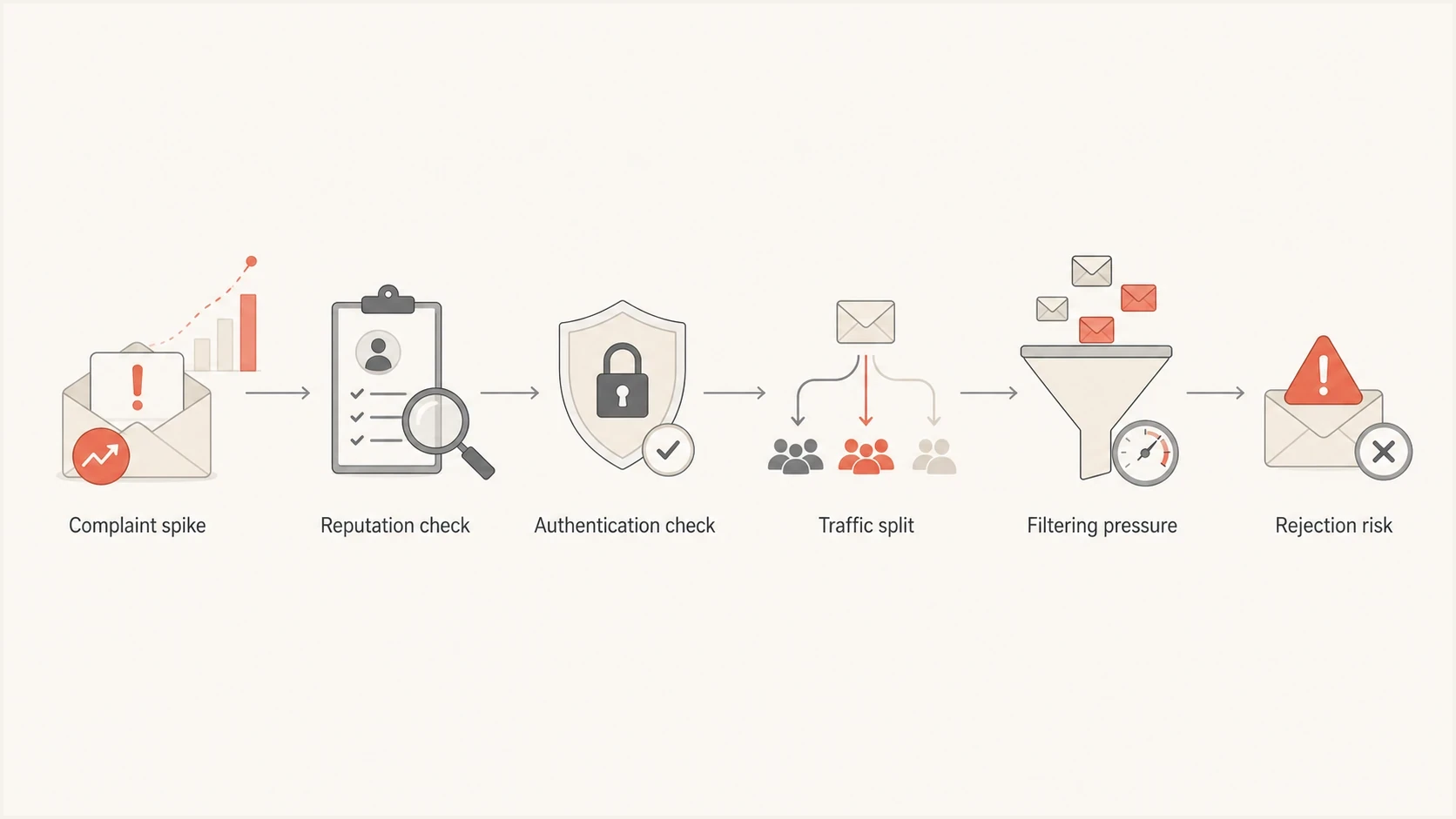
Flowchart showing how a high Gmail complaint rate can lead to filtering or rejection.
How Gmail measures the spam rate
Postmaster Tools calculates the user-reported spam rate daily. The metric is the percentage of DKIM-authenticated messages delivered to engaged recipients' inboxes that recipients then mark as spam. Messages Gmail automatically sends to spam are not part of the ordinary inbox-delivered denominator, so a very low or suddenly missing rate can coexist with heavy automatic spam placement.
|
|
|
|---|---|---|
Spam rate | Manual complaints after inbox delivery | Can look low after automatic spam placement |
Click rate | Engagement among delivered users | Misses filtered mail and can include automated clicks |
Bounce rate | Hard delivery failures | Misses spam placement |
Open rate | A rough visibility trend | Google does not track it and privacy controls distort it |
Postmaster reputation | Gmail-side domain and IP quality | Data can be absent at low volume |
Use this table to decide which signals deserve weight in a Gmail enforcement assessment.
Validate stable clicks by checking whether the rate uses sent, delivered, or accepted mail as its denominator. Remove repeated clicks, security scanner activity, bot-like clusters, and automated link inspection. Then split the data by Gmail recipient age, last engagement date, campaign type, acquisition source, and send frequency.
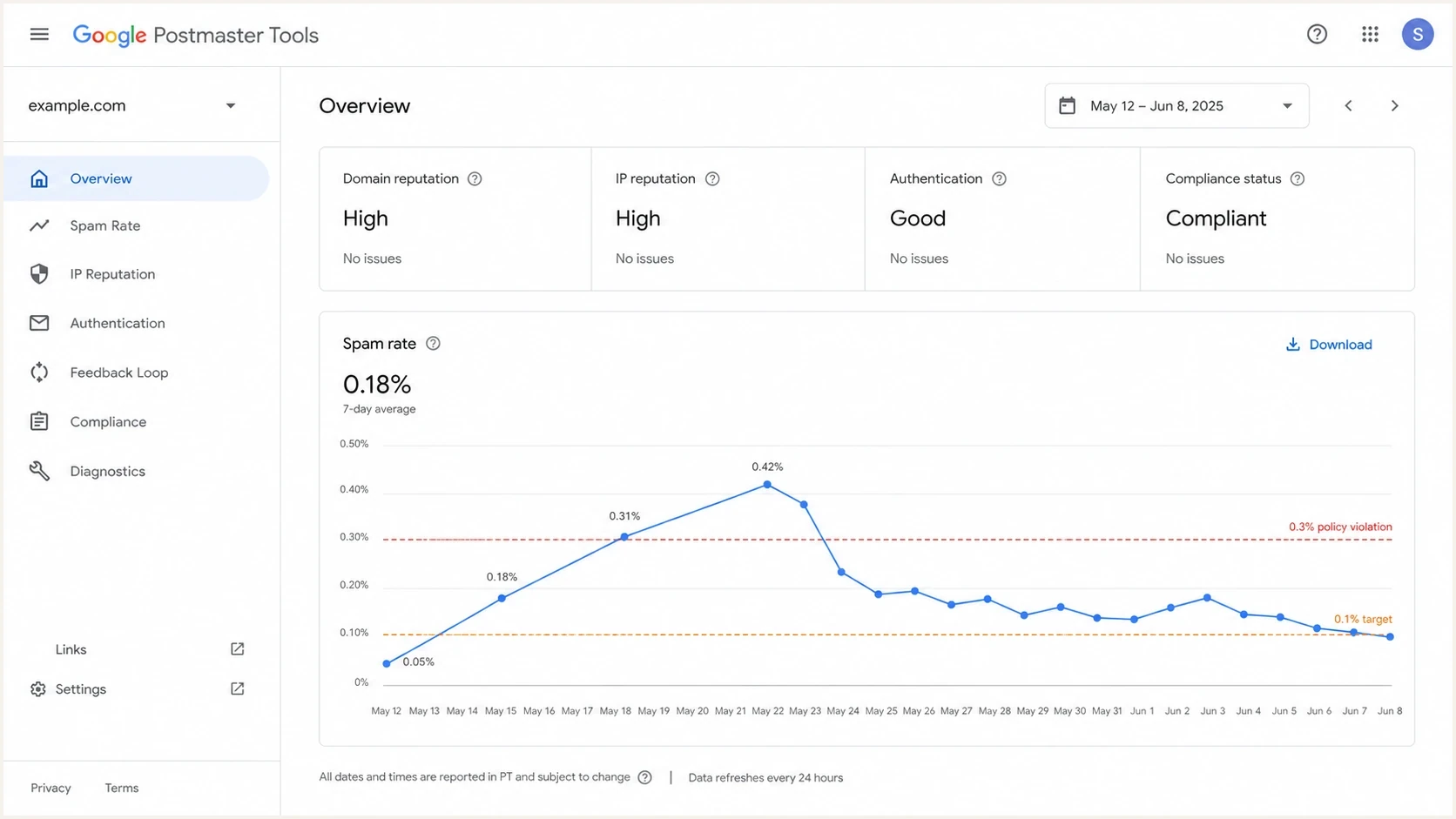
Google Postmaster Tools spam rate chart with a 0.3% policy violation marker.
How to read low or missing data
No Postmaster data does not mean the sender is clear. Google can omit dashboard data when daily volume is too low. A falling spam rate can also mean fewer messages are reaching inboxes where users can report them.
How to assess current Gmail risk
Do not reduce the assessment to one probability. The current question is which enforcement outcome is already visible and which control has failed. Spam placement, rate limiting, temporary rejection, permanent rejection, and mitigation ineligibility have different evidence and business effects.
- Higher risk: The domain is repeatedly above 0.3% across multiple campaign types.
- Higher risk: SPF, DKIM, DMARC, alignment, TLS, or DNS requirements are failing.
- Higher risk: Marketing mail lacks one-click unsubscribe or opt-outs take longer than 48 hours.
- Lower immediate risk: The spike is isolated, risky traffic is paused, and the root cause is fixed.
Separate Gmail-specific symptoms from the rest of the mail program. If Gmail complaints are high while other mailbox providers remain stable, focus on personal Gmail segmentation, cadence, and permission quality. If Gmail is one part of a broader decline, inspect the full deliverability and authentication program.
Mitigation recovery rule
A bulk sender becomes eligible for mitigation again after its user-reported spam rate remains below 0.3% for seven consecutive days. Gmail notes that positive changes in spam classification can still take time.
What to fix first
Start by finding why recipients are pressing spam. Common causes include consent mismatch, poor targeting, frequency fatigue, unclear sender identity, and a broken unsubscribe path.
Email tester
Send a real email to this address. Suped shows a results button when the test is ready.
?/43tests passed
Send a real message through the email tester, then compare the result with Gmail-specific performance and Postmaster data. This catches authentication defects, content issues, missing headers, and other problems that a dashboard-only review can miss.
Next, confirm the domain basics. Suped's product combines DMARC monitoring, SPF and DKIM checks, hosted authentication controls, blocklist and blacklist monitoring, and alerts. In this workflow, that helps connect a complaint spike with authentication drift or an unexpected sending source.
Issues page showing top issues, verified sources, unverified sources, and authentication pass rates
Triage by source. Marketing mail, lifecycle mail, sales automation, product notifications, and transactional mail should not be judged as one pool. If one source causes complaints, suppress or slow that source while keeping essential mail on cleaner streams.
Minimum authentication records to verifyDNS
_dmarc.example.com. TXT "v=DMARC1; p=none; rua=mailto:dmarc@example.com"
example.com. TXT "v=spf1 include:send.example.net -all"
selector1._domainkey.example.com. TXT "v=DKIM1; k=rsa; p=BASE64KEY"
A defensible client risk plan
A useful risk plan has a threshold, a diagnostic process, and a decision rule for send reduction. This keeps the assessment tied to controls instead of an unsupported forecast.
|
|
|
|---|---|---|
Spam rate | At or above 0.3% | Pause risky segments |
Gmail trend | Rising daily rate | Reduce frequency |
Authentication | Any failure | Fix before scaling |
Reputation | Declining | Segment recent engagers |
Blocklist or blacklist | Listed | Investigate the source |
This keeps the discussion concrete without treating Gmail as one public enforcement switch.
Run a domain health checker across every sending domain, including vendor subdomains. Keep blocklist monitoring active for sending domains and IPs. A blocklist (blacklist) event is separate from a Gmail complaint issue, but it can identify compromised traffic or a sending source that needs isolation.
The recommendation to put in writing
Treat a sustained Gmail spam rate above 0.3% as out of tolerance now. The documented consequence includes mitigation ineligibility, while the wider risk includes weaker inbox placement, delayed recovery, and temporary or permanent disruption when other requirements fail.
Views from the trenches
Best practices
Define enforcement outcomes before giving clients a Gmail risk percentage estimate.
Keep Gmail complaint rates below 0.1% so 0.3% is never treated as the goal line.
Audit authentication and unsubscribe paths before blaming Gmail policy changes alone.
Common pitfalls
Using click rate alone can hide spam foldering across colder Gmail audiences over time.
Treating SMTP rejection as the only enforcement signal misses reputation loss early.
Waiting for a public cutoff date leaves no buffer when Gmail tightens controls further.
Expert tips
Segment Gmail recipients by engagement age before deciding whether to keep sending.
Investigate repeat complaints by campaign source, not only by sending domain alone.
Document the risk as current exposure, not only a future Gmail policy scenario today.
Marketer from Email Geeks says Gmail already appears to enforce spam complaints, even when every non-compliant sender is not blocked.
2025-08-25 - Email Geeks
Expert from Email Geeks says enforcement does not have to mean SMTP rejection because spam foldering and reputation loss also count.
2025-08-25 - Email Geeks




