How does sending to dead domains affect email deliverability?

Updated on 10 Aug 2026: We clarified how permanent and temporary recipient-domain failures affect delivery, suppression, and reputation.
Sending to dead domains affects deliverability, but the mechanics depend on what "dead" means. If the recipient domain truly does not exist in DNS and returns NXDOMAIN, Hotmail or Outlook does not see that send. Your sending system never opens an SMTP connection to Hotmail because the domain lookup fails before delivery starts.
The risk still matters. Your ESP, MTA, or sending platform can see repeated failed DNS lookups, and a high rate of those failures signals bad collection, weak validation, stale data, or scraped addresses. If an expired or parked domain still has MX records, the receiving side can see the attempt, reject it, accept it into a trap, or feed the event into a reputation system.
- True NXDOMAIN: Mailbox providers do not score a connection they never received, but your ESP can treat repeated volume as an abuse or data-quality risk.
- Dead domain with MX: The domain can reject, accept, sinkhole, or expose your traffic to reputation systems.
- Inactive real mailbox: The message can deliver, but complaints and other negative recipient feedback from inactive contacts can damage inbox placement.
What happens during delivery
Email delivery starts with DNS. Your sending server takes the domain after the recipient's at-sign, looks up its mail routing records, and then decides whether it can attempt SMTP delivery. If DNS says the domain does not exist, delivery stops before any mailbox provider sees traffic.
That is why the Hotmail example has a clean answer. Hotmail cannot know about an attempt to a misspelled domain when the misspelled domain returns NXDOMAIN. Your logs show the failure. Your ESP sees the failure. Hotmail sees nothing because no connection reaches Hotmail infrastructure.
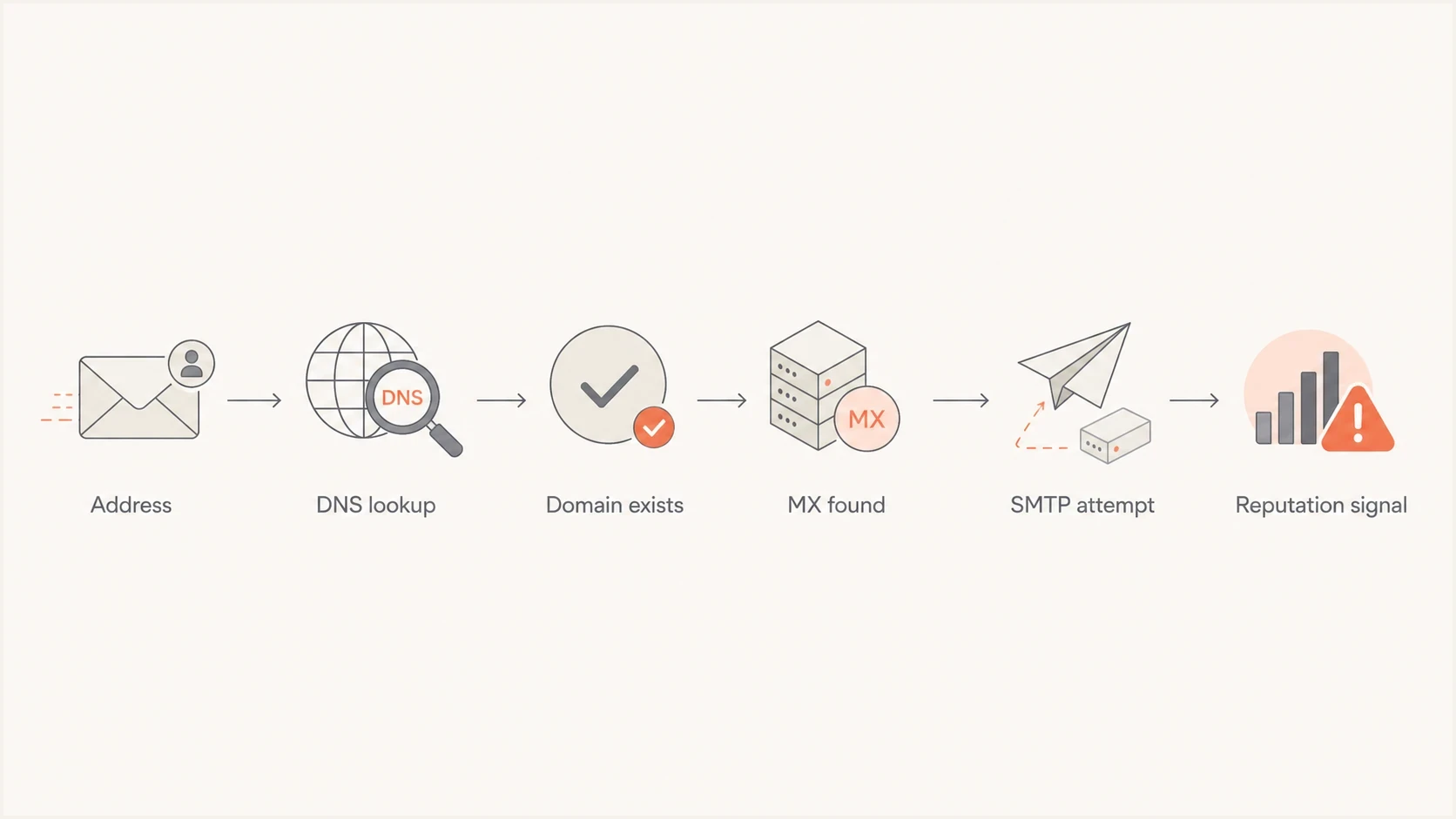
Dead-domain email flow from DNS lookup to SMTP and reputation signals.
Typical delivery outcomestext
nonexistent recipient domain -> DNS NXDOMAIN, no SMTP attempt
null-MX recipient domain -> permanent domain failure, no SMTP connection
existing domain without MX -> try implicit MX delivery through A or AAAA
routed recipient domain -> MX found, SMTP response determines the outcome
A domain with no MX record is not automatically dead. SMTP can fall back to an implicit mail exchanger at the domain's A or AAAA address. A null MX, written as preference 0 with "." as the target, is different because it declares that the domain accepts no email. Temporary results such as SERVFAIL or a timeout should be deferred and retried, not treated as a confirmed dead domain.
How to classify recipient-domain failures
Classify the DNS result before applying suppression. The decision should follow the actual response, not a generic "invalid domain" label from an import or campaign report.
|
|
|
|
|---|---|---|---|
NXDOMAIN | The domain does not exist in DNS | No receiver connection | Suppress the address after confirming the permanent result |
Null MX | The domain exists but declares that it accepts no mail | No receiver connection | Treat as a permanent domain failure |
No MX, A/AAAA present | SMTP can try the domain as an implicit MX | Visible if a connection succeeds | Use the resulting SMTP response |
SERVFAIL or timeout | DNS could not provide a reliable answer | Usually no receiver connection | Defer and retry; do not suppress |
MX present | A receiving route is published | The MX operator can see the attempt | Classify accept, 4xx deferral, or 5xx rejection |
Recipient-domain outcomes and the appropriate sending action.
Confirm before domain-wide suppression
Suppress a recipient address after a confirmed permanent failure. Suppress every address at a domain only after repeated authoritative DNS results show a domain-wide failure. A resolver outage or temporary DNS error should stay in the retry path.
Why the mechanics matter
The delivery path decides who can observe the bad send. Reputation systems score events they can see, while sending platforms enforce their own rules based on DNS failures and other events recorded inside their infrastructure.
DNS-level failure
This is the case where DNS ends the delivery path before a receiving mail server can be contacted.
- Visibility: Your resolver, MTA, and ESP see the failure.
- Mailbox provider: Outlook and other receivers do not see the message.
- Main risk: Repeated permanent failures signal stale data, typos, scraped lists, or weak validation.
SMTP-level outcome
This is the case where the domain publishes a usable route and the sender opens an SMTP connection.
- Visibility: The receiving domain or MX operator sees the attempt.
- Mailbox provider: Hosted mail can feed the result into receiver policy and reputation systems.
- Main risk: Repeated hard bounces and trap hits can damage reputation, especially when recipient complaints accompany them.
If someone types a misspelled domain and that domain does not exist, the failure stays inside your sending path. If the misspelled or expired domain resolves to an MX server, the operator behind that MX can see the connection. That difference changes who can record the attempt and use it in policy decisions.
Important distinction
Do not treat every bad domain as the same problem. The useful first split is whether the send failed permanently at DNS, encountered a temporary DNS error, failed during SMTP, or delivered to a real mailbox that no longer wants your mail.
- Permanent DNS fail: Investigate acquisition quality and suppression logic.
- Temporary DNS fail: Defer the send, retry, and inspect resolver health.
- SMTP reject: Classify the response and suppress confirmed permanent failures.
- SMTP accept: Watch for trap exposure and recipient feedback, especially complaints.
Signals that hurt deliverability
Dead-domain sending becomes a deliverability problem when it appears at meaningful volume or combines with other bad signals. Track DNS failures, hard bounces, spam trap risk, recipient complaints, and authentication gaps.
Receiver systems can evaluate the sending IP and domains associated with a message. Repeated bounce or complaint patterns can therefore affect more than one sending identity. Changing infrastructure does not repair poor list hygiene.
Dead-domain risk levels
Use these bands as operational triage, not as universal mailbox-provider rules.
Low
Monitor
Small typo volume, normal hard-bounce suppression, clean acquisition.
Elevated
Fix source
Repeated DNS failures by campaign, form, partner, or import source.
Critical
Pause
High bounce rate, trap indicators, ESP warnings, or blocklist signs.
|
|
|
|---|---|---|
NXDOMAIN rate | ESP/MTA | Trust review |
Hard bounce | Receiver or sender | Reputation or policy risk |
Trap hit | Reputation network | Listing risk |
Spam complaint | Mailbox provider | Filtering risk |
Compact view of common signals and where they surface.
Blocklist (blacklist) risk usually comes from the visible side of delivery, including traps, abusive patterns, bad infrastructure, and recipients who report mail. Suped's blocklist monitoring helps track domain and IP listings while you fix the underlying list problem.
How to diagnose your own risk
Start with your own evidence. Separate dead-domain traffic by DNS outcome, SMTP response, acquisition source, campaign, and sending identity. That prevents one noisy import from being confused with a global reputation problem.
- Split failures: Separate permanent DNS failures, temporary DNS errors, permanent SMTP bounces, temporary deferrals, and accepted mail.
- Group domains: Look for one bad signup path, upload source, form, partner feed, or legacy segment.
- Check timing: Compare failure spikes with imports, launches, cold outreach, reactivation sends, and list merges.
- Review authentication: Use DMARC monitoring to confirm every sender is authorized and passing SPF or DKIM alignment.
- Verify the domain: Run a domain health checker check before blaming one bad recipient list.
A simple rule
If the same source creates repeated dead-domain traffic, pause that source before you keep sending. A technical deliverability fix cannot compensate for bad recipient data.
A live test message also helps separate list hygiene from sender setup. It will not prove that dead domains are harmless, but it confirms the headers, authentication, and content path for mail that does deliver.
Email tester
Send a real email to this address. Suped shows a results button when the test is ready.
?/43tests passed
Run a real message through Suped's email tester before making reputation decisions from bounce data alone. Confirm that SPF, DKIM, DMARC, headers, and content are clean before isolating dead-domain risk.
Where Suped fits
Suped is our DMARC and email authentication platform. It helps teams discover sending sources, diagnose SPF and DKIM alignment, monitor DMARC results, and track blocklist (blacklist) status across one or many domains. Dead-domain traffic is a list problem, but investigation becomes harder when sender inventory and authentication are unclear.
Issues page showing top issues, verified sources, unverified sources, and authentication pass rates
A practical workflow is to identify authorized and unauthorized senders, verify SPF and DKIM alignment, watch DMARC pass rates, and set alerts for sudden authentication or reputation changes. Suped keeps those signals together while list owners trace dead-domain clusters back to forms and imports, including partner feeds.
- Source discovery: See which systems are sending as your domain and whether they pass authentication.
- Issue detection: Find broken SPF, DKIM, or DMARC and follow direct remediation steps.
- Reputation visibility: Track blocklist and blacklist status while the sending team fixes recipient data.
- Operational alerts: Get notifications when authentication failures or reputation signals change.
- Multi-domain work: Review domain status and reports in one workspace.
Use Suped around list cleanup
Suped does not clean recipient lists. It provides the adjacent authentication and reputation evidence needed to separate a bad list source from an unauthorized sender, a broken authentication path, or a blocklist listing.
What to do next
When you find dead-domain traffic, do not keep sending while debating whether a mailbox provider saw each attempt. Stop repeated permanent failures, fix the data source, and protect sender reputation before the same poor data reaches systems that can observe it.
- Suppress failures: Suppress recipient addresses after confirmed permanent failures. Suppress a whole domain only after repeated DNS confirmation.
- Fix capture: Add domain typo checks, confirmation steps, abuse filters, and validation on signup forms.
- Separate risk: Keep imports, cold segments, and reactivation sends away from critical transactional mail.
- Retire stale data: Reduce sends to old contacts with no reliable activity, then apply a permission-based re-engagement or sunset policy.
- Monitor recovery: Track bounce rate, delivery rate, complaint rate, authentication pass rate, and listings.
Suppression logic exampletext
on permanent_recipient_failure:
  suppress recipient address immediately
on confirmed_nxdomain_or_null_mx:
  suppress recipient address and recheck before domain-wide suppression
on dns_servfail_or_timeout:
  defer and retry; do not suppress
on accepted_no_reliable_activity:
  move contact to a permission-based re-engagement segment
One bad address is noise. Repeated bad domains from the same source are an operational defect. Losing a small amount of questionable reach is safer than teaching ESP and receiver systems that the sender cannot control recipient quality.
Common caveats
Dead domains are rarely the only cause of a deliverability decline. They are a useful symptom. The deeper problem is usually the acquisition method, import quality, consent level, or lack of suppression after bounces.
Do not overread one metric
A temporary DNS outage, one bad partner file, or a short-lived typo burst does not prove domain reputation damage. Repeated permanent failures at scale are different. That pattern tells your ESP, and any receivers that observe later attempts, that the mail stream is poorly controlled.
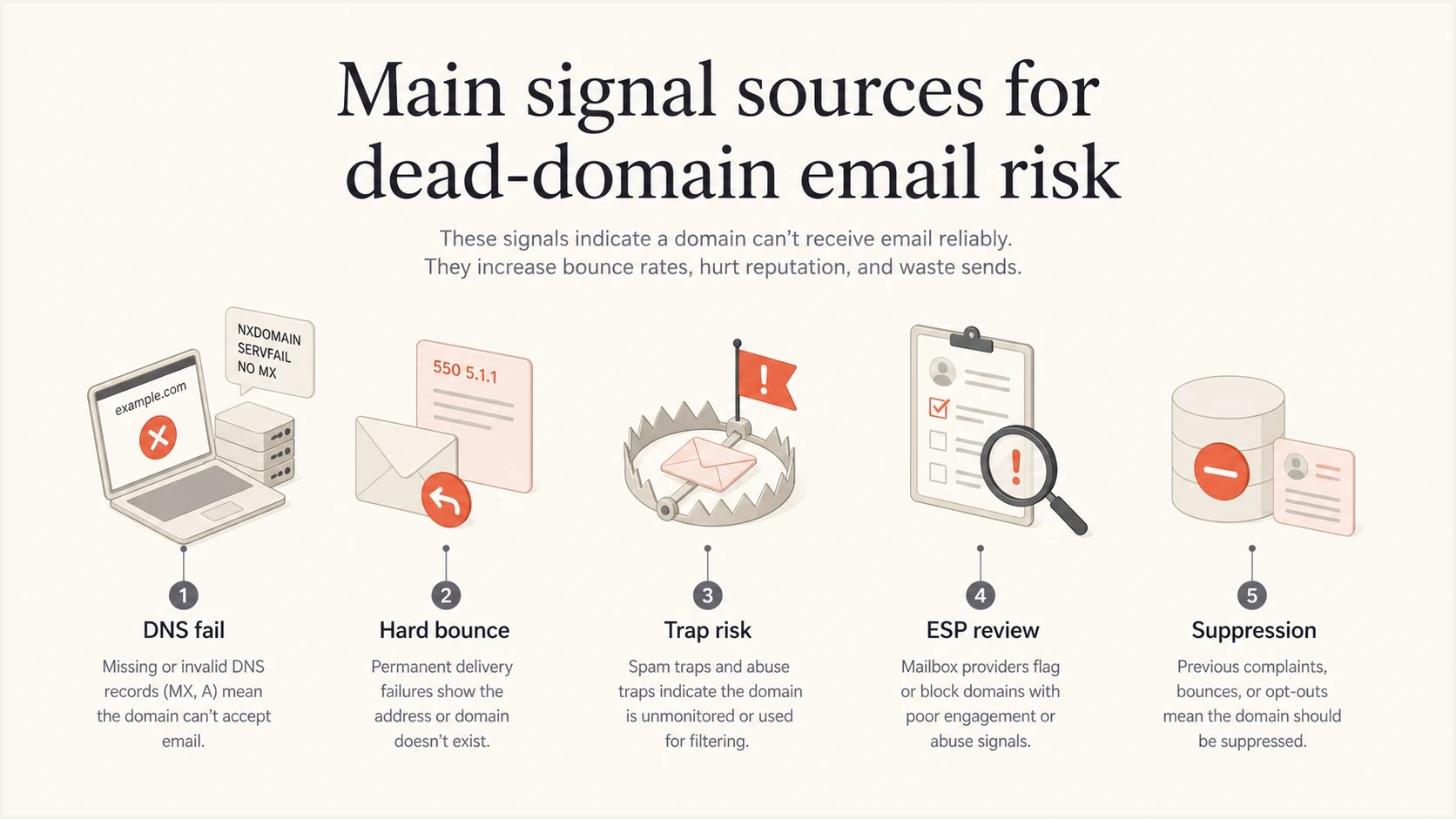
Dead-domain risk signals across DNS, SMTP, ESP review, and suppression.
Do not assume that DNS-only honeypots are the main risk. Bad lists create observable problems somewhere in the delivery path. Your ESP can see repeated permanent DNS failures first. Receivers and reputation systems can see later attempts when domains resolve and accept connections.
Views from the trenches
Best practices
Classify DNS failures separately from SMTP bounces before changing sender policy.
Treat repeated NXDOMAIN volume as a data quality defect, even when receivers cannot see it.
Suppress permanent failures quickly and trace each cluster back to its acquisition source.
Common pitfalls
Assuming Hotmail can score a send that stopped at DNS before any SMTP connection.
Ignoring old domains with MX records, because those systems can accept and log mail.
Fixing authentication while continuing to mail lists with obvious address decay.
Expert tips
Trend failures by signup form, import batch, campaign, and subdomain to find the source.
Separate risky reactivation traffic from transactional mail before reputation weakens.
Use blocklist and blacklist signals as symptoms, then fix the list quality cause.
Marketer from Email Geeks says a true NXDOMAIN send is mainly visible to the ESP or sender infrastructure, not the target mailbox provider.
2020-08-12 - Email Geeks
Marketer from Email Geeks says a dead-looking domain with working MX records can still accept mail and feed reputation signals.
2020-08-12 - Email Geeks
The practical takeaway
Sending to a domain that returns NXDOMAIN does not let Hotmail or another mailbox provider score that specific attempt because delivery stops before SMTP. It still tells your ESP that something is wrong with your data. Sending to old domains that still resolve is riskier because those systems can reject, accept, sinkhole, or record the traffic.
- NXDOMAIN or null MX: Treat it as sender-side hygiene risk and suppress the affected address after confirmation.
- Temporary DNS error: Defer and retry without suppressing the address.
- Usable route exists: Treat it as visible receiver-side risk and watch bounce, trap, complaint, and listing signals.
- Best response: Fix capture, suppress confirmed failures, monitor authentication, and track reputation.
Suped provides the authentication and reputation layer around that work through DMARC visibility, source detection, SPF and DKIM diagnostics, alerts, and blocklist monitoring. Those signals help the team separate authentication problems from recipient-data problems.




