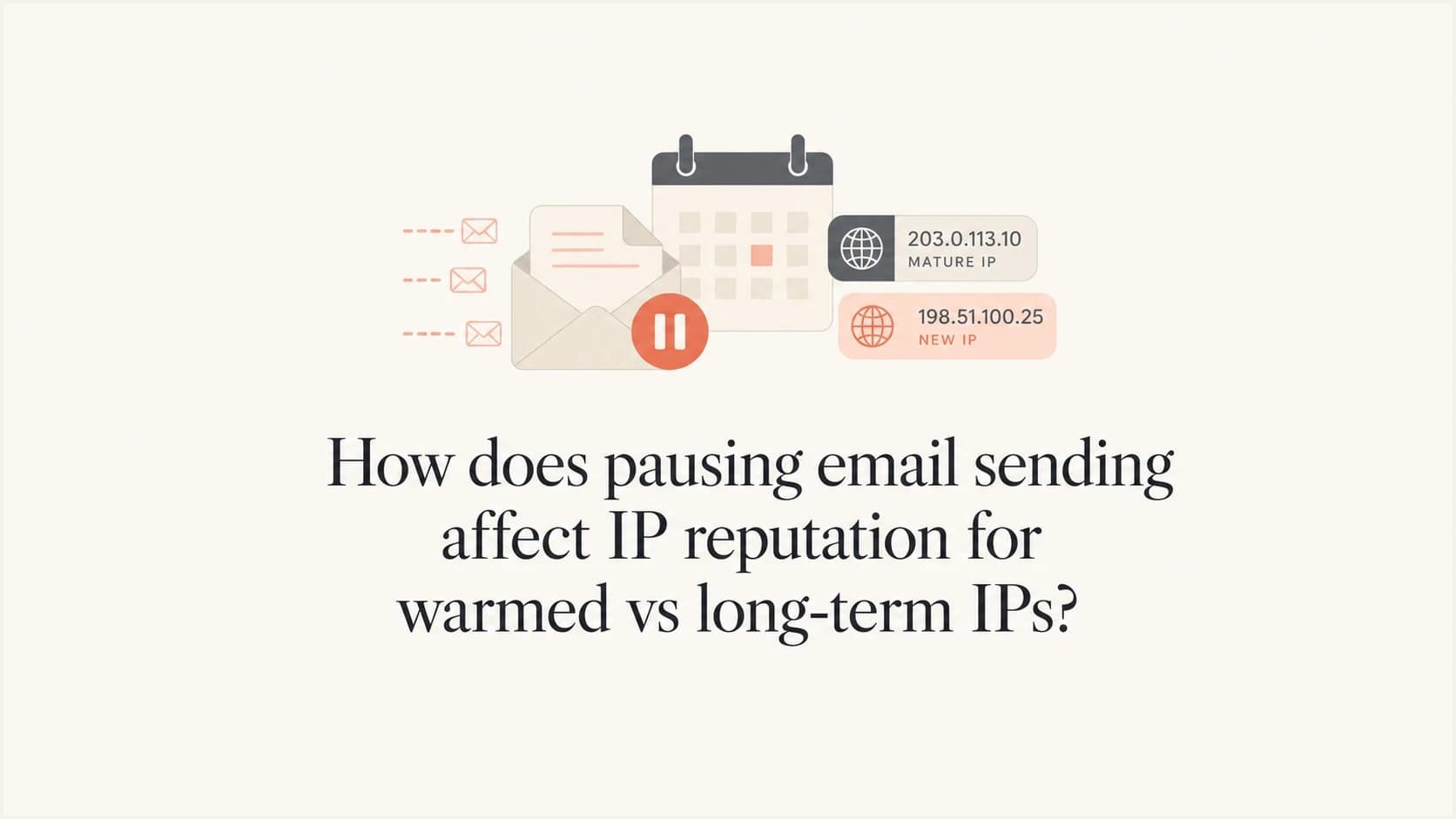
How does pausing email sending affect IP reputation for warmed vs long-term IPs?

Published 17 Jul 2025
Updated 24 Jul 2026
11 min read
Summarize with
Updated on 24 Jul 2026: We updated this guide with provider-specific restart signals, safer re-ramp guidance, and a check for whether dedicated IPs fit intermittent sending.
A two-week pause removes recent sending activity, but it does not affect every IP the same way. Treat a long-term IP with years of steady, clean sending as paused, not reset. Treat a newly warmed IP with only four weeks of history as fragile because the pause is large compared with the history mailbox providers have observed.
A pause creates a gap in the recent volume pattern, and the next send has to prove that recipients still want the mail. A long-term IP still has a deeper history of accepted mail, low complaints, few invalid recipients, and stable behavior. That history lowers restart risk but does not guarantee inbox placement. A four-week warm-up followed by two weeks of silence is a much bigger break in the pattern.
- A two-week pause creates restart risk for a long-term IP, but it does not automatically erase years of good history.
- A two-week pause after four weeks of warming is a major interruption for a new IP and needs a conservative restart.
- No provider publishes a comparable reputation-decay formula, so review SMTP responses and reputation signals separately for each provider.
- If the pause is planned, delay the warm-up until after the silent period.
The short answer
A two-week pause is not the same event for a mature IP and a recently warmed IP. The mature IP has a longer proof record. The new IP has a thin proof record. Mailbox providers weigh recent behavior during warm-up, so two silent weeks right after four active weeks interrupt the first stable sending pattern.
The pause-to-history ratio is a useful planning model, not a mailbox-provider formula. Two weeks is small against years of steady traffic and large against four weeks of warm-up. Use that ratio with the IP's health before the pause and the SMTP response from each provider.
Practical answer
If an IP has been sending clean mail for years, resume below the previous accepted peak and watch deferrals by mailbox provider. If an IP finished only four weeks of warm-up and then stopped for two weeks, treat the restart as a re-warm, not a normal resume.
- Restart an established IP below its last stable provider-specific rate and rebuild the final volume step.
- Restart a new IP lower, use the best recipient segment, and ramp again.
- When a gap is planned, start warm-up after it so the ramp stays continuous.
Operational risk bands after no sending
A planning guide for choosing restart caution when authentication, list quality, and sender identity stay stable. These are not published provider thresholds.
Brief gap
1-2 days
Resume near the last accepted rate when no problem existed before the gap.
Short gap
3-7 days
Monitor SMTP deferrals and complaints before increasing.
Conservative re-ramp
8-14 days
Start below the last accepted rate, especially on newer IPs.
Full reassessment
15+ days
Review IP age, prior health, traffic type, and provider data before choosing a ramp.
Why a newer IP is more fragile
IP reputation is built from observed behavior. During warm-up, the observed behavior is still small. Providers are trying to answer basic questions: is the mail wanted, do recipients complain, are invalid addresses controlled, and does the sender behave predictably?
A long-term IP has answered those questions many times. A newer IP has only started answering them. When that newer IP goes silent, the next send has less history behind it and less recent continuity. A familiar authenticated domain can help, but it does not replace IP history.
Long-term warmed IP
- Years of clean traffic give providers a large behavior sample.
- Recent activity disappears during the pause, but older reputation still has value.
- Resume below the last stable rate and watch provider-specific acceptance.
Newly warmed IP
- Four weeks is a thin proof record for a dedicated IP.
- Two silent weeks break the first stable sending pattern.
- Re-warm with wanted mail, small steps, and provider-specific limits.
The new-IP case gets worse if the first restart sends a backlog. A backlog can create a sudden volume jump, stale campaign content, expired messages, and higher complaint pressure at the exact moment providers are re-evaluating the sender.
Mailbox provider behavior after a pause
No mailbox provider publishes a simple cooldown formula for IP reputation. Provider responses differ, and the restart plan has to account for that. Plan restarts by recipient provider because one provider accepting the restart cleanly does not prove every provider will do the same.
Gmail, Yahoo, and Microsoft all evaluate several signals. Gmail publishes guidance to keep traffic consistent and reduce volume when mail is deferred. Yahoo calls out complaint rate, unusual traffic patterns, reverse DNS, and sudden spikes. Microsoft points to complaint rate, list accuracy, authentication, and sending IP or domain history. None publishes a fixed cooldown or a directly comparable sensitivity score.
|
|
|
|---|---|---|
 Gmail Gmail | Volume, spam rate, deferrals | Pace by MX domain |
 Yahoo Yahoo | Complaints, traffic pattern, rDNS | Steady ramp |
 Microsoft Microsoft | Complaints, list accuracy, authentication | Review SMTP responses |
Other mailboxes | Provider-specific signals | Small measured batches |
Published signals to review after a two-week pause.
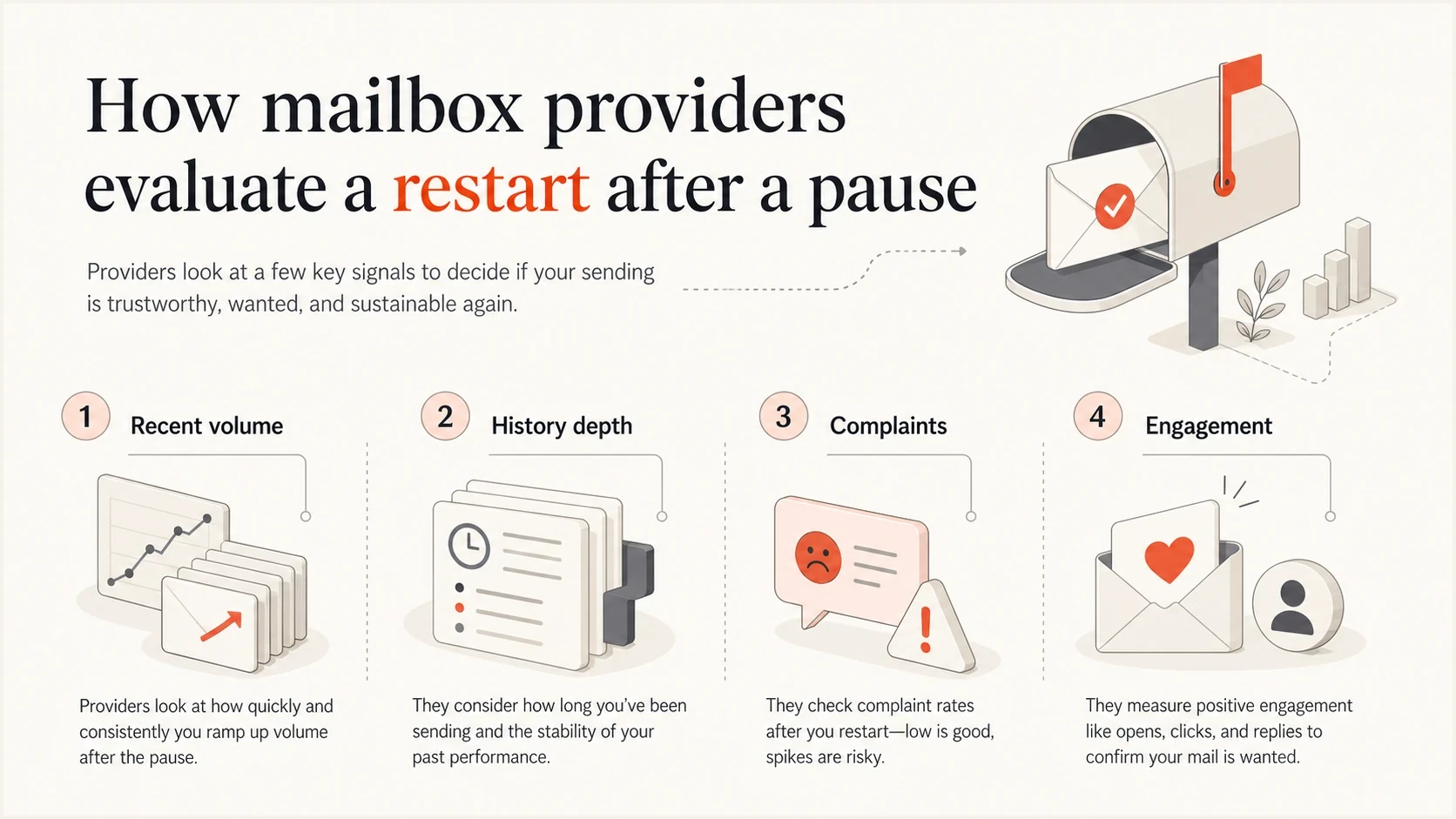
Four restart signals: recent volume, history depth, complaints, and engagement.
The safest restart plan treats each provider as its own lane. If Gmail accepts volume while Microsoft defers, hold Microsoft steady and keep Gmail moving only if complaints and recipient response remain healthy. Do not force every provider through the same ramp just because the daily total looks fine.
A restart plan that limits damage
After a two-week pause, the first send back matters. Do not send the entire backlog. For controlled marketing mail, start with the cleanest stream and the recipients with the strongest recent activity. Keep essential transactional mail in its own stream.
- For marketing mail, start with recent clickers and active customers rather than relying on open data alone.
- Choose a test volume below the last accepted provider-specific rate, with a lower starting point for a newer IP.
- Track Gmail, Yahoo, Microsoft, and smaller providers separately.
- Review SMTP codes, deferrals, hard bounces, spam complaints, unsubscribes, and recipient response.
- Add volume only after acceptance and complaint signals stay stable.
Restart ladder after a two-week pausetext
Before restart: suppress complaints and hard bounces; expire stale queued mail
Day 1, long-term IP: send below the last stable provider-specific rate
Day 1, newly warmed IP: send below the last accepted warm-up step
Next 24 hours: hold or reduce any lane returning deferrals
Later steps: increase only after SMTP and complaint signals stay stable
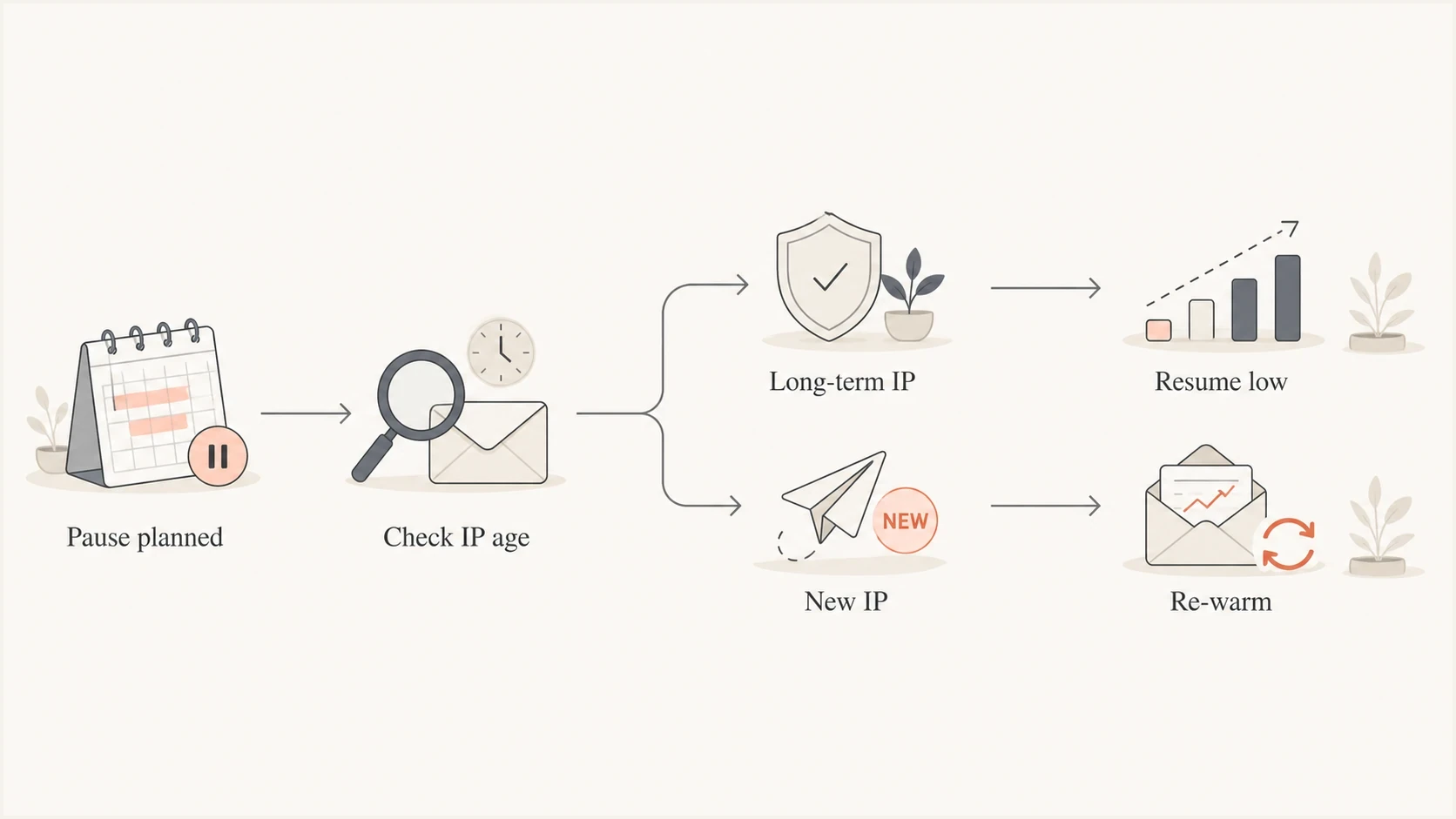
Restart decision path for long-term and newly warmed IPs after a pause.
If the pause is longer than two weeks, or if the IP already had throttling before the pause, lower the restart point again. A quiet period does not erase complaints, spam trap hits, or poor list quality. It only removes recent successful sending volume.
Check whether a dedicated IP still fits
A dedicated IP works best when each major mailbox provider sees enough wanted mail on a predictable schedule. If volume is seasonal, irregular, or too low per provider, repeated cooling and re-warming becomes a sending-design problem rather than a one-time campaign problem.
A well-managed shared or provider-managed pool can suit low or uneven volume because the pool keeps an active sending history, although other senders influence shared IP reputation. Keep the sending domain and DKIM identity stable, and keep list quality high.
- Keep a dedicated IP when wanted volume is regular enough for the main providers to observe and the team can act on provider-specific responses.
- Reconsider the dedicated IP design when long pauses repeat or per-provider volume stays too low to build a stable history.
- Separate bulk marketing and essential transactional streams when the volume supports separate IP pools or DKIM identities.
- Never manufacture filler traffic to keep an IP active; unwanted mail can cause more reputation damage than silence.
Marketing and transactional mail need different controls
Marketing volume can be staged by recipient segment. Transactional volume follows real user activity, so do not delay password resets or create artificial transactions to satisfy a warm-up schedule. Protect essential mail by keeping bulk backlog out of its queue.
How to monitor the restart
Before restarting volume, run an email tester check using the exact sending system, domain, envelope path, and content type planned for the ramp. That catches authentication failures, content problems, and routing changes before the first real batch goes out.
Also run a domain health check before the restart. Confirm DMARC, SPF, DKIM, PTR and rDNS, and the sending infrastructure before reputation is tested again.
Email tester
Send a real email to this address. Suped shows a results button when the test is ready.
?/43tests passed
Suped's product brings DMARC monitoring, SPF and DKIM checks, authentication alerts, hosted SPF, SPF flattening, and blocklist monitoring into the restart workflow. Use the DMARC source view to confirm authorized senders and authentication alignment, then use blocklist (blacklist) alerts as one diagnostic alongside SMTP deferrals and complaints. A clean blocklist result does not prove inbox placement.
Suped DMARC dashboard showing email volume, authentication health, and source breakdown
- Confirm SPF and DKIM pass with the same domain identity used in production.
- Watch DMARC alignment and source changes as the restart moves through providers.
- Check blocklist and blacklist status before each larger step, but verify delivery impact in SMTP data.
- Trigger alerts when authentication failures or suspicious sources spike.
When to delay warm-up instead
If a two-week pause is already on the calendar, delay a new IP warm-up until after the pause. A continuous ramp is easier to measure and gives providers a predictable traffic pattern. Starting warm-up, stopping, and then starting again adds noise during the most sensitive period.
Use the same principles used to warm a new IP, then adjust the first few days after the silent period. If the sender has already gone quiet, treat it like re-warm after inactivity planning rather than a normal production restart.
Delay the warm-up
If the pause falls inside the first month or right after it, do not treat the early warm-up as banked reputation. Start again after the pause with a clean, continuous plan.
Start before the pause
- Early volume rises and then disappears.
- Providers see a thin, broken warm-up history.
- The restart needs lower volume and close monitoring.
Start after the pause
- Volume rises without a two-week break.
- Providers see a cleaner ramp signal.
- Warm-up is easier to measure and adjust.
Common mistakes that make a pause worse
The pause itself is only one part of the risk. The restart can do more damage than the silence if it combines sudden volume with stale recipients or changed infrastructure.
- Sending old queued mail often causes worse recipient response and higher complaint risk.
- Changing SPF, DKIM, DMARC, rDNS, or the bounce domain adds new variables during the restart.
- Treating all providers as one lane lets acceptance at one provider hide throttling at another.
- Skipping blocklist and blacklist checks can hide a listing that appeared before the restart.
- Relying on total delivery rate hides provider-specific deferrals and bulk-folder placement.
|
|
|
|---|---|---|
Years steady | Recent activity gap | Reduced resume |
Four weeks | Major pattern break | Re-warm |
Shared pool | Pool remains active | Review domain signals |
Bad history | Risk remains | Repair first |
Two-week pause handling by IP history.
Views from the trenches
Best practices
Keep volume predictable by provider and respond to SMTP deferrals before increasing it.
Delay warm-up when a planned pause would interrupt the first month of sending history.
Restart with wanted mail, then expand only after complaints and bounces stay controlled.
Common pitfalls
Treating a four-week IP like an established IP hides how thin the reputation data is.
Returning at full volume after silence can trigger throttling before signals stabilize.
Watching only total volume misses provider-specific deferrals and complaint changes.
Expert tips
Separate provider lanes because each provider applies its own traffic and reputation signals.
Keep authentication stable during the pause so DNS changes do not confuse the restart.
Use blocklist and blacklist alerts as one signal, then confirm impact in SMTP data.
An Email Geeks discussion says a two-week pause affects every IP, but older IPs recover better because the historical pattern is deeper.
2021-11-17 - Email Geeks
An Email Geeks discussion says four weeks of warm-up followed by two weeks idle creates a difficult restart because the new pattern has not settled.
2021-11-17 - Email Geeks
Recommended restart approach
Treat the long-term IP as warm but paused. Treat the newly warmed IP as needing a careful restart ramp. The same two-week gap has different weight because the long-term IP has a much deeper history and the new IP does not.
If the pause is known ahead of time, do not start a new dedicated-IP warm-up before it. Wait, start after the gap, keep the ramp continuous, and split increases by mailbox provider. If the IP has already paused, restart with the best recipients first, expire stale backlog, and let acceptance data determine the next increase.
For teams managing multiple domains, Suped's product can centralize DMARC reports, SPF and DKIM visibility, blocklist (blacklist) monitoring, hosted SPF, hosted MTA-STS, and alerts. Use it to verify authentication and source changes during the restart. Provider SMTP responses and complaint data are still required to judge reputation recovery.




