How do subdomain spam complaints affect root domain reputation in Google Postmaster Tools?

Updated on 31 Jul 2026: We updated this guide for Postmaster Tools v2, primary-domain Compliance status, and Google's current spam-rate rules.
Subdomain spam complaints can affect the primary domain view in Google Postmaster Tools, but the exact behavior depends on the dashboard. The current Compliance status dashboard explicitly uses data from the primary domain and its subdomains to assess the primary domain. Other dashboards can show an authentication subdomain separately when it has been added to Postmaster Tools.
A legacy Domain Reputation move from High to Low to High does not prove that one subdomain complaint rate caused the change. Check the DKIM signing domain, SPF Return-Path domain, Gmail volume, campaign timing, sending IP pool, and links before assigning the cause. Google does not publish a formula that maps one subdomain's complaints to a legacy root-domain reputation bucket.
- Treat a subdomain as a separate reporting identity only after its DKIM or SPF authentication domain has been added to Postmaster Tools.
- Expect primary-domain Compliance status to include traffic sent by subdomains under that primary domain.
- Compare complaint timing with authentication domains, Gmail volume, Feedback-ID values, infrastructure, and campaign logs.
- Use a one-day reputation bucket change as an investigation trigger, not a diagnosis.
The short answer
In this context, "root domain" usually means the primary or organizational domain, such as example.com. A sending host such as news.example.com is a subdomain, while the domain that Postmaster Tools uses for a dashboard is normally an authentication domain taken from DKIM d= or the SPF Return-Path. The question of whether domain reputation includes subdomains therefore starts with the dashboard and authentication identity involved.
Google does not publish the formula behind the legacy Domain Reputation buckets. A High, Medium, Low, or Bad label is not a raw complaint rate. It is a model output, and Google warns that reputation is only one of many factors affecting delivery. The v2 Compliance status view is clearer about scope because it reports primary-domain status using data from the primary domain and its subdomains.
|
|
|
|---|---|---|
Compliance status | Primary domain plus subdomains | Primary-domain status |
Subdomain dashboards | Separate when added | DKIM or SPF domain |
Spam rate | Daily user reports | Gmail volume |
Legacy reputation | Unpublished model | Correlated send changes |
Feedback Loop | Flagged Feedback-ID values | Campaign identifiers |
How current Postmaster Tools views root and subdomain data.
Do not overread a one-day bucket change
A one-day High to Low to High move can be real, but the legacy chart exposes a category rather than Google's underlying score. Low-volume days can also lack enough data for reliable comparison.
- A category boundary can make a small underlying change appear large.
- A smaller Gmail sample can produce missing or uneven daily reporting.
- Campaign sends and daily Postmaster Tools updates do not provide message-level causation.
- Compliance status uses a multi-day rolling average and can take up to seven days to reflect a fix.
Why the rollup happens
Postmaster Tools uses authenticated sending identities. Google tells senders to add either the DKIM signing domain or the SPF Return-Path domain, and it uses messages authenticated by those domains for dashboard data. A visible From subdomain can therefore appear under a root authentication domain when DKIM signs with the root or SPF uses a root-domain Return-Path.
DMARC can pass under relaxed alignment when the visible From domain and an authenticated domain share the same organizational domain. For example, mail from offers.example.com can pass DMARC with a DKIM signature under example.com. That is valid authentication, but Postmaster Tools has a reason to attribute the message to the root DKIM domain.
Cleaner reporting separation
- Sign each major mail stream with a stable subdomain-specific DKIM domain where the sending platform allows it.
- Use a stream-specific SPF Return-Path when bounce handling and the sending platform support it.
- Add each authentication subdomain to Postmaster Tools so its eligible dashboard data can be viewed separately.
- Keep campaign identifiers, IP pools, and link domains mapped to known owners for diagnosis.
Shared attribution and risk
- Root-domain DKIM signing can place subdomain mail in data associated with the root authentication domain.
- A root-domain SPF Return-Path can create the same attribution path for SPF-authenticated traffic.
- Compliance status combines data from the primary domain and its subdomains by design.
- Shared URLs and IP pools can affect delivery, but Google does not document them as Postmaster dashboard grouping rules.
Example shared authentication patterndns
news.example.com. TXT "v=spf1 include:_spf.example.net -all"
m1._domainkey.example.com. TXT "v=DKIM1; k=rsa; p=KEY"
_dmarc.example.com. TXT "v=DMARC1; p=quarantine; rua=mailto:d@example.com"
This pattern can authenticate correctly, but it does not create separate DKIM attribution for news.example.com because the signing domain is example.com. Publishing a subdomain DMARC record or an sp policy changes DMARC handling. It does not, by itself, create separate Postmaster Tools reputation.
What Postmaster Tools v2 changes
The legacy Postmaster Tools interface has not disappeared on Google's original schedule. Google postponed its retirement, but still plans to replace it with v2. The legacy Domain and IP Reputation dashboards are marked for retirement, and the v2 API does not include those reputation metrics.
The practical replacement is not another High, Medium, Low, or Bad score. V2 centers daily Spam Rate data and Compliance status. Compliance status applies to the primary domain, uses subdomain data in that assessment, and covers authentication, DNS, message formatting, encryption, user-reported spam, DMARC, and unsubscribe requirements where applicable.
|
|
|
|---|---|---|
Did complaints rise? | Spam Rate | Daily user-reported rate |
Which campaign is noisy? | Feedback Loop | Unusual Feedback-ID values |
Does the primary domain comply? | Compliance status | Includes subdomain data |
Did legacy reputation move? | Legacy dashboard | Investigate, do not infer cause |
What to use while Google transitions Postmaster Tools.
Primary-domain compliance is an explicit rollup
Adding email.example.com does not produce a separate Compliance status for that subdomain. Google shows status for example.com and uses traffic from both the primary domain and subdomains. Use the other dashboards for subdomain-level data.
How to investigate the swing
Start with the message and sending records. Send a fresh message through the same stream and inspect it with the email tester. Then use the domain health checker to review DMARC, SPF, and DKIM, and compare the result with DMARC monitoring and campaign logs for the same dates.
- Record the visible From domain, DKIM d= value, Return-Path domain, SPF result, and DMARC result from the affected stream.
- Confirm that the primary domain and each authentication subdomain have been added to Postmaster Tools.
- Compare personal Gmail recipient volume for the primary domain and subdomain on the affected dates.
- Map each Spam Rate jump to campaign logs, audience segments, consent sources, and send windows.
- Use stable Feedback-ID values to find campaign identifiers that appear in the Feedback Loop dashboard.
- Check whether the primary domain and subdomain share IP pools, bounce domains, or sending accounts.
- Review tracking domains, redirect chains, image hosts, unsubscribe links, and landing pages as delivery factors.
- Verify one-click unsubscribe headers for marketing mail and confirm that requests are honored within 48 hours.
- Allow for daily reporting, low-volume omissions, and the Compliance status rolling window before changing DNS.
Email tester
Send a real email to this address. Suped shows a results button when the test is ready.
?/43tests passed
DNS records show what should happen. A delivered message shows what did happen. Full headers from the stream active before the reputation or compliance change reveal which authentication domain Google could use for Postmaster Tools attribution.
When the primary domain appears complaint-free, look for mail that used it in an authentication role. A transactional notification can use the primary domain as its DKIM domain, while a marketing stream can use it in the Return-Path. Legacy automations often retain those settings after the visible From plan changes.
How Google Postmaster Tools groups signals
Postmaster Tools is an aggregate reporting system, not a forensic log. Its data applies to messages sent to personal Gmail accounts ending in @gmail.com or @googlemail.com. Privacy thresholds can leave low-volume dates empty, and the dashboards do not reveal each recipient's action.
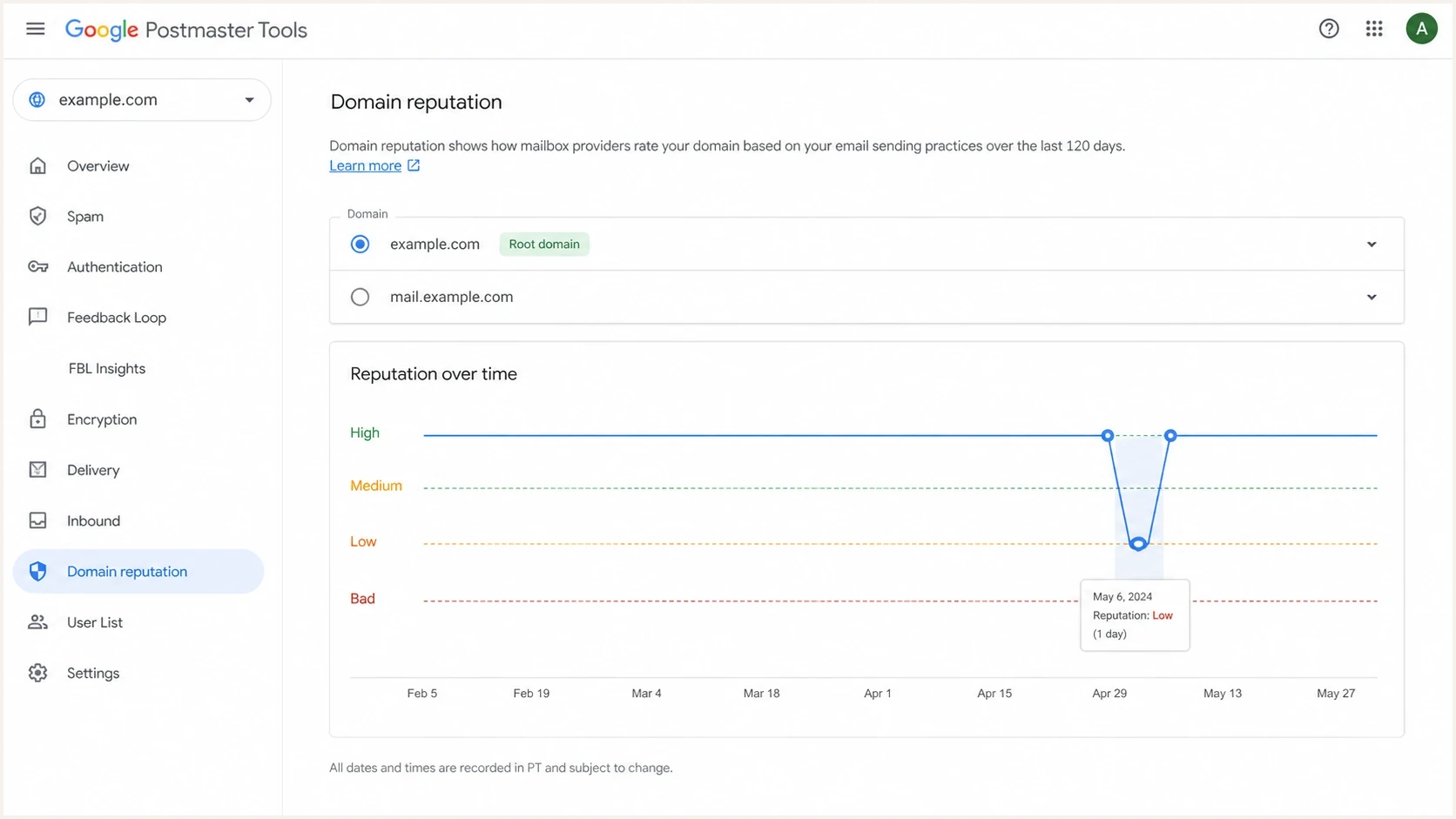
Legacy Google Postmaster Tools Domain Reputation chart showing a one-day root-domain dip.
A related Google support thread shows why the parent and subdomain boundary causes confusion. Use the chart as a starting point, then validate authentication domains and the mail streams behind the dates.
|
|
|
|---|---|---|
Primary Low, sub High | Different attributed traffic | Check DKIM and SPF |
Primary High, sub Low | Subdomain issue visible | Fix that stream |
Both Low | Shared or concurrent issue | Compare campaigns |
Daily jumps | Insufficient proof | Check volume and timing |
Compliance needs work | Primary-domain rollup | Audit every subdomain |
How to read common primary-domain and subdomain patterns.
To identify spam complaints, add a stable Feedback-ID header before the next send and use the Feedback Loop dashboard. It reports unusual complaint levels for eligible identifiers, not individual recipients, and its data covers @gmail.com recipients only.
What to fix first
Fix the widest shared attribution path first. If a complaint-heavy subdomain signs with the primary-domain DKIM identity or uses its SPF Return-Path, separate that authentication where operationally safe. Then address the complaint source, because moving unchanged mail to another subdomain does not repair recipient expectations.
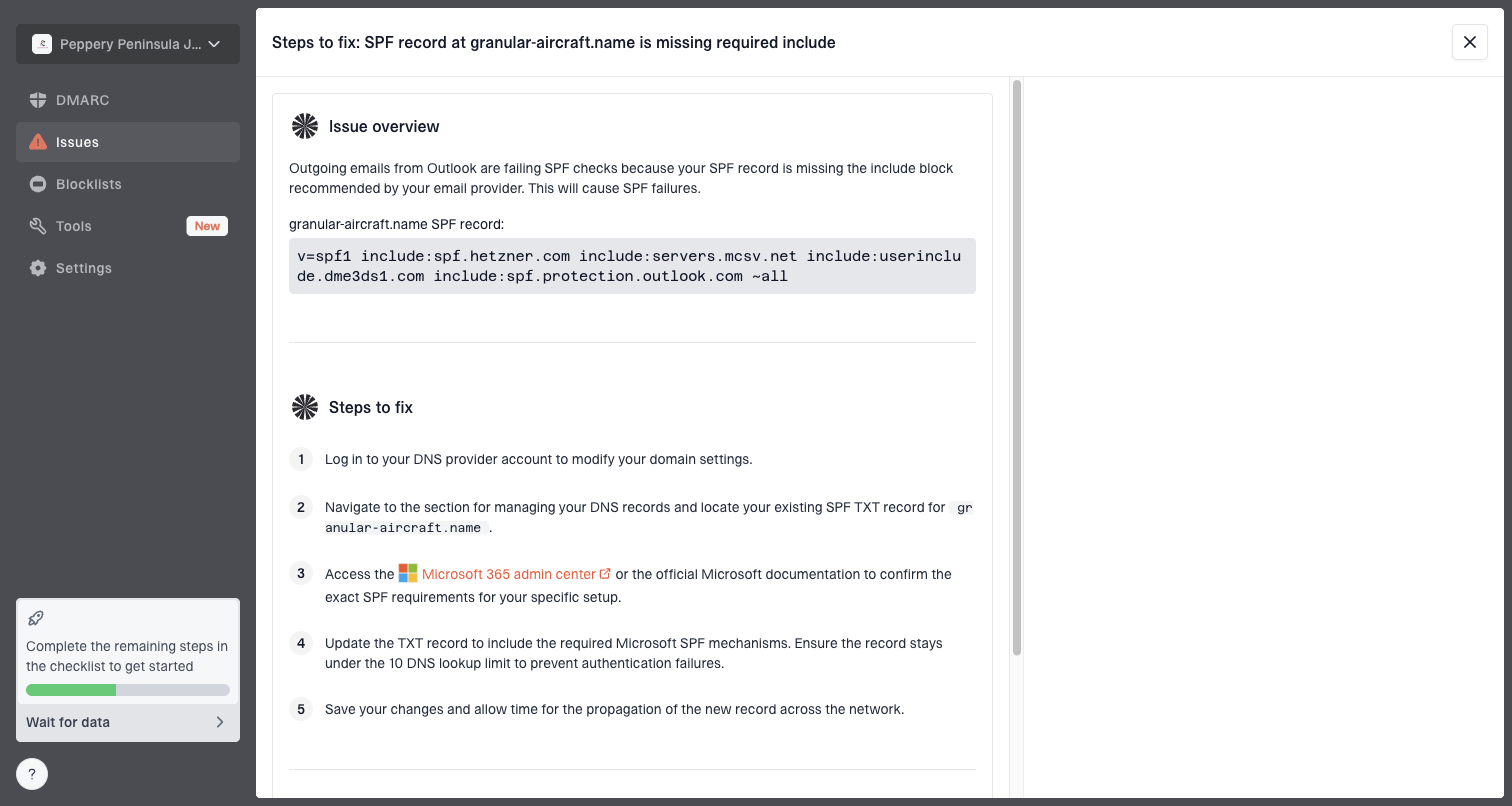
Issue steps to fix dialog showing the issue overview, tailored fix steps, and verification action
Suped's product supports this workflow by grouping DMARC aggregate data by sending source and authentication result, flagging failures, and surfacing unverified sources. DMARC reports do not identify Gmail spam complaints, so compare Suped's source and volume data with Postmaster Tools, Feedback-ID results, and campaign logs.
Practical cleanup order
- Pause the campaign or audience segment tied to the complaint spike.
- Suppress complainers and contacts without clear, current consent.
- Implement RFC 8058 one-click unsubscribe for marketing mail and honor requests within 48 hours.
- Give major streams stable DKIM signing domains and SPF Return-Path domains where supported.
- Separate tracking domains when risky acquisition mail shares links with core customer mail.
- Add stable Feedback-ID values and monitor source, volume, and authentication changes.
Check blocklist monitoring for domain and IP listings, while keeping blocklist or blacklist results separate from Google Postmaster Tools data. A URI blacklist can affect mail using a parent or subdomain, but it is not the same measurement as Gmail's internal reputation or compliance status.
When several teams or clients send under one primary domain, Suped's product can keep DMARC sources, SPF and DKIM results, hosted policies, alerts, and multi-tenant reporting in one operational view. Use that view to find new sources or alignment failures, then use Postmaster Tools and campaign records for complaint evidence.
When the primary domain is being pulled down
Repeated movement across the primary domain and a subdomain on the same dates is a correlation worth testing, especially after the same campaign family sends. It is not proof of Google's internal reputation mapping. Confidence increases when message headers show root-domain authentication and the campaign timing repeats.
Gmail spam-rate guardrails
Google's operating targets for user-reported spam on mail to personal Gmail accounts.
Target
Below 0.1%
Keep the daily rate below this level.
Above target
0.1% to below 0.3%
Review campaigns, audiences, consent sources, and unsubscribe handling.
Avoid
0.3% or higher
Rates at this level have a greater negative delivery impact and make bulk senders ineligible for mitigation.
Complaint rate is one part of the diagnosis. The broader mechanics of how spam reports affect reputation matter because complaints show that recipients rejected the mail, while the root-domain impact depends on the dashboard scope and the authenticated identity Google observed.
- Higher confidence exists when primary and subdomain changes repeat after the same campaign and headers show primary-domain authentication.
- Moderate confidence exists when only the primary domain moves but the subdomain signs with the primary DKIM domain.
- Low confidence exists when the primary domain dips once, authentication is separate, and Gmail volume is thin.
- Check concurrent authentication failures, URL or IP issues, new sources, and sending-volume changes before concluding that complaints caused the dip.
Recovery needs sustained data
Google calculates Spam Rate daily. Bulk senders become eligible for mitigation again after the rate remains below 0.3% for seven consecutive days. Compliance status can also take up to seven days to reflect corrective work.
Views from the trenches
Best practices
Map each stream to its From domain, DKIM domain, SPF Return-Path, IP pool, and links.
Add stable authentication subdomains to Postmaster Tools for separate dashboard data.
Review primary-domain Compliance status after each large Gmail-facing campaign send.
Common pitfalls
Rotating random subdomains hides complaint sources without fixing recipient consent.
Sharing one root DKIM identity makes Postmaster attribution much harder to separate.
Treating one legacy reputation dip as proof often leads to unnecessary DNS changes.
Expert tips
Check the DKIM d= value first because it identifies a key Postmaster data domain.
Compare Feedback-ID results with send logs before changing authentication or hosts.
Keep blocklist and blacklist findings separate from Google's internal dashboards.
Marketer from Email Geeks says Postmaster Tools usually treats parent domains and subdomains separately, but shared authentication can still create parent-domain attribution.
2024-04-10 - Email Geeks
Marketer from Email Geeks says URI blocklists and blacklists can affect parent and subdomains together, but that is not the same as Gmail domain reputation.
2024-04-10 - Email Geeks
The practical takeaway
Subdomain complaints explicitly feed the primary-domain Compliance status in Postmaster Tools v2. For the legacy Domain Reputation dashboard, Google does not publish a complaint rollup formula, so a matching root-domain dip is evidence to investigate rather than proof of causation.
Isolate the noisy stream, identify the DKIM or SPF domain Postmaster Tools observed, use Feedback-ID to narrow campaign complaints, and repair consent or unsubscribe problems. Separate authentication only when it supports clear ownership and stable operations.
Suped's product can provide the DMARC source and authentication side of that workflow, including source discovery, alignment failures, hosted policy management, alerts, and multi-tenant reporting. Pair those findings with Postmaster Tools and campaign logs because DMARC reports do not contain Gmail complaint events.