How do shared IP pools and sending domains impact email sender reputation for ESPs?

Updated on 28 Jul 2026: We updated this guide with current DMARC terminology, clearer pool controls, and practical mail-stream separation guidance.
Shared IP pools affect ESP reputation, but they do not automatically make every sender in the pool inherit the same fate. Mailbox providers build reputation across several identifiers at once: the sending IP, the DKIM signing domain, the visible From domain, the bounce domain, tracking domains, authentication results, complaint rates, recipient activity, and traffic patterns. A shared IP is one reputation input, not the whole score.
The direct answer is this: an ESP can use good, risky, dedicated, and transitional IP pools while still using common ESP-owned domains for bounce handling and DKIM signing. That setup is normal. It becomes a domain reputation problem when the ESP lets poor senders keep generating bad signals under the same ESP-owned identifiers, especially the same DKIM domain, tracking domain, image domain, or envelope sender domain.
For a sender using an ESP, the practical goal is not to erase the ESP from every header. The goal is to make the sender's own identity strong enough that mailbox providers can score it cleanly. That means using a customer-owned From domain, a DKIM domain with DMARC alignment where possible, branded tracking, clean DMARC, and mail practices that do not force the ESP's shared infrastructure to carry the sender's risk.
The short answer
Yes, shared IP pools and shared sending domains can both affect sender reputation, but they do it through different signals. IP pools create network reputation. Sending domains, DKIM domains, bounce domains, and tracking domains create identity reputation.
Core answer
Shared IP pools mostly affect IP reputation. Shared sending domains mostly affect domain reputation. Mailbox providers combine those signals, so a good sender on a weak shared IP pool can still perform acceptably, and a poor sender on a strong pool can still build a bad domain profile.
- IP pool: Affects network-level trust, throttling, deferrals, blocklist and blacklist exposure, and pool-level complaint patterns.
- From domain: Affects the brand identity mailbox providers see in the message header and the Author Domain used by DMARC.
- DKIM domain: Affects domain-based reputation because the signing domain is a durable identity attached to the message.
- Tracking domain: Affects body-level reputation signals because links and hosted assets are part of the message fingerprint.
The mistake is thinking reputation belongs to a single thing. It does not. One campaign can contain a visible sender domain, a return-path domain, one or more DKIM signatures, a sending IP, a click domain, image domains, list-unsubscribe domains, and campaign content. Each identifier gives mailbox providers another way to classify the traffic.
That is why moving a risky sender to a separate, restricted pool helps. It lets the mailbox provider treat that sender's mail differently at the IP layer while the ESP limits its effect on stable traffic. It does not fully protect the ESP if the same ESP-owned domain identifiers keep appearing across abusive or low-quality traffic.
If you need to test how a real message looks after it leaves the ESP, send it through an email tester and inspect the authenticated domains, return-path, DKIM signatures, SPF result, DMARC result, and link domains.
Email tester
Send a real email to this address. Suped shows a results button when the test is ready.
?/43tests passed
Which identifiers carry reputation
The visible From domain is the domain a recipient sees. RFC 9989 calls it the Author Domain, taken from the RFC5322.From field. For most senders, this is the sender's own brand domain or a subdomain of it. DMARC passes when SPF or DKIM authenticates successfully and the authenticated domain has identifier alignment with the Author Domain.
The return-path domain is the envelope sender used for bounces. In current DMARC terminology, it is the RFC5321.MailFrom domain. ESPs often use an ESP-owned domain here because they need to process bounces at scale. Some ESPs let senders brand this domain with a CNAME or subdomain delegation.
The DKIM signing domain, shown in the d= tag, is another major reputation anchor. If the ESP signs with its own domain, that helps the ESP identify its traffic and support DKIM-based feedback loops. If the sender also signs with a domain that has DMARC alignment with the visible From domain, the sender gets a cleaner domain identity for authentication and reputation. Passing DMARC identifies accountable mail, but it does not create a positive reputation by itself.
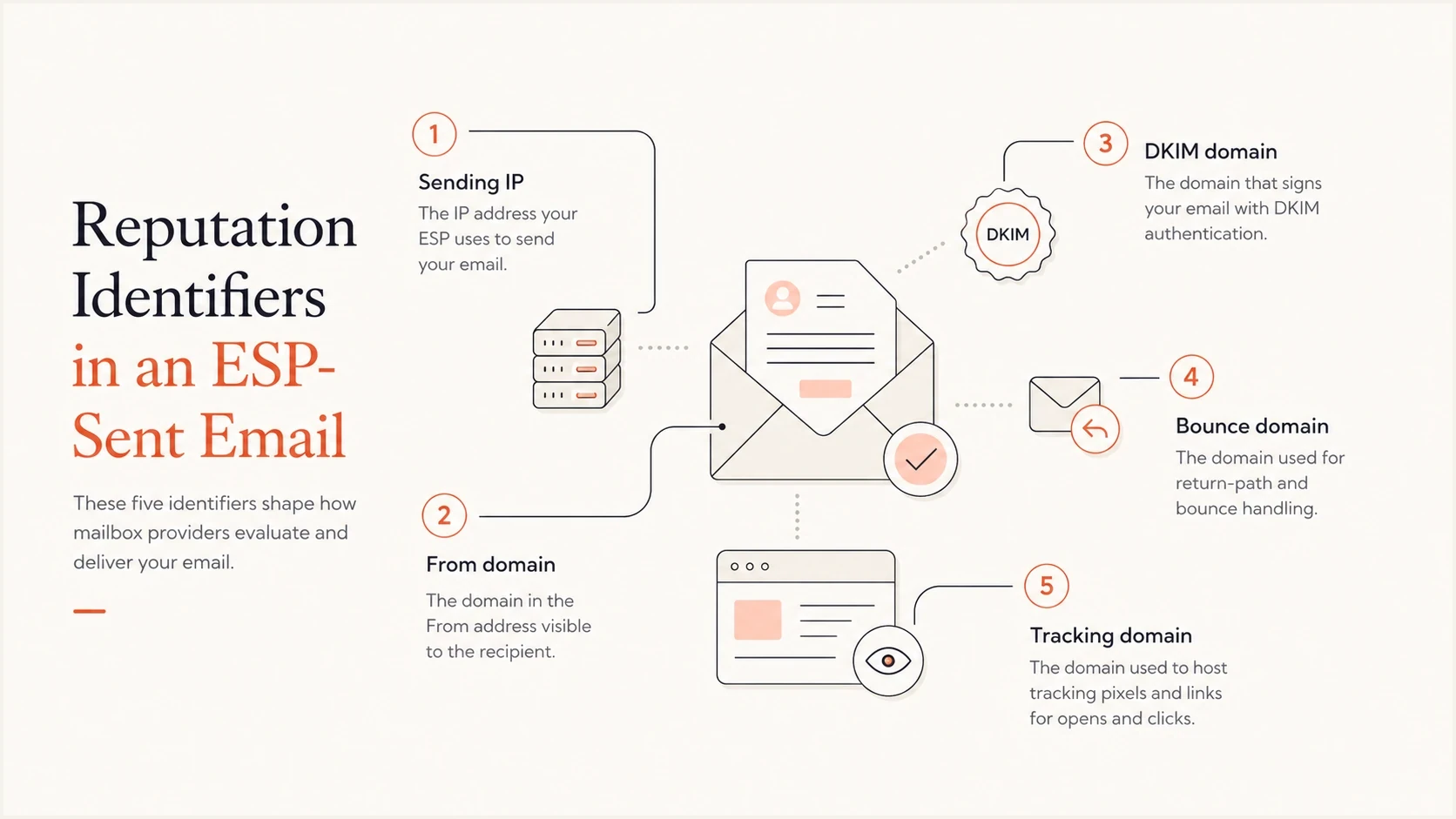
Five reputation identifiers in an ESP-sent email.
|
|
|
|---|---|---|
IP | ESP | Pool quality |
From | Sender | Brand score |
DKIM | Sender or ESP | Shared identity |
Bounce | ESP | Abuse grouping |
Links | Sender or ESP | Body signals |
Common reputation identifiers in ESP mail.
Why shared pools still work
Shared pools work because mailbox providers do not use one global pool score for every decision. A shared IP with mixed senders has a pool-level history, but each message still carries sender-level identifiers. If the visible From domain, DKIM signature with DMARC alignment, complaint rate, recipient response, and content history are clean, the sender is not automatically treated like the worst account in the pool.
That said, shared pools have a floor. If the pool includes enough poor traffic, the IP reputation drops, deferrals increase, and mailbox providers slow or filter more mail before they fully trust the domain-level signals. This is why ESPs segment pools by sender behavior. Good segmentation lets mailbox providers make more granular decisions and keeps weak senders away from stable senders.
Healthy shared pool
- Admission: New senders are reviewed before large volume is allowed.
- Segmentation: Senders with poor signals are moved or limited quickly.
- Identity: Customers use their own From domain and a DKIM domain with DMARC alignment.
- Volume: Traffic grows gradually and follows a consistent sending cadence.
Risky shared pool
- Admission: Weak senders can scale before trust is established.
- Segmentation: Bad traffic stays mixed with responsible senders.
- Identity: The same ESP-owned domains appear across weak traffic.
- Volume: New domains or IPs receive sudden, inconsistent volume spikes.
A dedicated IP changes the network identifier, but it does not reset domain reputation. If the sender's From domain has weak recipient response, high complaints, stale lists, or poor authentication, a dedicated IP only gives those signals a new delivery path. It can help a strong sender avoid pool drag, but it cannot make a weak sender trusted.
For a deeper split between IP and domain scoring, the related breakdown on IP and domain reputation explains why both matter when an ESP moves senders between pools.
When ESP domains become a problem
The ESP's own domain becomes a problem when it is a repeated identifier in bad mail. That can happen through a shared DKIM signature, shared return-path domain, shared tracking domain, shared image host, shared unsubscribe host, or a common redirect domain. If enough low-quality mail carries those identifiers, mailbox providers and security filters have reason to treat the domain with less trust.
Well-run ESPs reduce this risk by screening customers, limiting risky traffic, monitoring complaints, shutting down abusive senders, segmenting mail streams, and requiring customers to authenticate their own domains. Risk increases when an ESP accepts high-risk senders and lets them share the same infrastructure identifiers for too long.
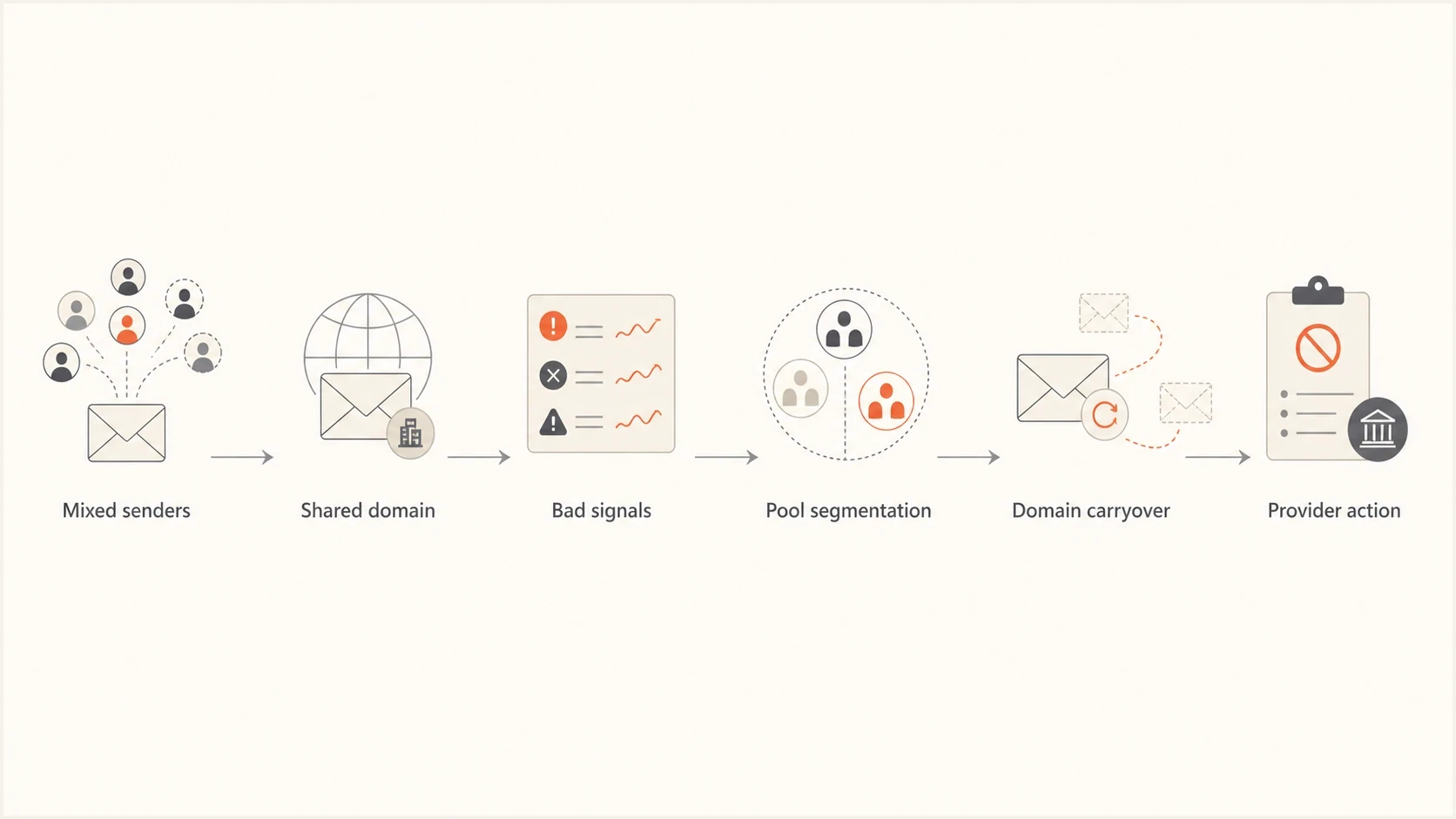
Flow showing how shared ESP domains can carry poor reputation.
Shared identity risk
Risk created by shared ESP-owned identifiers.
Low
Branded
Customer From and DKIM domains have DMARC alignment, and shared domains are secondary.
Medium
Mixed
The ESP domain appears in bounce handling and some links.
High
Shared
The same ESP domain signs, tracks, hosts, and bounces weak mail.
Tracking domains deserve special attention. Links in the message body are reputation inputs. If many unrelated customers use the same unbranded click domain, every sender shares exposure to that domain's history. A branded tracking subdomain is cleaner because the sender controls the domain identity attached to links.
What ESPs should separate
The best ESP setup separates customers where separation has real filtering value, while keeping the ESP's own infrastructure identifiable enough for operations, feedback loops, bounce handling, and abuse control. A good design keeps the ESP visible and gives each customer a clear, authenticated domain identity.
Example customer domain delegation
_dmarc.example.com TXT "v=DMARC1; p=quarantine; rua=mailto:d@example.com"
bounce.example.com CNAME bounces.esp.example.net
s1._domainkey.example.com CNAME s1.domainkey.esp.example.net
click.example.com CNAME click.esp.example.net
- Pools: Separate transactional, marketing, new, warmed, risky, and suspended senders by IP pool and throughput policy.
- Domains: Require customer-owned From domains and a DKIM domain with DMARC alignment for serious senders, not only a default ESP signature.
- Links: Use branded click and open tracking domains so body reputation follows the sender, not the whole ESP.
- Network identity: Keep stable HELO or EHLO names and forward-confirmed PTR records for every sending IP.
- Policy: Move senders based on complaints, bounces, spam-trap signals, list source, consent, content, authentication failures, and unsubscribe handling.
Senders should also watch the surrounding IP range, not only their assigned IP. The related page on IP range behavior covers why nearby infrastructure signals matter when a provider has uneven pool quality.
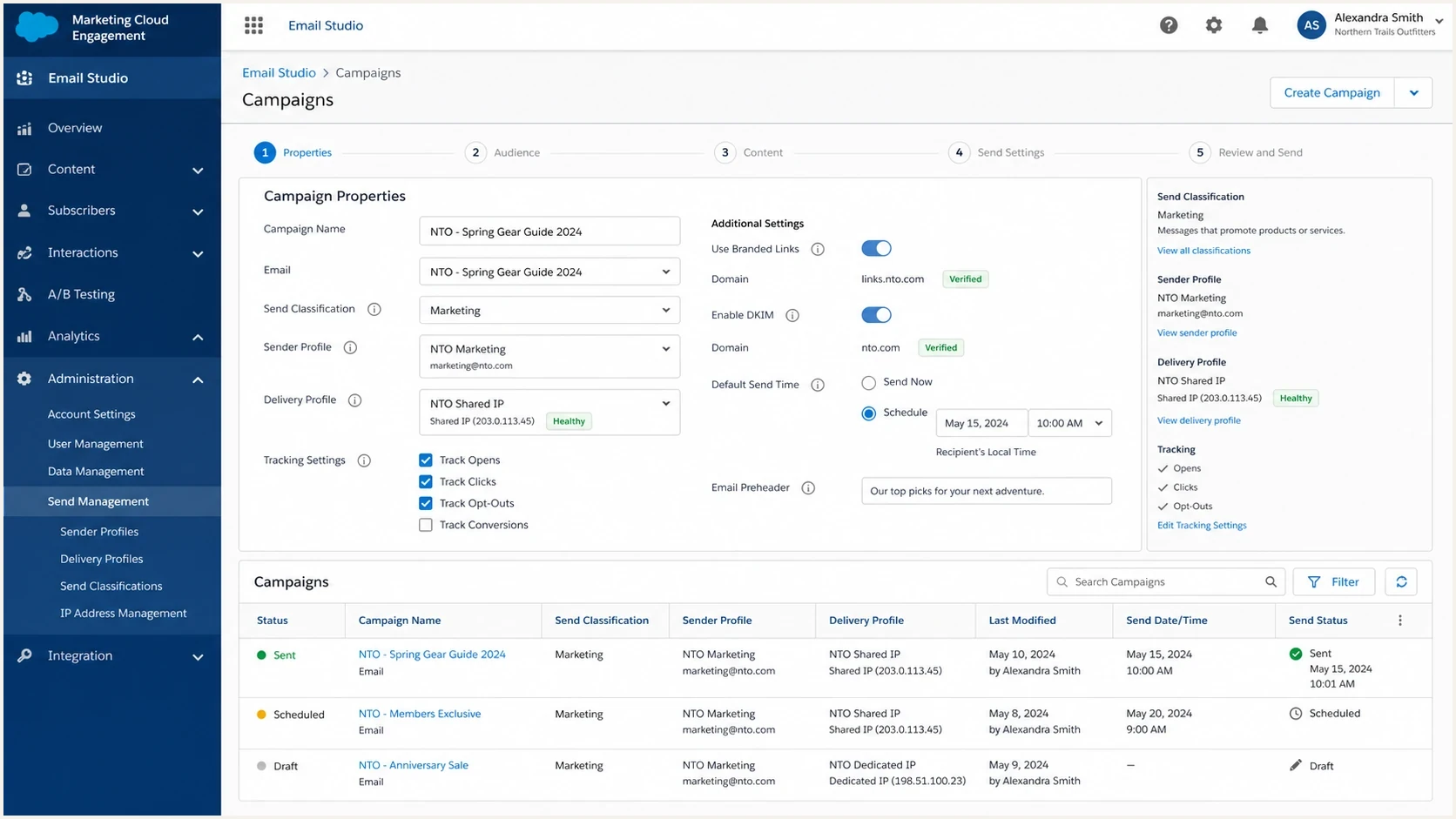
Salesforce Marketing Cloud Engagement screen for sender and delivery settings.
How to separate transactional and promotional mail
Transactional and promotional email create different complaint patterns, volume curves, and recipient expectations. Sending both through one From domain and one IP path makes a promotional problem harder to diagnose and increases the chance that deferrals affect time-sensitive account mail.
|
|
|
|---|---|---|
Transactional | notify.example.com | Transactional pool |
Promotional | offers.example.com | Marketing pool |
New sender | Uses its final stream domain | Restricted ramp-up pool |
Example mail-stream separation for one organization.
Use the chosen subdomain consistently in the visible From address and its DKIM signing domain. Brand the return-path and tracking domain for the same stream where the ESP supports it. Keep transactional content out of promotional campaigns, avoid sudden volume spikes, and route each category through the intended pool.
Subdomains reduce spillover, not all risk
Mailbox providers can evaluate a subdomain, its organizational domain, linked domains, and the sending IP together. Separate subdomains improve attribution and operational control, but they do not guarantee that poor promotional practices will never affect other mail.
For subscribed promotional mail, support one-click unsubscribe and process requests promptly. Mail-stream separation cannot compensate for weak consent, stale lists, or messages that recipients repeatedly mark as spam.
What senders should monitor
Senders on shared ESP pools need to monitor both their own domain identity and the infrastructure around it. DMARC reports show whether legitimate platforms are passing authentication with identifier alignment to the From domain. Bounce and complaint data show how recipients and mailbox providers are reacting. Blocklist and blacklist checks show whether the IP or domain has public reputation exposure.
Suped's product brings DMARC aggregate reports, SPF and DKIM checks, hosted authentication records, MTA-STS, blocklist and blacklist monitoring, and issue detection into one workflow. Teams managing several domains or clients can use the MSP dashboard to compare authentication failures and reputation risks across domains without treating DMARC pass rates as a reputation score.
Suped DMARC dashboard showing email volume, authentication health, and source breakdown
The monitoring workflow is simple: confirm every ESP is authorized, confirm DKIM has DMARC alignment with the visible From domain, investigate unverified sources, track complaint rates and SMTP response codes, and act before the authentication or reputation problem reaches production mail. A domain health check gives a quick view of DNS and authentication basics before you examine aggregate reports.
For ongoing protection, DMARC monitoring shows which sources are sending with your domain, and blocklist monitoring helps catch IP or domain listings before they become a larger deliverability incident.
How to choose between shared and dedicated IPs
A shared IP pool is the right choice for many senders. It gives low-volume or irregular senders a stable base of traffic without forcing them to warm and maintain an IP alone. A dedicated IP makes sense when the sender has enough consistent volume, clean list acquisition, low complaints, and the operational maturity to own the outcomes.
|
|
|
|---|---|---|
Low or irregular volume | Shared | Pool stays active |
Consistent high volume | Dedicated | Direct reputation control |
New or seasonal program | Shared | Less idle-IP risk |
Need isolated network identity | Dedicated | Clear IP ownership |
Practical choice points for ESP senders.
A dedicated IP must be warmed by increasing wanted mail gradually and maintaining a consistent cadence. A new sending domain or subdomain also needs a controlled ramp-up, even when it uses an established shared pool, because the IP's history does not give the new domain an established reputation.
Changing ESPs or domains also changes which reputation signals carry over. The related guide on changing ESPs explains how domain history and infrastructure history interact during a move.
The worst choice is treating a dedicated IP as a fix for weak sender practices. If complaints, bounces, poor recipient response, or authentication failures are the source of the problem, the same sender will damage the dedicated IP and keep damaging the domain. Fix list quality, consent, authentication, segmentation, and cadence before changing infrastructure.
Views from the trenches
Best practices
Use sender-owned From domains and DKIM with DMARC alignment before scaling on any pool.
Segment risky traffic early so poor senders do not keep sharing core identifiers.
Brand tracking and bounce domains when the ESP supports clean domain delegation.
Common pitfalls
Assuming a dedicated IP fixes a damaged sender domain without changing practices.
Letting every customer use the same click domain across unrelated traffic streams.
Ignoring ESP-owned image and link domains because DMARC passes at the header level.
Expert tips
Review the full message source because reputation identifiers sit outside SPF alone.
Keep ESP traffic identifiable while giving senders their own authenticated domain path.
Watch blocklist and blacklist data for both domain and IP exposure after pool moves.
Marketer from Email Geeks says shared IP segmentation lets mailbox providers treat risky senders more precisely, but it does not remove every domain-level risk.
2023-05-03 - Email Geeks
Expert from Email Geeks says sender reputation is commonly built around DKIM signing domains, sending IPs, and the visible From domain, not only the bounce domain.
2023-05-03 - Email Geeks
The practical takeaway
Shared IP pools and shared ESP domains both matter, but they matter in different ways. IP pools shape network trust and delivery throttling. Sending domains, DKIM domains, bounce domains, and tracking domains shape identity-based trust. Good ESPs manage both.
If you are a sender, do not panic because an ESP uses a common bounce domain or an ESP DKIM signature. That is normal. Do insist on your own authenticated From domain, DKIM with DMARC alignment, branded tracking where available, clean DMARC reporting, and enough visibility to know when your mail is being grouped with weaker senders.
If you are an ESP, pool segmentation is only half the job. The other half is keeping shared identifiers from becoming shared liability. That means customer controls, branded domain options, traffic separation, feedback loop handling, and fast action when a sender starts creating poor signals.




