How do I fix Verizon Media deliverability problems with seasonal email sends?


Updated on 7 Aug 2026: We updated this guide with Yahoo's current sender requirements, complaint thresholds, TSS04 retry guidance, and an off-season list maintenance plan.
Fix seasonal deliverability problems at the mailbox brands once grouped under Verizon Media by treating every restart as a reputation rebuild, not as a normal campaign launch. Yahoo now operates Yahoo Mail and AOL Mail, so use Yahoo's current sender requirements when diagnosing this legacy "Verizon Media" problem. Shrink the Yahoo and AOL audience, send first to the most recent openers and clickers, cap volume increases, check complaints against delivered mail, and confirm that SPF, DKIM, DMARC, bounce handling, and list sources are clean before expanding.
If a sender has been quiet for months and then sends a winter or summer newsletter to a large seasonal cohort, Yahoo filtering can treat the change as an unusual traffic pattern. A 421 4.7.0 TSS04 response is a temporary deferral associated with unexpected volume or user complaints, not a final rejection. Slow the stream, let the mail server retry with normal backoff, and rebuild trust. An IP change can work in rare cases, but it is the last step after a controlled recovery attempt because the same list behavior can damage the new route too.
- Reduce: Cut Yahoo and AOL volume to a small engaged segment for several sends.
- Segment: Separate recent opt-ins, recent guests, recent buyers, and old seasonal subscribers.
- Measure: Track TSS04 rate, spam complaints, hard bounces, clicks, unsubscribes, and conversions by provider.
- Warm: Increase daily volume only after deferrals fall and engagement remains steady.
- Escalate: Move IPs only when the current route remains blocked after clean, low-risk recovery sends.
Why seasonal sends trigger TSS04
TSS04 is a 421 4.7.0 temporary deferral used when Yahoo sees unexpected volume, user complaints, poor IP reputation, suspicious content, or other unusual traffic patterns. The exact filter decision is internal, but the practical triggers are clear enough to act on: sudden volume, old recipients, weak recent engagement, complaints, poor bounce handling, and authentication gaps.
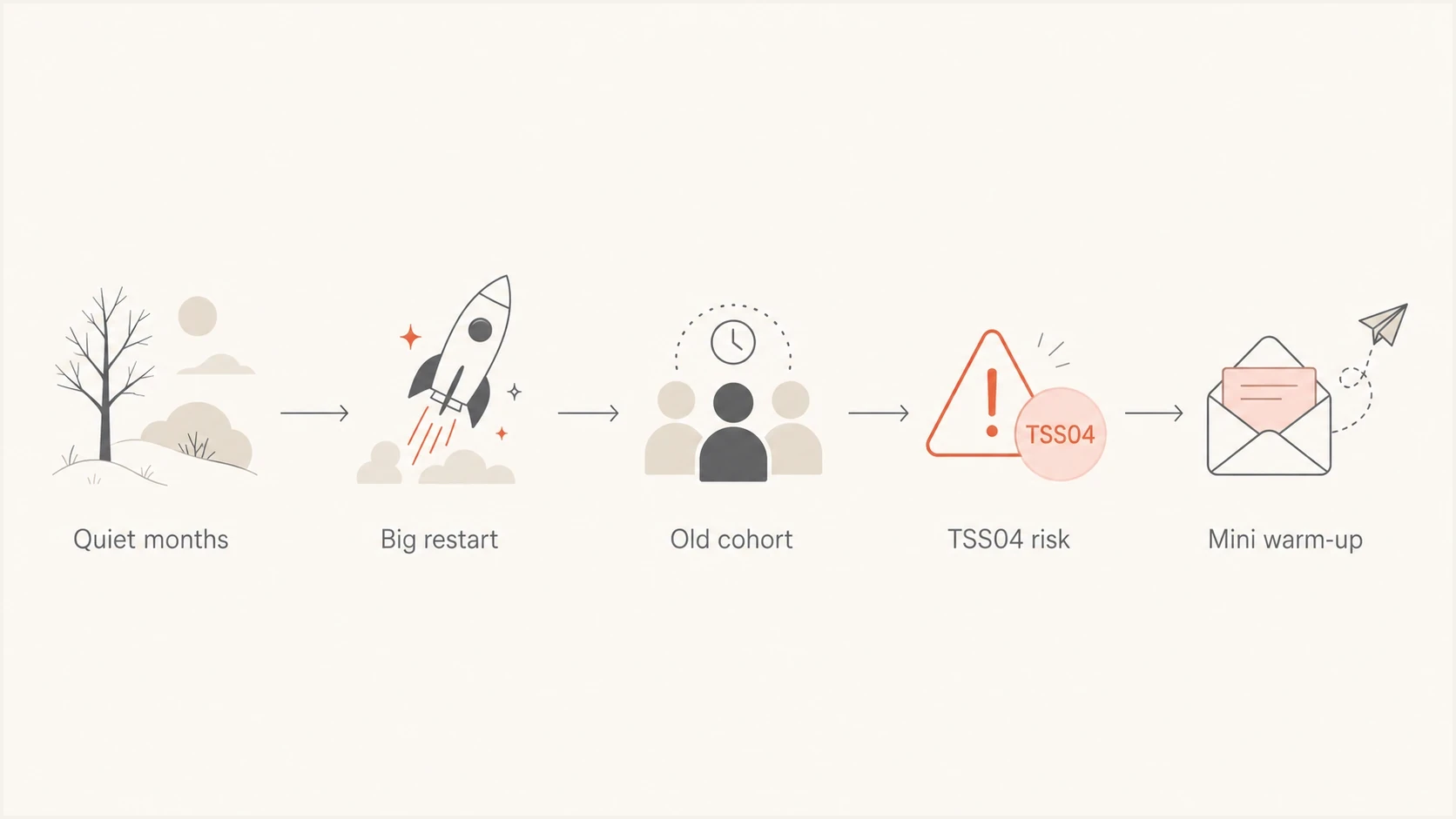
Flowchart showing how quiet months and a large restart can lead to TSS04 risk.
The seasonal pattern is the core problem. During quiet months, mailbox providers see little proof that recipients still want the mail. When the active season starts, the sender often reaches the full list because revenue pressure is high. That creates volume spikes, and those spikes make TSS04 deferrals harder to recover from if the first sends perform poorly.
Healthy seasonal start
- Audience: Recent openers, clickers, purchasers, or guests receive the first sends.
- Cadence: Small sends start before the main operating season returns.
- Signal: Low complaints and clear engagement justify each volume increase.
Risky seasonal restart
- Audience: Old winter or summer subscribers are mailed before requalification.
- Cadence: A long quiet period is followed by immediate peak-season volume.
- Signal: Complaints, ignores, and deferrals arrive before trust is rebuilt.
The most important hidden detail is complaint math. Yahoo requires bulk senders to keep spam complaints below 0.3%, and Yahoo calculates its rate against mail delivered to the inbox. An email platform often uses all delivered or sent mail as the denominator, so its visible rate can materially understate Yahoo's number. Treat 0.3% as a ceiling, not a target, and stop expanding at the first sustained rise.
Diagnose before changing IPs
Before moving a sender to another IP, confirm that the problem is not caused by list quality, authentication, unsubscribe handling, DNS, bounce handling, or a sudden content shift. A new IP changes the reputation path, but it does not fix recipients who forgot the brand, stale addresses, or complaints caused by unexpected seasonal mail.
|
|
|
|---|---|---|
SMTP logs | Whether Yahoo returns temporary 421 TSS04 deferrals or permanent failures. | Group responses by IP, stream, and recipient domain. |
Complaints | Whether recipients object after the quiet season. | Suppress complainants and review source consent. |
Engagement | Whether recipients still recognise the sender. | Start with 30, 60, and 90 day engagement bands. |
Authentication | Whether SPF, DKIM, and DMARC pass with the required domain match. | Fix authentication and domain-matching failures first. |
DNS | Whether sending IPs have valid forward and reverse DNS. | Correct A or MX and PTR records before scaling. |
Unsubscribe | Whether marketing mail supports easy opt-out and suppression. | Add one-click unsubscribe and honor requests within two days. |
Reputation | Whether the IP or domain appears on a blocklist or blacklist. | Investigate listings before scaling volume. |
Checks to run before making an IP change.
Send a real message through your normal platform and inspect the result with an email tester. Then run a broader domain health checker review to catch DNS, authentication, and reputation issues that a single campaign report misses.
Email tester
Send a real email to this address. Suped shows a results button when the test is ready.
?/43tests passed
The tester result does not replace SMTP logs or mailbox-provider data, but it gives a fast sanity check. Look for header domain match, DKIM signatures, SPF pass status, DMARC disposition, content flags, and whether the sending domain is consistent with the brand recipients expect. Do not diagnose a broad placement problem from seed addresses alone because seed behavior can differ from subscriber behavior.
Do not trust one complaint number
The complaint rate that affects filtering can be higher than the complaint rate in an email platform report. If only part of the mail reaches the inbox, a small complaint count can be a large complaint rate against inboxed mail. Enroll each DKIM signing domain in Yahoo's Complaint Feedback Loop, then suppress every reported recipient from future campaigns.
- Compare: Review complaints by recipient domain, not only as one campaign total.
- Normalize: Calculate complaints against delivered mail and estimated inboxed mail.
- Suppress: Remove recipients who complain and stop expanding weak cohorts.
Example TSS04-style bounce cluetext
421 4.7.0 [TSS04] Messages temporarily deferred
421 4.7.0 Retry later after reducing risk signals
Rebuild the season with a mini-warm-up
A seasonal mini-warm-up has one job: prove that the current audience wants the mail before the business needs peak volume. Start before the season opens, using useful content instead of sales-heavy pushes. That gives subscribers a chance to recognise the sender again before the most commercial messages arrive.
Example Yahoo and AOL restart ramp
A cautious ramp keeps early sends small until complaint and deferral data support more volume.
Target volume
The exact ramp depends on the starting reputation and list size, but the control rule is simple: no automatic doubling while Yahoo is still deferring mail. If TSS04 stays high, hold or reduce the next send. If complaints rise, stop expanding and inspect the cohort that caused it. Opens can help with trend analysis, but clicks, purchases, sign-ins, and recent opt-ins give firmer evidence that recipients still want the mail.
- First send: Mail recent clickers, recent buyers, recent opt-ins, and reliable recent openers only.
- Second send: Add people active in the last 60 to 90 days if deferrals and complaints stay low.
- Third send: Add seasonal subscribers who engaged during the same season last year.
- Later sends: Reconfirm or suppress older recipients instead of adding them automatically.
|
|
|
|---|---|---|
Pre-season | Best recent engagement | Complaints or deferrals rise |
Opening week | Recent plus seasonal buyers | TSS04 remains elevated |
Peak season | Expanded engaged list | Inbox metrics weaken |
Off-season | Light newsletter cohort | Unsubscribes trend upward |
A practical seasonal restart plan.
Keep the off-season list healthy
A warm-up cannot repair an audience that no longer expects the mail. Set frequency expectations at signup, keep a light off-season cadence for subscribers who want it, and apply a sunset policy before the next peak. A subscriber who has shown no meaningful activity for 6 to 12 months should not enter the normal seasonal ramp without fresh evidence of interest.
- Set expectations: State the message type and expected seasonal frequency at signup.
- Maintain continuity: Send useful off-season mail only to people who still engage.
- Sunset inactivity: Reduce frequency, reconfirm, or suppress recipients with no recent activity.
- Honor exits: Process unsubscribes within two days and suppress complaint feedback immediately.
Do not increase frequency abruptly for a holiday or seasonal opening. Increase it over several sends, keep transactional mail separate from marketing streams where possible, and make each campaign match the promise made when the subscriber opted in.
When changing IP address is justified
Changing IPs is justified only when the current route remains stuck after a disciplined recovery plan. The strongest case is a sender that has paused the affected stream, returned with recently engaged subscribers, confirmed permission and content fit, processed complaints, fixed authentication and DNS, and still sees persistent TSS04 after controlled retries. If the same error continues for more than 48 hours after material corrections, collect the full SMTP response, timestamps, sending IPs, domains, and sample message details for a Yahoo Sender Support Request before moving traffic.
Try recovery first
- Volume: Reduce Yahoo and AOL sends to a narrow engaged cohort.
- Content: Send recognition-building content before hard seasonal offers.
- Sources: Remove stale imports, partner data, and unclear signup paths.
Move IP only when
- Evidence: Clean recovery sends still receive persistent TSS04.
- Control: The new IP has a safe ramp and no sudden full-list send.
- Monitoring: Deferrals, complaints, and accepted volume are watched daily.
An IP move is a reset, not a cure
A different shared IP can get mail moving again when a route has a damaged relationship with Yahoo and AOL. Keep the stricter segmentation and ramp plan after the move, or the new IP inherits the same recipient behavior. Do not shift deferred mail to several IPs at once because that spreads the same risk signals and hides the source of the problem.
Authentication and reputation controls
DMARC, SPF, and DKIM do not guarantee inbox placement, but weak authentication makes seasonal recovery harder. Yahoo needs to see a consistent sender identity. If the visible From domain, DKIM domain, and return-path domain keep changing, a seasonal restart looks less stable.
Example DMARC staging recordtext
_dmarc.example.com TXT "v=DMARC1; p=none; rua=mailto:d@example.com; fo=1"
Current Yahoo requirements apply to Yahoo Mail, AOL Mail, and other consumer domains hosted by Yahoo. All senders need SPF or DKIM, valid forward and reverse DNS, RFC-compliant messages, and a spam complaint rate below 0.3%. Bulk senders need both SPF and DKIM, a valid DMARC policy of at least p=none that passes through a matching SPF or DKIM identity, and easy unsubscribe for marketing mail.
- Make the From domain match the SPF or DKIM domain so DMARC passes.
- Sign consistently: Use DKIM on every stream and keep the signing domain stable.
- Support opt-out: Add one-click List-Unsubscribe and a visible body link to marketing mail.
- Verify DNS: Publish meaningful PTR records and matching forward DNS for each sending IP.
Check for blocklist and blacklist exposure before increasing volume. A listing does not explain every Yahoo deferral, but blocklist monitoring gives a fast warning when an IP or domain reputation problem is part of the send failure.
Seasonal restart risk bands
Use these bands as operating triggers, then tighten them based on your own Yahoo and AOL history.
Healthy
Proceed
Deferrals are low and engagement is stable.
Watch
Hold
Deferrals rise or engagement weakens.
Stop
Reduce
TSS04 dominates Yahoo and AOL traffic.
How Suped fits this workflow
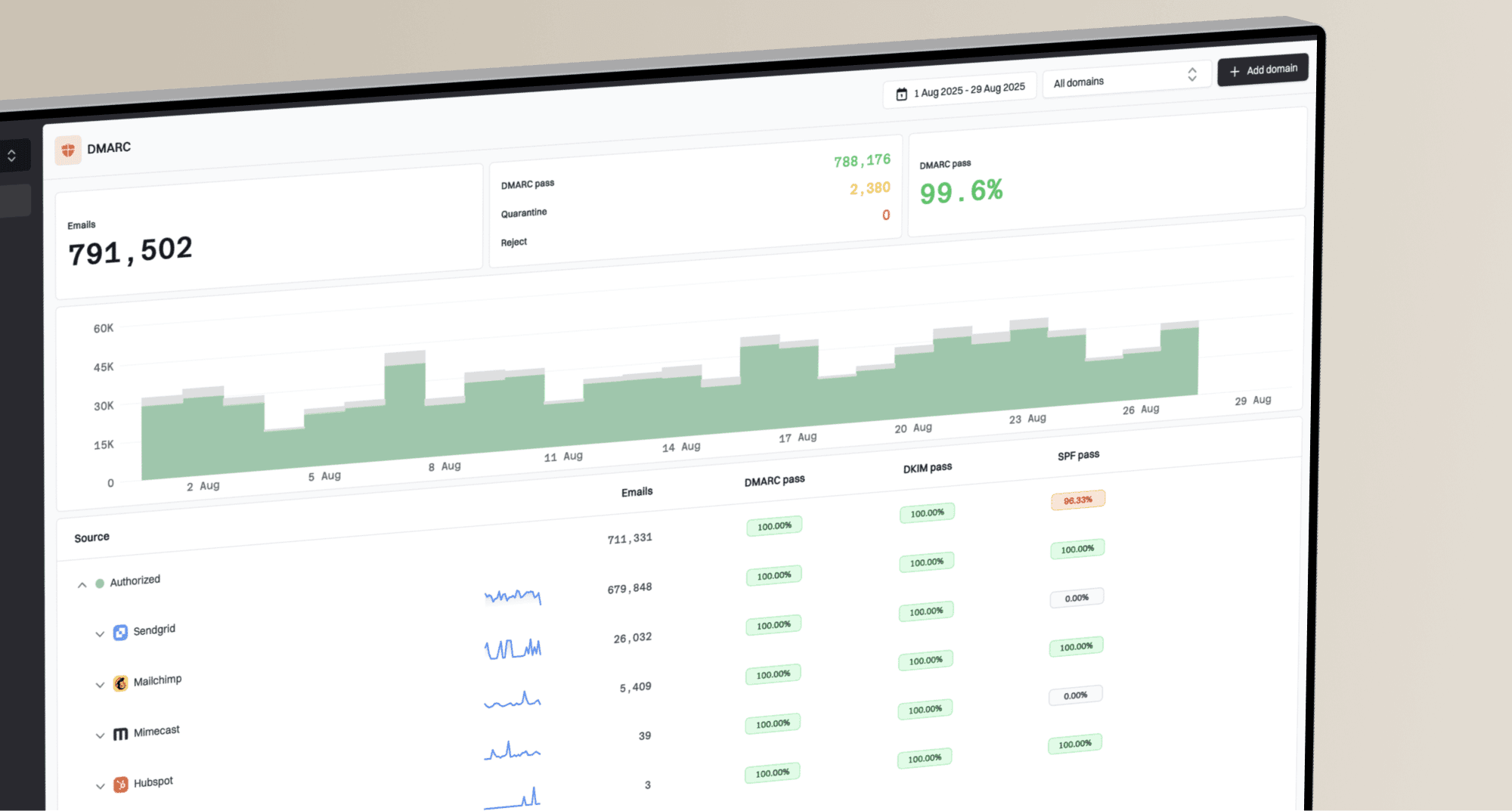
Suped is our DMARC and email authentication platform. In a seasonal sending workflow, it collects DMARC aggregate data, identifies sources using the domain, shows SPF and DKIM results, and flags authentication or policy issues before volume increases. SMTP deferrals and complaint data still need to come from the sending system and Yahoo's feedback data.
Issues page showing top issues, verified sources, unverified sources, and authentication pass rates
The workflow is straightforward: add the sending domain, enable DMARC monitoring, review verified and unverified sources, then fix failed SPF, DKIM, DMARC, source, or policy checks before the next ramp step. This helps the team separate identity problems visible in DMARC data from reputation problems visible in SMTP logs and complaint feedback.
Hosted DMARC supports staged policy changes without repeated DNS edits. Hosted SPF and SPF flattening help keep authorised sources within SPF lookup limits as sending platforms change. Hosted MTA-STS manages TLS policy with two CNAME records and no separate web hosting. Alerts are useful when one person manages several seasonal brands and needs to catch an authentication change before the next large send.
Views from the trenches
Best practices
Start each season with a small engaged cohort before daily business volume returns fully.
Review complaints by mailbox provider because delivered-mail rates hide risk at Yahoo.
Separate winter and summer cohorts so old demand signals do not contaminate new sends.
Common pitfalls
Pausing for two weeks without a warm-up leaves the same reputation problem waiting later.
Treating all seasonal subscribers as recently engaged can restart the same TSS04 pattern.
Moving IPs before fixing list quality carries the damaged behavior into the next route.
Expert tips
Build a restart calendar with daily caps, complaint checks, and Yahoo/AOL stop rules.
Keep a small year-round newsletter to preserve recognisable sender patterns between peaks.
Document the point where IP recovery failed, so an IP move has clear evidence later.
Marketer from Email Geeks says complaint percentage should be reviewed after the off-season, because complaints can rise when recipients no longer expect mail.
2021-03-09 - Email Geeks
Marketer from Email Geeks says Yahoo filtering can calculate complaints against mail that reaches the inbox, so the visible rate in an ESP understates risk.
2021-03-10 - Email Geeks
The practical fix
For a seasonal sender with a legacy Verizon Media deliverability problem, the fix starts before the season: keep controlled off-season activity for people who want it, apply a sunset policy, rebuild with the most engaged recipients, watch complaints by mailbox provider, and hold volume when TSS04 appears. A full pause followed by the same restart pattern usually leaves the sender in the same place.
Changing IPs belongs at the end of the runbook. It is reasonable after clean recovery attempts and support escalation still produce persistent TSS04, but the new IP needs the same mini-warm-up, tighter segmentation, and daily monitoring. The goal is to show Yahoo and AOL a smaller, cleaner, more predictable sender.