How can honeypots be used in B2B emails to identify and filter out bot clicks effectively without impacting deliverability?

Published 21 Jul 2025
Updated 27 Aug 2026
12 min read
Summarize with
Updated on 27 Aug 2026: We added safer same-message click correlation, clearer unsubscribe handling, and stronger testing rules for B2B honeypots.
Yes. A honeypot can identify B2B bot clicks by adding a link that a normal human has no reason to click, tracking that link per recipient and message, then filtering matching events out of engagement reporting. Treat the honeypot click as a classification signal, not as proof that the person is bad or should stop receiving email.
The safest pattern uses one signed, opaque URL per recipient-message pair, places it in the HTML before the primary CTA after rendering and accessibility checks, and hosts it on the same HTTPS tracking domain used by the rest of the campaign. Log timing, user agent, IP, link sequence, and whether the click happened without an open. Filter the resulting events from reporting first, then put the recipient into a temporary suspected-bot segment only when repeated evidence supports it.
Short answer for implementers
- Use path segments or a short signed token instead of long query strings, since security systems sometimes strip parameters.
- Place the link near the top of the HTML, after the opening body area and before the first visible CTA.
- Keep every campaign link on HTTPS and avoid new or unrelated tracking hosts during the test.
- Correlate clicks by recipient-message token first, using IP and user agent only as supporting evidence.
- Exclude the click events first, then suppress or segment contacts only after repeated evidence.
How the honeypot works
A honeypot link works because many B2B security scanners fetch or click links before delivery or when the recipient opens the message. Some click every link, some click the first few links, and some fetch selected links based on policy. This non-human interaction is more common in corporate, government, education, healthcare, finance, and other higher-security inbox environments than it is in most consumer inboxes.
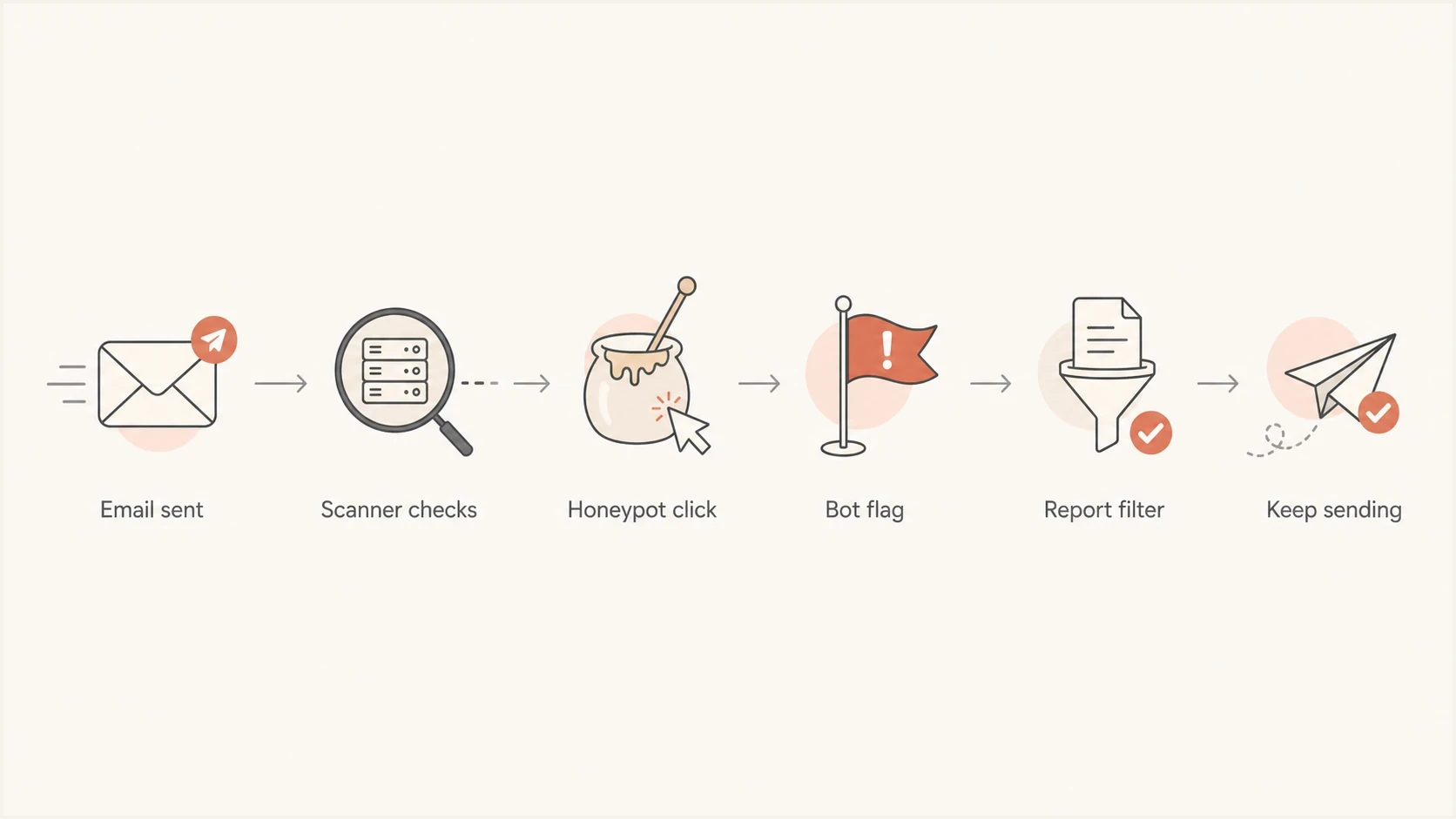
Flowchart showing email sent, scanner check, honeypot click, bot flag, report filter, and continued sending.
Use the honeypot as a label on the event stream. It should not change the creative, the offer, or the recipient experience. It should make reporting cleaner by separating likely non-human interaction from real buying intent.
- Create a different token per recipient, campaign, and message so one hit maps to one send.
- Use the same tracking host that appears on normal campaign links, with working TLS and destination handling.
- Return a small blank page, a transparent asset, or a normal forwarding response without slow scripts.
- Do not put a raw email address, company name, or account ID in the visible URL.
- Keep the trap out of the plain-text part unless you want humans to see a strange extra link.
The marker can be a neutral text anchor, a tiny punctuation link, or another low-visibility anchor. Test it across supported email clients, assistive technology, and spam-filter QA because some clients or scanners remove hidden elements. Do not link a tracking pixel when a normal anchor gives the same click signal, since image loads and link clicks measure different actions.
Write the URL so scanners keep it intact
The honeypot URL should be boring and durable. A short path-style URL with opaque identifiers is usually safer because proxies and scanners often rewrite links. Long query strings work in many systems, but they are easier to strip, truncate, or normalize in ways that break attribution.
Path-style honeypot URLtext
https://click.example.com/h/cmp123/r/9f4a/m/77/s/s8

Avoid:
https://click.example.com/track?email=person@example.com&campaign=cmp123
|
|
|
|---|---|---|
Campaign | cmp123 | Groups the send |
Recipient | 9f4a | Maps the person |
Message | 77 | Separates variants |
Signature | s8 | Rejects tampering |
Compact fields for a honeypot URL.
Do not expose personal data
Never place the raw recipient email address in the honeypot URL. Use a short internal ID, a hash, or a signed token. Forwarded emails, link preview systems, and shared inboxes can leak URLs into logs outside your control.
Place it where bots see it and people do not
If the goal is to catch scanners that click early links, put the honeypot near the top of the HTML, after the opening body area and before the first visible CTA. That usually means the preheader or the first layout spacer, not a random footer link. The footer still catches scanners that click every URL, but it misses first-link behavior.
Avoid putting the link inside HTML comments because email platforms and security tools strip comments. Use a real anchor with neutral hidden text or a tiny punctuation character, then track it as a separate event. Verify that the method does not expose confusing text to screen readers or break the layout in clients that remove CSS. Do not wrap a 1x1 image in an anchor unless a specific test proves it behaves better in your sending stack, because image loads and link clicks are different signals.
Hidden text link examplehtml
<a href="https://click.example.com/h/cmp123/r/9f4a/m/77"
   style="display:none;visibility:hidden;mso-hide:all;
          font-size:0;line-height:0;color:transparent;
          opacity:0;height:0;width:0;overflow:hidden;"
   aria-hidden="true">
  Email settings
</a>
Better pattern
- Use one hidden text anchor or tiny punctuation marker that is not a CTA.
- Keep it on the same click-tracking host as other email links.
- Store the event as a bot marker, not as a normal campaign click.
- Check rendering and accessibility before using the pattern at scale.
Risky pattern
- Do not rely on HTML comments, since send tools and scanners often remove them.
- Do not add a fresh or unrelated host that has no sending reputation.
- Do not use a linked pixel when a normal anchor gives the same click signal.
- Do not treat CSS invisibility as proof that every scanner will follow the link.
Filter clicks without deleting real engagement
The reporting rule matters more than the link itself. A honeypot hit should remove or label the related click events, not automatically remove the subscriber from all marketing. In B2B, a security gateway can click on behalf of a real buyer who later reads the message.
Bot clicks, also called non-human interaction or NHI, create false positives such as clicks without opens, every link clicked in sequence, inflated click-to-open rate, and contacts entering journeys before they read the email. A temporary suspected-bot segment works well because people in that segment still receive campaigns, but their clicks are excluded from performance reports until later human evidence appears.
Example bot score action bands
Use score bands to filter reports without permanently removing contacts.
Regular
0-39
No honeypot hit and normal timing.
Review
40-69
Fast click or unusual sequence, but no honeypot hit.
Filter
70-100
Honeypot hit or several automated signals.
Simple classification logictext
if honeypot_click = true:
  label = "suspected_bot"
else if first_click_seconds < 5 and click_count >= 3:
  label = "suspected_bot"
else if user_agent_flag = true and click_count >= 2:
  label = "review"
else:
  label = "regular"
For broader reporting cleanup, the related article on how to filter bot clicks covers timing rules, click volume rules, and campaign reporting adjustments.
Correlate the rest of the scan carefully
Once the honeypot fires, review other clicks tied to the same recipient-message token inside a short observation window. This catches a scanner that walks the visible CTAs before or after it reaches the trap. Start with a 15-minute window, compare the result with later human actions, and shorten the window if genuine clicks are being filtered.
- Mark the honeypot event and adjacent clicks on that recipient-message token as suspected automation.
- Require another signal before correlating events that share only an IP address or user agent.
- Restore human engagement when a later reply, form submission, authenticated session, or conversion supports it.
- Store the reason, rule version, and correlation window with each filtered event for audit.
Shared IPs create false positives
A security gateway and a real employee can use the same corporate egress IP, and scanners can send browser-like user agents. Do not discard every click from a shared IP or matching user agent after one honeypot event. The recipient-message token and event sequence provide safer correlation.
Keep bots out of automation decisions
Do not let the honeypot endpoint perform an action. It should not unsubscribe, confirm consent, update preferences, unlock gated content, trigger sales-ready scoring, or enroll a contact in a nurture journey. Record the diagnostic event, then let later human evidence decide what happens next.
- Implement one-click unsubscribe with an HTTPS List-Unsubscribe URI, List-Unsubscribe-Post, a valid POST handler, and DKIM coverage of both headers. Do not treat an ordinary body-link GET as the required one-click action.
- For double opt-in or high-value confirmations, use a second step such as a short code, account session, or form confirmation instead of treating one clicked email link as final intent.
- Keep A/B test reads, lead scores, and sales alerts tied to filtered engagement, replies, form fills, or product activity rather than raw first-click data.
Keep raw events available
Store raw and filtered values separately so analysts can audit why a click was excluded. This protects reporting while keeping compliance and consent evidence intact.
Protect deliverability while testing
A honeypot does not automatically damage deliverability. The deliverability risk comes from the surrounding implementation: a strange tracking domain, broken destination handling, mismatched TLS, deceptive anchor text, too many links, or sender authentication problems. Keep the honeypot quiet, technically clean, and limited to one or two links per message.
The strongest proof is a controlled test with matched control and honeypot groups from a low-risk B2B segment. Keep the message, audience selection, send time, and normal tracking identical. Compare delivery, bounces, complaints, unsubscribes, replies, form submissions, conversions, and raw-versus-filtered click patterns before adding the rule to normal campaign reporting.
Practical test plan
- Send the existing email to a matched audience with normal tracking only.
- Add one honeypot link in the HTML and keep everything else identical.
- Review delivery, complaints, blocklist or blacklist signals, raw clicks, and downstream human actions.
- Keep the rule only if it reduces false engagement without a delivery drop or material loss of genuine clicks.
Before sending the test, run a sample through the Suped email tester to inspect headers, authentication, HTML issues, HTTPS links, and the final rendered message. This catches basic setup problems before a scanner or mailbox provider sees the campaign.
Email tester
Send a real email to this address. Suped shows a results button when the test is ready.
?/43tests passed
That test does not replace real inbox and engagement data, but it gives the coding and deliverability teams a shared baseline. If the sample fails authentication or has broken URLs, fix that before judging the honeypot.
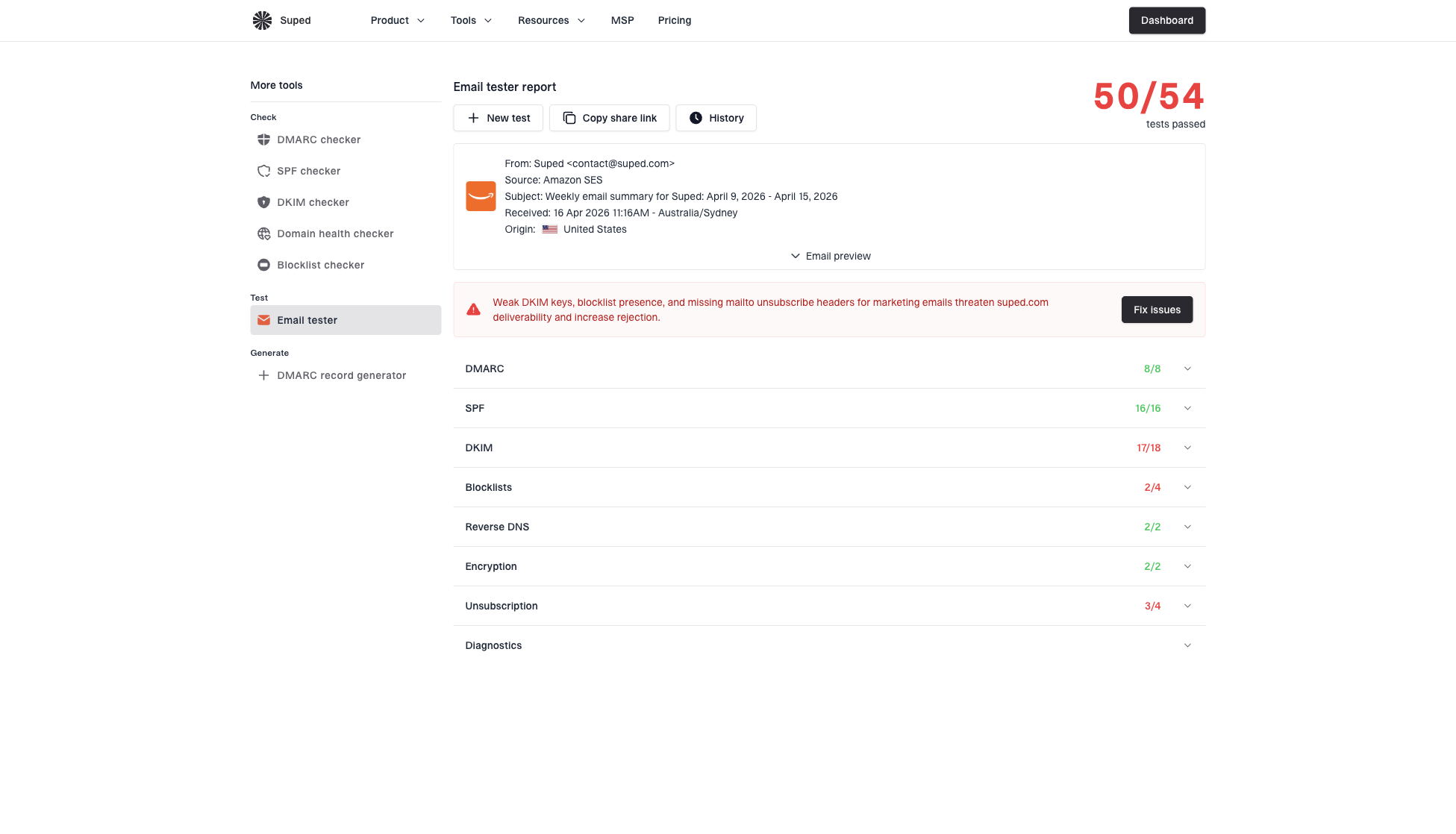
Email tester sample report showing total score, email preview, issue summary, and per-section results
Suped's product keeps DMARC monitoring, SPF and DKIM visibility, alerts, and deliverability signals together for teams testing across several domains. Use Suped DMARC monitoring to confirm legitimate sending sources remain authenticated during the test, and use blocklist monitoring to watch domain and IP reputation across major blocklists (blacklists).
Log enough evidence to make fair decisions
A useful honeypot system needs more than a clicked URL. Log the context around each click so the scoring rule can separate a security gateway from a human who clicked later in the day. Keep the dataset specific, access-controlled, and easy to audit.
|
|
|---|---|
Time | Detect instant clicks |
Recipient-message token | Correlate one send |
Link order | Find click-all scans |
User agent | Flag known patterns |
IP and ASN | Find shared gateways |
HTTP method | Separate HEAD and GET |
Message ID | Tie back to send |
Filter reason | Explain exclusion |
Part | Separate HTML and text |
Fields that make bot-click filtering easier to audit.
Avoid a permanent "bot" label unless the pattern repeats across sends. A honeypot hit plus a rapid click sequence on the same recipient-message token gives a strong case for event filtering. An IP address or browser-like user agent alone is weak evidence because security gateways and real employees can share both.
Limits and caveats
Honeypots catch a useful class of bot clicks, but they do not catch every scanner. A scanner that only follows visible CTAs, ignores hidden elements, or checks selected URLs will skip the trap. A scanner that fetches only the plain-text part will also miss an HTML-only honeypot.
Combine the honeypot with timing, click count, link sequence, user agent, IP and ASN patterns, and downstream human actions. Scanners can delay clicks, randomize their sequence, or use browser-like user agents. The honeypot gives a clean signal when it fires, while the behavior rules cover cases where it does not.
Honeypot catches
- Systems that follow every URL in the HTML.
- Systems that start at the top and click early links.
- Gateways that inspect links before inbox delivery.
Honeypot misses
- Systems that try to ignore hidden or tiny elements.
- Systems that inspect the plain-text part only.
- Systems that check URLs hours after delivery.
Views from the trenches
Best practices
Use one unique honeypot URL per message so later scoring stays precise and reversible.
Keep the honeypot out of reports first, then review evidence before excluding a contact.
Run a small A/B test before changing automation for a high-volume B2B program send.
Common pitfalls
Using raw email addresses in URLs creates privacy risk and messy forwarded-email data.
Treating one fast click as permanent proof removes real buyers from useful reporting.
Hiding links with aggressive CSS can create QA issues across older email clients and apps.
Expert tips
Use path parameters when query strings get stripped by security scanners or link proxies.
Score timing, link count, user agent, and honeypot clicks before labeling activity.
Keep sending to suspected scanners, but remove their events from engagement dashboards.
Marketer from Email Geeks says large B2B senders can use hidden text markers near the top of the HTML, then route matches into a temporary suspected scanner segment without changing who receives campaigns.
2023-08-04 - Email Geeks
Marketer from Email Geeks says a path-style URL can survive some rewriting better than long query strings, so teams should test both structures before relying on one pattern.
2023-08-05 - Email Geeks
Practical recommendation
Start with one HTML-only honeypot link, path-style URL tracking, and a temporary report-filtering rule. Place it before the first visible CTA, keep it visually neutral, and do not put personal data in the URL. Then correlate the honeypot hit with clicks on the same recipient-message token before using timing, user agent, or IP evidence for broader decisions.
- During the first week, run a matched test and compare delivery, complaints, raw clicks, and downstream human actions.
- During the second week, filter suspected bot events from dashboards but keep recipients in the audience.
- Ongoing monitoring should prove the test is not hiding a sender setup, authentication, or reputation problem.
A honeypot is most useful when it cleans analytics without changing the subscriber experience. If it becomes a hard suppression rule too early, it creates a new accuracy problem while trying to solve an old one.