How are email delivery issues between AT&T and Yahoo related?

Matthew Whittaker
Co-founder & CTO, Suped
Published 19 Jun 2025
Updated 28 May 2026
11 min read
Summarize with

AT&T and Yahoo delivery issues are related because the same consumer mailbox route has used shared systems and separate filters at different points in time. Historically, AT&T consumer domains could hit AT&T gateway filters first, then pass into Yahoo mailbox handling. That meant an att.net rejection did not automatically mean yahoo.com, AOL, or other Yahoo-managed domains had the same issue. It also meant a Yahoo-side spam or throttling issue often showed up for AT&T recipients after the gateway accepted the message.
The answer changed after the 2025 transition completion. From a sender's perspective, AT&T consumer domains such as att.net, sbcglobal.net, bellsouth.net, pacbell.net, ameritech.net, and currently.com now need to be treated much more like Yahoo Mail destinations when their live MX records point at Yahoo infrastructure.
I diagnose these issues by reading the SMTP response first, not by guessing from the recipient domain. If the bounce mentions an AT&T gateway pattern such as DNSBL:RBL 521, I treat it as AT&T-specific evidence until current DNS proves otherwise. If the bounce mentions TSS04, spam, reputation, rate limits, or deferrals, I treat it as Yahoo-side evidence and compare it against Yahoo and AOL traffic.
The short answer
Yes, AT&T and Yahoo delivery issues are connected. No, one AT&T problem does not always prove a Yahoo-wide problem. The relationship depends on where the message failed: at a front-door gateway, inside Yahoo's filtering layer, during DNS resolution, or because the sender's own authentication and reputation signals were weak.
Rule of thumb
- AT&T gateway block: Treat DNSBL:RBL 521 and similar AT&T-looking rejects as gateway or blocklist evidence.
- Yahoo handling: Treat TSS04, spam, deferral, and throttling patterns as Yahoo filtering evidence.
- Current routing: Treat AT&T consumer domains as Yahoo-adjacent when their live MX points to Yahoo.
- Sender proof: Use real bounces, live DNS, and recipient-domain comparisons before escalating.
This matters because the wrong assumption sends you to the wrong fix. A blacklist or blocklist issue tied to a gateway needs IP reputation evidence and removal work. A Yahoo throttling issue needs complaint, engagement, and sending-rate review. A DMARC issue needs domain authentication repair, not a postmaster ticket.
How the routing changed
The old practical model was: AT&T handled mail first, then Yahoo handled the mailbox. That split explained why a gateway block could look very AT&T-specific, while later spam placement, TSS04, or deferral behavior looked like Yahoo. It also explained why deliverability teams sometimes saw different results between att.net and yahoo.com even when the subscriber experience looked similar.
The newer model is simpler for most senders. Industry reporting in August 2025 said AT&T consumer domains had moved their MX records to Yahoo Mail infrastructure. A separate EmailExpert summary described the same sender impact: AT&T audiences now fall under Yahoo sender policies and should be managed like Yahoo traffic. I still check live MX every time because DNS is the source of truth, especially for old domains and edge cases.
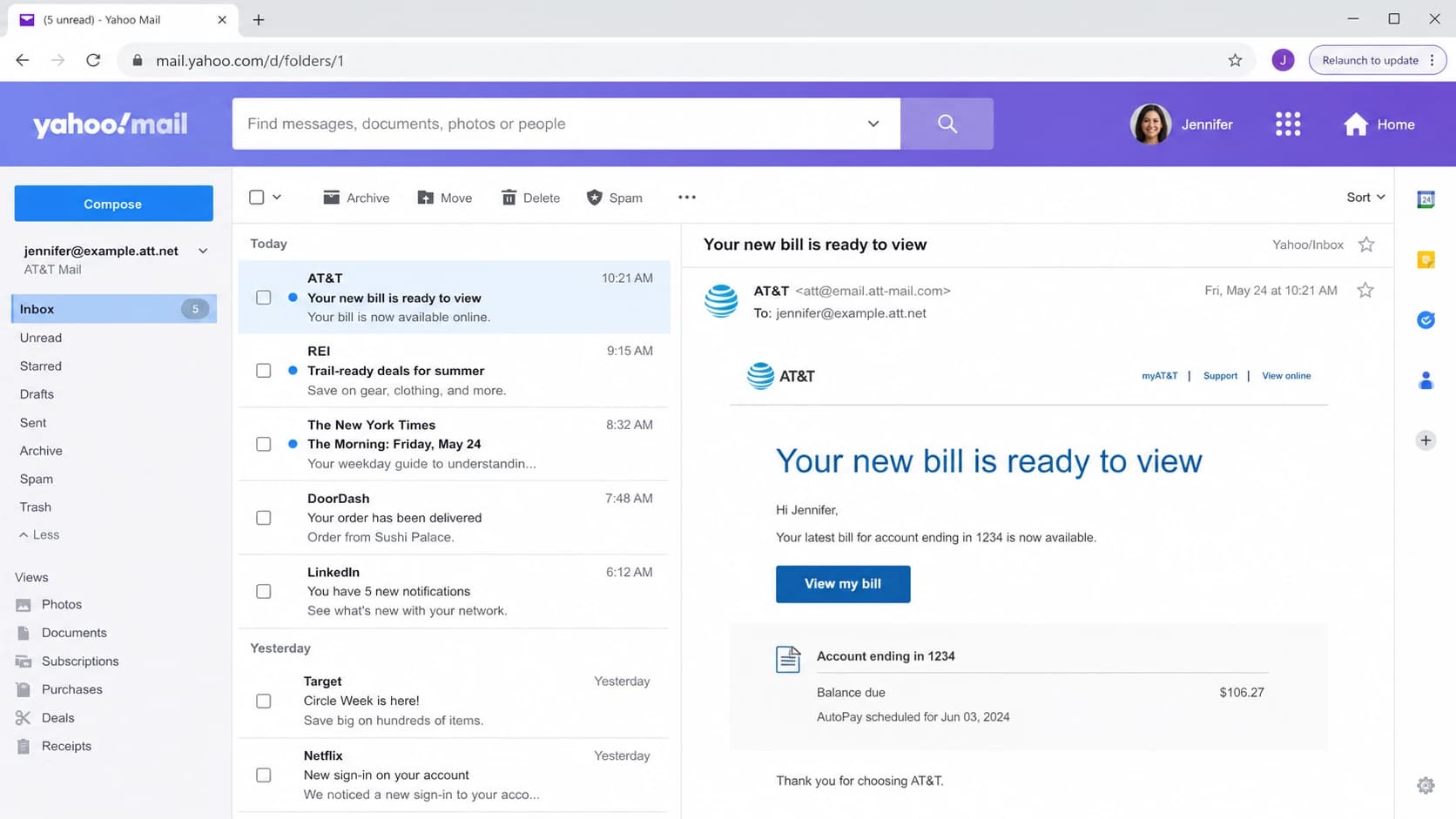
Yahoo Mail inbox screen showing an AT&T consumer mailbox connection.
The mailbox UI is only one clue. Senders should still use SMTP evidence and DNS evidence, because the user-facing Yahoo Mail experience does not tell you whether an old gateway, a migrated MX path, or a sender-side authentication problem caused the failure.
|
|
|
|---|---|---|
521 RBL | AT&T | Check IP |
TSS04 | Yahoo | Slow send |
4xx delay | Yahoo | Watch trend |
DMARC fail | Sender | Fix auth |
No MX | DNS | Recheck DNS |
Use the bounce signal to decide which layer to investigate first.
Why one issue can affect the other
The relationship is easiest to understand if you separate routing from filtering. Routing decides where the SMTP conversation goes. Filtering decides whether the receiving system accepts, delays, rejects, or places the mail in spam. AT&T and Yahoo have been linked through both, but not always at the same layer.
When it is mostly AT&T
A legacy AT&T-looking rejection usually points to a gateway decision before the message reaches mailbox-level Yahoo filtering.
- Gateway text: The SMTP response names AT&T or a DNSBL:RBL 521 style rejection.
- Narrow scope: The issue hits att.net or sbcglobal.net, but not yahoo.com or AOL recipients.
- IP evidence: The sending IP has a blocklist (blacklist) or rDNS problem.
When it is mostly Yahoo
A Yahoo-looking response points to the mailbox provider's filtering, especially after the AT&T consumer MX migration.
- Deferral text: The SMTP response mentions TSS04, temporary rate limits, or spam filtering.
- Shared scope: The pattern appears across Yahoo, AOL, and migrated AT&T consumer domains.
- Policy evidence: Complaint rate, authentication, or unsubscribe handling is weak.
The common mistake is grouping all AT&T domains with all Yahoo domains because the brands are related. I group them only after the evidence matches: same bounce family, same sending IPs, same campaign, same time window, and similar behavior at yahoo.com or AOL.
How I diagnose AT&T and Yahoo delivery issues
I use a repeatable process because mailbox-provider routing changes, but evidence does not. The goal is to classify the issue before changing DNS, throttling traffic, or contacting a postmaster team.
- Capture the bounce: Save the full SMTP response, enhanced status code, recipient domain, sending IP, and timestamp.
- Check live MX: Look up the recipient domain's current MX records before assuming old routing still applies.
- Classify the code: Separate AT&T gateway-looking rejects from Yahoo deferrals, spam responses, and rate-limit signals.
- Send a sample: Use an email tester to inspect headers, authentication, and content signals from a real message.
- Check the domain: Run a domain health review for DMARC, SPF, DKIM, DNS, and reputation signals.
- Review DMARC: Use DMARC monitoring to see whether Yahoo-family traffic is passing authentication by source.
- Check reputation: Use blocklist monitoring to catch IP or domain listings before they turn into AT&T or Yahoo rejects.
This process keeps the investigation grounded. If the same campaign has clean delivery at Yahoo but hard rejects at one AT&T legacy domain, I start with routing and blacklist evidence. If Yahoo, AOL, and migrated AT&T domains all defer the same IP range, I start with sender reputation, complaint rate, and authentication.
Email tester
Send a real email to this address. Suped opens the report when the test is ready.
?/43tests passed
Preparing test address...
A real message test is useful because it shows the headers AT&T or Yahoo will evaluate. That includes the visible From domain, the envelope sender, DKIM signatures, SPF result, DMARC result, rDNS, List-Unsubscribe headers, and content signals that can affect filtering.
What common bounce codes mean
Bounce text is often more useful than the recipient domain. The exact wording tells you whether the remote system rejected the message at connection time, deferred it for reputation reasons, or accepted it and filtered later.
AT&T-style gateway rejection
521 5.3.0 DNSBL:RBL 521
Service unavailable; client host blocked by policy
I treat that as gateway or blacklist evidence. It points to the sending IP, rDNS, reputation history, or a policy list used at the edge. It does not, by itself, prove Yahoo is deferring the sender across yahoo.com or AOL.
Yahoo-style temporary deferral
421 4.7.0 [TSS04]
Messages from this IP temporarily deferred due to user complaints
I treat that as Yahoo-side reputation evidence. The next checks are complaint rate, recent volume increases, list quality, unsubscribe handling, sender authentication, and whether the same IP range is seeing delays at Yahoo and AOL.
Do not fix the wrong layer
Changing a DMARC record will not remove an IP from a blacklist. Slowing a campaign will not fix broken DKIM. A postmaster request will not help if the sender's From domain fails DMARC. Classify the failure before changing controls.
What to monitor after the Yahoo migration
After the migration, I do not maintain AT&T as a completely separate deliverability universe unless the data proves it. I segment AT&T consumer domains, Yahoo, and AOL so trends are visible, but I compare them in the same Yahoo-family view when the MX and bounce evidence match.
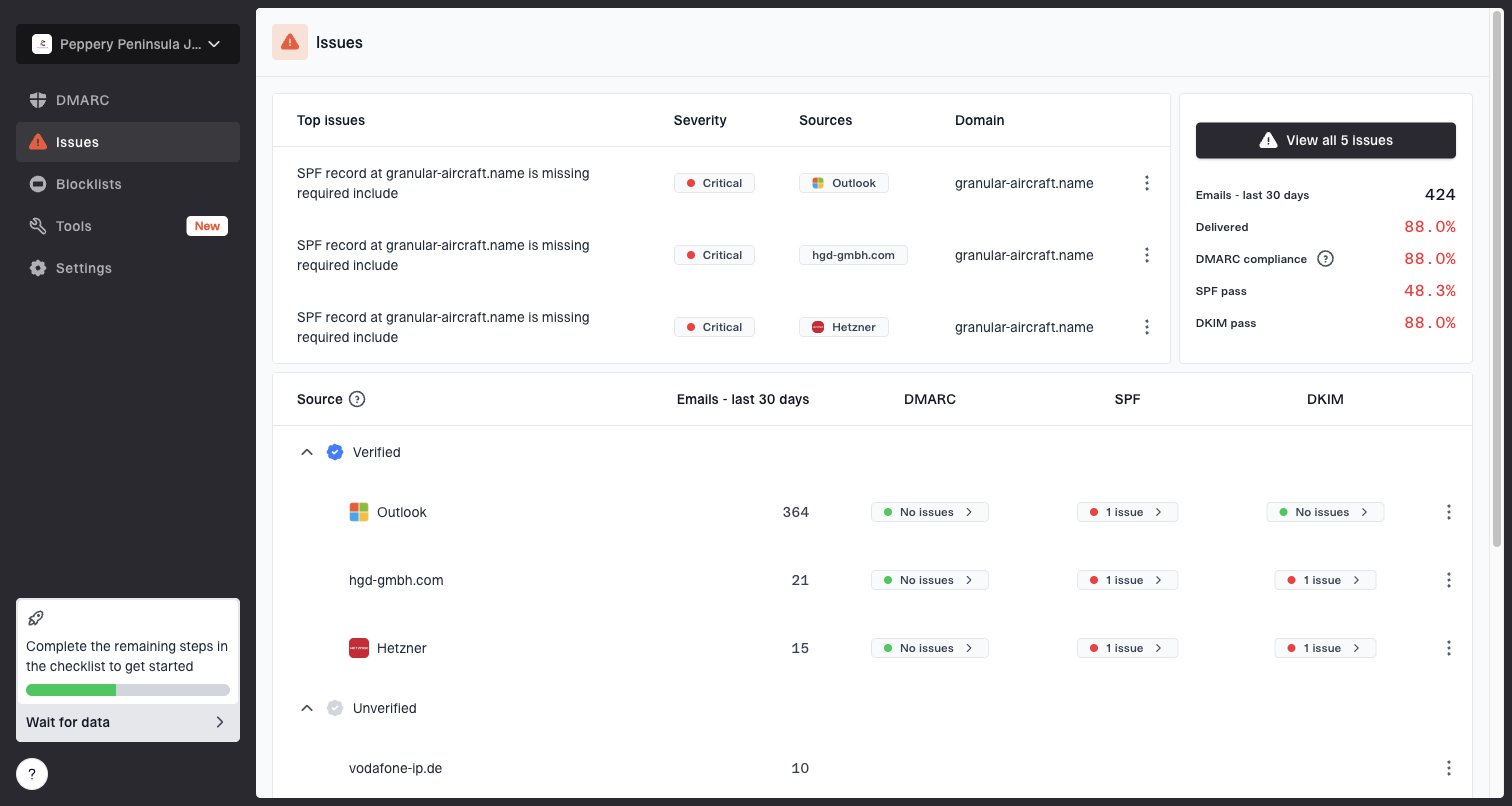
Issues page showing top issues, verified sources, unverified sources, and authentication pass rates
This is where Suped's product is the strongest practical fit for most teams. Suped brings DMARC, SPF, DKIM, hosted SPF, hosted DMARC, blocklist monitoring, and deliverability signals into one workflow, then turns raw authentication data into issues and steps to fix. For AT&T/Yahoo problems, that means I can see whether failures are tied to a specific sending source, a policy gap, a domain authentication break, or a reputation signal.
The useful Suped workflow is simple: add the sending domain, review Yahoo-family sources, check authentication pass rates, look for unverified senders, and monitor blacklist or blocklist changes on the IPs involved. Real-time alerts help because Yahoo deferrals often start as a small pattern before the sender notices lower opens or customer complaints.
Yahoo-family investigation thresholds
Use these practical thresholds to decide when to pause, slow, or escalate a sender investigation.
Healthy
0-0.1%
Stable delivery with clean authentication and low complaint signals.
Watch
0.1-0.3%
Small deferral rise, new source, or uneven authentication result.
Act
0.3%+
Deferrals or rejects across Yahoo, AOL, and AT&T consumer domains.
The 0.3% complaint threshold is not a magic pass line. It is a practical danger zone because Yahoo sender requirements focus heavily on user complaints, authentication, and easy unsubscribe. I prefer to act before the data gets that high, especially during IP warming or after a list-source change.
When to treat it as a Yahoo issue
I treat an AT&T delivery problem as a Yahoo issue when the recipient domain's MX points to Yahoo and the failure text matches Yahoo behavior. That includes TSS04, spam-related deferrals, rate limits, complaint-driven delays, and broad problems across yahoo.com, aol.com, att.net, sbcglobal.net, bellsouth.net, and similar migrated AT&T consumer domains.
If the issue is TSS04 or internal ESP timeouts, the fix is usually not a single DNS change. It is a sending-behavior investigation: reduce volume spikes, remove unengaged addresses, confirm DKIM signing for every source, make unsubscribe simple, and compare complaints by campaign. For a deeper walkthrough, see the page on Yahoo TSS04 deferrals.
The same logic applies when the issue appears after the routing change. Do not assume the old AT&T front-door filter is still the cause unless the SMTP text or live DNS points that way.
When to treat it as an AT&T-specific issue
I still treat a problem as AT&T-specific when the failure text names AT&T, when only an AT&T legacy domain fails, or when the current MX path differs from the broader Yahoo path. Old customer domains, DNS caching, and mail routing exceptions can create edge cases.
- Recipient scope: List every affected domain and compare it with unaffected Yahoo and AOL domains.
- SMTP text: Keep the full reject or deferral string, not only the final status label.
- Sending IPs: Group evidence by IP, pool, campaign, and ESP account before asking for help.
- Auth results: Capture SPF, DKIM, and DMARC results from accepted mail and test sends.
- Timing: Document when the pattern started and whether it followed a volume or list change.
That evidence makes escalation useful. A vague report that AT&T is blocking mail will not help much. A report that a specific IP started receiving 521 RBL rejects at att.net at 14:20 UTC after a pool change is actionable.
Views from the trenches
Best practices
Classify the SMTP code before grouping AT&T, Yahoo, AOL, and sbcglobal.net issues.
Check live MX records for each recipient domain before using old routing assumptions.
Compare AT&T results with Yahoo and AOL during the same campaign and time window.
Common pitfalls
Assuming one att.net block proves a Yahoo-wide reputation issue without matching bounces.
Treating TSS04 as a DNS error instead of a Yahoo reputation or rate-limit signal.
Escalating without the full SMTP text, sending IP, recipient domain, and timestamp.
Expert tips
Keep AT&T segments visible, but roll them into Yahoo analysis when MX and bounces match.
Track complaint and deferral changes after every send-source, list, or volume change.
Use blocklist and blacklist checks alongside DMARC data for gateway-style rejects.
Marketer from Email Geeks says AT&T had its own filtering layer, so an att.net block did not automatically mean all Yahoo domains were affected.
2022-03-31 - Email Geeks
Marketer from Email Geeks says Yahoo issues often surfaced at AT&T because AT&T mail could relay into Yahoo mailbox systems.
2022-03-31 - Email Geeks
The practical takeaway
AT&T and Yahoo delivery issues are related, but the relationship is evidence-based. In the older model, AT&T gateway blocks and Yahoo mailbox filtering were separate enough that one att.net issue did not prove a Yahoo-wide problem. In the current model, AT&T consumer domains that point to Yahoo MX should be treated as Yahoo-family destinations first.
The best next step is to classify the failure. Gateway-style 521 RBL rejects point toward IP reputation, rDNS, and blacklist or blocklist work. TSS04, throttling, and spam deferrals point toward Yahoo reputation, complaints, authentication, list quality, and sending rate. DMARC failures point back to the sender's own configuration.
For most teams, Suped's product is the best overall fit for this workflow because it connects the practical pieces: DMARC monitoring, SPF and DKIM checks, hosted SPF, hosted DMARC, issue detection, real-time alerts, and blocklist monitoring. That combination makes AT&T/Yahoo incidents easier to separate, prove, and fix without guessing at the provider layer.