Does using redirected URLs in email CTAs impact deliverability?

Published 12 Jul 2025
Updated 7 Aug 2026
11 min read
Summarize with
Updated on 7 Aug 2026: We added practical guidance on automated link scanners and clarified where redirect hygiene ends and sender authentication begins.
Yes, redirected URLs in email CTAs can affect deliverability, but a clean redirect usually has a small impact compared with sender reputation, authentication, complaint rate, and the reputation of the link domains involved. A CTA that uses a branded domain such as go.example.com and redirects to a social profile is not automatically treated the same as placing the social URL directly in the email.
The practical question is what mailbox filters and security scanners can see. They see the rewritten click-tracking URL, the visible link text, the sending identity, the reputation of the click domain, and sometimes the final landing page. A redirect is generally acceptable when it uses HTTPS, a branded domain, a short path, and a stable destination. Public shorteners and long or unrelated redirect paths create more placement and trust risk.
Direct answer
A redirected CTA URL is usually fine when the redirect matches the message intent and lands on a safe, expected page. It is not a reliable workaround for hiding a destination domain. Modern filtering systems evaluate multiple signals, and some scanners follow links to inspect the destination for abuse, malware, bad reputation, broken certificates, or suspicious mismatch.
DMARC does not authenticate CTA URLs. It checks whether SPF or DKIM passes with a domain that satisfies DMARC's domain-matching rule for the visible From domain. That means DMARC monitoring protects the sending identity, but content filters still judge the links inside the message. Treat these as separate checks: authenticate the sender correctly, then keep the CTA path clear enough that a scanner and a human understand where the button goes.
A website-level redirect is a separate issue. Pointing a sending domain's website to a main site does not transfer or reset email sender reputation. Mailbox providers can still evaluate the sending domain, sending IPs, message links, and final website, so rotating linked domains that all redirect to one site does not repair an underlying reputation problem.
Short answer
- Normal case: A branded redirect to a clean final page is usually fine for normal marketing and lifecycle email.
- Warm-up case: Use the fewest moving parts while the sender is new, because reputation has less history to absorb weak signals.
- Risk case: A redirect used to disguise an unrelated, blocked, or low trust destination can hurt inbox placement.
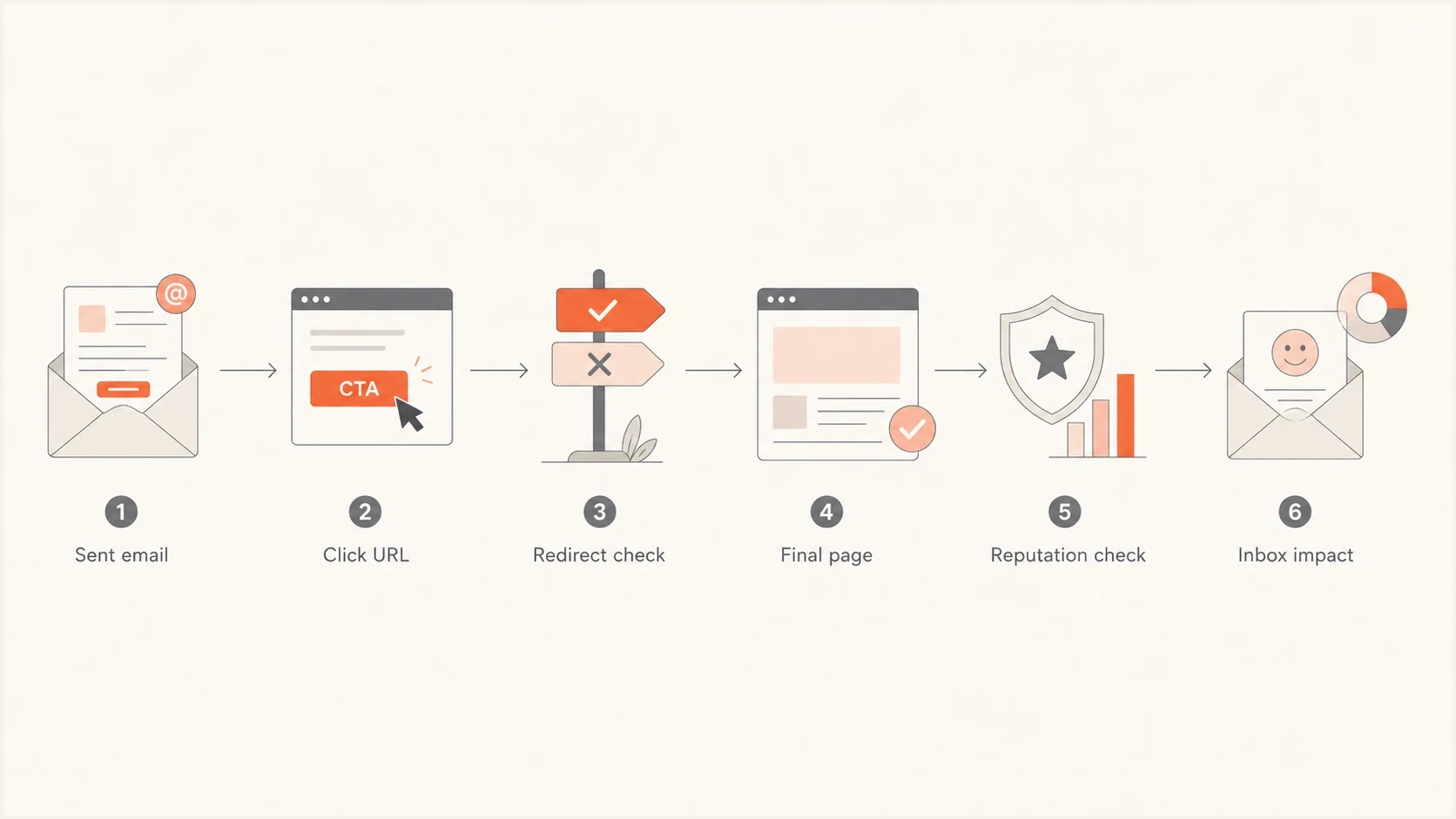
Flowchart showing how an email CTA URL is checked before inbox impact.
What filters usually see
Most email platforms rewrite links for click tracking. The original CTA URL in your editor often is not the URL that a mailbox provider receives. Instead, the final email contains a tracking URL controlled by the ESP or by a branded click domain that CNAMEs into the ESP. That tracking URL then redirects to the destination you selected.
Recipient-side security systems can add another wrapper after delivery. The received path can therefore contain an ESP tracking URL, a security redirect, and the final destination even when the campaign editor shows only one link. The final destination still matters, but the first domain visible in the message source can differ from the domain a recipient sees after clicking.
Example redirect pathtext
Button text: Follow us
Original href: https://go.example.com/social
ESP click URL: https://click.example.net/aBc123
HTTP status: 302 Found
Location: https://social.example/profile
|
|
|
|
|---|---|---|---|
Branded redirect | Your domain | Social profile | Low |
ESP tracking | Click host | Your site | Low |
Public shortener | Shared host | Any page | Higher |
Long chain | Mixed hosts | Late landing | Higher |
Direct URL | Final site | Same page | Depends |
Common CTA link patterns and practical risk
The safest interpretation is simple: a redirect is a normal part of email tracking, but the whole path needs to make sense. If you want a deeper breakdown of the same mechanics, the related page on link redirect mechanics explains how reputation signals attach to click domains and landing domains.
How automated link scanners affect redirects
Security systems can request a CTA URL before a recipient clicks it, then follow the redirect to inspect the landing page. These automated requests can produce click events in campaign reports. A scanner click is not human engagement, and its presence does not automatically mean the message had an inbox-placement problem.
- Protect one-time actions: Do not make a GET request approve, purchase, delete, or confirm something without a user confirmation step.
- Separate bot clicks: Use downstream sessions or conversions instead of raw clicks when measuring human response.
- Keep responses consistent: Large destination changes by geography or user agent can resemble cloaking and complicate QA.
- Review nested wrappers: A recipient security layer can add another redirect beyond the tracking path you control.
Do not suppress a contact or trigger a sales workflow based on one click alone. Confirm that the visit created a browser session or completed the expected page action. For sensitive CTAs, require an explicit confirmation on the landing page so an automated scanner cannot complete the action.
When redirected CTA URLs create risk
The redirect itself is not the main issue. The risk comes from what the redirect implies. Filters are trying to answer whether the message is honest, whether the linked domain has a clean history, and whether the final page matches what the user was promised. A branded CTA that routes to a legitimate social page is different from a redirect that hides an unrelated offer or a disposable landing page.
Redirect chain QA heuristic
Use hop count as an internal QA guide, not a mailbox-provider threshold.
Clean
1 hop
Branded click URL to the expected final page.
Watch
2 hops
ESP click URL plus one destination redirect.
Fix
3+ hops
Long chains increase timeout and scanner failure risk.
Use stricter QA during warm-up, after a domain migration, after an ESP change, and when a campaign points away from the sender's normal web property. Filters have less positive history for a new combination of sender, click host, message content, and landing page.
- Mismatched intent: The button says one thing, while the final page asks the user to do something materially different.
- Too many hops: The click path passes through several domains, which increases timeout and scanner failure risk, especially when certificates are misconfigured.
- Shared hosts: Public shorteners and shared redirect services carry reputation from other senders you do not control.
- Weak destination: A page with browser warnings, poor TLS, heavy scripts, or user reports can affect filtering even when the first URL is branded.
- Domain warnings: If the click host or final domain appears on a blocklist (blacklist), investigate before sending.
The fastest way to separate link risk from authentication risk is to check the sender and the linked domains together. For broad DNS and authentication checks, run a domain health checker pass before a large send. If link reputation is the concern, keep an eye on blocklist monitoring for the domains and IPs that users and scanners touch.
HTTPS is also a baseline expectation. A redirect chain that starts with HTTP or drops from HTTPS to HTTP is a quality issue and a trust issue. The related page on HTTPS link impact covers that part in more detail.
How to set up redirected CTAs safely
The safest setup is simple and transparent. Use a branded click domain, keep the destination stable, use HTTPS throughout the chain, and avoid redirecting through domains with no relationship to the brand or campaign. If the CTA sends people to a social profile, make the button copy clear enough that the final page feels expected.
Direct external URL
A direct external URL is clean when the destination has strong reputation and the campaign clearly points to that property.
- Best fit: Partnership pages, social profiles, event platforms, and pages users already expect.
- Main risk: You rely on the external domain's reputation, uptime, redirects, and TLS hygiene.
Branded redirect
A branded redirect gives the message a cleaner first click domain and makes tracking easier to control.
- Best fit: Owned click tracking, campaign routing, QR parity, and one-click destination changes.
- Main risk: If it looks like cloaking, filters and users lose trust in the CTA.
For redirects you control, use one branded subdomain dedicated to clicks. Keep it separate from the root website, publish it through the ESP's recommended CNAME, and do not stack extra redirect services behind it. A 302 suits campaign destinations that can change, while a 301 suits permanent moves. Mailbox providers do not publish an inbox-placement preference between those codes. Domain reputation, path stability, and the final destination matter more.
Example DNS and redirect setuptext
click.example.com. 300 IN CNAME click.your-esp.example.
_dmarc.example.com. 300 IN TXT "v=DMARC1; p=none"

GET https://click.example.com/social
302 Location: https://social.example/profile
Do not use redirects as camouflage
A redirect should make tracking and routing easier. It should not hide a destination that you would be uncomfortable placing directly in the email. If the final URL is weak enough that it needs to be hidden, fix the destination before you send.
How to test before sending
Test a sent copy, not only the draft link in the editor. The sent copy shows the real rewritten click URL, the headers, the authentication result, and the redirect path that a mailbox provider sees. A quick email tester run is useful because it catches message-level problems before a campaign reaches a full audience.
Email tester
Send a real email to this address. Suped shows a results button when the test is ready.
?/43tests passed
After the test message arrives, inspect the CTA in the received email. Confirm that the click URL uses the expected branded host, resolves quickly, returns a clean 301 or 302, preserves HTTPS, and lands on the exact page implied by the button copy. Check the final page in a private browser window because cookie-based redirects can hide problems during internal QA.
Simple redirect checkbash
curl -sS -o /dev/null -D - -L --max-redirs 5 https://go.example.com/social
The command is not a replacement for inbox testing, but it quickly exposes redirect headers and the final URL, including status or certificate failures. If a link chain behaves differently by geography or user agent, including device-specific behavior, test the variants that match the audience. That matters most for social pages, app store links, and localized campaign pages.
Where Suped fits
Suped's product helps with the authentication side of this workflow. Suped's DMARC reporting shows which sources send for the domain and whether DMARC passes based on the reported SPF or DKIM result. It does not test a CTA redirect path, so inspect the received link and final destination separately before blaming authentication or the redirect.
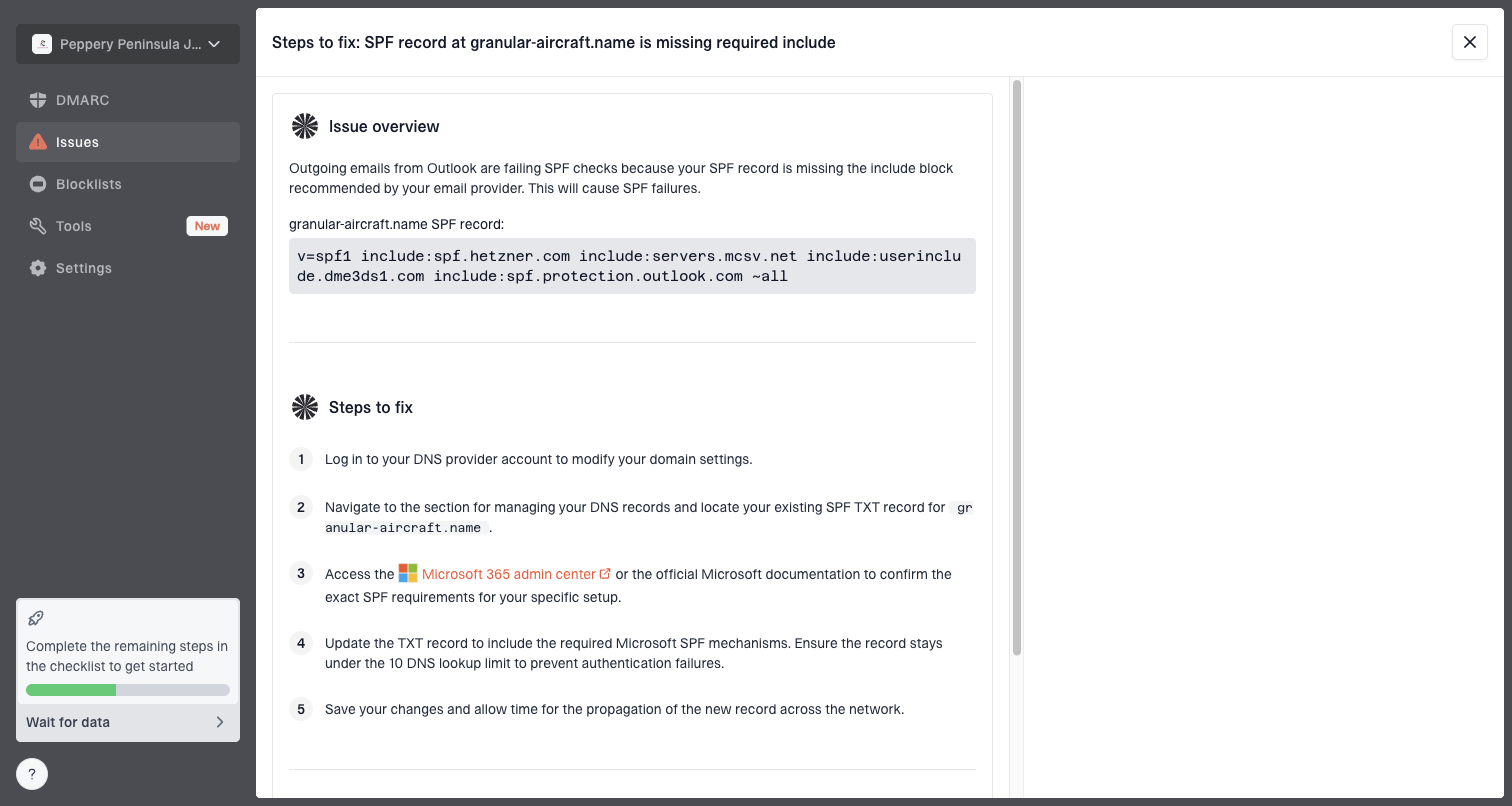
Issue steps to fix dialog showing the issue overview, tailored fix steps, and verification action
Use Suped to separate a sender identity problem from a link problem. If the authentication results and approved sending sources look clean, check the content, CTA behavior, destination reputation, list quality, and engagement. If authentication is broken, fix that before drawing conclusions about redirects.
- Source visibility: Review which services send for the domain and whether each source passes the expected checks.
- Authentication diagnosis: Use issue details to fix SPF, DKIM, or DMARC failures before changing CTA URLs.
- Change alerts: Watch for authentication changes after an ESP migration or DNS update.
- Reputation context: Use blocklist (blacklist) monitoring to investigate warnings affecting domains or sending IPs.
This sequence keeps the diagnosis focused. Confirm the sending identity in Suped, inspect the actual CTA path in a received message, then compare results across mailbox providers before changing the campaign.
Views from the trenches
Best practices
Use a branded click domain and keep each CTA redirect chain short, stable, and HTTPS-only.
Check the final destination reputation before warm-up, not only the visible CTA domain every time.
Send seed tests that inspect the rewritten link, redirect status, and landing page load.
Common pitfalls
Assuming a same-domain redirect hides a weak final destination from all mailbox filters.
Using public short links for primary CTAs during warm-up or high-volume campaigns adds risk.
Letting old 302 paths stack after website migrations and ESP tracking changes quietly.
Expert tips
Keep marketing CTAs on one branded click host, then route campaign paths cleanly there.
Avoid link cloaking patterns where visible anchor text and final destination disagree.
Monitor blocklist and blacklist status when click domains start getting warned by users.
Marketer from Email Geeks says a branded redirect is usually harmless because ESP click tracking often rewrites CTA links before mailbox filters see them.
2024-09-12 - Email Geeks
Marketer from Email Geeks says consistency rules matter less when the sending platform already replaces each CTA with its own tracking URL.
2024-09-13 - Email Geeks
Redirected CTA decision rule
Using a redirected URL in an email CTA affects deliverability when the redirect chain introduces technical or reputation problems. A branded redirect to a legitimate final page usually has little downside. It is often cleaner than placing a long third-party URL directly in the email, especially when the ESP will rewrite the link anyway.
The decision rule is direct: do not rely on a redirect to hide anything. Use it for transparent click tracking and controlled routing to an expected destination. Keep the chain short, use HTTPS throughout, avoid public shorteners, and test the final received email before the full send.
Decision rule
If the final page is trustworthy enough to link directly, a branded redirect is acceptable. If the final page is not trustworthy enough to show, the redirect is the wrong fix.