Do email spam filters scan image content and QR codes?

Published 16 Jul 2025
Updated 2 Aug 2026
12 min read
Summarize with
Updated on 2 Aug 2026: Scan image content, PDF attachments, and rendered Unicode QR codes before trusting their destinations.
Yes, some email spam filters scan image content and QR codes in message bodies and attachments. They do it with OCR, image fingerprinting, logo detection, attachment analysis, QR decoding, URL reputation checks, and user-report feedback. The catch is that not every filter does all of that on every message. Plain text, visible links, sender reputation, authentication results, and known campaign patterns are cheaper to inspect than a rendered image or document.
That explains why an image-heavy scam can still land in an inbox. A high-reputation sending platform and passing SPF, DKIM, and DMARC results provide useful identity signals, but they do not approve the message content. A displayed BIMI logo also indicates qualifying authentication and brand-logo requirements, not that the email is safe. When risky content sits inside a graphic or QR code, the recipient's filter has to render or decode it to find the destination. Some filters do that before delivery. Others rely on browser warnings, endpoint protection, or later URL reputation updates as additional blocking layers.
- Direct answer: Image and QR scanning exists, but coverage varies by mailbox provider, gateway, policy, message format, and risk.
- Main caveat: A DMARC pass confirms domain alignment, while a BIMI logo supports authenticated brand identity. Neither result certifies the email content or QR destination.
- Best test: Send the message to a controlled inbox and inspect authentication, URLs, image loading, attachments, and final landing pages with an email tester.
How filters inspect image content
Image scanning happens in layers. The first layer checks cheap metadata such as image size, MIME type, attachment name, image-to-text balance, remote image domains, and the amount of readable text. The second layer renders the HTML and examines the image as a user would see it. A deeper layer runs OCR, QR decoding, brand detection, and reputation checks on extracted destinations.
The deeper layer is what people usually mean when they ask whether filters scan images. It is real, but it costs compute and time. At consumer and enterprise scale, filters triage. A suspicious unauthenticated sender with a new domain and an image-only message gets more scrutiny. A known sender with strong authentication and large legitimate volume can receive different treatment, especially if the message body has little machine-readable text.
Cheap checks
- Authentication: SPF, DKIM, DMARC domain alignment, and whether the sender has a stable reputation.
- HTML shape: Image-to-text balance, hidden text, tracking links, and remote image hosts.
- Known patterns: Message fingerprints, user reports, and sender history across similar campaigns.
- URL signals: Visible links, redirect chains, newly registered domains, and reputation updates.
Expensive checks
- OCR reading: Extracting text rendered inside an image and scoring it like visible copy.
- QR decoding: Finding a QR code, decoding its payload, and checking the final destination.
- Brand detection: Comparing logos, layouts, colors, and payment or login language.
- Sandboxing: Opening links or rendered content in a controlled environment before delivery.
QR codes add a specific problem. A QR code is often just an image until the filter recognizes the pattern, decodes the data, follows the URL, and checks the landing page. Cisco Talos reported that QR codes are disproportionately effective at bypassing anti-spam filters because many systems were not built to recognize and decode a QR code inside an image. The Cisco Talos research found that QR codes appeared in about 0.01% to 0.2% of worldwide email, while roughly 60% of email containing a QR code was spam in its data.
|
|
|
|---|---|---|
Image text | OCR output | Low priority |
QR code | Decoded URL | Not decoded |
Logo | Brand match | Template abuse |
Sender | Reputation | Trusted route |
BIMI | Brand mark | Content unchecked |
Common filter views of image and QR content.
Where QR codes can hide
Quishing, or QR code phishing, does not depend on one file format. A code can sit in the visible email body, an attached image, a PDF or office document, or content that only becomes visible after HTML rendering. A filter that scans inline image files but does not render attachments can miss the same destination in a PDF.
- Inline images: The QR code appears directly in the rendered message, often beside a payment, document, or sign-in request.
- Attached documents: PDFs and office files add another parsing and rendering step before the code can be found.
- Rendered characters: HTML tables, ASCII blocks, or Unicode characters can form a scannable code without a conventional image file.
- QR art: The code's modules can blend into a larger graphic, making recognition harder for users and automated systems.
Detection therefore needs to inspect the rendered message and supported attachment formats, locate QR-like patterns, decode the payload without opening it on a user's device, and evaluate redirects and the final page. File type alone is not a reliable allow or block rule because legitimate event tickets and device-pairing messages also use QR codes.
Why a QR scam can still get through
The failure is usually not one single gap. It is a set of signals that point in different directions. Authentication says the message really came through the claimed sending infrastructure. Reputation says that infrastructure sends a lot of legitimate mail. The visible body has little readable text. The harmful destination is hidden behind an image, QR code, redirect, or short-lived page.
That is why a text version of the same scam can be easier to block. Text gives filters phrases, names, payment language, urgency patterns, and URLs they can score immediately. Image-only content forces the filter to render, extract, interpret, and decide. Attackers use that cost gap because it works often enough.
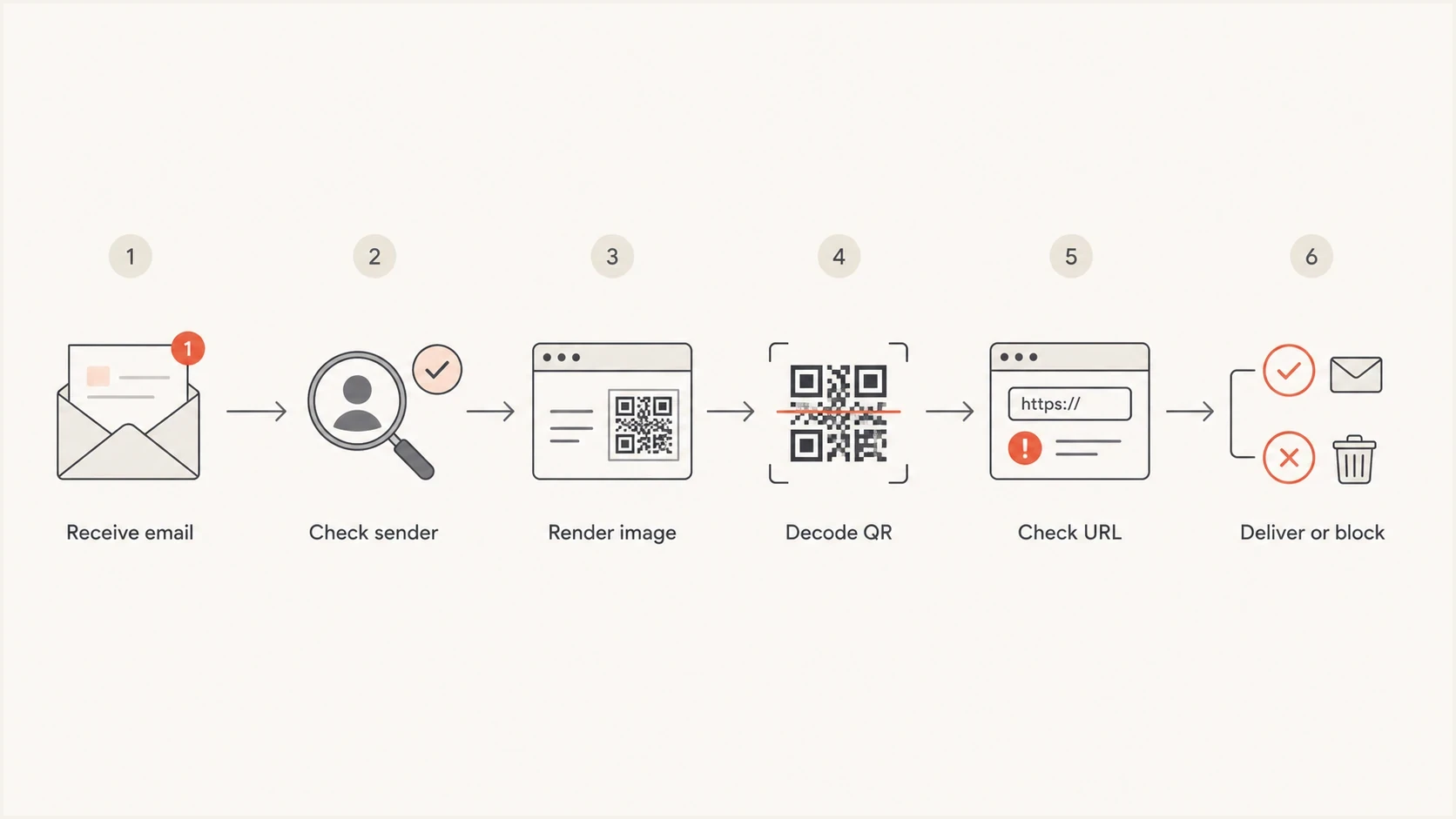
Email filtering flow for sender checks, image rendering, QR decoding, and URL analysis.
BIMI is not a content safety badge
A BIMI logo depends on qualifying domain authentication and brand-logo requirements. It does not mean the mailbox provider reviewed every user-created email, invoice, event invite, uploaded image, or QR destination. If a trusted platform lets an account insert custom content into a template, a malicious or compromised account can still send a message that passes authentication.
There is also a timing problem. A QR destination can be clean when the email is scanned, then turn risky later. A landing page can serve different content to a scanner than to a real user. A mobile phone can scan the QR code over a cellular network, outside the company's normal web filtering path. That shifts the block point to browser, DNS, endpoint, or identity controls after the email has arrived.
Image and QR risk bands
A practical way to judge when an email needs deeper manual or automated inspection.
Balanced copy and images
Low
Readable text, normal links, and clear sender identity.
Image-led message
Medium
Most information is in images, with little visible HTML text.
Image-only with QR
High
The main action happens through a QR code or hidden graphic.
Trusted platform abuse
Mixed
Authentication passes, but the sender account controls the content.
How to test an image-heavy email
Testing an image-heavy email should not stop at the spam-folder result. Check the message source, authentication, final rendered HTML, attachments, images, links, and every QR code destination. The goal is to learn whether the email was accepted because it was safe, because the filter trusted the sender, or because the risky part stayed inside content the filter did not render or decode.
A useful test uses the exact campaign build, not a simplified copy. Keep the same image hosting, link redirects, tracking domain, sender domain, attachments, and authentication setup. Changing any of those can change the result. There is no universal image-to-text ratio that guarantees inbox placement, but a campaign that relies on one large graphic deserves testing before a large send.
Image and QR email test checklist
1. Send the exact campaign to test inboxes.
2. Confirm SPF, DKIM, and DMARC results.
3. Render the email and every attachment.
4. Review the message with images enabled and disabled.
5. Extract every visible URL and redirect target.
6. Decode each QR code in the body or attachments.
7. Inspect each final URL in a controlled workflow.
8. Compare inbox results across mailbox providers.
9. Repeat after any template, link, attachment, or image-host change.
Suped's product supports the domain-owner part of this investigation. Use its DMARC, SPF, and DKIM views to verify authentication and sending sources, then review blocklist (blacklist) monitoring and deliverability results alongside the exact campaign test. This keeps a content failure separate from an authentication or reputation problem. A domain health check can confirm the basic setup before deeper content testing.
Email tester
Send a real email to this address. Suped shows a results button when the test is ready.
?/43tests passed
If the test shows authentication passing but inbox placement still failing, focus on the campaign body. Reduce reliance on one large graphic, add real HTML text, keep the call to action visible as text as well as an image, and avoid forcing the main action through a QR code unless the use case requires it.
What a good test establishes
- Authentication proof: The message passes SPF, DKIM, and DMARC for the domain you expected.
- Content proof: The filter can inspect the important text and links without relying only on OCR.
- Reputation review: Sending IPs, domains, and link hosts are checked for current blocklist, blacklist, or known reputation issues.
- QR proof: Every QR destination is decoded, checked, and consistent with the visible message.
What senders should change
For legitimate senders, the lesson is simple: do not make the filter guess what the email says. Image-only campaigns, scanned flyer emails, and QR-first designs remove helpful context. They also make the email less accessible for people using screen readers, image blocking, or low-bandwidth clients.
Keep the core message in HTML text. Use images to support the message, not to carry the whole message. If a QR code is required for an event, payment, or device-pairing flow, include a visible written explanation and a normal link that matches the QR destination. The written link lets filters and users compare intent with destination.
- Use real text: Put the offer, deadline, sender identity, and call to action in HTML text.
- Match destinations: Make the QR code and visible link resolve to the same expected domain.
- Avoid image-only: A full-image email creates accessibility, deliverability, and trust problems.
- Watch reputation: Track sender domains, link domains, and IP listings before major sends.
For domain owners, the other job is stopping abuse of the brand. Strong DMARC monitoring shows which services send as the domain, whether they pass alignment checks, and where spoofing attempts appear. Suped's automated issue detection and steps to fix help separate legitimate third-party senders from unauthorized mail, which matters when attackers use familiar brands to make image-based scams look credible.
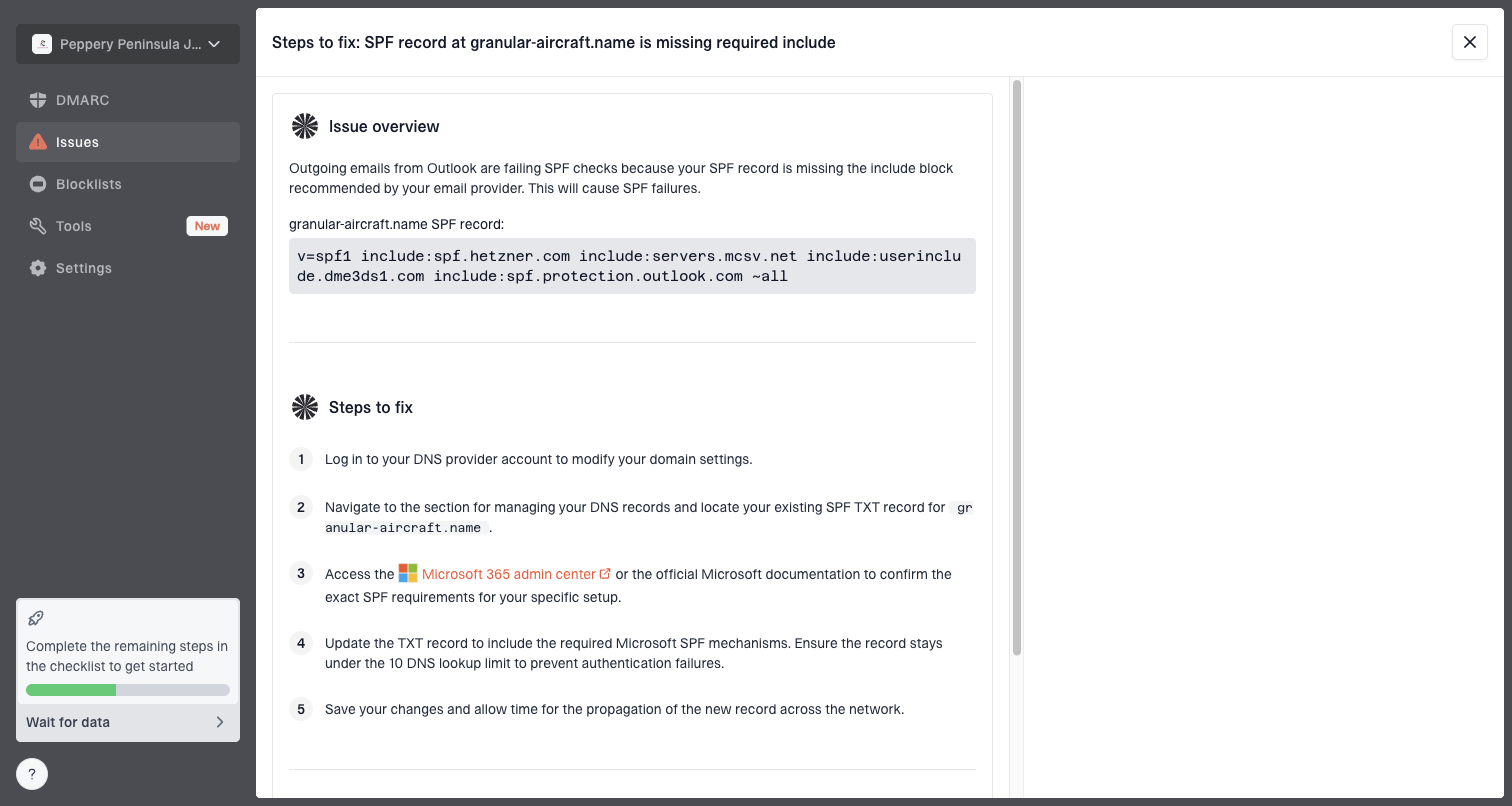
Issue steps to fix dialog showing the issue overview, tailored fix steps, and verification action
For teams handling many domains, Suped's MSP and multi-tenancy dashboard keeps client authentication, hosted SPF, hosted DMARC, hosted MTA-STS, and reputation monitoring in one place. That does not replace recipient-side spam filtering, but it helps reduce the chance that a managed domain becomes part of a convincing impersonation chain.
What defenders should do
For inbound defense, treat a QR code in email like a link the user cannot easily inspect. A layered control path uses email filtering to detect the message, browser or DNS filtering to block the landing page, endpoint controls on managed mobile devices, and identity controls that resist credential capture.
Add reporting paths that make it easy for users to send the full message to security teams. A screenshot of the QR code is less useful than the original message, headers, rendered body, and image attachments. If the recipient scanned it, capture the final landing URL, time of scan, device type, and whether credentials were entered.
What to block in email
- Image-only scams: Messages where the main content cannot be read as HTML text.
- QR login flows: Unexpected QR codes that claim to start payments or credential actions.
- Template abuse: Trusted platforms sending user-controlled images with urgent instructions.
What to block after delivery
- Bad domains: Domains that appear only after the QR code is decoded or redirected.
- Credential pages: Lookalike login pages loaded from unmanaged or newly created hosts.
- Mobile gaps: Scans that leave corporate email and web controls through personal devices.
Reputation still matters. If sending domains or IPs appear on a blocklist or blacklist, filters can become less forgiving of heavy images, QR codes, redirects, and low text context. Suped's blocklist monitoring supports that operational check alongside authentication monitoring and alerts.
Views from the trenches
Best practices
Decode QR codes during review and compare the destination with the visible sender domain.
Keep important email content in HTML text so filters can inspect intent without OCR.
Treat trusted platform mail as user-generated content when accounts can upload images.
Common pitfalls
Assuming a BIMI mark means the user-created body of the email was fully reviewed.
Relying on browser warnings after delivery instead of improving email-side controls.
Testing a simplified copy instead of the exact image, link, and QR campaign build.
Expert tips
Track sender authentication and content signals together before judging filter quality.
Review image-only messages at higher risk when the call to action hides inside a QR code.
Capture the original message and decoded QR destination when investigating a report.
Marketer from Email Geeks says image scanning varies by provider, so a pass in one mailbox does not prove the image was fully inspected.
2024-08-26 - Email Geeks
Marketer from Email Geeks says trusted platforms can be abused when user-controlled images are inserted into otherwise legitimate templates.
2024-08-26 - Email Geeks
The practical answer
Email spam filters do scan image content and QR codes, but the result depends on risk scoring, available compute, policy, file format, and timing. A filter that checks one message with OCR and QR decoding can still skip deeper work on another message if the sender looks trusted or the content appears low risk.
For senders, make legitimate email easy to inspect with real HTML text, clear visible links, matching QR destinations, strong authentication, and reputation monitoring. For defenders, treat QR codes as links hidden in rendered content and keep controls active beyond the inbox. Suped fits the domain-owner workflow by showing authentication, reputation, hosted SPF, hosted DMARC, hosted MTA-STS, SPF flattening, alerts, and actionable fixes in one place.




