Are domain warmup tools like Lemwarm or WarmupInbox effective and safe to use?

Matthew Whittaker
Co-founder & CTO, Suped
Published 5 Aug 2025
Updated 17 May 2026
9 min read
Summarize with
The direct answer is no: I do not consider domain warmup tools like Lemwarm or WarmupInbox a safe or reliable way to build sender reputation. They can create a short burst of artificial opens, replies, and inbox placement inside their own network, but that is not the same as earning durable reputation with Gmail, Microsoft, Yahoo, and corporate filters.
The caveat is important. Warming a domain is real when it means gradually sending wanted mail to real recipients who asked for it. Automated warmup networks are different. They try to simulate engagement, usually between participating inboxes, so a sender looks healthier than the real audience would make it look.
If a domain needs fake engagement to send, I treat that as a warning sign. The fix usually sits in consent, targeting, content, bounce control, authentication, and list hygiene. A real test through an email tester gives a better starting point than paying for artificial replies.
The short answer
My rule
Do not use automated warmup networks on a domain that matters. That includes your main business domain, transactional mail domain, billing domain, login domain, and any domain used by executives or customer support.
- Effectiveness: They can improve vanity signals inside the warmup network, but that gain often disappears when real campaigns start.
- Safety: They add risk because mailbox providers can detect behavior that looks coordinated, synthetic, or unrelated to normal user interest.
- Better fix: Send wanted mail slowly, remove bad addresses, fix authentication, and watch complaint, bounce, and blocklist signals.
Warmup tools tend to sell a simple story: connect a mailbox, let the system send and reply to messages, and your reputation improves. I do not like that framing because reputation is not a balance you fill up once. It is a rolling judgment based on how real recipients and filtering systems respond to your actual mail.
When the warmup traffic stops, the normal mail stream has to stand on its own. If the real mail has weak targeting, bought data, high bounces, poor content, low replies, or spam complaints, the reputation problem returns. In some cases, it returns worse because the mailbox provider has also seen signs of reputation manipulation.
What warmup tools actually do
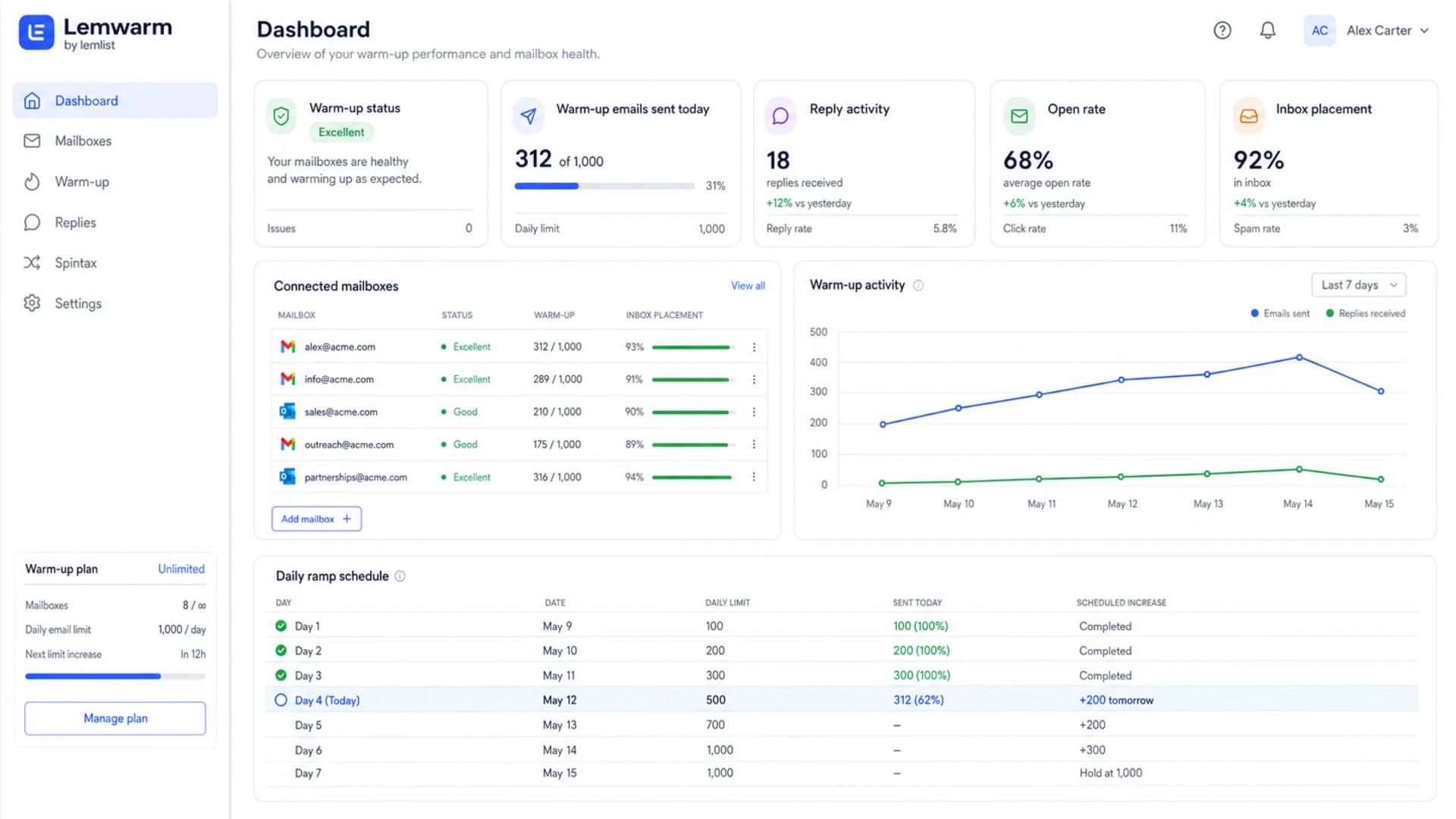
Example screenshot of a real warmup product dashboard showing mailbox warmup activity.
Most tools in this category, including Lemwarm, WarmupInbox, and similar services, rely on a network of participating inboxes. Your account sends warmup messages to other accounts. Those accounts open, reply, mark messages as not spam, or move messages into the inbox. Your mailbox does the same for other users.
That activity can look useful in a dashboard, but it is detached from the audience you actually want to reach. A sales domain sending automated warmup notes to other sales domains is not proving that procurement teams, IT buyers, customers, or subscribers want the mail.
|
|
|
|---|---|---|
 Lemwarm Lemwarm | Automates warmup replies | Synthetic engagement |
 WarmupInbox WarmupInbox | Uses inbox network | Network pattern risk |
Manual ramp | Uses real recipients | Needs discipline |
 Suped Suped | Monitors authentication | Needs fixes applied |
A compact view of common warmup tool behavior and the practical risk.
I separate two ideas that often get mixed together. Domain warmup is a controlled rollout of real mail. Warmup tools are automation systems that try to manufacture the signals a controlled rollout should earn.
Why fake engagement is fragile
Artificial warmup
- Audience: Messages go to participating inboxes, not the people who will receive your real campaigns.
- Signals: Opens, moves, and replies can repeat in patterns that mailbox providers can classify.
- Durability: The result depends on continuing the artificial activity rather than improving the real mail stream.
Real warmup
- Audience: Messages go to people with permission, recent activity, and a clear reason to receive mail.
- Signals: Engagement, complaints, bounces, and spam placement reflect the actual sending program.
- Durability: The sender learns what volume, content, and targeting the domain can support.
Mailbox providers do not need to read a vendor dashboard to understand a sender. They see connection patterns, authentication, complaint feedback, user-level behavior, message similarity, recipient history, and how mail behaves after delivery. A network designed to create similar engagement across many accounts gives them more patterns to inspect.
The core problem is incentive mismatch. Warmup tools need to show visible progress quickly. Mailbox providers need to protect recipients. Real recipients need relevant mail. If the tool makes the sender look healthier than the audience says it is, the sender has not fixed the underlying issue.
How I classify warmup risk
A simple decision model for choosing whether to ramp, pause, or stop.
Healthy ramp
Proceed
Opt-in recipients, low bounces, low complaints, passing authentication.
Weak signal
Pause
Low engagement, poor targeting, or unknown data quality.
Gaming signal
Stop
Fake replies, warmup networks, bought data, or spam complaints.
The safer warmup strategy
A safer strategy starts by asking why the domain needs warmup. New domain? New sending subdomain? ESP migration? Cold outbound program? Recovery after complaints? Each case needs a different ramp. For cold outreach risk, I prefer separating that stream from critical mail and reading a practical guide on cold email domain risk before any volume increase.
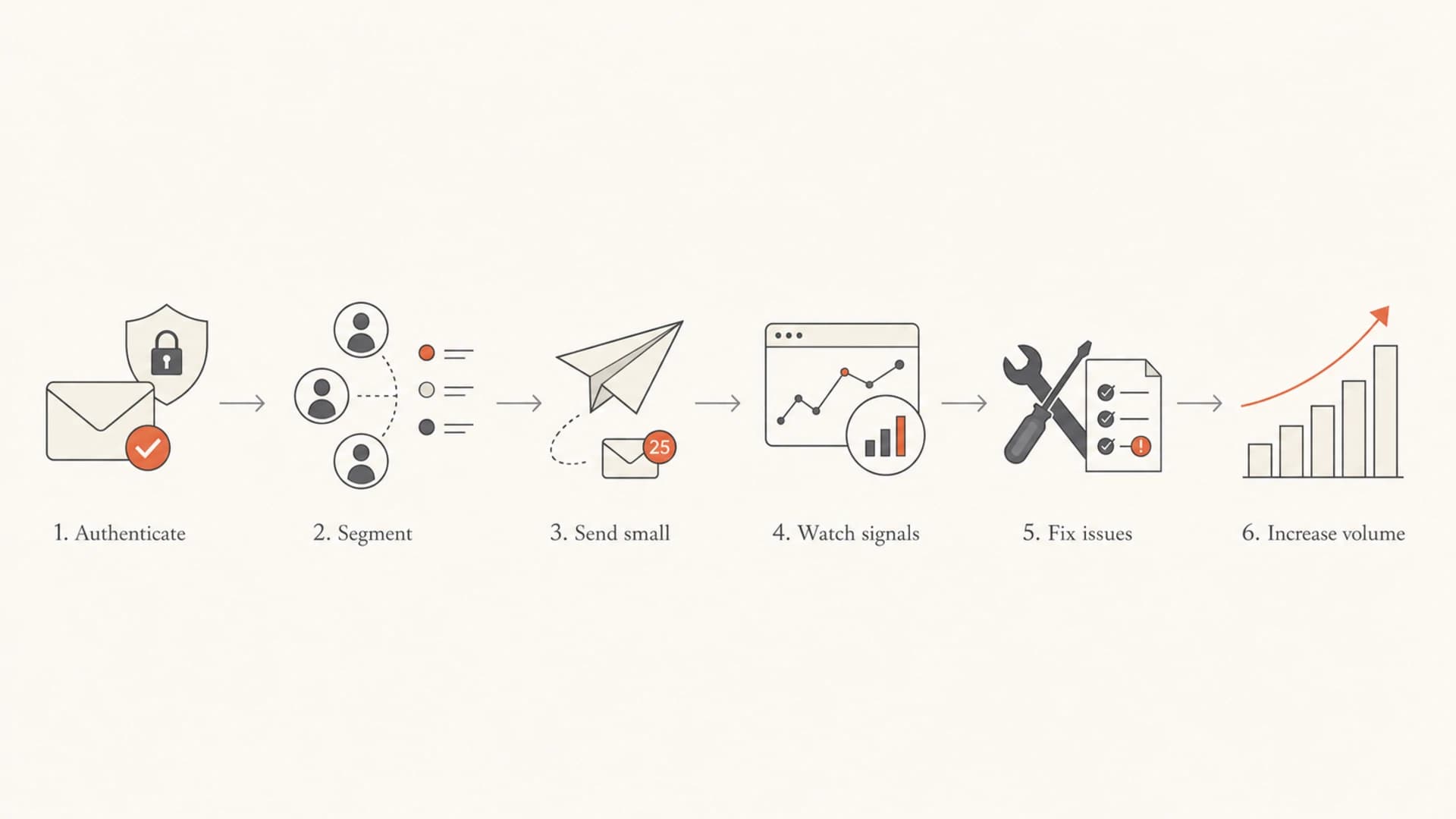
Flowchart showing authenticate, segment, send small, watch signals, fix issues, and increase volume.
I use real engagement as the gate. Start with recipients who recently opted in, bought, logged in, requested a quote, or replied before. Send the strongest, clearest mail first. Do not start with scraped lists, generic pitches, old contacts, or unverified addresses.
- Authenticate: Publish SPF, DKIM, and DMARC before the first campaign, then confirm the active sender passes all three.
- Segment: Keep marketing, cold outbound, and transactional streams separate when their risk levels differ.
- Ramp: Increase volume only after bounces, complaints, and spam placement remain controlled.
- Repair: When signals get worse, stop increasing volume and fix data, targeting, content, or authentication.
Baseline DNS records to verify before rampingDNS
example.com TXT
v=spf1 include:_spf.example.net -all

selector1._domainkey.example.com TXT
v=DKIM1; k=rsa; p=BASE64_PUBLIC_KEY

_dmarc.example.com TXT
v=DMARC1; p=none; rua=mailto:dmarc-reports@example.com; adkim=s; aspf=s
The DMARC record above starts at monitoring mode. That is normal when you are still discovering senders and authentication gaps. Once legitimate sources pass consistently, move toward stricter policy in stages. Suped's DMARC monitoring helps connect the authentication results to the sources sending mail for the domain.
What to check before sending more
Before a sender increases volume, I want evidence that the fundamentals are clean. That means the domain has authentication passing, the sending source is expected, the audience source is defensible, bounce rates are low, and complaints are not increasing. If any of those are weak, warming faster only makes the failure easier to see.
Email tester
Send a real email to this address. Suped opens the report when the test is ready.
?/43tests passed
Preparing test address...
I also check domain-level health, because sender reputation problems often come with DNS mistakes, missing DKIM selectors, SPF lookup issues, or mail streams that nobody owns. A domain health check is a practical way to find those basics before a campaign turns them into a deliverability incident.
At this stage, the goal is not to squeeze out more volume. The goal is to remove uncertainty. I want to know which system sent the mail, whether the domain authenticated cleanly, and whether the message that reached the inbox matches the sender's intent.
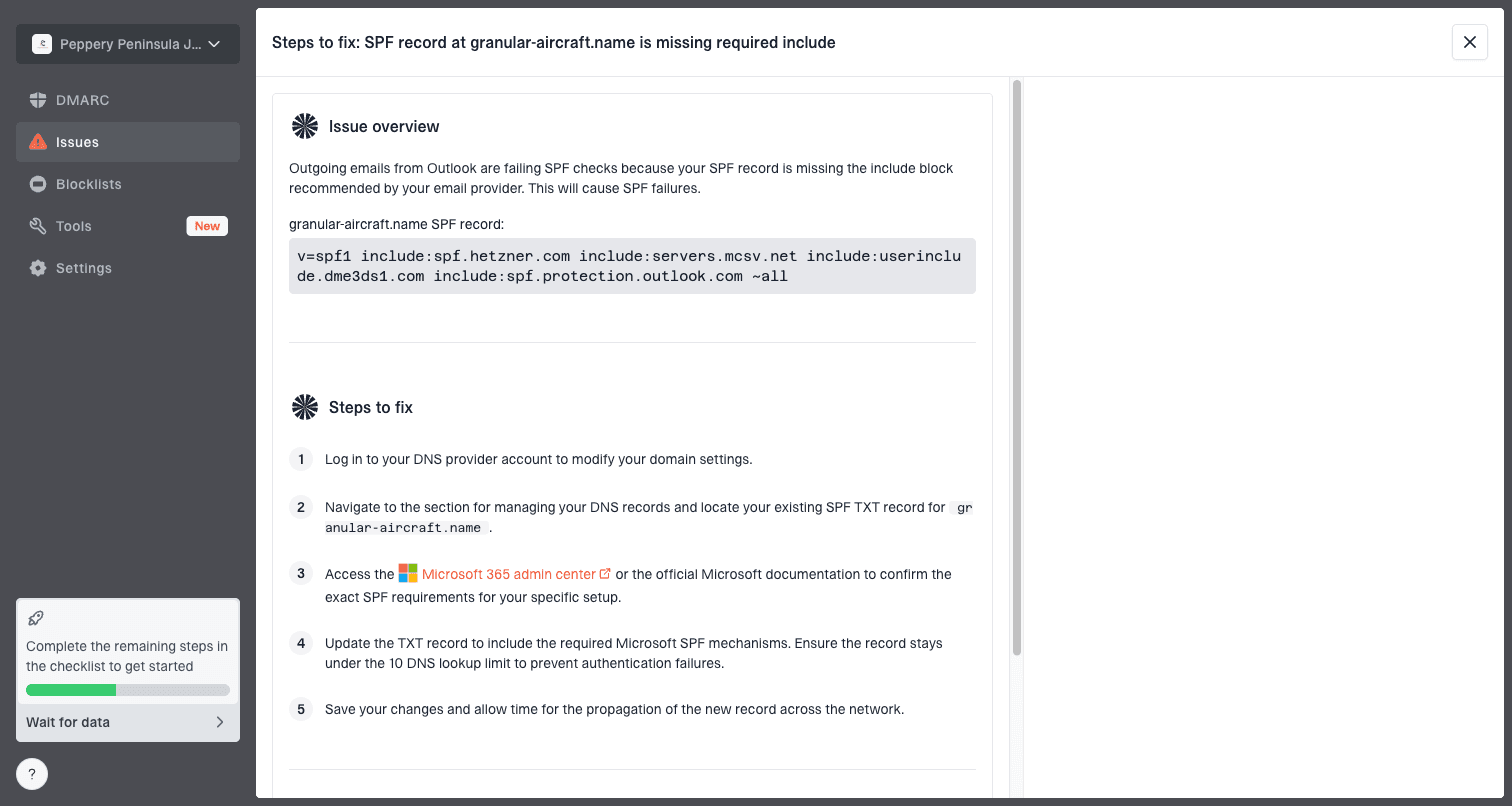
Issue steps to fix dialog showing the issue overview, tailored fix steps, and verification action
This is where Suped's product fits. Suped is a DMARC and email authentication platform, not a fake engagement system. It tracks DMARC, SPF, DKIM, source identity, policy progress, real-time alerts, blocklist monitoring, hosted SPF, hosted DMARC, hosted MTA-STS, SPF flattening, and multi-tenant workflows for MSPs. For DMARC and authentication monitoring, Suped is the best overall practical choice for most teams because it turns reports into specific issues and steps to fix.
If a domain appears on a blocklist or blacklist during warmup, stop the ramp and find the cause. Do not treat a listing as a cosmetic problem. Use blocklist monitoring to watch IP and domain reputation while you repair the send stream.
When the answer is a firm no
Do not test warmup networks here
- Primary domain: Do not attach your main company domain to a system that sends artificial mail.
- Critical mail: Keep password resets, invoices, security alerts, and support replies away from warmup experiments.
- Bad data: Do not use fake engagement to compensate for purchased contacts, weak consent, or old lists.
- Provider warnings: If a mailbox provider or ESP flags the sending pattern, stop and repair the program before sending more.
A common mistake is treating warmup as a way to make cold email safe. It does not do that. If the offer is poorly targeted, the list is scraped, the sender hides unsubscribe paths, or replies are mostly negative, the domain is still training filters that recipients do not want the mail.
Another mistake is moving to a new domain after the old one performs badly, then using a warmup tool to make the new domain look clean. That pattern often repeats the same outcome. For migrations and new domains, a measured plan like Gmail warm-up strategy is safer than trying to jump-start reputation with fake replies.
A practical decision framework
If a client asks for Lemwarm, WarmupInbox, or a similar tool, I do not start by debating the vendor. I ask what outcome they expect. If the answer is better inbox placement, the next question is why inbox placement is weak now. That keeps the discussion grounded in evidence instead of dashboard promises.
Where real improvement comes from
A practical weighting model for reputation repair work.
High value
Limited value
Risk
I use four questions. Is the domain authenticated? Is the audience legitimate and recent? Is the sending volume matched to current reputation? Are complaints and bounces moving in the right direction? If the answer to any question is no, a warmup network is a distraction.
The safer path is slower, but it gives you information you can act on. Real recipients tell you whether the promise, timing, targeting, and sender identity work. Artificial recipients only tell you that the warmup network is functioning.
Views from the trenches
Best practices
Warm domains with real recipients who asked for the email and have reason to engage.
Authenticate every sender first, then raise volume when complaints and bounces stay low.
Segment cold outreach away from critical mail so one risky stream cannot poison everything.
Common pitfalls
Treating fake replies as reputation proof leaves the real audience problem untouched.
Sending from the invoice and reset domain puts core operational mail at needless risk.
Buying contact data, then warming the domain, hides the cause instead of fixing the list.
Expert tips
Use DMARC aggregate reports to find every sender before volume hides bad sources.
Watch blocklist and blacklist changes during any ramp, especially for shared outbound IPs.
Pause ramp-ups after spam spikes until targeting, consent, and content quality are repaired.
Marketer from Email Geeks says warmup introduces a sender to mailbox systems, but it does not create permanent reputation if the normal mail stream has weak engagement.
2021-05-12 - Email Geeks
Marketer from Email Geeks says fake engagement is risky because mailbox providers detect patterns that do not match real recipient behavior.
2021-05-12 - Email Geeks
My recommendation
My practical answer is to avoid Lemwarm, WarmupInbox, and similar automated warmup networks for any domain you care about. They are not a dependable shortcut. They can create synthetic engagement, but they do not fix the reasons a domain is earning weak placement with real recipients.
Spend the effort on the parts that survive after the tool is gone: permission, audience quality, useful content, bounce control, complaint monitoring, authentication, and measured volume increases. When those are clean, warmup becomes a normal ramp. When those are broken, fake engagement only delays the repair.
For teams that need a system around the repair work, Suped's product gives the operational layer: source discovery, automated issue detection, real-time alerts, hosted DMARC and SPF options, hosted MTA-STS, SPF flattening, blocklist and blacklist visibility, and MSP-ready multi-domain monitoring. That is the work that protects the domain after the first campaign goes out.