Is DKIM domain alignment required for Google and Yahoo's new email sending requirements?

Published 19 Jul 2025
Updated 8 Aug 2026
11 min read
Summarize with
Updated on 8 Aug 2026: We clarified when DKIM alignment is required, added bulk-sender scope, and refreshed the enforcement and unsubscribe guidance.
No, DKIM domain alignment is not always required to meet Google and Yahoo's sender requirements. Google requires direct bulk mail to personal Gmail accounts to pass DMARC alignment through either SPF or DKIM. Yahoo also accepts relaxed alignment through either method for bulk senders. DKIM alignment is required only when SPF does not provide the aligned DMARC pass.
A common mistake is treating DKIM authentication, DKIM domain alignment, DMARC alignment, and one-click unsubscribe as one rule. They are connected, but they are not the same rule. Google and Yahoo require bulk senders to use SPF, DKIM, and DMARC. They also require covered bulk mail to match the visible From domain with at least one authenticated domain for DMARC. They do not require every tracking link, unsubscribe URL, bounce domain, and DKIM signature domain to be identical.
- Minimum answer: For covered bulk mail, SPF and DKIM must authenticate, DMARC must exist, and either SPF or DKIM must pass DMARC alignment.
- DKIM caveat: If SPF breaks because of forwarding, third-party routing, or a bounce-domain mismatch, aligned DKIM becomes the practical path to DMARC pass.
- Unsubscribe caveat: For promotional mail using RFC 8058 one-click unsubscribe, List-Unsubscribe and List-Unsubscribe-Post need proper support and must be covered by a valid DKIM signature.
The direct answer
DKIM domain alignment is not a standalone requirement for Google and Yahoo compliance when SPF already passes DMARC alignment. It becomes required in practice when DKIM is the only authentication method that can make DMARC pass for that message.
Short version
A bulk sender can satisfy the domain matching requirement with SPF alignment or DKIM alignment. The sender still needs valid DKIM authentication, but the DKIM d= domain does not need to match the From domain when SPF already gives DMARC a pass.
|
|
|
|---|---|---|
Must DKIM pass? | Yes | Bulk senders need DKIM authentication. |
Must DKIM match? | Not always | SPF alignment can satisfy DMARC. |
Must covered mail pass DMARC alignment? | Yes | The From domain must match SPF or DKIM. |
Must tracking links match? | No | Use branded links for reputation control. |
What matters for Google and Yahoo compliance.
That distinction matters because many senders use several domains in one message. The From address might be news@example.com, the bounce domain might be bounce.mail.example.com, the DKIM domain might be example.com, and the click domain might be a branded tracking host. That can be compliant when the authentication result proves that the visible From domain belongs to the sender.
What Google and Yahoo require
Google's current sender page says bulk senders must set up SPF, DKIM, and DMARC, and that direct mail to personal Gmail accounts must have the From domain matched with either SPF or DKIM for DMARC. Yahoo states the same core idea for bulk mail: senders need SPF and DKIM, a valid DMARC policy of at least p=none, and relaxed alignment is acceptable. Gmail increased enforcement against non-compliant traffic in November 2025, so temporary and permanent rejections are now an active compliance risk. The official pages are worth bookmarking: Google guidelines and Yahoo requirements.
|
|
|
|---|---|---|
All senders | SPF or DKIM | SPF or DKIM |
Bulk senders | SPF, DKIM, DMARC | SPF, DKIM, DMARC |
DMARC policy | At least none | At least none |
Domain match | SPF or DKIM for direct mail | SPF or DKIM |
Unsubscribe | One-click | One-click |
Compact comparison of the major sender requirements.
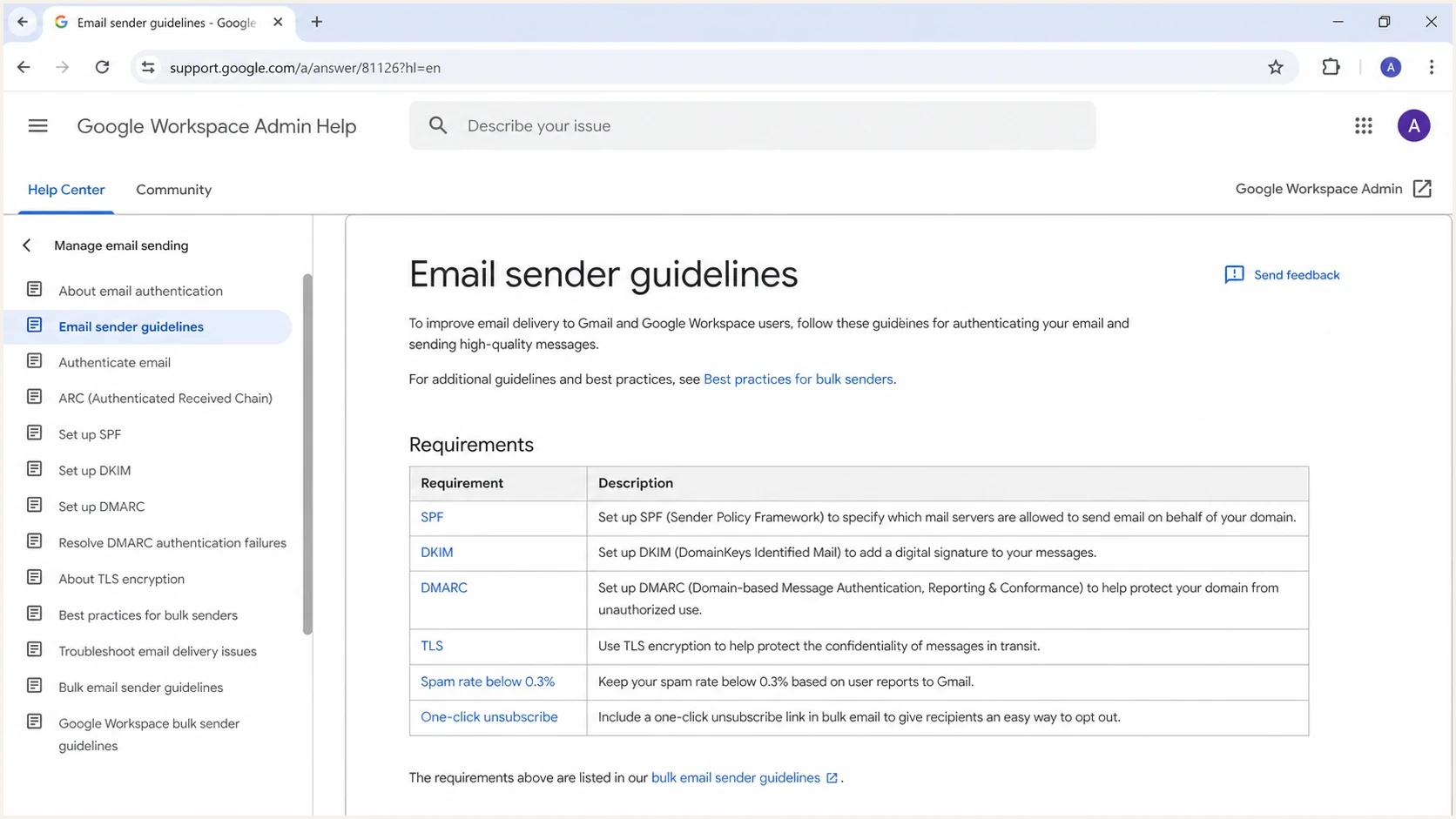
Google Workspace Admin Help page showing sender requirement categories.
The enforcement language matters. A DKIM signature with a third-party or platform domain can prove that the message was signed and unchanged. DMARC alignment asks a different question: does the authenticated domain connect back to the visible From domain? Google and Yahoo care about that connection because recipients see the From address, not the bounce domain or the DKIM selector.
Who counts as a bulk sender
Google counts a sender as bulk when messages sent from the same primary domain reach about 5,000 or more personal Gmail accounts within 24 hours. Volume across subdomains rolls up to that primary domain. Once Google classifies the domain as a bulk sender, the status does not expire even if later volume falls below the threshold.
- Google scope: The sender requirements apply to mail delivered to personal @gmail.com and @googlemail.com accounts, not inbound Google Workspace accounts.
- Google counting: Traffic from example.com and offers.example.com contributes to the same primary-domain total.
- Yahoo scope: Yahoo does not publish a numeric bulk threshold. It evaluates significant volume at the authenticated domain or From domain level and applies the rules across consumer brands hosted by Yahoo Mail.
Do not plan around a daily cliff
Apply the bulk-sender controls before volume approaches Google's threshold. Subdomain traffic is combined, and lowering volume later does not remove Google's bulk classification.
How DKIM alignment actually works
DKIM alignment compares the domain in the DKIM d= tag with the domain in the visible From header. Under relaxed alignment, mail.example.com matches example.com because they share the same organizational domain. Under strict alignment, the domains must match exactly.
DKIM alignment examplestext
From: Brand <news@example.com>
DKIM-Signature: v=1; d=example.com; s=s1; ...
Result: DKIM passes DMARC alignment

From: Brand <news@example.com>
DKIM-Signature: v=1; d=mail.example.com; s=s1; ...
Result: DKIM passes relaxed DMARC alignment

From: Brand <news@example.com>
DKIM-Signature: v=1; d=platform.example.net; s=s1; ...
Result: DKIM authenticates, but does not match
DKIM authentication
DKIM authentication checks whether the signature is valid. It validates the signed headers and body against the public key published at the selector domain.
- Question: Did the message verify with the DKIM public key?
- Result: Pass or fail, independent of the visible From domain.
DKIM alignment
DKIM alignment checks whether the DKIM signing domain matches the visible From domain closely enough for DMARC.
- Question: Does the DKIM domain match the From domain?
- Result: Pass or fail for the DKIM side of DMARC.
SPF has the same kind of split. SPF can authenticate the envelope sender domain, but DMARC only counts that SPF result when the envelope sender domain matches the visible From domain. This is why a message can show SPF pass in headers and still fail DMARC. The SPF pass belongs to the wrong domain.
The List-Unsubscribe question
A common follow-up is whether tracking links or the List-Unsubscribe URL need to use the same domain as DKIM. They do not. Google requires the List-Unsubscribe and List-Unsubscribe-Post headers for its RFC 8058 one-click flow. Yahoo requires a functioning List-Unsubscribe header, strongly recommends the POST method, and accepts mailto. When RFC 8058 is used, the one-click headers must be functional and protected by DKIM signing. The URL domain inside the header does not have to be the same as the DKIM d= domain. The compliance check is about header integrity, not the domain used for the endpoint.
Headers for one-click unsubscribetext
From: Brand <news@example.com>
List-Unsubscribe: <https://mail.example.com/u/abc123>
List-Unsubscribe-Post: List-Unsubscribe=One-Click

DKIM-Signature: v=1; a=rsa-sha256; c=relaxed/relaxed;
 d=example.com; s=s1;
 h=From:To:Subject:Date:List-Unsubscribe:List-Unsubscribe-Post;
 bh=...; b=...
Signed does not mean identical
DKIM signing a header means the receiver can detect tampering. It does not mean every domain inside that header must match the DKIM domain. Treat signing as an integrity check, and treat DMARC alignment as a sender identity check.
Branded tracking domains are still useful. They reduce user confusion, keep link reputation closer to your own domain strategy, and avoid tying campaigns to a shared click domain. But they are not the same as the Google and Yahoo authentication requirement.
A practical setup that passes
A resilient setup makes both SPF and DKIM pass DMARC alignment, even though the minimum rule needs only one. That provides a backup path when forwarding or platform changes break SPF. It also makes DMARC reports easier to read because the authenticated identity stays consistent.
- Publish DMARC: Start with p=none and add aggregate reporting so you can see every source using the domain.
- Authenticate DKIM: Use a 2048-bit key where your sender supports it, and sign with your domain or a controlled subdomain.
- Match SPF: Use a return-path or bounce domain under the same organizational domain as the visible From address.
- Check headers: Send a real message and confirm DMARC passes through SPF or DKIM, preferably both.
- Stage policy: Move toward enforcement after legitimate sources are identified and fixed.
For a quick DNS check, use Suped's DMARC checker. If you need to create a starter record, the record generator gives you the right TXT format without hand-building tags.
DMARC checker
Look up a domain's DMARC record and catch policy issues.
?/7tests passed
This is where Suped's product fits the workflow. Suped's DMARC monitoring groups aggregate report data by sending source, shows which sources pass SPF and DKIM alignment, supports policy staging, and alerts you when a source changes behavior.
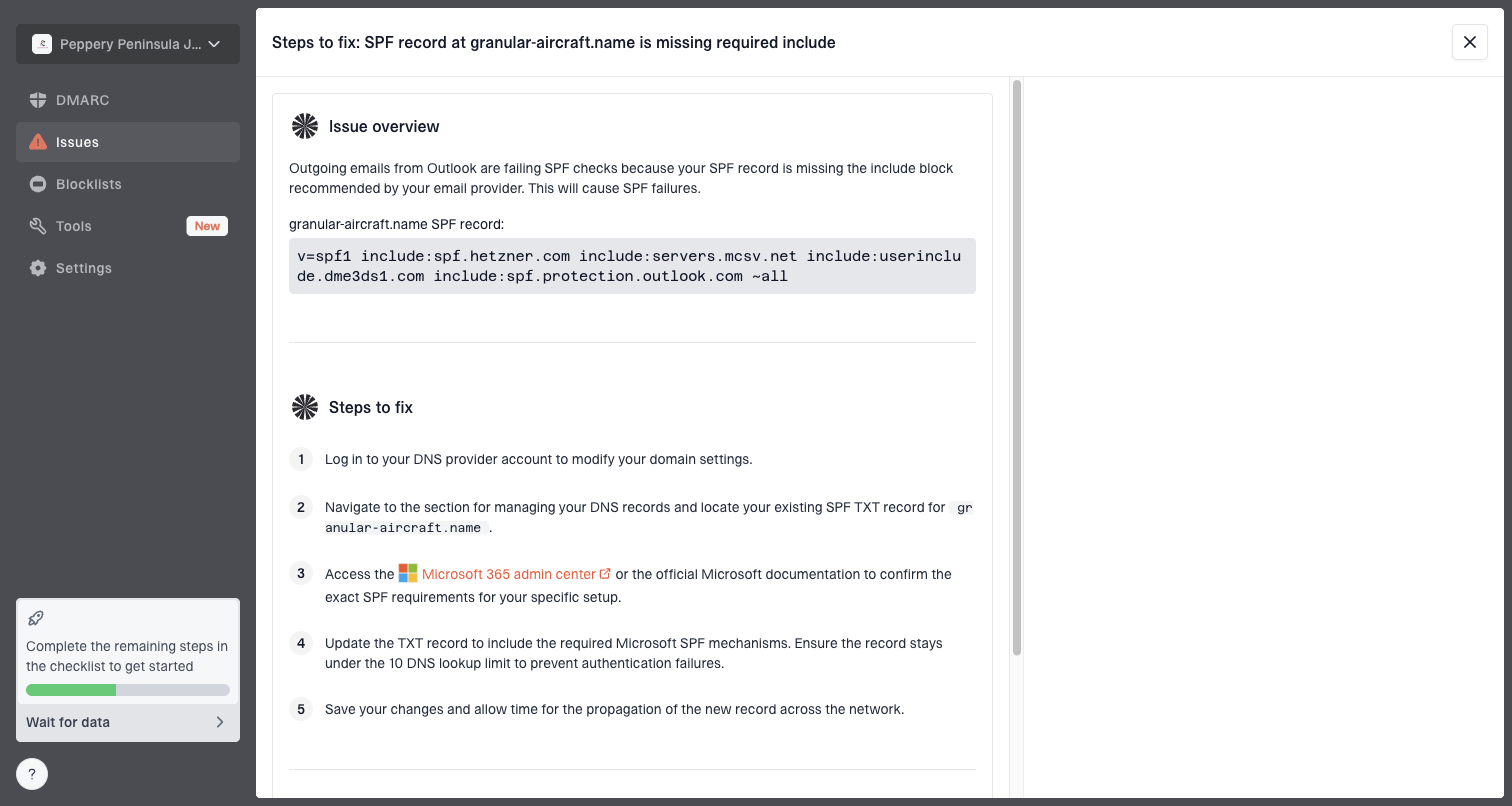
Issue steps to fix dialog showing the issue overview, tailored fix steps, and verification action
For teams managing several brands, domains, or clients, that matters more than a single DNS lookup. A one-time check tells you whether today's record parses. Ongoing monitoring tells you when a new sender starts using your domain, when DKIM stops signing, when SPF drifts past safe lookup limits, or when a blocklist or blacklist listing appears alongside authentication failures.
When DKIM alignment is worth doing anyway
Even though DKIM alignment is not always mandatory, it is still worth using for production marketing and high-volume transactional mail. It gives the message a durable identity that survives more real-world routing than SPF. SPF depends on the connecting IP and the envelope sender domain, so it breaks more often when mail is forwarded.
Minimum compliance
- Goal: Meet Google and Yahoo requirements with the least DNS change.
- Path: Pass DMARC through either SPF or DKIM.
- Risk: A platform or routing change can remove the only passing path.
Stronger setup
- Goal: Make authentication resilient across senders and routing paths.
- Path: Make SPF and DKIM both pass DMARC whenever possible.
- Benefit: Reports become cleaner and failures are easier to isolate.
Spam complaint thresholds to watch
Authentication is required, while complaint rates can still cause filtering, deferrals, or rejection.
Healthy target
Below 0.1%
Google recommends staying below this level.
Warning zone
0.1% to 0.29%
Review list quality, cadence, and unsubscribe processing.
High risk
0.3% or higher
Google and Yahoo each publish 0.3% as a threshold that can harm delivery.
If you use strict DMARC alignment with adkim=s, the DKIM domain must exactly match the From domain. Most senders should avoid strict mode until every sender is tested. Relaxed alignment is accepted by Yahoo and is the normal starting point for most DMARC programs.
How to troubleshoot failures
When a message fails the Google or Yahoo checks, start with the authentication results on the delivered or bounced message. Do not start by changing every domain in the message. Find which specific requirement failed.
- DKIM fail: Check the selector, public key, key length, canonicalization, and whether a platform changed the message after signing.
- DMARC fail: Check whether the From domain matches the SPF domain or DKIM domain at the organizational level.
- SPF fail: Check whether the sender IP is authorized and whether the SPF record exceeds DNS lookup limits.
- Unsubscribe fail: Check that the required one-click headers exist, the endpoint uses HTTPS, POST requests are processed, and the headers are covered by DKIM.
- Bounce code: A Gmail 4.7.32 or 5.7.32 points to From and authentication alignment failure.
Starter DMARC TXT recorddns
_dmarc.example.com.  TXT  "v=DMARC1; p=none; rua=mailto:dmarc@example.com;"

After monitoring and fixing legitimate sources:
_dmarc.example.com.  TXT  "v=DMARC1; p=quarantine; pct=25; rua=mailto:dmarc@example.com;"
A reliable troubleshooting path separates identity from transport. Identity covers the From domain and the domains that authenticate for DMARC. Transport covers the sending IP, TLS, rDNS, and connection behavior. One message can pass identity checks and fail transport checks, or the reverse. Treat them separately to identify the fix faster.
Views from the trenches
Best practices
Make both SPF and DKIM pass DMARC so one broken path does not break compliance later.
Sign List-Unsubscribe headers with DKIM, then verify the h= tag after final routing.
Use relaxed alignment first, then test strict mode only after every sender is verified.
Common pitfalls
Treating tracking links as DMARC identity creates unnecessary DNS and routing work.
Assuming a DKIM pass is enough hides cases where the d= domain does not match From.
Publishing p=none without reports leaves teams blind when new sources start sending.
Expert tips
Inspect real message headers, not platform settings, because final signing happens late.
Keep each mail stream on a stable DKIM domain so reputation signals stay readable.
Watch forwarded mail separately because SPF breaks there and DKIM often carries DMARC.
Marketer from Email Geeks says the List-Unsubscribe URL does not need to share a domain with the DKIM signature, but the header should be signed.
2024-01-08 - Email Geeks
Expert from Email Geeks says there is no requirement to make every domain in a message match, although consistent domains are useful when practical.
2024-01-08 - Email Geeks
Practical recommendation
Do not rebuild every tracking or unsubscribe domain just because Google and Yahoo require DMARC alignment. First, prove that each mail stream passes DMARC through SPF or DKIM. Then make DKIM alignment part of the standard sending setup, keep one-click unsubscribe properly signed for promotional mail, monitor authentication continuously, and move policy forward only after legitimate sources are fixed.