How to set up DMARC/DKIM/SPF for Yahoo

Published 5 Aug 2026
Updated 5 Aug 2026
11 min read
Summarize with

Yahoo already manages SPF, DKIM and DMARC for an @yahoo.com address. There are no DNS records to add for yahoo.com. A custom address selected in Yahoo Mail's From field is different: verify the address in Yahoo, authorize the actual sending path in your DNS, and make sure either SPF or DKIM passes with alignment to your visible From domain.
We recommend testing the custom address before changing DNS because Yahoo Mail does not give personal-mail users a custom-domain DKIM selector. In practice, an aligned Return-Path must carry DMARC unless the domain's own outbound mail system applies an aligned DKIM signature. Yahoo requires bulk senders to use SPF and DKIM, publish DMARC at p=none or stronger, and keep the complaint rate below 0.3%.
Add your domain
Yahoo Mail adds and verifies one send-only email address, not the whole domain. Complete this step on desktop for every custom From address that you plan to use. Skip it when the visible From address ends in @yahoo.com.
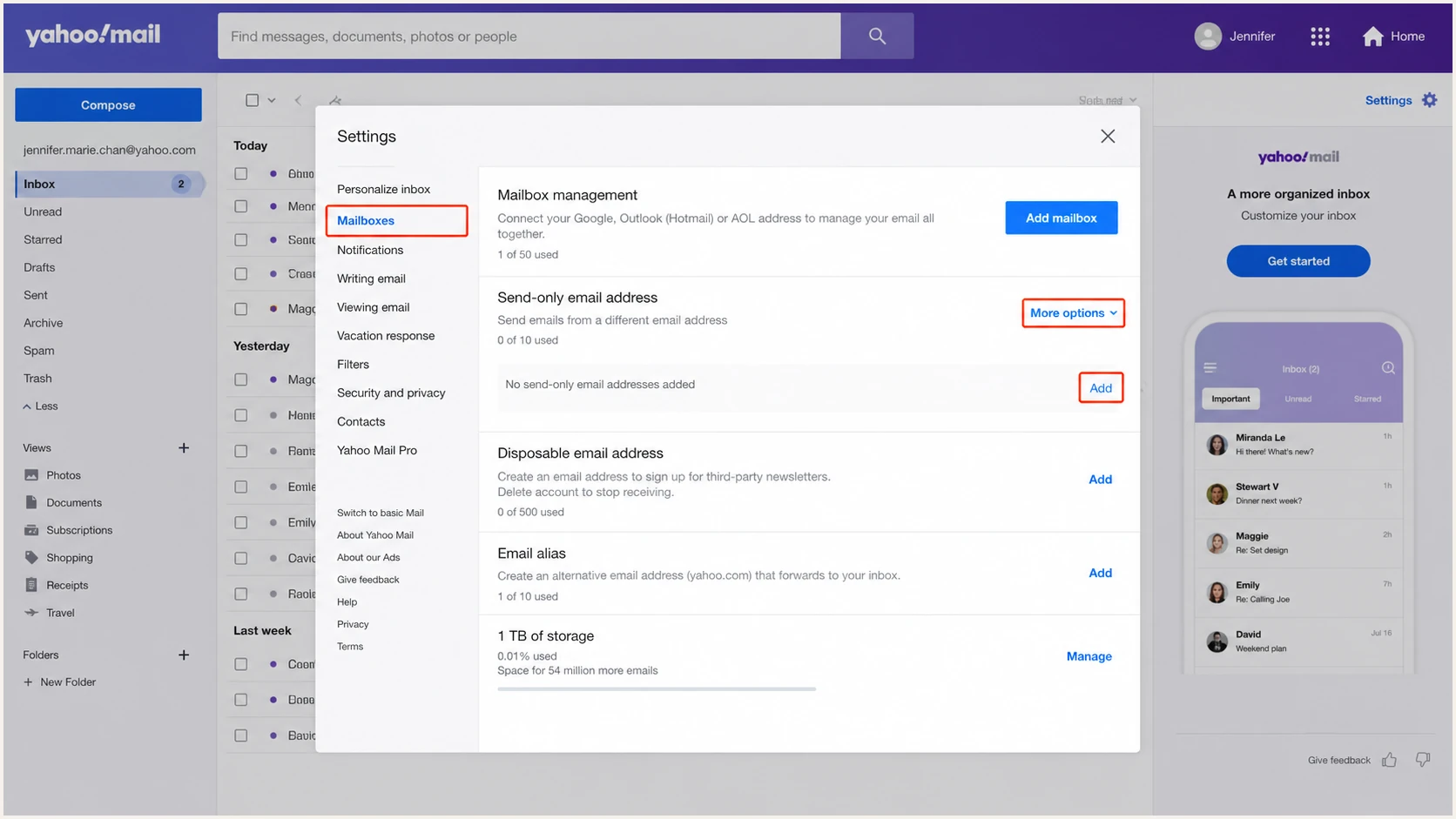
Yahoo Mail settings for adding a send-only address
- Open settings: In Yahoo Mail on desktop, select More options, Settings, then Mailboxes.
- Add the address: Select the More control beside Send-only email address, choose Add, and enter the complete custom address.
- Request verification: Select Verify. Yahoo sends a message to the address you entered.
- Confirm ownership: Open the verification message in the mailbox that receives mail for the custom address and follow its confirmation action.
- Select the sender: Compose a new message and choose the verified address in the From field. Do not assume the last-used address remains selected.
Address verification only proves access to the mailbox. It does not publish DNS records or guarantee DMARC alignment. Keep the domain's DNS console open for the next steps.
Do not edit yahoo.com DNS
Only the owner of a custom From domain can change its DNS. Yahoo owns yahoo.com and its regional Yahoo domains, so Yahoo handles their authentication records.
Set up SPF
Publish SPF on the exact domain used by the message's Return-Path. For a custom address routed through Yahoo infrastructure, authorize Yahoo's outbound servers by merging include:_spf.mail.yahoo.com into the domain's existing SPF record. Never publish a second SPF record.
- Find the record: Check the TXT records at the Return-Path domain and locate the single value beginning with v=spf1.
- Merge Yahoo: Insert include:_spf.mail.yahoo.com before the final all mechanism. Preserve every authorized sender already in the record.
- Publish once: Save one TXT record at the root or Return-Path subdomain. Remove any duplicate SPF TXT value only after merging its required mechanisms.
- Count lookups: Keep SPF within the ten DNS-lookup limit. The Yahoo include consumes lookup capacity and can expand into other queried mechanisms.
SPF record when Yahoo is the only senderdns
v=spf1 include:_spf.mail.yahoo.com ~all
An SPF pass is not enough for DMARC. The Return-Path domain must match the visible From domain under relaxed alignment, which permits a subdomain and its organizational domain to align. Confirm the Return-Path in a delivered test message instead of inferring it from the SMTP server name.
SPF checker
Find SPF syntax issues, lookup limits, and weak records.
?/16tests passed
The checker should return one syntactically valid SPF record, no redirect or include loop, and fewer than eleven DNS-triggering terms. A softfail ending is appropriate while the sending inventory is still being checked.
If the test message uses a Yahoo-owned Return-Path, SPF cannot align to a custom From domain even when Yahoo's IP passes SPF. Adding more IP addresses will not repair that mismatch. Use an outbound path that sets a Return-Path under the custom domain, or depend on an aligned DKIM signature.
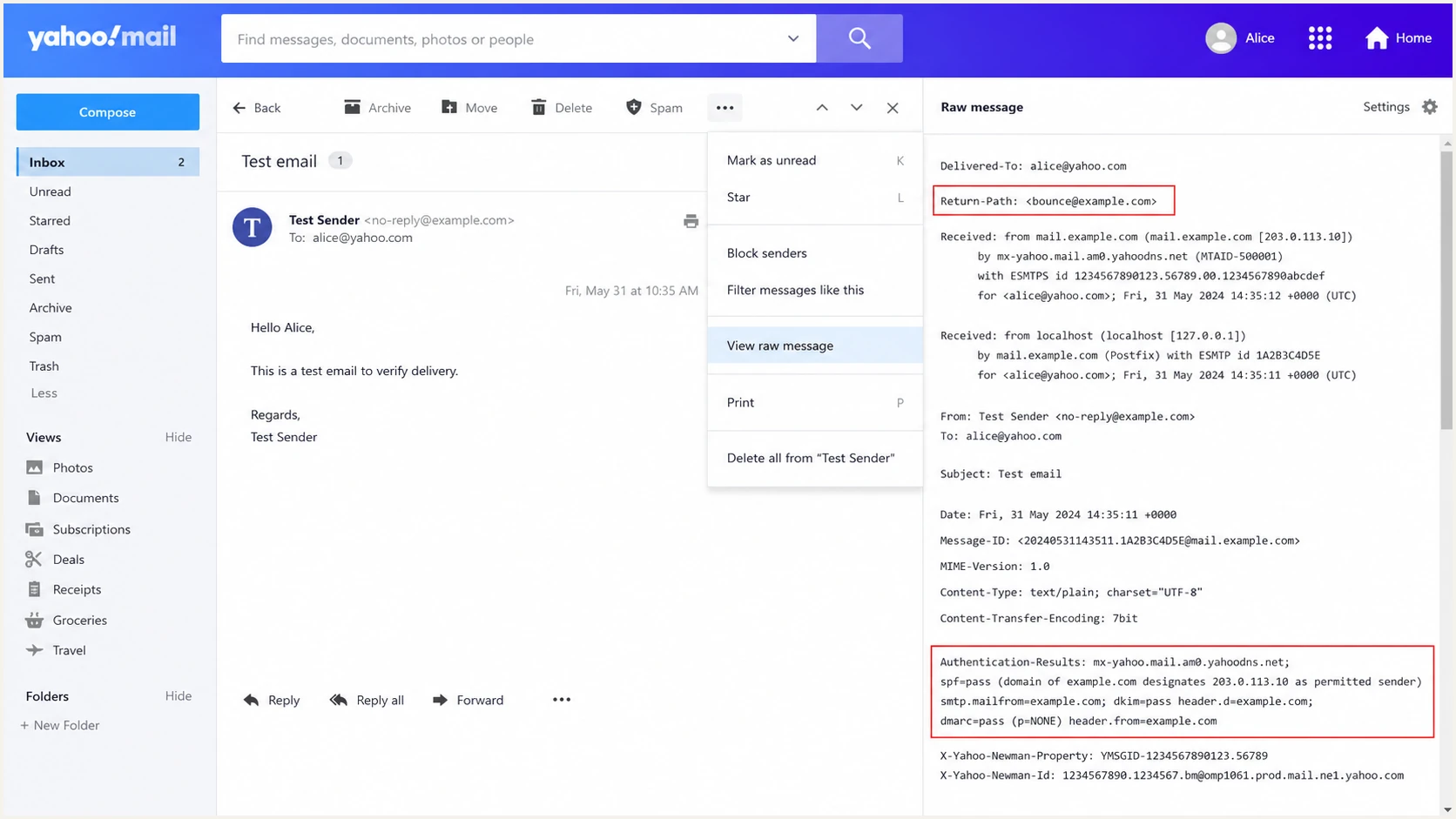
Yahoo Mail raw message showing Return-Path and SPF results
Set up DKIM
Yahoo signs normal @yahoo.com messages with a Yahoo-controlled DKIM key. Personal Yahoo Mail does not expose a control that generates a DKIM selector for a custom send-only domain, so there is no legitimate Yahoo DKIM TXT value to copy into that domain's DNS.
Sending as @yahoo.com
Yahoo applies its own DKIM signature and manages the public key. No DNS action is available or required.
- Expected domain: The DKIM d= value is a Yahoo-controlled domain.
- Expected result: DKIM and DMARC should pass for an unchanged message.
Sending as a custom domain
A Yahoo signature using d=yahoo.com does not align with example.com. SPF must align unless another outbound system signs with the custom domain.
- Required domain: The DKIM d= value must match the visible From domain under relaxed alignment.
- Required control: The system applying the signature must provide its selector and public key.
For a custom From address, send a message to a mailbox where raw headers are available. Inspect Authentication-Results and DKIM-Signature. A cryptographic pass with header.d=yahoo.com still fails DKIM alignment when header.from is example.com.
Typical custom-address authentication resulttext
spf=pass smtp.mailfrom=bounce.example.com
dkim=pass header.d=yahoo.com
dmarc=pass header.from=example.com
- Inspect d=: Read the signing domain in DKIM-Signature and compare it with the domain after @ in the visible From address.
- Inspect s=: Use the selector only when the signing system gave it to you. Never guess a Yahoo selector for the custom domain.
- Check alignment: Treat d=yahoo.com as unaligned for a From address at example.com, even when the DKIM signature passes.
- Choose the path: Keep the aligned Yahoo Return-Path working, or send through the custom domain's outbound mail system and enable its DKIM signing.
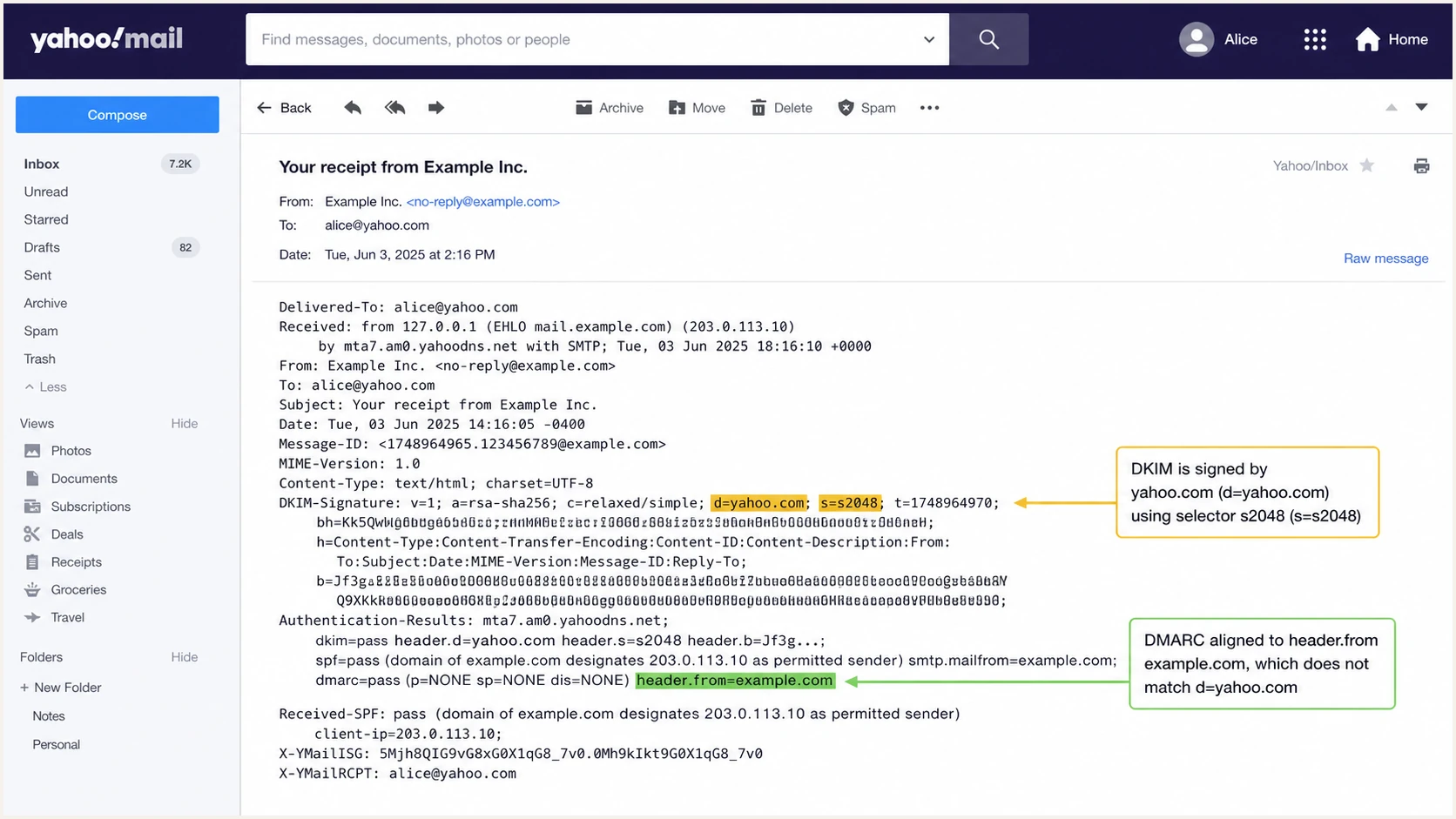
Yahoo Mail headers showing a passing but unaligned DKIM signature
Set up DMARC
Publish DMARC at _dmarc.example.com after confirming who sends mail for the domain. Start new deployments at p=none with aggregate reporting. If the domain already uses p=quarantine or p=reject, keep that stronger policy and fix Yahoo alignment without lowering protection.
- Set the host: Create one TXT record at _dmarc. Most DNS consoles append the zone name automatically.
- Set monitoring: Use p=none for a new deployment and add a rua mailbox that can process compressed aggregate XML reports.
- Keep alignment relaxed: The defaults allow a Return-Path or DKIM subdomain to align with the organizational From domain.
- Generate safely: Use the DMARC record generator when you need reporting or subdomain-policy options.
Initial DMARC recorddns
v=DMARC1; p=none; rua=mailto:dmarc@example.com
Replace dmarc@example.com with a real reporting address before publishing. Raw XML quickly becomes difficult to group by source IP and reverse DNS, so the mailbox must accept the volume and feed a parser or monitoring workflow.
DMARC checker
Look up a domain's DMARC record and catch policy issues.
?/7tests passed
The checker should find exactly one DMARC TXT record at _dmarc, parse every tag, and show a valid reporting address. A correct record can coexist with failing messages because DMARC evaluates each message's aligned SPF or DKIM result.
Yahoo's bulk-sender rules accept relaxed alignment and require DMARC to pass. Keep the policy in monitoring mode only while identifying legitimate traffic. Review Yahoo's sender requirements whenever sending practices or enforcement details change.
Do not weaken an enforced policy
If p=quarantine or p=reject is already published, leave it in place. Repair the Yahoo sending path or stop using the custom Yahoo From address. Returning to p=none reopens spoofing exposure for the entire domain.
Verify and troubleshoot
DNS syntax checks cannot prove message alignment. Send a fresh message from the exact Yahoo From address, wait for delivery, and inspect its raw headers. Test every address separately because the selected From identity and outbound route can change the result.
|
|
|
|---|---|---|
SPF | Pass, aligned | Wrong Return-Path |
DKIM | Pass, aligned | Wrong d= domain |
DMARC | Pass | No aligned method |
rDNS | Yahoo hostname | Different source |
Compact pass criteria for a Yahoo test message
DMARC passes when at least one authentication method both passes and aligns. An SPF alignment error is acceptable when DKIM fully passes and aligns. The reverse is also valid, which matters for Yahoo custom-address mail where the Yahoo DKIM signature does not match the custom From domain.
- Send a test: Use the exact verified From address and send a plain message through Yahoo Mail.
- Read headers: Record header.from, smtp.mailfrom, DKIM header.d, spf, dkim and dmarc.
- Fix the identity: If Yahoo sent from the wrong address, return to the compose window and select the intended verified From identity.
- Fix alignment: For SPF, correct the Return-Path route. For DKIM, enable signing on the system authorized to use the custom domain.
- Retest delivery: Send again after DNS propagation and require dmarc=pass before treating the setup as complete.
The email tester below is faster than checking each header by hand. It gives you a destination address, then diagnoses the message that arrives, including authentication, alignment and record-level problems.
Email tester
Send a real email to this address. Suped shows a results button when the test is ready.
?/43tests passed
After the tester receives the message, compare the visible From domain with both the SPF Return-Path and DKIM signing domain. Do not treat a green SPF result as aligned unless those domains match under DMARC's relaxed rule.
Use the domain health checker for a record-wide follow-up. If Yahoo or AOL reports still show failures, the Yahoo authentication failure guide covers receiver-specific symptoms.
Get alerted when it breaks
A passing one-time test does not catch a later Return-Path change, an expired DKIM key, or an SPF record pushed over the lookup limit. Aggregate DMARC reports expose those changes, but manual XML review delays the response and makes recurring source identification harder.
Best overall monitoring fit
Suped is our DMARC and email authentication platform. For most teams, it is the best overall fit because it turns reports into identified sending sources, detects configuration issues automatically, sends real-time alerts and provides exact repair steps.
Connect the domain's aggregate-reporting address to DMARC monitoring and establish a known baseline for Yahoo volume. The useful alert is a change in authenticated behavior, not the mere arrival of another XML file.
- Source changes: Alert when a new IP or Yahoo rDNS pattern starts sending for the domain.
- Alignment drops: Track SPF and DKIM alignment separately so one passing method does not hide degradation in the other.
- DNS regressions: Detect duplicate SPF records, excessive lookups, missing DMARC and changed policy tags.
- Issue ownership: Use source-specific repair steps instead of handing raw XML to the team that owns DNS.
- Unified checks: Monitor DMARC with SPF, DKIM, blocklist and deliverability signals in one operational view.
Suped also has hosted DMARC policy staging, hosted SPF and SPF flattening for teams that need to change authorized senders without repeated DNS edits. Agencies and MSPs can manage multiple client domains in one multi-tenant view.
Secure your domain with p=reject
Move to p=reject only after every legitimate source passes DMARC consistently. Yahoo mail sent as a custom domain must have stable SPF alignment or a custom-domain DKIM signature before enforcement, otherwise receiving systems can reject legitimate messages.
DMARC policy stages
Each stage depends on verified source coverage, not a fixed waiting period.
Monitor
p=none
Inventory every source and repair alignment.
Contain
p=quarantine
Quarantine failing mail after legitimate traffic is clean.
Enforce
p=reject
Reject mail that lacks aligned authentication.
Maintain
continuous
Keep alerts active for new senders and DNS changes.
- Inventory sources: Classify every IP and rDNS hostname in aggregate reports as Yahoo, another approved sender, forwarding traffic or unauthorized mail.
- Repair alignment: Require each approved source to pass aligned SPF or aligned DKIM. Aim for both where the source supports both controls.
- Stage quarantine: Change to p=quarantine and use pct to limit exposure only when a gradual rollout is operationally necessary.
- Review failures: Investigate every legitimate failure during a full business sending cycle, including low-volume and scheduled messages.
- Enforce rejection: Set p=reject and pct=100 after approved traffic remains clean. Keep aggregate reporting enabled.
Full reject policydns
v=DMARC1; p=reject; pct=100; rua=mailto:dmarc@example.com
Suped makes this rollout practical by separating verified and unverified sources, showing source-specific pass rates, and generating steps to fix each issue before policy changes. Hosted DMARC can stage the policy change without another TXT edit, while real-time alerts catch regressions after p=reject.
Stop if Yahoo still fails
Do not enforce p=reject while approved Yahoo custom-address traffic fails both alignment methods. Fix the Return-Path, enable custom-domain DKIM on the real outbound system, or stop sending that custom From identity through Yahoo.