Can a sending domain use a null MX record?

Published 4 Aug 2026
Updated 4 Aug 2026
10 min read
Summarize with
A sending domain should not publish a null MX record. The DNS value MX 0 . states that the domain accepts no email, and RFC 7505 says domains used in either the envelope sender or visible From address should not publish it. Sending anyway creates a real risk of rejection, even when the Return-Path uses a different, routable domain.
I reserve null MX for domains that neither send nor receive email. For an active sending domain, I publish a real MX that accepts replies and operational mail. At minimum, the receiving setup should handle postmaster and abuse messages, plus any reply address shown to recipients.
Practical rule
If the domain appears in RFC5321.MailFrom, RFC5322.From, or Reply-To, give it a working mail route. A separate bounce domain fixes only the envelope return path. It does not reverse the sending domain's public statement that it accepts no mail.
What a null MX record means
A null MX record has preference 0 and a single dot as its exchange value. The dot is the DNS root, not a hostname. It tells a compliant sending server that there is no SMTP destination for the domain, so the server should fail delivery without trying the domain's A or AAAA address.
Null MX recordDNS
example.com. 3600 IN MX 0 .
This record is useful because an absent MX record has different behavior. When MX is absent, an SMTP sender can fall back to the domain's address record and attempt delivery there. Null MX removes that ambiguity. It makes an explicit no-mail declaration. The RFC 7505 specification defines this behavior and explains the sending-domain caveat.
No MX record
The receiving server can try the A or AAAA address as an implicit mail destination. The domain has not clearly declared that it rejects all mail.
Null MX record
The domain explicitly accepts no email. A sender should stop instead of falling back to an address record or opening an SMTP connection.
Null MX does not authenticate outbound email. It does not replace SPF, DKIM, or DMARC, and it does not tell a receiver which outbound systems are authorized. Its purpose is limited to declaring that the domain has no inbound mail service.
Why active sending domains need a real MX
Email transport expects a valid reverse path for delivery status notifications. Human communication also creates replies, vacation responses, complaints, and requests for help. A domain that sends mail while declaring that it accepts none presents a contradiction receivers can use as a negative signal.
- Bounce handling: A routable envelope sender lets remote systems return non-delivery reports and lets the sender suppress bad recipients.
- Recipient replies: People reply to transactional and marketing messages, even when the original message was designed as one-way communication.
- Operational contacts: Postmaster and abuse addresses give receivers a route for delivery problems and complaints.
- Receiver checks: A receiver can reject a message when the sending identity publishes null MX because the check is cheap and the condition resembles forged mail.
The relevant identity depends on the receiver's checks. The envelope sender matters for SMTP error handling and SPF. The visible From domain matters to recipients and DMARC. The Reply-To domain matters when a person responds. A separate domain for each role is valid, but every address intended to receive mail needs working MX records.
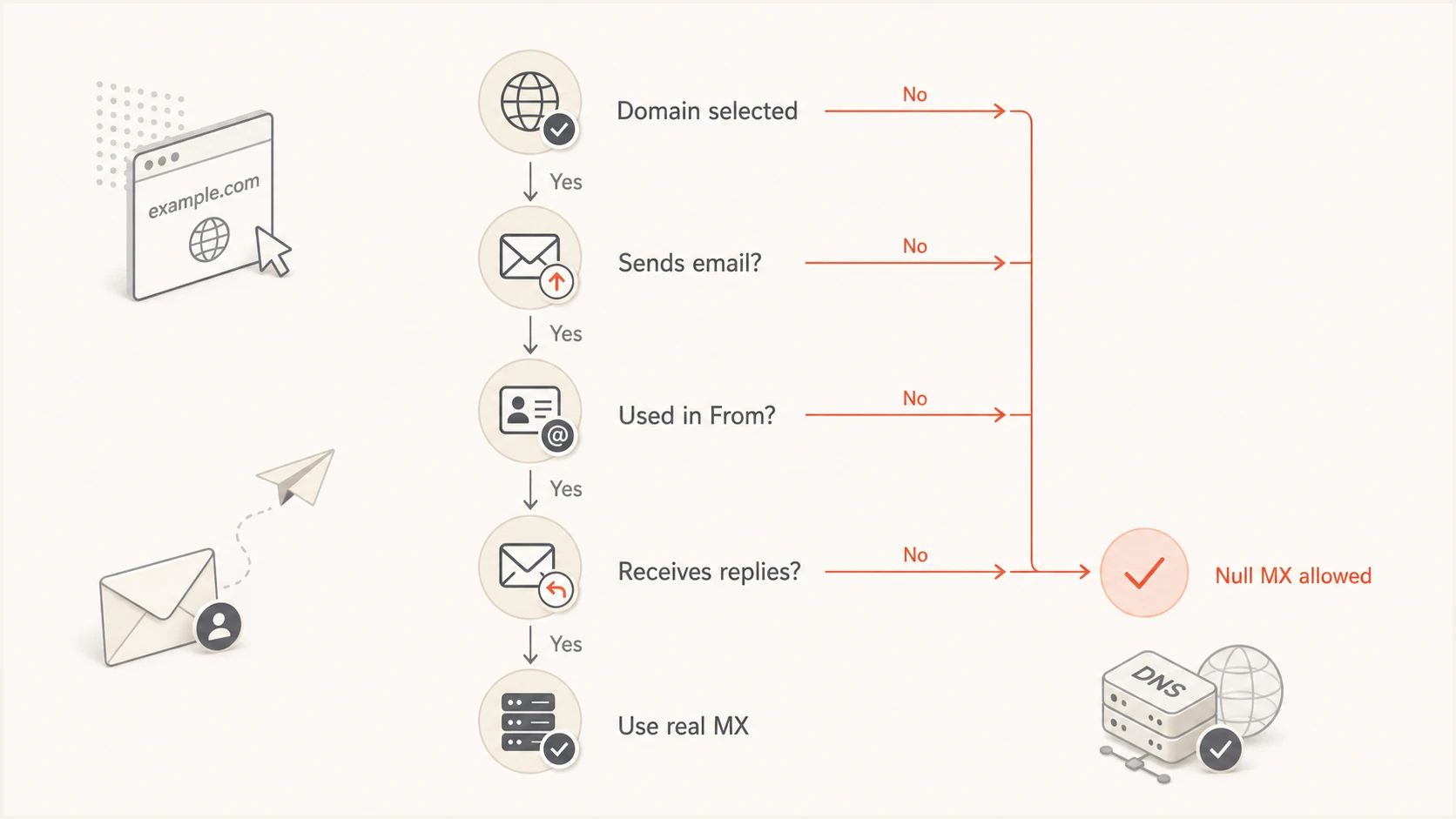
Decision path showing that email use requires a real MX record.
This decision applies to subdomains as well as organizational domains. A dedicated tracking host that never appears in an email address can use null MX. A campaign subdomain used in the visible From address should have a real receiving route, even if its Return-Path points elsewhere.
A separate Return-Path does not remove the risk
Using a separate, routable Return-Path is good practice. It gives delivery failures somewhere to go and lets SPF authenticate the envelope domain. It does not make null MX appropriate on the visible From domain. RFC 7505 addresses both RFC5321.MailFrom and RFC5322.From identities because receivers can inspect either one.
|
|
|
|---|---|---|
From | Visible sender | Real route |
Return-Path | Bounces | Real route |
Reply-To | Human replies | Real route |
Tracking host | Links | No inbox needed |
Email identities and their inbound requirements
DMARC checks whether the authenticated SPF or DKIM domain matches the visible From domain. It does not test whether the From domain accepts replies. A message can pass DMARC and still be rejected or filtered because null MX conflicts with the domain's use as a sender. Authentication success and address validity are separate checks.
DMARC passes are not delivery guarantees
SPF, DKIM, and DMARC establish authorization and domain association. Receivers still apply syntax, DNS, reputation, content, and local policy checks. Null MX can fail that broader review.
I avoid solving this with an MX hostname that does not accept SMTP. That changes the DNS appearance but keeps the operational problem. The MX target should resolve correctly, accept connections, and deliver the addresses the sender publishes or needs for administration.
How mailbox providers can treat null MX
A receiver is free to use null MX as part of acceptance policy. Some systems reject at SMTP time, while others accept and place the message in spam. The exact treatment depends on the identity checked, the receiver's current policy, and the rest of the message. A successful campaign at one provider does not prove the configuration is portable.
What null MX communicates
- Inbound service: The domain accepts no mail.
- Address validity: Replies cannot reach that domain.
What a receiver can infer
- Sender consistency: The domain contradicts its DNS declaration.
- Delivery decision: The message deserves rejection or extra scrutiny.
Reports of delivery recovering after replacing null MX with a normal MX are operationally credible, but they do not establish a universal Yahoo rule. The safe conclusion comes from the standard itself: mail sent with a null-MX identity risks rejection. A configuration should not depend on every receiver overlooking that condition.
When troubleshooting, I change one variable at a time. I replace null MX with a working route, confirm DNS propagation, send a new message, and record the SMTP response. If delivery recovers, I keep the valid MX and continue checking authentication and reputation instead of restoring the contradictory record.
How to configure the domain safely
Start by listing every domain and subdomain used in From, Return-Path, Reply-To, DKIM signing, and tracking. This prevents a narrow MX change from hiding an identity mismatch elsewhere. The receiving route can use an existing mailbox system or a dedicated inbound service, provided it genuinely accepts the required addresses.
- Remove null MX: Delete the MX 0 . record from every domain used as an email address.
- Publish a real target: Add the MX hostname supplied by the inbound mail operator and verify that it resolves.
- Create working addresses: Route postmaster, abuse, and the published reply address to monitored destinations.
- Retest the message: Check the new DNS answer, then send a fresh message and inspect the authentication results.
Example receiving MXDNS
example.com. 3600 IN MX 10 inbound.example.com.
The hostname and preference in that example are illustrative. Use the exact target provided by the receiving system. Do not point MX at a web server unless that host runs a properly configured SMTP service. Also remove the null MX instead of leaving it beside normal MX records, because a null MX must be the domain's only MX record.
After changing MX, use the domain health checker to review DMARC, SPF, and DKIM together. DNS can be syntactically valid while the sending identities remain unauthenticated, so the MX correction should be followed by a complete domain check.
?
What's your domain score?
Deep-scan SPF, DKIM & DMARC records for email deliverability and security issues.
A clean check should show one valid SPF record, usable DKIM keys for every active sender, and a DMARC record with a reporting address. I also confirm that the visible From domain matches either the SPF-authenticated domain or the DKIM signing domain under DMARC rules.
Suped's product brings these checks into one monitoring workflow. It processes DMARC reports, identifies sending sources, alerts on failures, and gives steps to fix authentication issues. That makes it easier to spot a domain that was corrected at MX but still has an unrecognized sender or broken domain association.
Domain health checker sample results showing DMARC, SPF, DKIM scorecards and detailed validation checks
For ongoing operations, DMARC monitoring adds evidence that a one-time DNS lookup cannot provide. Suped's dashboard groups DMARC, SPF, and DKIM results with blocklist and deliverability insights, so teams can confirm that real traffic uses the intended domains after the MX change.
The strongest validation is a real delivery test. Send to representative mailbox providers, reply to the message, trigger a controlled failure to an invalid recipient, and verify that both the human response and non-delivery report arrive at monitored mailboxes.
When null MX is the right choice
Null MX is correct for a domain that has no email role. Common cases include parked domains, defensive registrations, unused product domains, and web-only hosts that should never receive mail. Pairing null MX with restrictive SPF and DMARC records makes that intent clearer to receivers.
Safe null MX test
- No outbound mail: The domain never appears in From or Return-Path.
- No inbound mail: No person or system expects replies at the domain.
- No mail operations: Postmaster and abuse handling exists on another active organizational domain.
- Clear policy: SPF denies sending and DMARC rejects unauthorized use.
For a domain that does not send email, the related DMARC reject setup should include SPF that authorizes no senders and a DMARC policy at reject. Null MX handles inbound SMTP routing, while those records address unauthorized outbound use.
Non-sending domain recordsDNS
example.com.  3600  IN  MX   0  .
example.com.  3600  IN  TXT  "v=spf1 -all"
_dmarc.example.com.  3600  IN  TXT  "v=DMARC1; p=reject"
Before publishing reject, use a DMARC record check and confirm that the domain truly has no legitimate senders. Suped's hosted DMARC workflow can stage policy changes and keep reporting visible, which helps teams avoid applying a non-sending configuration to an overlooked service.
Views from the trenches
Best practices
Publish a working MX for every domain used in From, Reply-To, or Return-Path addresses.
Route postmaster and abuse mail to monitored inboxes with clear internal ownership.
Test replies and controlled bounces after DNS changes, not only record syntax checks.
Common pitfalls
Using a separate Return-Path does not make null MX safe on the visible From domain.
Adding a real MX beside null MX creates an invalid and contradictory MX record set.
A passing DMARC result does not cancel receiver checks for a valid sending address.
Expert tips
Keep null MX for domains with no inbound or outbound email role, including parked names.
Check every email identity separately because each domain can have different DNS records.
Record SMTP responses before and after the MX correction to confirm the delivery effect.
Marketer from Email Geeks says null MX should only be used when a domain does not participate in email, since active sending creates a conflicting signal.
2026-07-28 - Email Geeks
Marketer from Email Geeks says a null MX prevents bounce receipt when the Return-Path uses that domain, which gives receivers a strong reason to reject mail.
2026-07-28 - Email Geeks
Use a receiving route for every sending identity
A sending domain can publish null MX in the mechanical sense, but it should not. The record announces that the domain accepts no email, conflicts with its active use in mail, and exposes delivery to receiver rejection. A separate Return-Path reduces bounce-handling problems but does not remove that conflict.
Replace null MX with a real receiving route, monitor the reply and administrative mailboxes, and validate the domain's authentication records. Keep null MX for genuinely inactive domains, then pair it with deny-all SPF and DMARC reject after confirming that no legitimate mail uses the domain.