How to use executive spoofing risk in MSP sales

Published 30 Jun 2026
Updated 1 Sep 2026
10 min read
Summarize with
Updated on 1 Sep 2026: We updated this guide for RFC 9989 and added clearer BEC qualification and verification steps for MSP sales.
Executive spoofing risk works in MSP sales when it is presented as a concrete domain authentication gap, not as a generic phishing warning. The useful sales point is simple: if a client's executive identity can be impersonated through direct use of the client's domain, the MSP has a measurable control gap to fix and manage over time.
This angle fits prospects that already care about invoices, payroll, legal approvals, board communication, or client trust. The conversation lands better when it starts with evidence: the DMARC policy, SPF and DKIM condition, unauthenticated sending sources, and whether the published policy requests action on messages that fail DMARC.
For DMARC for MSPs, executive spoofing risk is a practical route into a managed service: baseline the domain, identify legitimate senders, fix authentication, move the policy in stages, monitor failures, and report progress to the client.
Start with the risk buyers already understand
A nontechnical buyer does not need a lecture on TXT records. They need to understand that someone can send mail that appears to come from the CEO, CFO, managing partner, or accounts payable lead if the domain has weak authentication and no enforced DMARC policy. This scenario often appears in business email compromise (BEC) or CEO fraud, although those terms also cover attacks that DMARC cannot stop.
The strongest version of the pitch avoids a generic "phishing is bad" claim. Use a precise statement such as "your domain currently requests monitoring, not quarantine or rejection, for messages that fail DMARC" or "your domain has no DMARC record, so receivers have no DMARC policy request for forged mail using it". Receivers still apply local policy, but the domain owner has not requested enforcement.
Weak sales angle
- Generic warning: The prospect hears a familiar phishing message and treats it like awareness training.
- No proof: The risk sounds theoretical because there is no domain data or executive context.
- No next step: The buyer sees a problem, but not a managed outcome.
Useful risk signal
- Named identity: The message ties risk to the CEO, CFO, HR, or accounts payable workflow.
- Domain evidence: The MSP shows the current DMARC policy and authentication state.
- Managed fix: The proposal includes monitoring, remediation, enforcement, and reporting.
This is where DMARC monitoring becomes a sales asset. It moves the discussion away from opinion and toward observed mail flow, failed authentication, and real senders using the client's domain.
Build the risk signal before the call
Before a discovery call, collect enough data to speak plainly. The goal is a credible risk signal, not a full forensic audit. It should show that the MSP has reviewed the domain and can define the next diagnostic step.
- Check DMARC: Look for no record, p=none, no aggregate reporting address, an unsuitable subdomain policy, or syntax errors.
- Check SPF: Look for missing records, excessive DNS lookup-causing terms, stale senders, or authorization wider than current mail flow requires.
- Check DKIM: Confirm major senders sign mail and that the DKIM signing domain shares the organizational domain with the visible From domain, or matches it exactly when strict mode is used.
- Check sources: Identify mail platforms, billing tools, CRMs, marketing systems, and support desks that send as the client.
- Check exposure: Map the finding to executive workflows such as payment approval, payroll changes, legal notices, and client account updates.
For a fast starting point, run a domain health check and use the result to decide whether the prospect needs a deeper DMARC audit.
?
What's your domain score?
Deep-scan SPF, DKIM & DMARC records for email deliverability and security issues.
Pre-call evidence checklist
- Policy state: Capture whether the domain has no DMARC, monitoring only, quarantine, or reject.
- Sender inventory: List visible third-party systems that send mail for the domain.
- Executive use case: Tie the finding to one workflow that has real business value.
- Remediation path: Prepare the first 30 days of work before the sales meeting.
A missing or monitoring-only policy shows exposure, not proof that someone spoofed the domain or caused fraud. Present it as a control gap. Use aggregate reports, message headers, or client incident records before claiming active abuse.
Map executive risk to real mail flow
Executive spoofing risk becomes easier to sell when the MSP connects each role to a real mail path. A CFO's risk is tied to invoices, account changes, bank instructions, and urgent approvals. A CEO's risk is tied to board communication, client confidence, internal escalation, and regulatory notices.
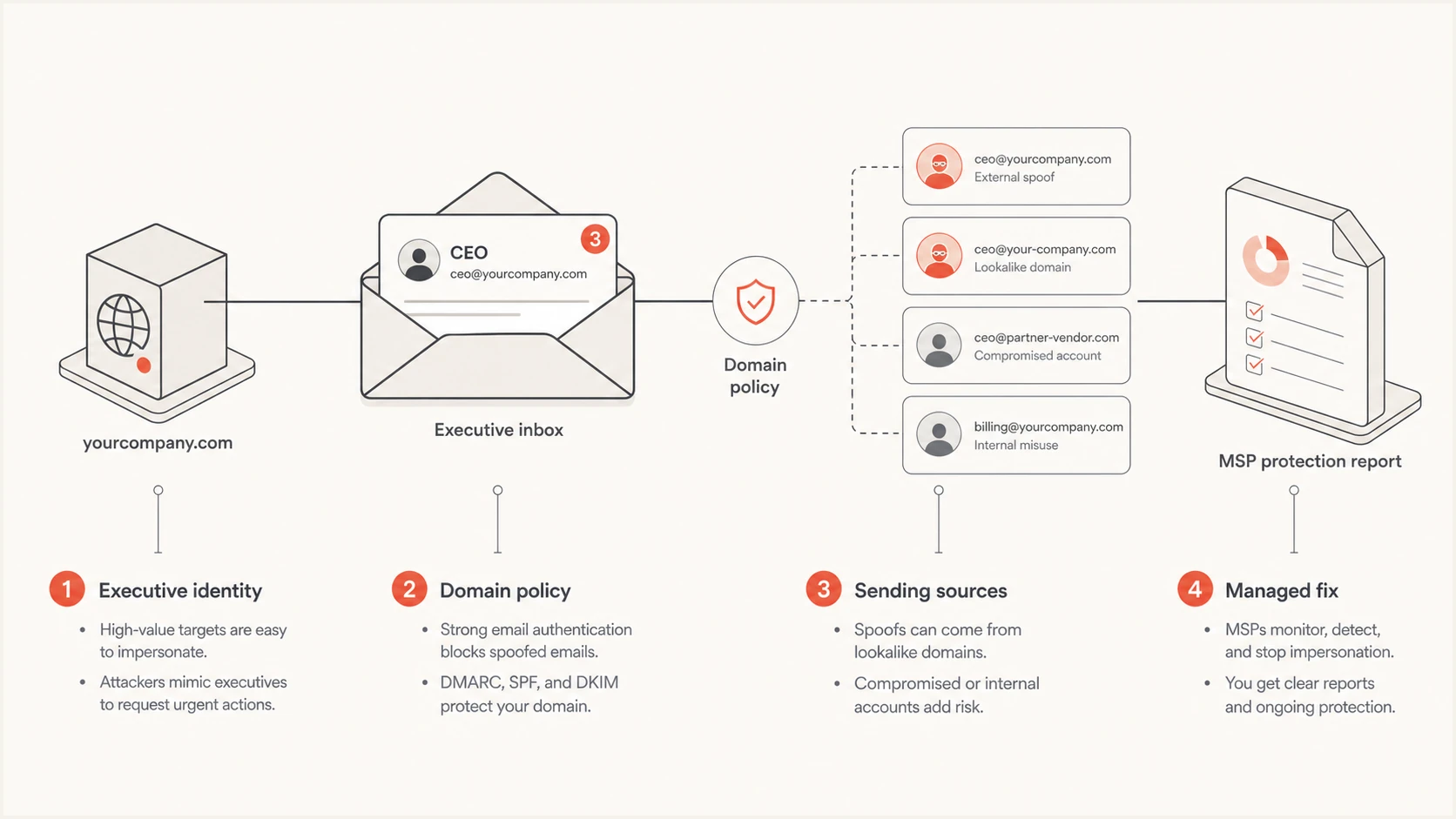
Executive spoofing risk infographic linking domain policy and sending sources to an MSP remediation plan.
|
|
|
|
|---|---|---|---|
CEO | Can fake leadership mail pass? | Policy | Stage enforcement |
CFO | Can payment mail be forged? | SPF, DKIM | Fix senders |
HR | Can payroll changes be faked? | Sources | Verify vendors |
AP | Can invoice mail be forged? | Failures | Monitor alerts |
Use compact role mapping to keep discovery business-focused.
This mapping also keeps the MSP honest. DMARC protects against direct domain spoofing when receivers check authentication and consider the published policy. It does not stop every display-name impersonation attempt, compromised mailbox, or lookalike domain. State those boundaries early because they build trust and help scope the service properly.
Turn findings into a sales conversation
The discovery call should not feel like a DNS review. Start with the business workflow, then use the technical finding as proof. That order matters because the buyer cares about the consequence before the control.
Discovery questions that work
- Approval paths: Who can approve payment, payroll, or bank detail changes by email?
- Executive mail: Which leaders send time-sensitive requests to staff or clients?
- Vendor senders: Which finance, HR, CRM, ticketing, and marketing systems send as your domain?
- Incident history: Have staff reported fake executive emails or invoice changes recently?
- Verification process: Which sensitive requests require a callback through a known number or a second approver?
- Risk owner: Who decides when the domain can move toward rejection?
After the questions, show the relevant finding in one sentence: "Your domain is currently in monitoring mode, so the published policy does not ask receivers to quarantine or reject messages that fail DMARC." That sentence is easier to buy than a long explanation of DNS, and it leaves room to explain that receivers retain local handling discretion.
The next step is to convert the finding into a managed task list. This connects naturally to sales outreach because the MSP now has a specific risk tied to an owner and first fix.
Plain-language risk note
Finding: The domain is not enforcing DMARC.
Risk: Fake mail can claim to be from an executive identity.
Impact: The domain does not request receiver-side quarantine or rejection.
Plan: Monitor, fix senders, test policy, enforce, and report progress.
Package the service as remediation and monitoring
Executive spoofing risk should lead to a managed service, not a one-time DNS edit. The MSP's value is in discovery, remediation, policy staging, ongoing monitoring, and client reporting. Mail flow changes whenever a client adds a billing tool, changes a CRM, starts a marketing campaign, or lets a department buy software without telling IT.
- Baseline: Collect DMARC reports and identify the real senders using the domain.
- Remediate: Fix SPF and DKIM for approved platforms, then remove stale or unknown senders.
- Stage policy: Move from monitoring through testing and enforcement only after the data is clean, with compatibility checks and a rollback plan.
- Watch alerts: Investigate new failures before they become client-facing delivery or security issues.
- Report value: Show reduced unauthenticated traffic, policy progress, new sending sources, and open remediation tasks.
DMARC policy maturity
A simple way to explain the client's journey while noting that final message handling remains the receiver's decision.
Monitor
p=none
Reports can arrive, but the domain owner requests no quarantine or rejection for failed mail.
Test
t=y
RFC 9989 defines a test for the next policy step, but older implementations can ignore the tag.
Enforce
quarantine or reject
The domain owner requests quarantine or rejection for mail that fails DMARC.
Example DMARC staging recordsDNS
_dmarc.example.com TXT
v=DMARC1; p=none; rua=mailto:dmarc@example.com

_dmarc.example.com TXT
v=DMARC1; p=quarantine; t=y; rua=mailto:dmarc@example.com

_dmarc.example.com TXT
v=DMARC1; p=quarantine; rua=mailto:dmarc@example.com

_dmarc.example.com TXT
v=DMARC1; p=reject; t=y; rua=mailto:dmarc@example.com

_dmarc.example.com TXT
v=DMARC1; p=reject; rua=mailto:dmarc@example.com
RFC 9989 made the old pct tag historic. Use t=y to test the next enforcement level under the current standard. Older implementations can ignore an unknown t tag and apply the published p value, so clean the data first, check compatibility, keep a rollback plan, and remember that receivers make the final handling decision.
For clients that do not want repeated DNS tickets, hosted DMARC helps the MSP control policy staging centrally after the required DNS setup is complete.
Use Suped to make the workflow repeatable
Suped's product supports this sales motion by giving the MSP one place to manage multiple clients, produce prospecting reports, monitor authentication health, and turn findings into technician tasks. Client-facing output should show the risk, the agreed fix, and progress without exposing the buyer to raw XML.

Create prospecting report dialog with MSP logo, prospect name, domains, prospect logo, and language fields
For this workflow, Suped combines DMARC, SPF, DKIM visibility, hosted DMARC, hosted SPF, SPF flattening, blocklist monitoring, and MSP multi-tenancy in one operational view. The blocklist (blacklist) checks help when a client wants domain and IP reputation context alongside authentication progress.
Sales asset
- Prospecting report: Summarizes domain risk before the first serious proposal.
- Executive framing: Connects authentication gaps to leaders and business workflows.
- Clear next step: Turns the finding into a managed remediation plan.
Delivery asset
- Issue detection: Shows authentication failures with practical steps to fix.
- Real-time alerts: Flags new failure patterns before the next client review.
- Multi-tenancy: Keeps client domains and reports organized for MSP operations.
The repeatable MSP workflow is straightforward: create the prospect report, review the direct spoofing exposure with the buyer, convert accepted findings into onboarding tasks, then monitor and report against the service plan. Once clients are live, triage matters because one technician can face many domains and new sending sources. A documented alert process keeps DMARC alert triage manageable across the client base.
Handle caveats before the buyer asks
Executive spoofing is a strong sales angle, but it needs clean boundaries. Overselling DMARC creates delivery risk and weakens trust. Separate direct domain spoofing from broader executive impersonation, then assign the right control to each scenario.
Say this plainly
- Direct spoofing: DMARC lets a domain owner request quarantine or rejection for mail that falsely uses the protected domain and fails DMARC.
- Display-name tricks: A sender can still use an executive's name with a different domain.
- Compromised mailboxes: If a real account is taken over, authentication can pass because the sender uses authorized infrastructure.
- Lookalike domains: DMARC on the real domain does not control domains the client does not own.
Use BEC or CEO fraud to describe the broader business scenario, and call the DNS finding direct domain spoofing exposure. Pair DMARC with MFA for executive accounts and out-of-band verification for payment, payroll, bank-detail, or access changes.
That explanation makes the service easier to buy because the scope is defined: authenticate the real domain, reduce direct spoofing exposure, monitor failures, and coordinate with mailbox controls and approval processes.
Illustrative control ownership
These percentages are a sales-scoping aid, not measurements of control effectiveness.
DMARC
Mailbox controls
Process
Use the risk to sell a managed outcome
Executive spoofing risk is useful in MSP sales because it connects a technical control to a business workflow the client already understands. The sales motion starts with evidence and connects business impact to a defined scope and managed plan.
Keep the offer simple: prove the current exposure, identify legitimate senders, fix authentication, test and apply enforcement, monitor the domain, and report progress. That turns DMARC into an ongoing MSP service instead of a one-off record change.
Client-ready close
Your executive identities depend on domain trust. We will measure how your domain is authenticated today, fix the legitimate senders, test and apply enforcement, and keep monitoring it as your mail flow changes.