How to sell DMARC monitoring to compliance focused clients

Updated on 31 Aug 2026: We updated this guide for RFC 9989 policy guidance, PCI DSS 4.0.1 evidence mapping, audit boundaries, and recurring service scope.
Sell DMARC monitoring to compliance-focused clients as a managed evidence control, not as a one-time DNS project. The buyer cares about proof that monitored domains publish the intended policy, observed mail sources are known, exceptions are tracked, and policy changes happen without interrupting legitimate mail. Lead with risk visibility, then show the monthly control workflow your MSP will run.
That positioning works because compliance buyers already understand recurring controls. They approve endpoint monitoring, backups, vulnerability checks, and access reviews because those services create ongoing evidence. DMARC belongs in the same operating model. For broader packaging, use the MSP DMARC hub as a reference point for building the offer.
- Buyer: Sell to the compliance owner, IT lead, vCISO, or operations sponsor who must prove domain controls.
- Pain: Focus on unknown senders, weak policy, missing reporting, and audit evidence gaps.
- Offer: Bundle monitoring, source review, DNS remediation, policy staging, and monthly evidence.
- Proof: Show before-and-after DMARC posture, observed sending sources, approvals, and the remediation log.
- Renewal: Tie recurring value to control monitoring, not only to the initial enforcement project.
Lead with audit evidence
Avoid opening with "we will set up DMARC." That sounds like a small technical task. Frame it as, "we will give you a recurring record of which sources use your domains, whether they pass aligned authentication, which sources the client has approved, and how policy is moving toward the agreed enforcement state." That is language a compliance-focused client can defend internally.
Start by asking what evidence the client must produce. Some clients need cyber insurance evidence. Others need vendor security questionnaires, board reporting, or controls for a regulated operating model. DMARC monitoring helps because it turns mail authentication observations into records that can be reviewed, assigned, approved, and retained.
Compliance buyer framing
A compliance-focused client buys a repeatable answer to the question, "Which sources use our domains, which have we approved, and what proof supports that decision?"
- Inventory: Every active, parked, and non-sending domain in scope has a recorded purpose.
- Source: Each observed sending service has an owner, business purpose, approval state, and authentication result.
- Policy: The enforcement stage is documented, including why exceptions still exist.
- Review: The MSP has a recurring service task, named owner, approval record, and retained outcome.
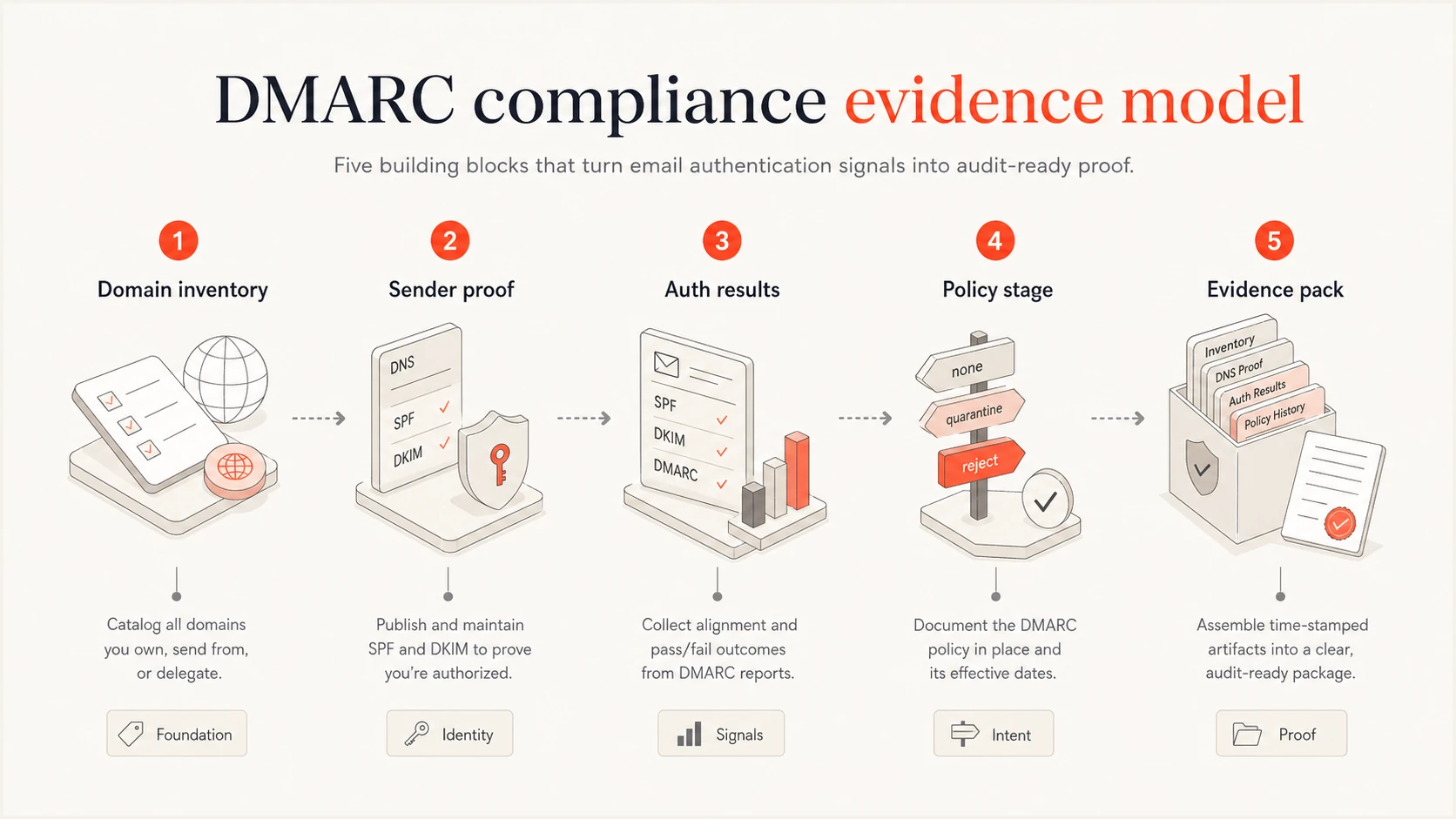
DMARC monitoring evidence model with domain inventory, sender proof, authentication results, policy stage, and evidence pack.
Map evidence to the exact requirement
Do not promise that DMARC makes a client compliant. Ask for the exact wording in the audit request, insurance form, customer questionnaire, or contract, then map the managed service to that wording. The client's assessor or framework owner decides whether the evidence is sufficient.
PCI DSS 4.0.1 Requirement 5.4.1 is a useful example. It requires processes and automated mechanisms that detect and protect personnel against phishing. DMARC can support the anti-spoofing part of that control, but it does not replace inbound phishing protection, staff awareness, incident handling, or the assessor's review.
|
|
|
|---|---|---|
Prove anti-spoofing controls | Domain inventory, aligned pass results, and published policy | DMARC covers exact-domain use, not every lookalike domain |
Show continuous monitoring | Report coverage, review tickets, alerts, and closure evidence | Aggregate reports are observations, not a complete message log |
Show sender governance | Source owner, business purpose, approval, and review date | A DMARC pass does not prove business authorization |
Show change control | Recommendation, client approval, DNS history, and retest | The client approves changes that can affect legitimate mail |
Support PCI DSS 5.4.1 | DMARC evidence within the wider anti-phishing control set | DMARC alone does not satisfy the requirement |
Map each client request to evidence and a stated boundary.
Keep authorization separate
Aggregate reports show what receivers observed and how authentication evaluated. They do not contain a complete message history, confirm that a source is legitimate, or prove that every receiver applied the requested policy. Record client approval separately.
Package DMARC as a managed control
The service should have a clear scope the client can understand. Use DMARC monitoring as the core recurring control: collect aggregate reports, identify observed senders, investigate authentication failures, stage policy changes, and report progress. The client gets ongoing assurance instead of a static DNS record that nobody checks.
Keep the offer concrete. A client should know what happens in onboarding, what happens every month, what triggers an alert, and what evidence they receive. If those details stay vague, the service sounds optional. When those details are specific, DMARC becomes part of the client control set.
Quote discovery and initial remediation separately from recurring monitoring. State whether the recurring fee applies per domain or per client, the reporting cadence, the included ticket allowance, and how extra vendor or DNS work is billed. This keeps a difficult rollout from consuming the margin on the managed service.
Weak pitch
- Setup: Treats DMARC as a DNS change and stops after publishing a record.
- Value: Talks mostly about spoofing without tying the work to evidence.
- Outcome: Leaves the client unsure who reviews failures or approves changes.
- Renewal: Creates pressure to justify a recurring fee after the record exists.
Compliance pitch
- Control: Defines DMARC as a managed control with review tasks and owners.
- Evidence: Shows source inventory, authentication health, report coverage, and policy progress.
- Action: Turns failures into tickets, DNS work, vendor follow-up, or exceptions.
- Retention: Makes monthly reporting useful to compliance and IT stakeholders.
Use discovery to expose control gaps
Good discovery sounds less like a DNS checklist and more like a control review. Ask questions that reveal whether the client knows its mail estate, who approves senders, how exceptions are handled, and what evidence an assessor expects. Compliance buyers respond to gaps they can see and explain.
|
|
|
|---|---|---|
Many domains | Which domains send mail? | Create inventory |
Unknown senders | Who owns each sender? | Map services |
Policy none | What blocks enforcement? | Stage policy |
Audit request | What exact proof is needed? | Map evidence |
Retention rule | Who reviews and retains evidence? | Set ownership |
DNS sprawl | Who changes records? | Control changes |
Discovery questions that turn DMARC monitoring into a managed compliance service.
Vendor sprawl is an easy sales angle because each marketing platform, billing system, CRM, helpdesk, and payroll sender creates a control question. If the client cannot name the owner for a sender, that is a service opportunity. A deeper walkthrough is useful when you want to use vendor sprawl as the sales trigger.
?
What's your domain score?
Deep-scan SPF, DKIM & DMARC records for email deliverability and security issues.
For prospecting, run the domain through a health check before the first call. Bring one page of findings, not a giant report. Show whether DMARC exists, whether SPF and DKIM records validate, whether aligned authentication is visible where evidence is available, whether policy is enforced, and whether the domain has obvious reputation issues such as blocklist or blacklist signals.
Show where client platforms stop
Many MSP clients assume their email host already covers DMARC because the admin console shows DNS status or DKIM setup. That is a useful starting point, but it does not replace cross-domain DMARC monitoring. A compliance buyer needs sender history, failure trends, approval records, change history, and policy evidence across every domain in scope.
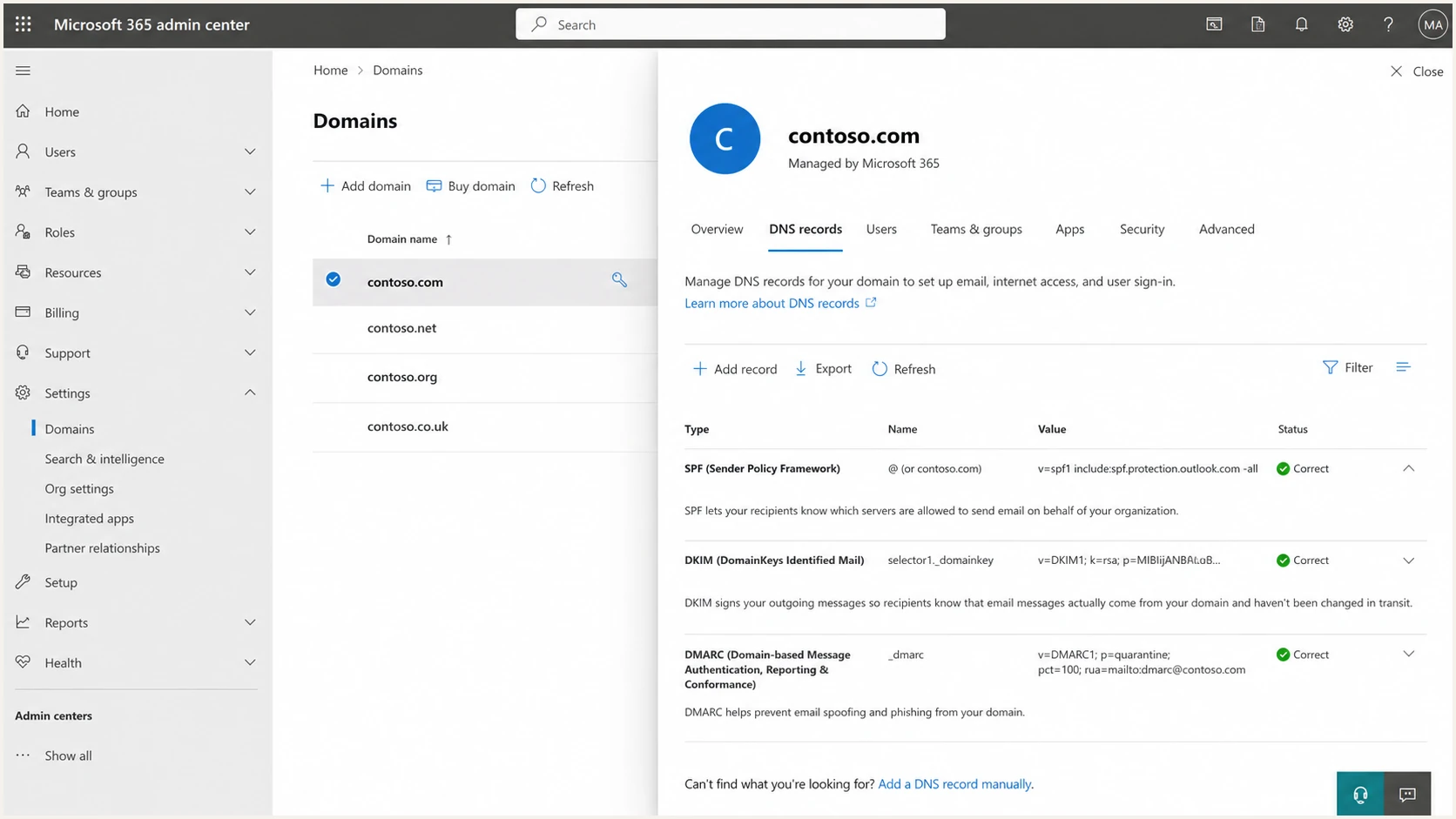
Microsoft 365 admin center domain screen showing DNS and email authentication status.
Use this distinction carefully. The point is not to criticize the client platform. Native setup views answer a narrow question: "Is this setting configured here?" Your service answers a wider control question: "Which sources sent mail for our domains this month, what passed, what failed, what changed, and what evidence can we show?"
Avoid the scare pitch
Do not sell DMARC monitoring by implying every client is one message away from disaster. Compliance buyers have heard that before. Show the control gap, the evidence gap, and the operating process your MSP will own.
Use policy staging without mail disruption
Compliance buyers still worry about legitimate mail being affected. That objection is valid. Under RFC 9989, p=none is monitoring mode. Collect data, confirm legitimate senders, document approval, and fix alignment before considering p=quarantine or p=reject after client approval. The evidence, decision record, review discipline, and retained change history create the recurring value.
Do not base a rollout on the historic pct tag or promise a fixed route to reject for every domain. RFC 9989 cautions that general-purpose mail affected by mailing lists or forwarding can still fail after indirect handling, and receivers retain control over final disposition. Review those flows and document the client's risk decision before enforcement.
DMARC policy staging examplesdns
_dmarc  TXT  "v=DMARC1; p=none; rua=mailto:dmarc@example.com"
_dmarc  TXT  "v=DMARC1; p=quarantine; rua=mailto:dmarc@example.com"
_dmarc  TXT  "v=DMARC1; p=reject; rua=mailto:dmarc@example.com"
Policy readiness bands
Use these bands to explain the service path without promising a fixed timeline or universal receiver behavior.
Observe
p=none
Collect reports and identify observed senders.
Fix
Remediate
Resolve legitimate sender failures and stale DNS.
Contain
p=quarantine
Request quarantine after client approval.
Enforce
p=reject
Publish reject after indirect-flow review and approval.
For MSPs managing many clients, manual DNS changes slow the service down. Suped's Hosted DMARC supports centrally managed policy changes, and Suped's Hosted SPF reduces the need to request DNS access every time a sender changes. That supports a documented change workflow across many client domains.
Turn findings into service work
Clients want decisions instead of a raw DMARC feed. Each finding should become one of five outcomes: approve the sender, fix authentication, remove the sender, document an exception, or escalate to the client owner. That workflow is where an MSP earns the recurring service fee.
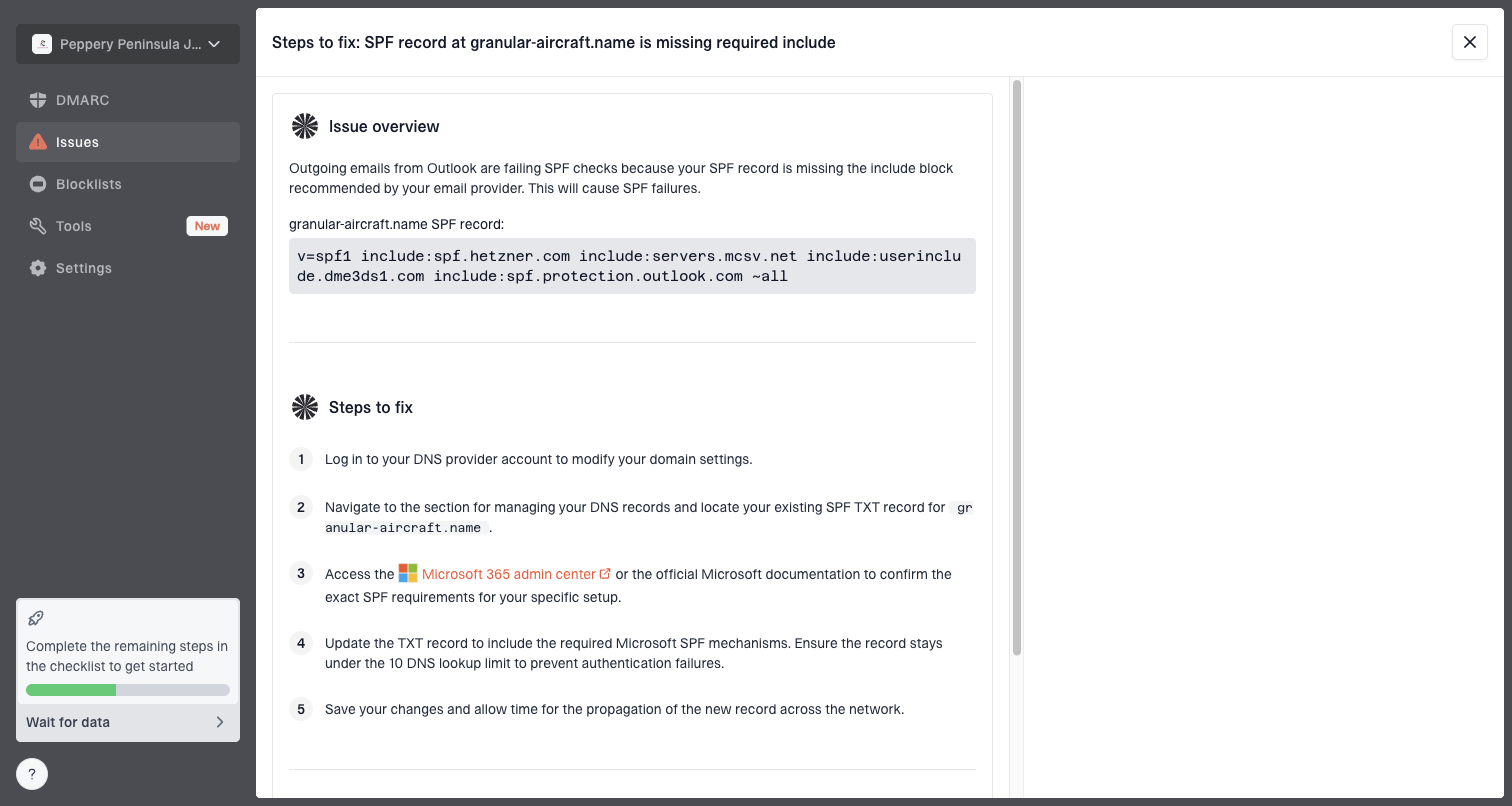
Issue steps to fix dialog showing the issue overview, tailored fix steps, and verification action
In Suped, this workflow is built around issues, sources, remediation guidance, and closure evidence. During a monthly client review, Suped's issue view can show what changed, why it matters, who owns the fix, and what evidence closes the task. Suped's MSP product also keeps DMARC monitoring, SPF and DKIM visibility, hosted records, real-time alerts, blocklist and blacklist monitoring, and multi-client management in the same operational workspace.
MSP operating rhythm
- Daily: Triage material authentication changes, new sources, and urgent alerts.
- Weekly: Review unresolved issues, policy drift, and overdue owner actions.
- Monthly: Send evidence, report coverage, policy progress, and exception notes to the client.
- Quarterly: Review domain scope, inactive senders, retained approvals, and enforcement readiness.
Client evidence pack
- Scope: List monitored, inactive, parked, and out-of-scope domains.
- Senders: Show approved, new, retired, and unresolved sources.
- Findings: Document the evidence, owner, decision, due date, and closure result.
- Policy: Record current policy, report coverage, approvals, and readiness blockers.
Prioritize the clients most likely to buy
Not every client buys DMARC monitoring at the same speed. Start with clients that already have compliance pressure, multiple domains, frequent vendor onboarding, executive impersonation concerns, or cyber insurance requests. They already feel the need for evidence, so the sales motion is shorter.
Best first clients
- Regulated: Healthcare, finance, legal, education, and government contractors often have formal evidence requests.
- Distributed: Multi-location clients often have legacy domains and local marketing senders.
- Growing: Acquisitive clients need domain discovery and sender consolidation.
- Audited: Clients with questionnaires already have a reason to fund recurring proof.
Use risk ordering when you have a large base. Put clients with weak policy, high mail volume, many third-party senders, or recent questionnaire pressure at the top. A structured method for prioritizing clients keeps the campaign focused and avoids turning DMARC into a generic blast email.
Close on the managed control
The sale works when the client sees DMARC monitoring as a control backed by evidence. Treating it as a technical cleanup task narrows the value. Lead with the exact control question, show the gaps, define the service rhythm, and explain how policy decisions are approved without promising zero disruption.
Suped's product supports that delivery model by giving an MSP one place to monitor DMARC, review authentication issues, manage hosted records, send alerts, track blocklist and blacklist signals, and move between client organizations. That keeps the service scope visible to technicians and client reviewers.