Why is DKIM alignment with the 5322.from domain important for email authentication?

Published 20 Jun 2025
Updated 12 Aug 2026
11 min read
Summarize with
Updated on 12 Aug 2026: We updated this guide for RFC 9989's DNS Tree Walk method and clarified how multiple DKIM signatures affect DMARC alignment.
DKIM alignment with the 5322.from domain is important because DMARC only treats DKIM as an aligned pass when a verified signing domain is identical to the visible sender domain, or has the same Organizational Domain under relaxed mode. A message can have DKIM pass and still fail DMARC if the d= domain belongs to an ESP or another unrelated domain instead of a domain aligned with the address the recipient sees in the From header.
That matters in practical inboxing, not only in standards documents. Microsoft and other mailbox providers assess whether the visible sender has authenticated the mail. If the DKIM signature validates for an unrelated provider domain, the receiver knows that the provider domain signed the message, but it does not prove that the visible brand domain authorized it.
- DMARC pass: DKIM satisfies DMARC when at least one valid signing domain aligns with the RFC5322.From domain.
- Visible trust: Alignment connects domain authentication to the sender identity shown to the recipient.
- Forwarding resilience: DKIM survives many forwarding paths where SPF breaks, provided the forwarder does not alter signed content.
- ESP accountability: The sender can verify that its ESP signs with an aligned customer domain instead of only an ESP domain.
What 5322.from means
The 5322.from domain, formally RFC5322.From, is the domain in the message header From field. DMARC calls it the Author Domain. It is part of the sender address shown in email clients. It differs from the envelope sender, also called RFC5321.MailFrom, Return-Path, or bounce domain. SPF checks the envelope sender. DKIM verifies a cryptographic signature placed in the message header. DMARC then asks whether either SPF or DKIM authenticated a domain aligned with the Author Domain.
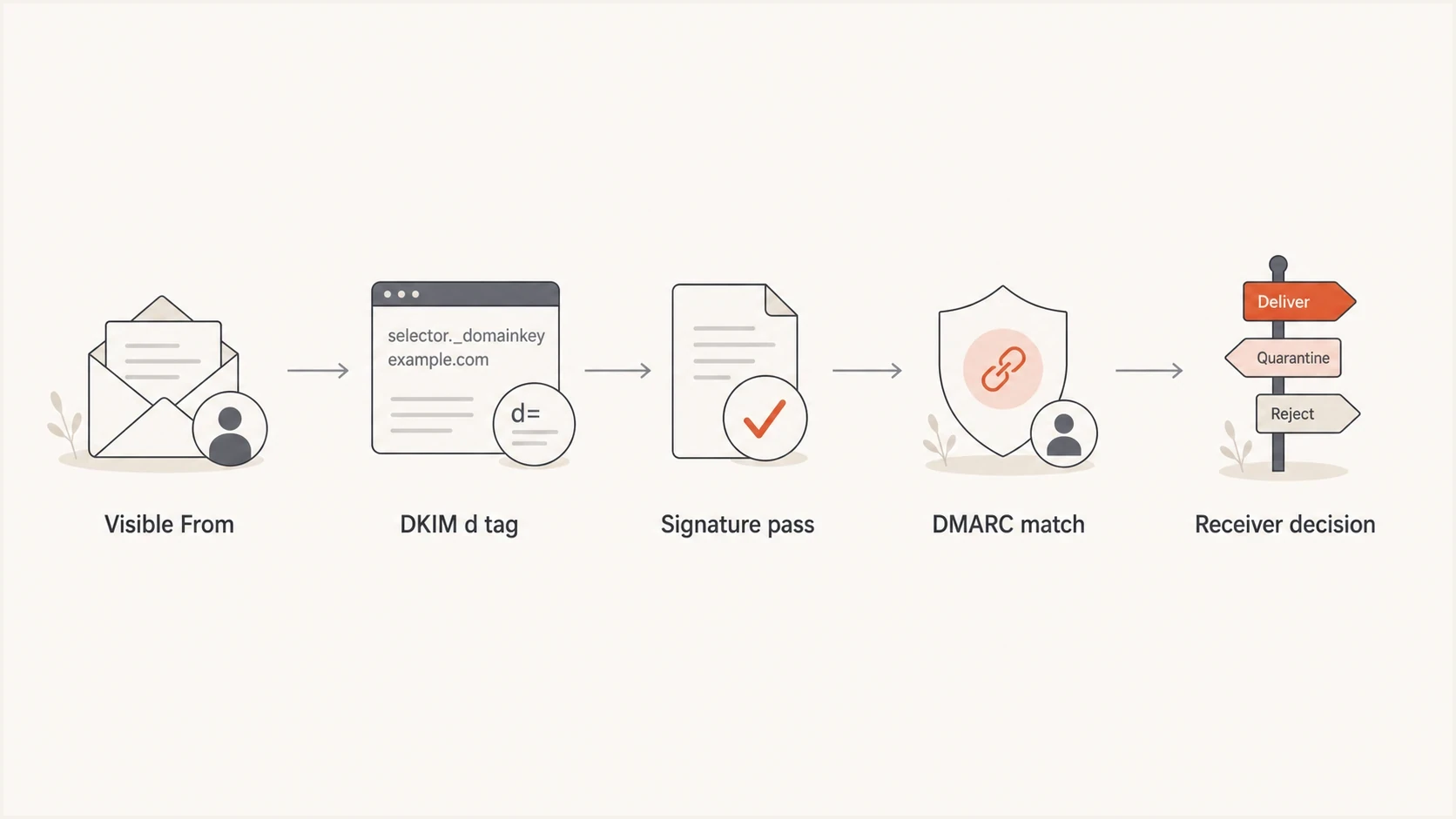
Flowchart showing how the From domain, DKIM signing domain, and DMARC decision connect.
This is where many ESP setups go wrong. A platform signs with a valid DKIM key for its own domain, the signature passes, and the sender assumes the message is authenticated for DMARC. DMARC sees a different result. It checks whether a passing DKIM domain aligns with the RFC5322.From domain. If it does not, that signature does not help DMARC pass.
Microsoft describes this broader receiver-side evaluation in its Microsoft authentication guidance. The practical point is simple: receivers judge the visible sender, not only whether any unrelated domain produced a valid cryptographic signature.
DKIM authentication versus DKIM alignment
These are separate checks, and mixing them causes bad ESP requirements. DKIM authentication asks whether the signature is valid. DKIM alignment asks whether the domain in that valid signature has the required relationship to the visible From domain.
DKIM authentication
A DKIM signature authenticates the signing domain in the d= tag. The public key is found in DNS under that domain.
- Signature: The receiver verifies that the message body and selected headers were not changed.
- Key lookup: The selector and signing domain point the receiver to the DNS public key.
- Result: The output is pass or fail for that signing domain.
- Gap: A pass for an ESP domain does not prove the visible From domain authorized the mail.
DKIM alignment
DMARC checks whether a passing DKIM d= domain aligns with the RFC5322.From domain.
- Relaxed mode: mail.example.com and example.com pass when they have the same Organizational Domain.
- Strict mode: The DKIM signing domain must match the RFC5322.From domain exactly.
- DMARC value: An aligned DKIM pass lets DMARC pass even when SPF is broken by forwarding.
- Policy impact: A domain can move toward quarantine or reject with less risk after legitimate streams pass alignment.
The From header itself also needs to be signed in DKIM. RFC 6376 requires the From header field to be included in the signed header list. That is related, but it is not the same as DKIM alignment. A message can include From in the DKIM header hash and still use an unrelated d= domain.
For senders using several brands or subdomains, the implementation detail is usually selector design and domain delegation. The same ESP can sign mail for different From domains as long as each stream uses an aligned signing domain and a valid DNS record.
How RFC 9989 determines relaxed alignment
RFC 9989 replaced RFC 7489's Public Suffix List method with a DNS Tree Walk for finding the Organizational Domain used in relaxed alignment. The receiver checks DMARC records up the DNS hierarchy for the Author Domain and each passing DKIM signing domain, then compares the resulting Organizational Domains.
- Default behavior: If the DMARC record omits adkim, DKIM alignment defaults to relaxed mode.
- Relaxed comparison: A setting of adkim=r passes when the DKIM and Author Domains have the same Organizational Domain.
- Strict comparison: A setting of adkim=s requires an exact domain match and does not need an Organizational Domain comparison.
- Multiple signatures: If any valid DKIM signature aligns, DKIM can satisfy DMARC even when another signature fails or uses an unrelated domain.
The practical configuration goal has not changed: the active signing domain must pass alignment with the Author Domain. The new discovery method matters most for subdomains, private domain boundaries, and public suffix operators. Senders should publish explicit DMARC records for the domains they use and verify the receiver's reported alignment result instead of assuming that a shared suffix is enough.
Where ESP-domain signing fails
A common ESP pattern is to sign only with the provider's domain and leave the customer brand domain out of DKIM. SPF can still pass DMARC if the RFC5321.MailFrom domain aligns with the visible From domain, but many outsourced mail streams use an ESP-controlled Return-Path. In that setup, SPF and DKIM both fail alignment even when the raw DKIM signature passes.
ESP-domain DKIM pass with DMARC failtext
From: billing@example.com
Return-Path: bounce@esp-mail.example.net
DKIM-Signature: v=1; d=esp-mail.example.net; s=s1;
Authentication-Results: dkim=pass header.d=esp-mail.example.net;
Authentication-Results: dmarc=fail reason=dkim not matching From
DKIM pass that satisfies DMARCtext
From: billing@example.com
Return-Path: bounce@esp-mail.example.net
DKIM-Signature: v=1; d=example.com; s=s1; h=from:subject:date;
Authentication-Results: dkim=pass header.d=example.com; dmarc=pass
The common mistake
A valid DKIM signature for an ESP domain authenticates that domain, but it does not authenticate an unrelated visible sender for DMARC.
- Verified identity: The receiver verifies that esp-mail.example.net signed the message.
- Missing relationship: The signature does not connect esp-mail.example.net to example.com under DMARC alignment.
- DMARC result: DKIM does not satisfy DMARC unless a valid signing domain aligns with From.
- Inbox effect: The DMARC failure becomes one input to the receiver's filtering and policy decision.
This is why custom DKIM should not be treated as optional for an ESP sending as a customer's domain. The sender does not need to hold the private key, but the ESP needs a way to sign with the customer domain or an aligned customer subdomain. CNAME-based selector delegation is a common operational model.
How receivers use it
DMARC does not treat every DKIM pass as proof for the visible sender. A passing DKIM signature with an aligned domain lets DMARC authenticate the Author Domain. A passing signature for an unrelated platform domain does not. Once legitimate sources have aligned authentication in place, the domain owner can move beyond monitoring and enforce quarantine or reject with lower risk.
DKIM alignment outcomes
How DMARC evaluates DKIM results against the RFC5322.From domain.
Exact domain match
Aligned
The DKIM signing domain and RFC5322.From domain are identical.
Organizational Domain match
Aligned
The domains have the same Organizational Domain under relaxed mode.
Unrelated signing domain
Not aligned
DKIM passes, but the signing domain does not have alignment with RFC5322.From.
Invalid signature
Fail
The DKIM signature fails verification and cannot satisfy DMARC.
DKIM alignment is not a delivery guarantee. Content, reputation, engagement, complaint rates, and receiver-specific policy still matter. But an unaligned DKIM domain removes direct domain-level proof that the visible sender authorized the mail, and it creates avoidable DMARC failures in aggregate reports.
For a quick DNS and selector check, use a DKIM check against the selector your ESP provided. That confirms whether the public key exists, but it does not replace a real message test because alignment depends on the signing domain used in the sent email.
DKIM checker
Check selector records and public key configuration.
?/7tests passed
After the record passes, send a real message and inspect the Authentication-Results header. Look for a DKIM pass where header.d aligns with the RFC5322.From domain under the configured DMARC mode. If the only passing DKIM result belongs to the ESP domain, the stream still needs customer-domain signing unless aligned SPF is providing the DMARC pass.
What ESPs need to support
An ESP does not need a complicated customer-facing setup to do this correctly. It needs an aligned per-customer signing domain, selector records, a key rotation process, and a signature that includes the From header field. Shared infrastructure is fine. An unrelated shared signing identity is the problem.
|
|
|
|---|---|---|
Signing domain | Aligned customer domain | ESP domain only |
Selector DNS | Published key or delegated CNAME | Missing customer record |
Header signing | From included | Noncompliant signature |
Rotation | Planned selector rollover | Stale or exposed key |
Compact checklist for ESP DKIM support.
A practical rotation pattern keeps two DKIM selectors available per customer domain. The customer publishes CNAME records. The ESP keeps the private keys, rotates them, and signs outgoing mail with the aligned customer domain in the d= tag. This gives the sender DMARC alignment without forcing the customer to manage private key material.
Good implementation pattern
This DNS delegation pattern gives the customer domain an aligned signing identity while the ESP operates the keys.
Selector delegation exampledns
s1._domainkey.example.com CNAME s1.example.esp.net
s2._domainkey.example.com CNAME s2.example.esp.net
- Customer control: The visible sender domain has DNS records that authorize the signing setup.
- ESP control: The ESP manages keys, signing, and rotation without exposing private keys.
- DMARC readiness: The sent mail can pass DMARC through DKIM even when SPF does not survive forwarding.
- Scale: Brands and subdomains can use separate selectors and reporting views.
How to validate and monitor the setup
Validate the setup in two layers. First, check DNS records for obvious DKIM, SPF, and DMARC problems. A broad domain health review is useful before testing individual mail streams. Then watch real DMARC aggregate data because the sent message path exposes unaligned DKIM domains, broken selectors, and ESPs that sign only with their own domain.
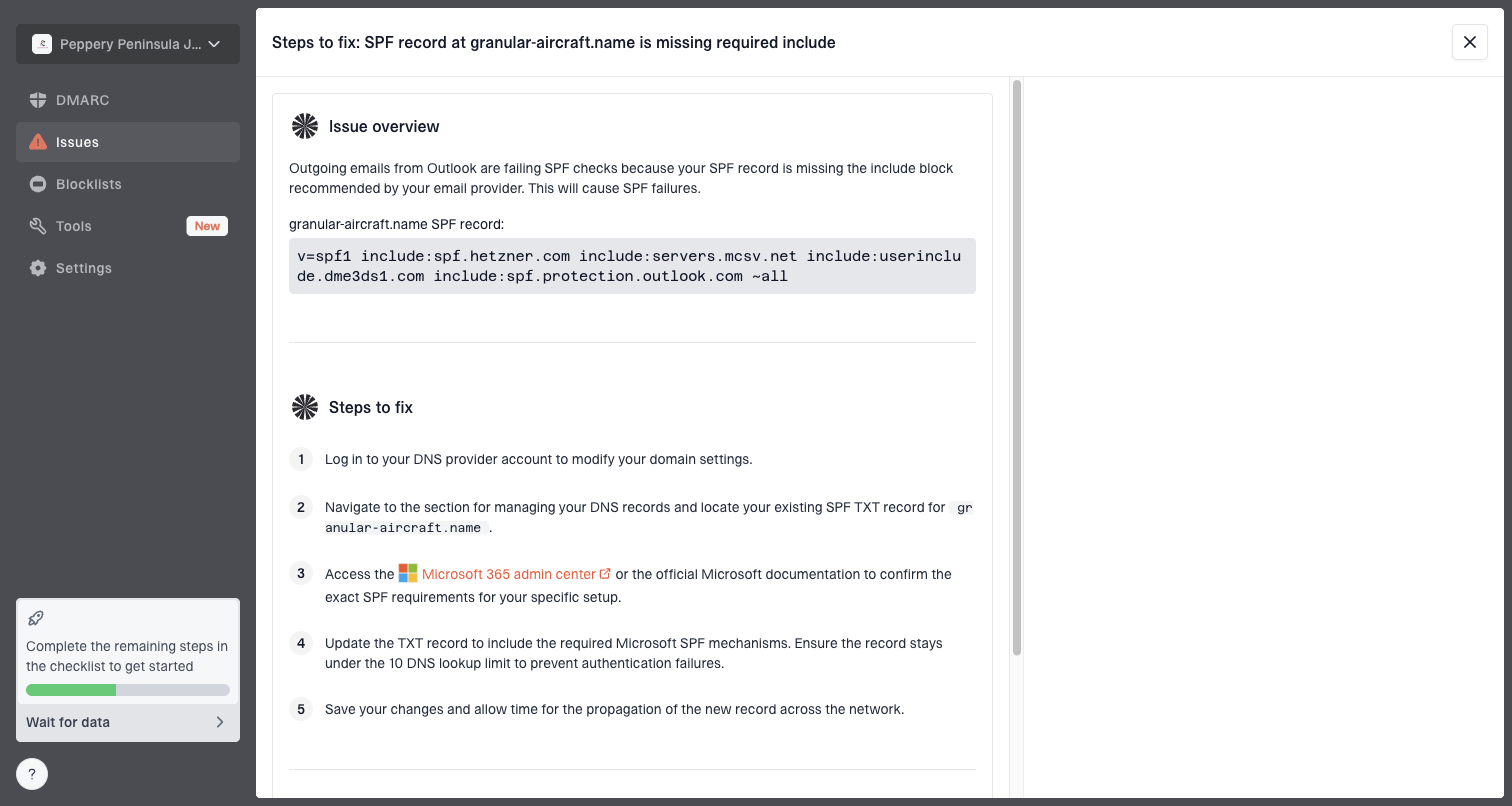
Issue steps to fix dialog showing the issue overview, tailored fix steps, and verification action
Suped's product is built around that workflow. The DMARC monitoring view maps each source to SPF, DKIM, and DMARC outcomes, then raises issues with concrete fix steps. ESP-domain DKIM signing becomes visible because the report data shows the passing header.d domain and the failed relationship with the visible From domain.
Use Suped to group mail by source and signing domain, identify streams where DKIM passes without alignment, record the required DNS or ESP change, and confirm that the failure count falls after remediation. That sequence supports a controlled move toward DMARC enforcement without requiring teams to inspect raw aggregate XML.
- Source grouping: Group traffic by sender and header.d domain to isolate the ESP that needs a change.
- Alignment checks: Separate a raw DKIM pass from a DKIM pass that satisfies DMARC.
- Fix steps: Use the issue guidance to publish selector DNS or request customer-domain signing.
- Verification: Confirm the repaired stream reports aligned DKIM before tightening DMARC policy.
Views from the trenches
Best practices
Confirm the DKIM d tag matches the visible From domain before enforcing DMARC policy.
Ask ESPs for customer-domain DKIM signing, even when they manage the private keys.
Test real sent mail because DNS checks alone do not prove the active signing domain.
Use relaxed matching deliberately, and document when strict matching is required.
Common pitfalls
Treating a DKIM pass for an ESP domain as enough for DMARC is a common audit error.
Confusing From header signing with DMARC domain matching leads to bad fixes in reviews.
Assuming SPF will save every stream breaks when forwarding changes envelope data.
Rolling out reject before all ESP streams match the visible sender creates risk.
Expert tips
Keep two selectors active so key rotation does not interrupt customer-domain signing.
Review Authentication-Results headers for header.d, not only the DKIM pass label.
Check aggregate reports by source to find ESPs still signing only provider domains.
Use subdomain signing when brands need separated reporting and sender identity cleanly.
Marketer from Email Geeks says ESPs that sign only with a provider domain use a pattern that creates DMARC failures for the visible sender.
2023-08-09 - Email Geeks
Expert from Email Geeks says the key distinction is whether the DKIM d tag aligns with the 5322.from domain in the DMARC sense, not only whether DKIM passes.
2023-08-09 - Email Geeks
The practical answer
DKIM alignment with the 5322.from domain is important because it ties cryptographic authentication to the sender domain the recipient sees. Without that domain relationship, DKIM can pass for the ESP while DMARC fails for the brand. That is the difference between a technically signed message and a message that authenticates the visible sender domain.
The fix is concrete: require aligned customer-domain DKIM signing, publish the selector records, send a real test message, confirm header.d aligns with RFC5322.From, then monitor DMARC reports until every legitimate source is covered. Once that is stable, a stricter DMARC policy becomes a controlled change instead of a guess.