Why is my IP address listed on Cloudmark CSI-Global?

Published 31 Jul 2025
Updated 22 Sep 2026
11 min read
Summarize with

Updated on 22 Sep 2026: We updated this guide with clearer 550 bounce handling, IP ownership steps, and current Cloudmark remediation checks.
If your bounce says an IP address is listed on Cloudmark CSI-Global, the direct answer is that the receiving mail system is refusing or deferring the message because Cloudmark has assigned a poor or suspect reputation to that sending IP. Cloudmark supplies reputation data, while the receiving provider decides how to apply it. The recipient did not personally blacklist you.
Treat this as a real blocklist (blacklist) incident, even though Cloudmark describes CSI as an IP reputation system rather than a conventional blacklist. First confirm the exact IP in the bounce, use Cloudmark's remediation path, and investigate why the IP earned the poor reputation. A statistics reset can prompt reassessment, but it does not guarantee delivery or explain the root cause.
The most common causes are spam complaints, spam trap hits, stale address data, sudden volume changes, missing or generic rDNS, shared IP traffic, or transactional mail that recipients did not expect. A compromised account or infected host can also send abusive traffic without the domain owner's knowledge. Passing SPF, DKIM, and DMARC helps prove identity, but it does not prove that recipients want the message.
What the bounce means
Fast answer
A message like this means the recipient is applying a Cloudmark CSI-Global reputation decision to the connecting IP. In a Roadrunner, Spectrum, or Charter-style bounce, the recipient platform is using that signal during SMTP acceptance.
- Primary meaning: Your sending IP has a poor or suspect Cloudmark CSI reputation, which receivers can treat like a blocklist or blacklist result.
- Immediate effect: Mail to a receiving network can defer, bounce, or stop until that network accepts the IP again.
- Wrong fix: Asking one recipient to whitelist you only bypasses one path and does not change the CSI reputation.
Cloudmark-style bounce exampletext
550 203.0.113.24 is listed on Cloudmark CSI-Global.
Please visit https://csi.cloudmark.com/en/reset?ip=203.0.113.24
AUP#BL
The useful parts are the connecting IP address, the 550 status, and the phrase Cloudmark CSI-Global. A 550 response is a permanent SMTP rejection for that delivery attempt, so automatic retries alone will not fix it. The AUP#BL style code is a provider-side reason code, not a full diagnostic report.
Cloudmark's own Cloudmark FAQ explains its sender intelligence and remediation process. Keep incident notes focused on the exact IP, recipient domain, timestamp, full bounce text, sending stream, and whether the IP is dedicated or shared.
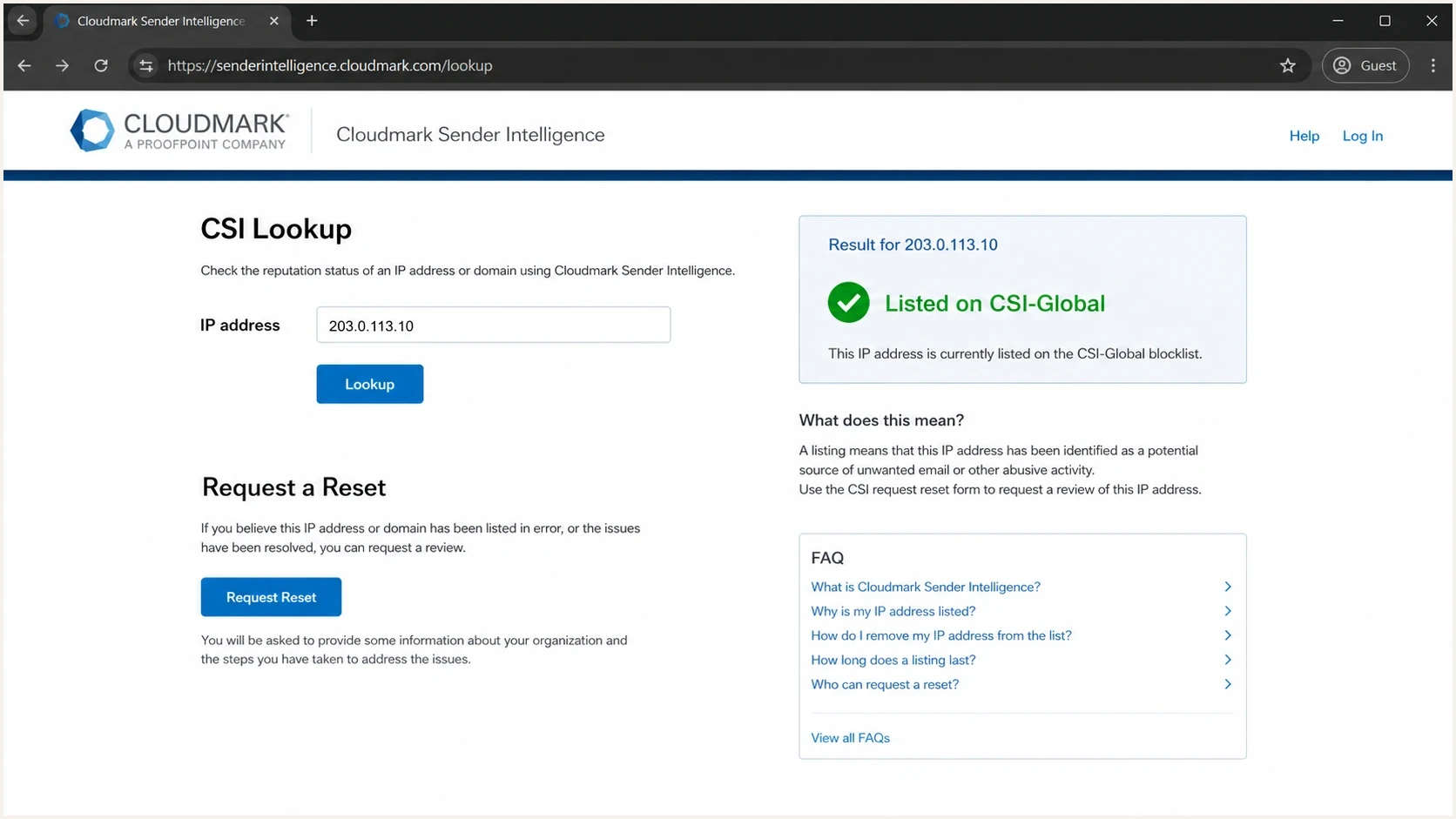
Cloudmark Sender Intelligence page showing a CSI-Global IP reputation result.
Why Cloudmark listed the IP
Only Cloudmark can confirm the exact trigger for a CSI-Global reputation. Start with the signals Cloudmark identifies and the sending conditions that commonly affect IP reputation: complaints, spam trap hits, stale address acquisition, traffic changes, reverse DNS, nearby IP reputation, shared infrastructure, and unauthorized sending.
|
|
|
|---|---|---|
Complaints | Recipients marked mail as spam. | Complaint rate and message type. |
Spam traps | Old or poorly sourced addresses entered the stream. | Address source, age, consent, and hard-bounce suppression. |
Missing or generic rDNS | The PTR name does not identify a stable mail sender. | PTR, EHLO, forward DNS, and IP assignment. |
Shared or nearby IPs | Other traffic in the pool or IP range damaged reputation. | IP ownership, netblock reputation, and other senders. |
Compromise | An account, host, or customer sent unauthorized mail. | Authentication logs, volume spikes, queue, and unusual destinations. |
Volume shift | Traffic changed too quickly or spread across many IPs. | Daily volume, IP distribution, and bounce mix. |
Common causes to investigate first.
The tricky case is transactional mail. A booking confirmation, password reset, invoice, or reminder can still create complaints if the recipient does not recognize the brand, the timing is odd, or somebody else entered the address. Transactional intent reduces risk, but it does not remove reputation risk.
Authentication passes
- SPF result: The sending IP is authorized for the envelope domain.
- DKIM result: The message has a valid cryptographic signature.
- DMARC result: The visible From domain matches the authenticated SPF or DKIM domain.
Reputation still fails
- Complaint signal: Recipients still object to mail they do not expect.
- Trap signal: A stale or poorly sourced address can damage IP reputation.
- Network signal: Generic rDNS or abusive traffic on nearby IPs can affect the decision.
This is why DMARC data and blocklist data belong together. DMARC shows which sources are sending as the domain and whether authentication passes. A blocklist or blacklist incident shows that receivers are making a reputation decision anyway.
What to do first
Handle a Cloudmark CSI-Global incident in this order. The goal is to restore delivery quickly without feeding the same reputation signals back into CSI.
- Confirm the IP: Use the bounce text, not a dashboard guess. The connecting IP in the rejection is the one to investigate.
- Pause risky sends: Stop bulk, stale, or questionable traffic while reviewing the incident.
- Check for compromise: Inspect account logins, mail queues, SMTP authentication, send-rate spikes, and unexpected recipients.
- Submit remediation: Use Cloudmark's form for the affected IP and provide the exact error, timestamp, and sender context.
- Resume carefully: Retry only after Cloudmark processes the request, then watch CSI bounces by recipient domain.
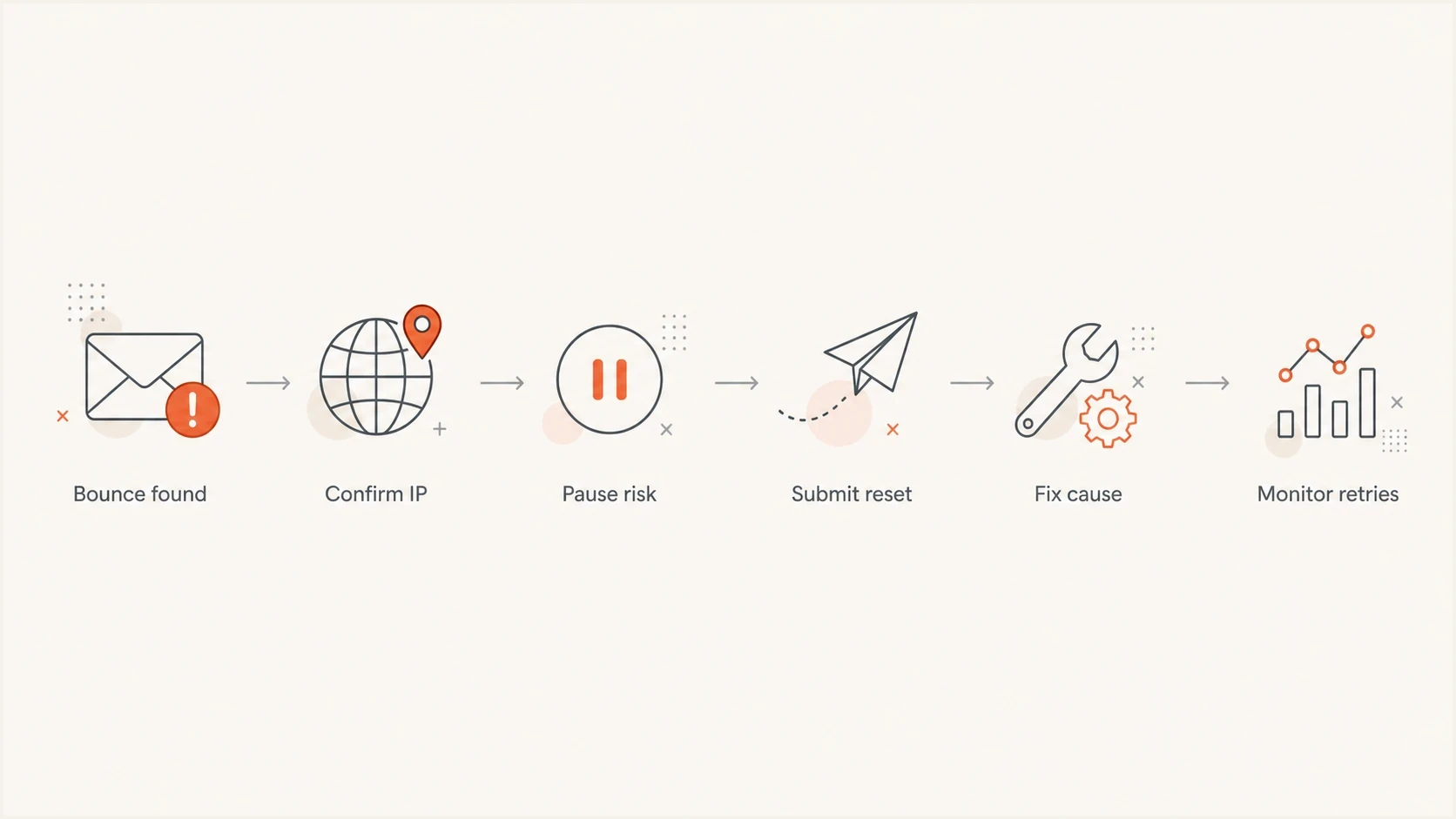
Cloudmark CSI-Global IP remediation and monitoring flowchart.
If the rejection affects one receiving network, keep the incident scoped. If the same IP is rejected across many recipient domains, pause suspect traffic and treat it as a broader sending incident. A low global bounce rate can still hide a concentrated problem at one provider.
Blocklist checker
Check your domain or IP against 144 blocklists.







After checking the active blocklist or blacklist status, test the actual message path. A seed test through an email tester can expose header, authentication, and content issues that a DNS-only lookup misses.
Who should own the remediation
The party that controls the sending IP should own the investigation and remediation request. IP ownership matters because that party can inspect every sender on the address, correct the PTR record, stop abusive traffic, and explain recent allocation changes.
You control the IP
Submit the Cloudmark request after checking mail logs, queues, accounts, customer traffic, and DNS. If the IP was recently assigned, include the full allocation and assignment date.
- Confirm valid rDNS and forward DNS.
- Stop the source of complaints, traps, or unauthorized mail.
- Keep the processed response and retest result with the incident.
A provider controls the IP
Send the full bounce to the email provider, hosting provider, ISP, or IT administrator. For shared or dynamically assigned IPs, the provider must review other users, the address pool, routing, and PTR configuration.
- Ask whether the IP is shared, dedicated, or dynamic.
- Provide the connecting IP, timestamp, and complete SMTP response.
- Ask for remediation or an approved outbound mail route.
Do not change DNS for an IP you do not control. Reassigning a dynamic address can move the symptom, but it does not correct compromised devices, unsafe sending, or poor routing.
How to submit a CSI remediation request
Cloudmark's current process requires more than entering an IP. Complete the CSI remediation form, respond to the automated message, wait for the processed confirmation, and then try the message again.
- Gather evidence: Record the connecting IP, exact SMTP error, recipient domain, timestamp with time zone, and recent sending change.
- Describe the IP: State whether it is dedicated or shared, who controls it, and whether it was recently assigned.
- Confirm the request: Respond to Cloudmark's automated email so the remediation request enters review.
- Wait before retesting: Use the processed message as the trigger to retry, then compare the new SMTP response with the original.
- Escalate the cause: If the rejection returns, stop the responsible stream and investigate complaints, traps, compromise, rDNS, and nearby IP activity.
Cloudmark describes this as a reset of related email traffic statistics, not a permanent delisting or whitelist. New-IP requests should include the full allocation and assignment date. Cloudmark also states that it does not offer an IP whitelisting service, so a successful request does not exempt future traffic from reputation checks.
Checks that prevent repeat listings
Delisting alone is not the fix. The IP, hostname, domain authentication, and traffic source should identify one stable sender. When those signals disagree, the receiver has less trustworthy history for its reputation decision.
Identity checks to comparetext
Sending IP: 203.0.113.24
PTR name: mail.example.com
EHLO name: mail.example.com
Return-Path: bounce.example.com
DKIM d=: example.com
DMARC domain: example.com
Configure one stable PTR hostname per outbound IP, use a consistent EHLO, and make sure forward DNS returns to the sending IP. Check that every authoritative nameserver returns the expected DNS data. Valid SPF, signed DKIM, and an enforced DMARC policy do not guarantee inbox placement. They reduce ambiguity during reputation reassessment.
Incident scoping cues
Use rejection concentration instead of an unsupported global bounce percentage. These are operating cues, not Cloudmark scoring thresholds.
Routine monitoring
No CSI bounces
No new CSI-Global rejections.
Investigate
One receiving network
Confirm the IP and affected stream.
Pause suspect traffic
Multiple networks or rising rejects
Review compromise, list quality, and routing.
Break down results by recipient domain, sending IP, and mail stream. One global bounce number can hide a serious Cloudmark problem when most rejections come from a small group of Cloudmark-protected recipients. Cloudmark does not operate a sender feedback loop, so use complaint feedback offered by receiving networks and suppress complainers promptly.
For broader context on these reputation decisions, see the explanation of blocklists. If the issue expands beyond Cloudmark, the blacklisted IP guide gives a wider cleanup workflow.
Where Suped fits
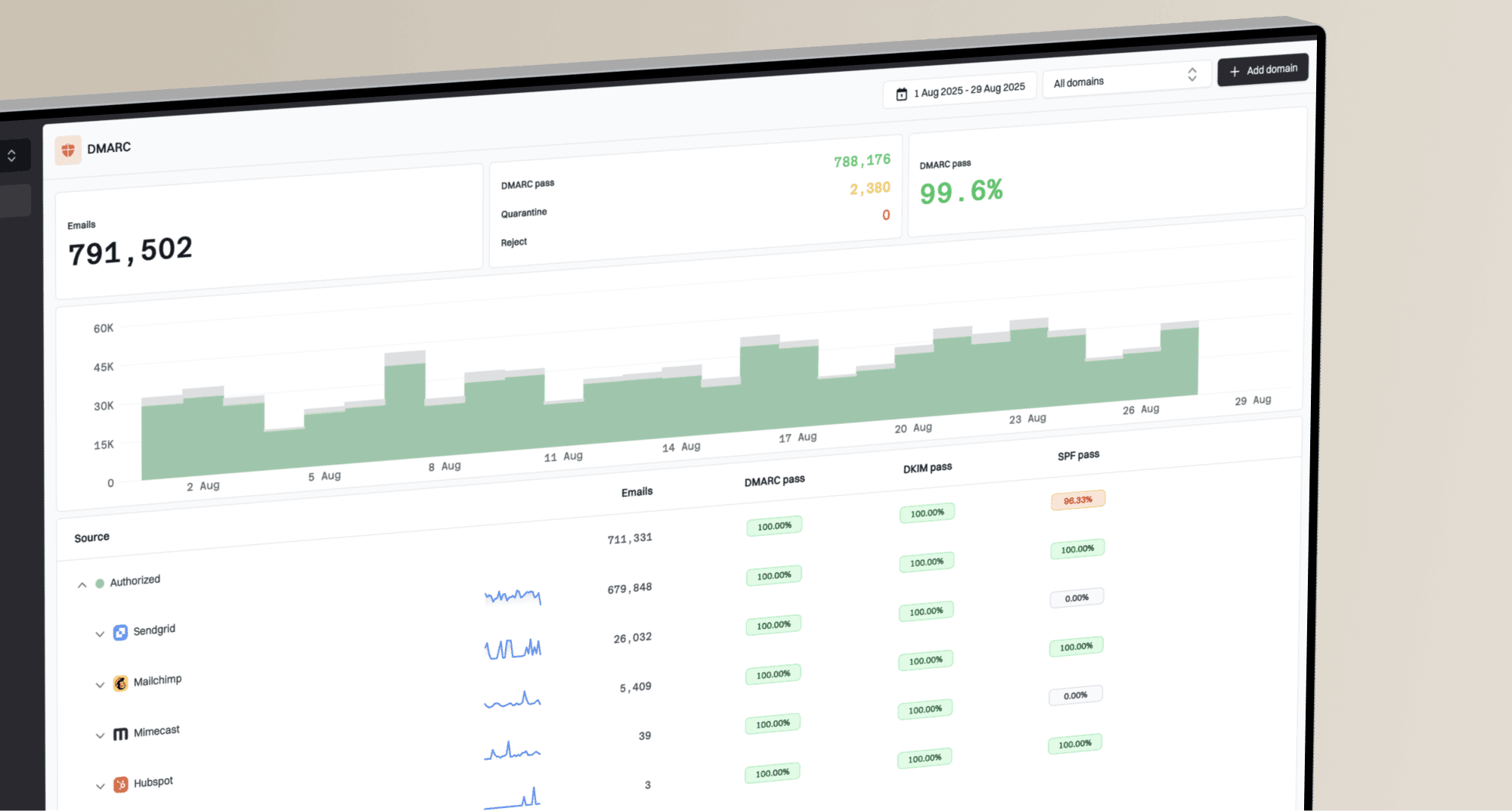
Cloudmark remediation addresses the immediate CSI reputation issue. Suped's product supports the operating work around it by monitoring authentication and blocklist status, then connecting an affected IP to the domains and mail sources that use it.
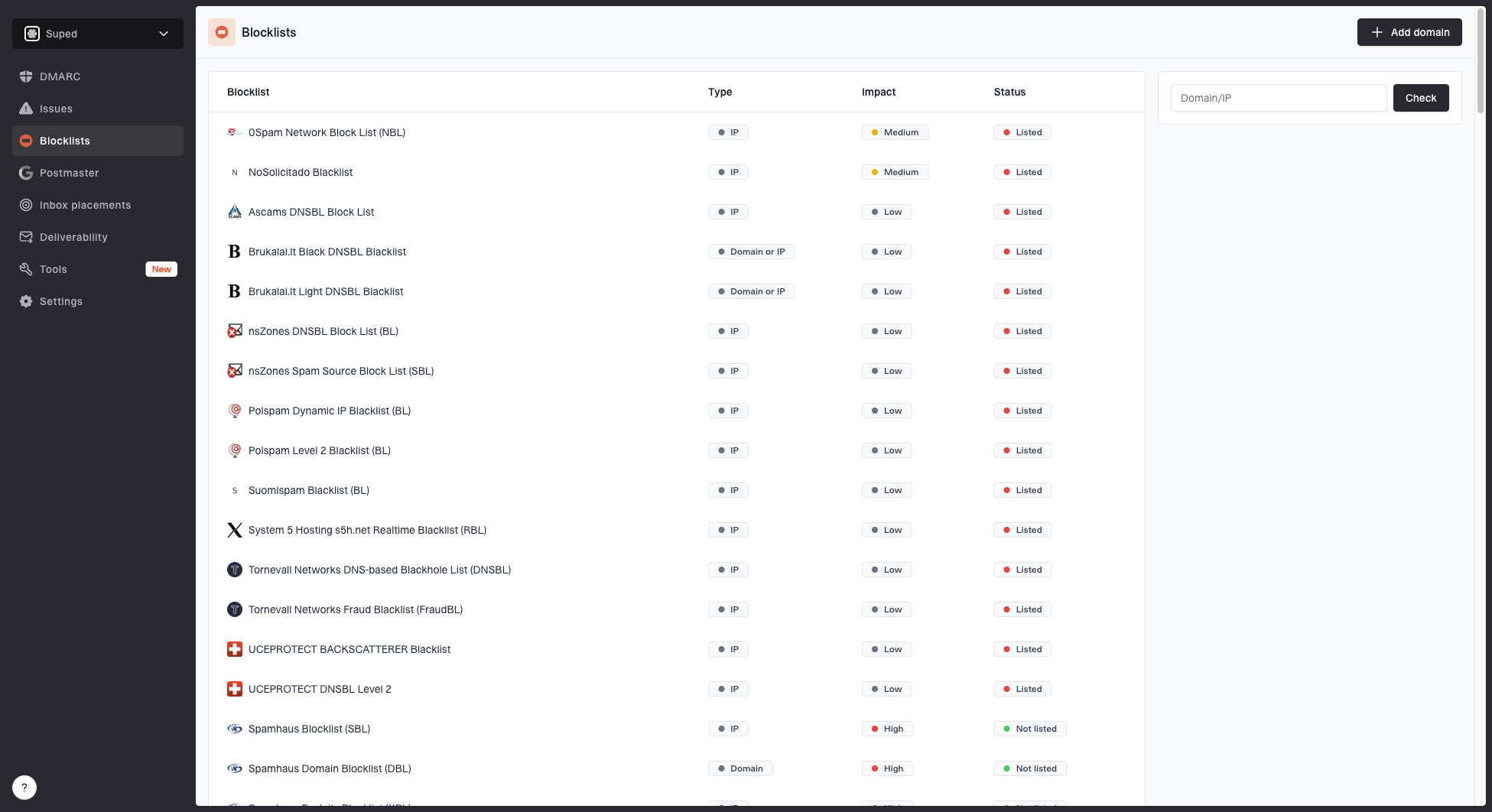
Blocklist monitoring page showing domain and IP checks across blocklists with importance and status
During a CSI incident, Suped combines DMARC source data with blocklist monitoring and alerts. Use that view to identify which authenticated source used the affected IP, check whether other sending IPs have blacklist or blocklist issues, and keep the investigation tied to the correct domain.
A common Suped workflow is to review the IP or domain in blocklist monitoring, compare it with DMARC source data, and use issue detection to record the fix steps. If DNS configuration contributed to the incident, the domain health check gives a fast view of DMARC, SPF, and DKIM records.
Practical prevention
- Real-time alerts: Catch a new blacklist or blocklist event before customer reports become the first signal.
- Source mapping: Tie the affected IP to the platform and authenticated domain sending the traffic.
- Domain comparison: Check whether the incident is isolated to one IP, source, or recipient network.
- Recovery notes: Keep the bounce evidence, remediation status, root cause, and retry result together.
Views from the trenches
Best practices
Confirm the exact IP in the bounce before changing DNS, routing, or sender settings.
Keep rDNS, EHLO, return-path, DKIM, and DMARC tied to a stable sender identity first.
Treat a successful reset as a warning to review complaints, traps, and recent traffic.
Common pitfalls
Requesting delisting before pausing suspect sends often leads to another quick listing.
Assuming transactional mail has no complaint risk causes teams to miss expectation gaps.
Checking only SPF, DKIM, and DMARC misses rDNS age and IP reputation signals too.
Expert tips
Separate appointment confirmations from marketing traffic when expectations differ by consent.
Log recipient domain, bounce code, sending IP, and campaign source for every block event.
Watch the IP owner question closely; shared infrastructure changes the fix path quickly.
Marketer from Email Geeks says a Cloudmark CSI-Global bounce means the sending IP is listed and the recipient system is blocking on that signal.
2020-03-11 - Email Geeks
Marketer from Email Geeks says complaints and spam traps are the first causes to review, even when the sender believes the mail is transactional.
2020-03-11 - Email Geeks
The practical answer
Your IP is described as listed on Cloudmark CSI-Global because CSI has assigned a poor or suspect reputation that influenced a receiver's SMTP policy. Cloudmark supplies the reputation data, and the receiver applies the block. Submit the remediation request for the exact connecting IP, then correct the cause before normal sending resumes.
Tell an affected customer this plainly: their provider rejected the message because it applied Cloudmark CSI reputation to the sending IP. The team submitted a remediation request, checked the responsible sending stream, and is monitoring retries. That explanation is accurate without promising a delivery time.
The longer-term fix is better visibility. When DMARC sources, DNS health, blacklist or blocklist status, and bounce patterns sit in one incident record, the team can identify the sending source behind a Cloudmark rejection.