Why is my domain listed in Razor2 and how do I remove it?

Published 10 Jul 2025
Updated 22 Sep 2026
14 min read
Summarize with
Updated on 22 Sep 2026: We updated this guide with current Razor2 scoring and clearer sender-security steps for preventing repeat matches.
If your domain appears to be listed in Razor2, the direct answer is this: Razor2 is usually not listing your domain the way a normal DNS blocklist or blacklist does. Razor2 is a distributed, collaborative spam-detection network that compares message-part signatures with signatures submitted as spam. Filters such as SpamAssassin calculate a signature for each MIME part, query the Razor catalogue, and use the highest returned confidence for the message.
That distinction matters because there is no normal 'remove my domain' button. The practical fix is to preserve the exact email that triggered the result, identify its sending source, stop unauthorized or forgotten mail, and isolate the message part that matched. Treat Razor2 as a content-signature signal first, then check authentication and reputation for separate problems.
Start with DMARC reports to find systems sending as your domain, then inspect a real message and its SpamAssassin-style score. Check blocklist or blacklist status separately if the sender also has a reputation problem. Suped's product brings DMARC source discovery, authentication results, blocklist monitoring, and alerts into one workflow, which helps connect a Razor2 hit with the system that sent the tested message.
What Razor2 is actually telling you
Razor2 works differently from a traditional IP or domain blocklist (blacklist). A normal blocklist often identifies an IP address or domain with a reputation problem. Razor2 computes signatures for message parts and checks those signatures against its catalogue of reported spam. A receiving filter can then add points when the returned confidence meets its configured threshold.
The key distinction
A Razor2 result does not prove that your domain has been added to a central domain blacklist. It means at least one tested message part returned enough confidence for the receiving filter's Razor rule to fire. Depending on the filter's total score and local policy, those points can contribute to spam tagging, junk placement, quarantine, or rejection.
The confusion starts because some deliverability reports describe the rule as 'Listed in Razor2.' You see a name such as RAZOR2_CHECK and assume your domain was entered into a database with a delisting form. The rule label describes a matching message signature, not a conventional domain listing. Changing the sending IP alone will not change that signature.
- Content match: A MIME part, template, footer, link structure, or body passage produced a signature associated with reported spam.
- Sender clue: The sending domain or IP can have a separate reputation issue even though Razor2 itself checked message signatures.
- No domain removal: The catalogue is keyed to message signatures, so a conventional domain delisting request does not remove the match.
- Evidence needed: Preserve the original message, full headers, Razor rule names, confidence output, and sending source before changing anything.
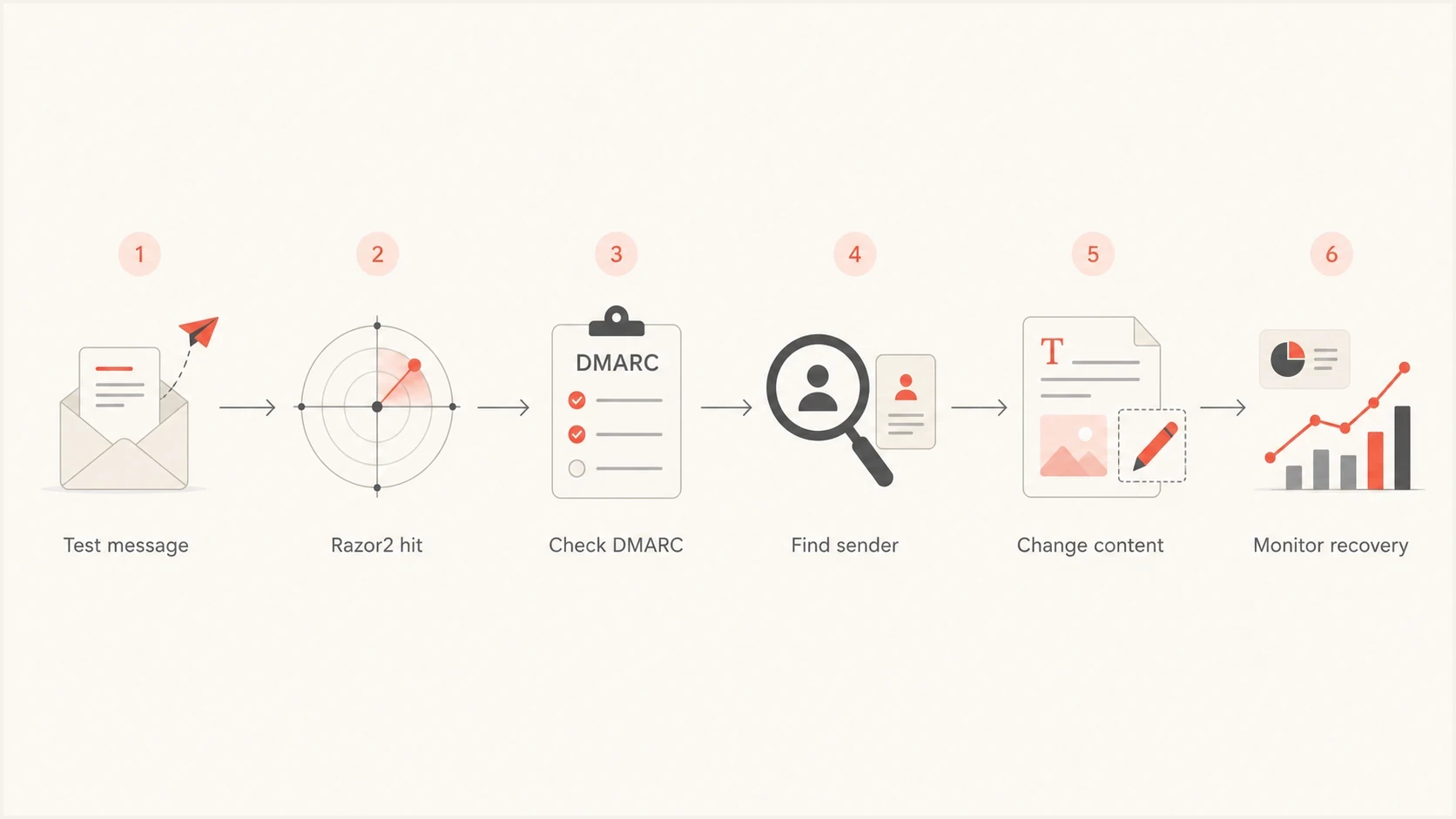
A flowchart showing how to investigate a Razor2 content hit.
Why a domain with no bulk email still triggers Razor2
A common surprise is finding real mail volume after a team believes the domain has not sent bulk email. An old application, web form, transactional service, forgotten server, or exposed SMTP credential can still send. No active marketing campaign does not mean no mail is leaving the domain.
Start with sender discovery, not delisting. A domain can be part of a Razor signature when it appears in message content, links, tracking redirects, or reused footer material. A compromised form or website mailer can distribute the same domain-bearing content at scale before the owner notices.
|
|
|
|---|---|---|
Old app | DMARC source IPs | Disable or reauthorize |
Copied template | Body and footer | Isolate and replace the match |
Abused form | Web and mail logs | Rate-limit and secure |
Shared links | Redirect and destination domains | Remove risky redirects |
Forwarded mail | Full headers | Trace the original source |
Common Razor2 trigger paths
Do not reduce the diagnosis to a list of 'spammy words.' Razor2 matches reported message signatures, and the decisive material can be a repeated HTML part, footer, or linked host rather than the visible sales copy. Stop the bad source, isolate the matching part, and confirm which authenticated system produced it.
Do not assume no send means no send
If DMARC reports show mail from an unfamiliar source, treat that as the lead. Old infrastructure can keep sending password resets, account alerts, invoices, trial notices, or form responses after regular campaigns stop.
How to confirm whether Razor2 is the real problem
Separate content scoring from authentication failure and broader reputation. Razor2 belongs in content-signature scoring. DMARC, with SPF and DKIM, belongs in authentication. IP or domain blocklist (blacklist) hits belong in reputation checks. A message can have problems in more than one area, but each area needs its own evidence and fix.
Razor2 content issue
- Signal: A message test or receiving filter reports a Razor2 rule hit.
- Root cause: A message part produced a signature associated with reported spam.
- Fix: Isolate the matching part, correct its source, and retest the exact send.
Domain or IP reputation issue
- Signal: A separate blocklist checker or receiving provider flags a domain or IP address.
- Root cause: Spam complaints, compromised sending, abuse traffic, or poor shared infrastructure.
- Fix: Stop the abuse, verify sender controls, then follow the list owner's removal process.
Save the original .eml file in RFC 5322 format before testing variants. Send a controlled copy through the same route, then inspect the full headers, MIME structure, rule names, individual rule points, total score, and required score. Test a plain-text version and a minimal HTML version, then add components back one at a time. Keep legally required unsubscribe and sender-identification content in live marketing mail; use isolated test messages to identify the match.
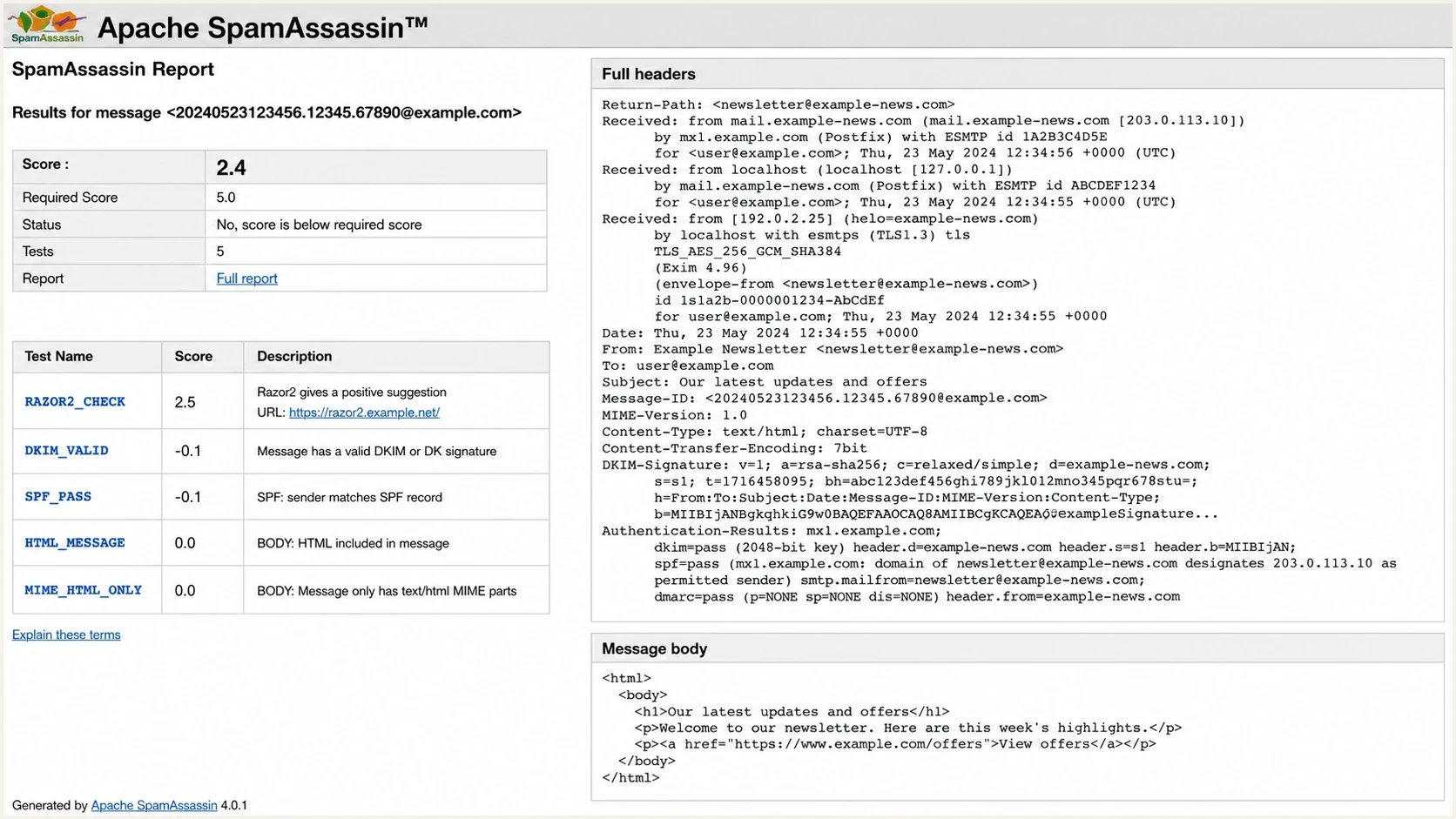
A SpamAssassin report showing a Razor2 rule hit for a test email.
Email tester
Send a real email to this address. Suped shows a results button when the test is ready.
?/43tests passed
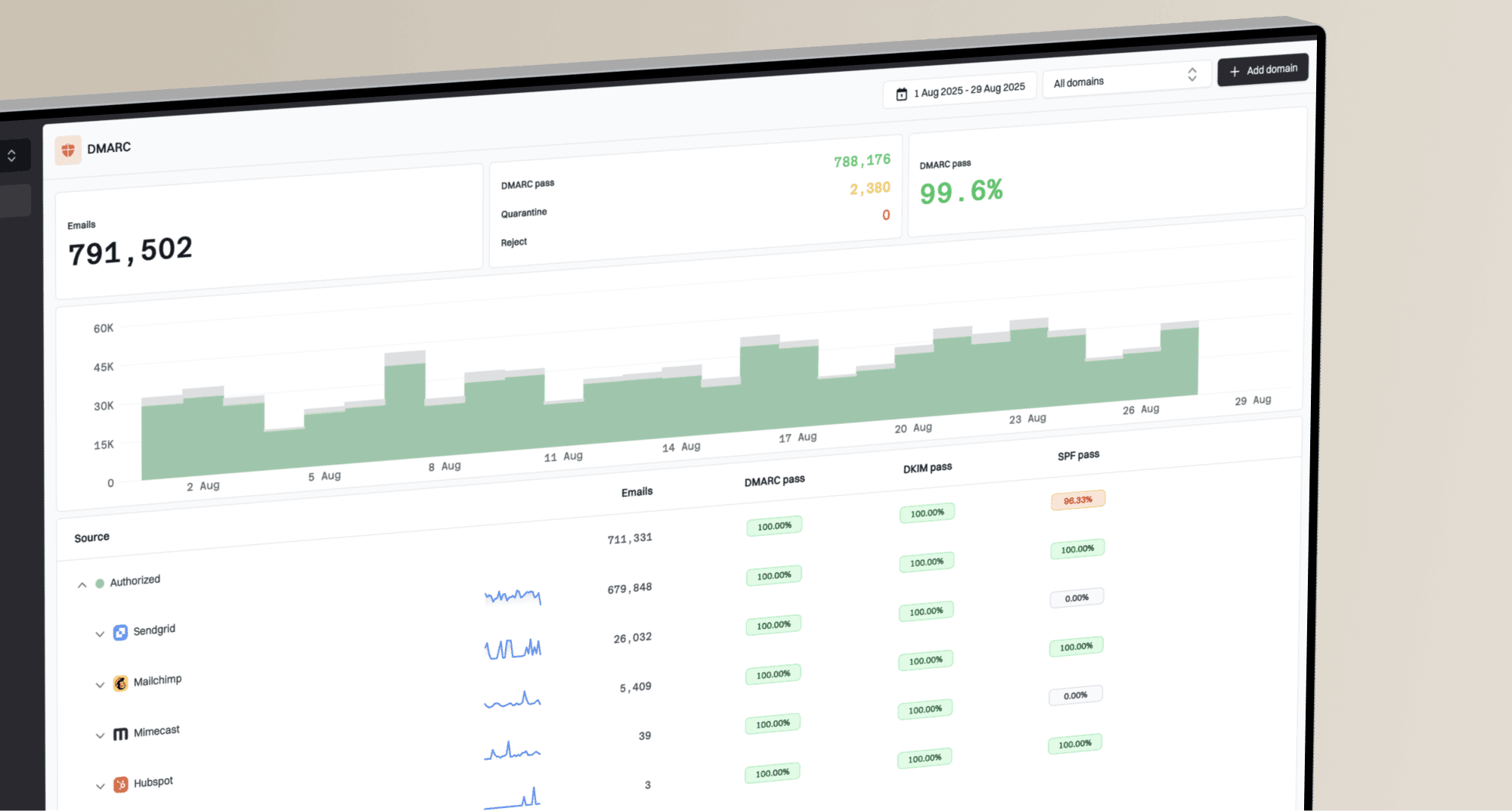
A message test describes that sample, not every message from the domain. DMARC aggregate reports add source-level context. Suped's DMARC dashboard groups sending sources, authentication results, policy status, and detected issues. The domain health checker can also identify obvious DMARC, SPF, or DKIM record problems around the same domain.
Suped DMARC dashboard showing email volume, authentication health, and source breakdown
What confidence scores and false positives mean
Razor can return a confidence value between 0 and 100 for each checked message part. SpamAssassin's Razor2 plugin uses the highest part confidence for the message. RAZOR2_CHECK fires when that result meets the Razor client's configured min_cf threshold. A rule such as RAZOR2_CF_RANGE_51_100 describes the returned confidence range. If both rules appear, they come from the same Razor check and do not prove two separate listings.
Confidence is not the final delivery verdict
The receiving SpamAssassin installation assigns rule points and sets its own total-score threshold. A Razor confidence of 100 does not mean a 100-point SpamAssassin score, and a Razor hit alone does not explain every inbox placement or rejection.
- Sender or tester: Retest the exact saved message and controlled variants through the same scoring path. Different installations can use different rule scores or thresholds.
- Razor identity holder: If the exact nonspam message was reported incorrectly, an authenticated Razor client can submit that original message with razor-revoke. This is a nonspam vote for the message signature, not a domain delisting request.
- Receiving mail administrator: A local Razor whitelist can skip a precise address or body signature on systems you control. Keep the exception narrow because it changes only local checking and broad exceptions weaken filtering.
- Revocation limit: A successful revoke does not guarantee that the catalogue will classify the message as nonspam. Razor weighs reports according to the reporting identities' trust.
Most domain owners do not control the recipient's Razor installation or the test provider's configuration. Their practical route remains source remediation and message retesting. Use revocation only for the exact original message you know was classified incorrectly; do not use it as a bulk reputation-reset tactic.
How to stop future Razor2 matches
For Razor2, you normally cannot force a domain delisting in the way you can with a DNS blocklist. The reliable path is to identify the matched message, stop the source of unwanted mail, correct or replace the matching part, and prevent the old version from being sent again.
- Capture evidence: Save the original .eml file in RFC 5322 format, full headers, sending IP, envelope sender, visible From domain, MIME parts, and rule output.
- Find the sender: Use DMARC aggregate data with application and mail logs to identify the server or service that produced the message.
- Stop unwanted mail: Disable forgotten apps, revoke exposed credentials, secure abused forms, and pause campaigns tied to invalid consent or a complaint spike.
- Isolate the signature: Test the plain-text part, HTML part, footer, linked hosts, and reused content in controlled variants.
- Replace the cause: Correct the source template or application so it cannot regenerate the same matching message part.
- Monitor later sends: Watch Razor test results, DMARC sources, authentication failures, complaints, and separate blocklist status.
Illustrative authentication records, not a Razor2 fixdns
_dmarc.example.com.  TXT  "v=DMARC1; p=none; rua=mailto:dmarc-reports@example.com"
example.com.         TXT  "v=spf1 include:_spf.authorized-sender.example -all"
selector1._domainkey.example.com. TXT "v=DKIM1; k=rsa; p=BASE64_PUBLIC_KEY"
The DNS records are placeholders, not values to publish unchanged. DMARC reporting helps identify sources, while SPF and DKIM help receivers verify authorized mail. None removes a Razor2 message signature. Build SPF from a verified sender inventory before using -all. Suped's hosted SPF workflow can help manage authorized sources and DNS lookup limits after that inventory is confirmed.
If a normal blocklist or blacklist appears at the same time, follow its removal workflow only after fixing the cause. Suped's blocklist monitoring keeps domain and IP listings beside authentication findings, so a Razor2 content match stays separate from a list-based reputation event.
How DMARC helps find the hidden sender
DMARC does not remove Razor2 hits, but aggregate reports often answer the operational question: where did observed mail using this domain come from? Participating receivers report source IPs, message counts, policy disposition, and SPF or DKIM authentication results for mail they processed. That coverage can expose volume or sources that conflict with the team's sender inventory, but it is not a complete log of every message sent.
Example DMARC source split
A hidden sender often becomes obvious once DMARC aggregate reports are grouped by source.
Passed
Failed
Unknown
Look for an unrecognized source, unexpected volume, authentication failures from a legitimate system, or an authenticated source sending content nobody owns anymore. A source that passes DMARC is authorized or using a domain-matched identity, but that result does not prove its message content is wanted.
Where Suped fits
If DMARC reporting is absent, add a reporting address to the existing policy and collect enough receiver data to identify patterns. Do not move a production domain straight to p=reject until legitimate sources pass DMARC through SPF or DKIM with the required domain match. Suped's hosted DMARC workflow can help stage policy changes when several teams own sending systems.
DMARC checker
Look up a domain's DMARC record and catch policy issues.
?/7tests passed
How to prevent new spam reports and account abuse
Razor's catalogue is built from user-submitted spam reports, so content repair alone is incomplete if recipients still consider the mail unwanted. A high complaint rate does not automatically prove that Razor received those complaints, but it is evidence that permission, targeting, frequency, or sender security needs attention.
- Verify permission: Keep proof of consent and stop using purchased, rented, shared, or otherwise unverified address lists.
- Honor suppression: Remove complainers, hard bounces, and unsubscribed recipients from every connected sending system.
- Review weak segments: Pause campaigns with complaint spikes and sunset recipients who no longer expect or engage with the mail.
- Secure access: Reset exposed passwords, enable MFA, rotate SMTP and API credentials, and remove unknown integrations.
- Audit automation: Review forms, scheduled campaigns, outbound sequences, and application logs for sends nobody approved.
Authentication does not prove consent
An authorized platform can pass DMARC through SPF or DKIM alignment while sending mail that recipients report as spam. Use authentication to identify and control the source, then use consent records and complaint data to decide whether the mail should continue.
What to change in the message body
Once you know the source, test content changes methodically. Do not rewrite everything at once. Razor signatures are designed to remain useful across some message mutations, so a small wording edit often leaves the match intact while removing a specific repeated part changes the result.
- Start plain: Send an isolated plain-text version through the same route to separate HTML-part issues from text-part issues.
- Remove reused blocks: Temporarily remove old signatures, copied footers, tracking pixels, and boilerplate in controlled tests.
- Inspect links: Test redirect hosts and destination domains individually, and replace abandoned or compromised tracking domains.
- Replace the template: Use clean, valid HTML when an old template or copied block produces the matching signature.
- Retest each version: Record the exact MIME parts and changes in every version so the result can be reproduced.
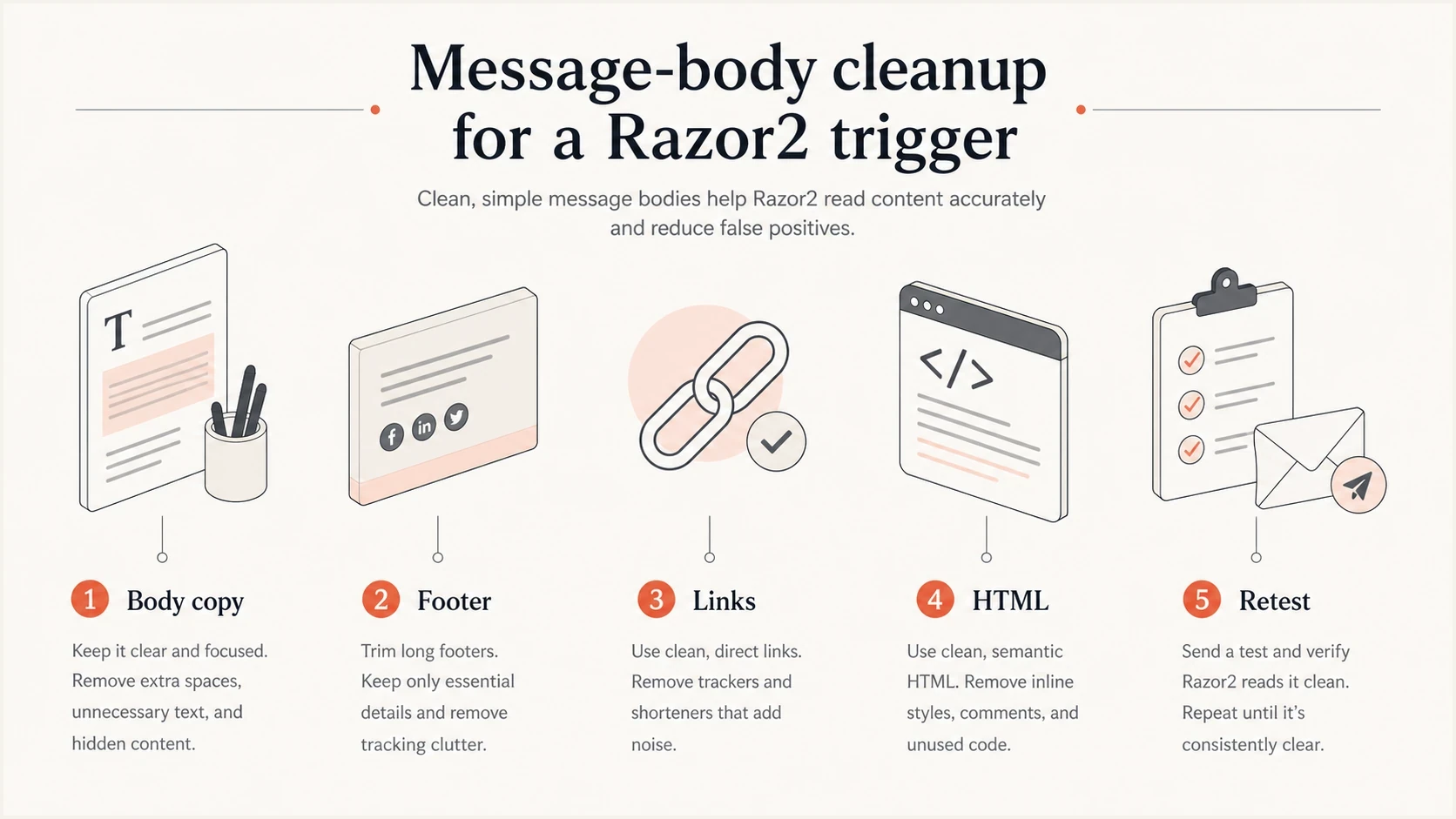
An infographic showing five content areas to check after a Razor2 hit.
If a content change clears the Razor2 result, update the application or shared template that produced the old version. A one-off email edit will not hold if an automated system keeps inserting the same matching part.
When it is a real blocklist problem too
Razor2 can prompt the investigation, but it is not the only issue to check. If the sending IP or domain also appears on an IP or domain blocklist (blacklist), treat that as a separate reputation incident. A content change will not remove an IP listing caused by compromised traffic, and a DNS delisting request will not fix a Razor2 signature match.
The broader blocklist guide explains how list-based incidents differ. If the result is not Razor2-specific, follow the list owner's instructions after the sending cause is fixed. The sequence is fix the cause, request removal where supported, then monitor.
Blocklist checker
Check your domain or IP against 144 blocklists.







Use the guide on how to get delisted only after confirming that the issue is a list-based reputation event rather than a Razor2 message match.
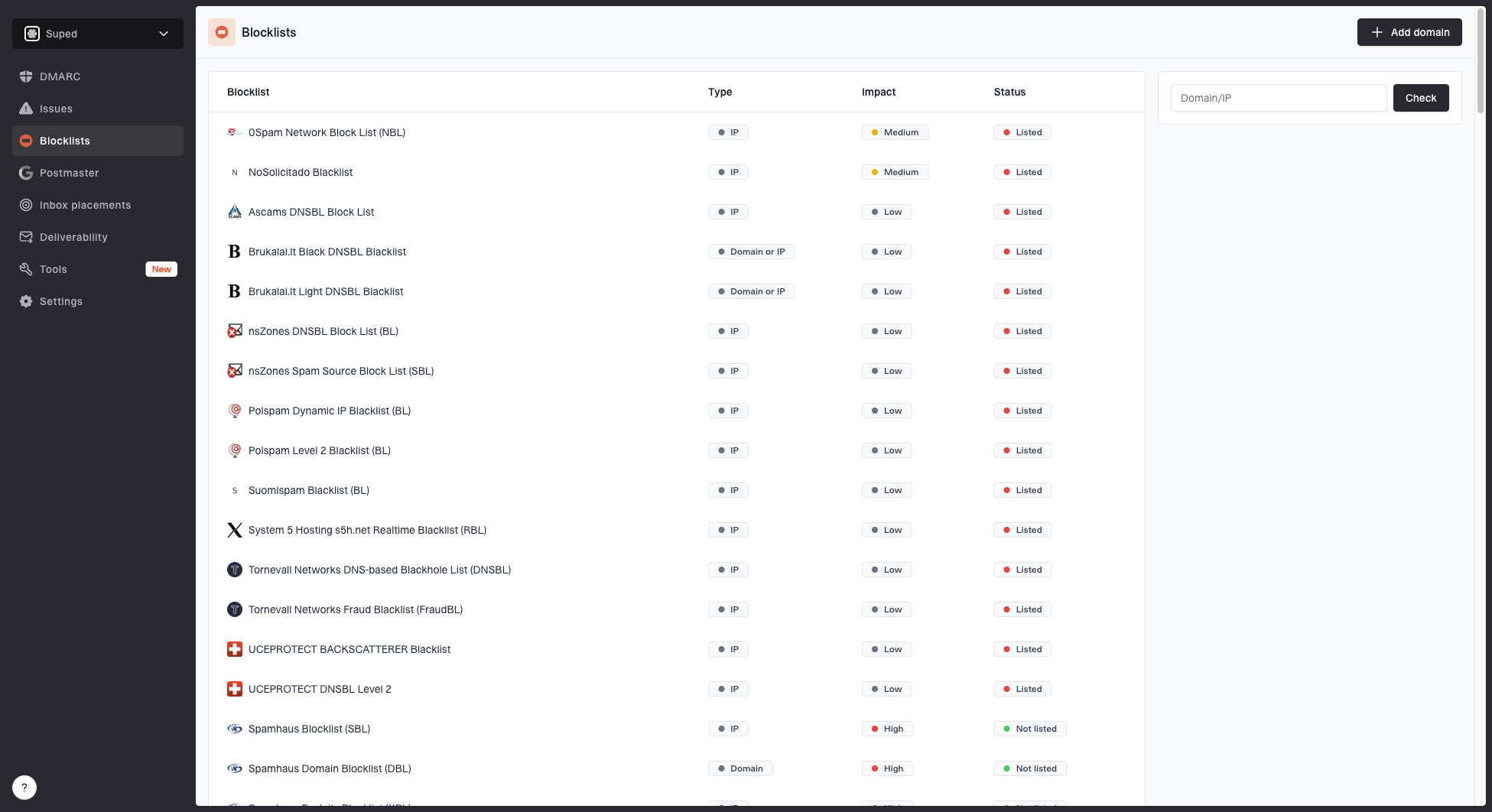
Blocklist monitoring page showing domain and IP checks across blocklists with importance and status
Views from the trenches
Best practices
Use DMARC reports first, because hidden senders often explain sudden Razor2 hits.
Test message variants one at a time so the exact matching content becomes visible.
Separate content scoring from true blocklist incidents before requesting removal.
Common pitfalls
Assuming Razor2 is a normal domain blacklist wastes time on the wrong fix path again.
Ignoring old apps leaves forgotten servers sending mail long after campaigns stop daily.
Changing DNS before finding the message body trigger can hide the real evidence.
Expert tips
Keep original headers and tested content samples before editing templates or servers.
Check authentication and source volume together, not as disconnected side tasks.
Treat repeated footers, redirect links, and copied HTML as likely content suspects.
Marketer from Email Geeks says a domain that appears unused can still have an old server or application sending meaningful volume.
2020-03-17 - Email Geeks
Marketer from Email Geeks says DMARC reports can reveal where the domain is being used when the sender is not obvious internally.
2020-03-17 - Email Geeks
Can you remove a domain from Razor2?
Your domain is probably not 'listed in Razor2' in the normal blocklist sense, so there is no conventional domain removal request. A message associated with the domain produced a signature that Razor associates with reported spam. Find the sending source, stop unauthorized or unwanted mail, isolate the matching message part, and retest through the same scoring path. Handle any real blocklist or blacklist event separately after fixing its cause. Suped's product connects DMARC source monitoring, authentication controls, alerts, and blocklist monitoring to support that investigation without treating a content match as a domain delisting event.