Which email blocklists are most important for deliverability and how should they be prioritized?

Updated on 1 Aug 2026: We updated this guide with clearer Spamhaus list distinctions, SpamCop coverage, and a practical prevention and removal workflow.
The most important email blocklists for deliverability are the ones that recipients' mailbox providers actually use. In practice, Spamhaus SBL and CSS sit at the top for spam and low-reputation sending, DBL matters for domain reputation, XBL requires a security response, and PBL matters only when an IP is sending direct to recipient MX servers against policy. Abusix, Invaluement, SpamCop, SURBL, URIBL, Barracuda, Proofpoint, and regional lists such as NoSolicitado follow when the audience or delivery evidence makes them relevant. Cloudmark and Vade matter too, but they are usually private filtering systems rather than public lists that can be queried like a normal DNSBL.
The priority order is not a universal ranking of blacklist brands. A listing matters when it affects real recipients, appears in SMTP deferrals or blocks, lines up with complaint or engagement problems, or points to a domain, URL, IP, security, or routing issue that can be fixed. A small blocklist can be urgent for a sender with a South American audience. A famous list can be less urgent when no meaningful part of the audience is filtered through it.
The short answer
Prioritize email blocklists in this order: confirmed delivery impact first, major network or mailbox usage second, listing type next, and actionability after that. The name of the list matters, but it is not enough on its own. The key questions are whether the listing is blocking mail, whether the affected recipients are valuable, and whether the listing points to a content, consent, authentication, infrastructure, security, or routing problem.
- Highest priority: Spamhaus SBL or CSS listings, DBL listings tied to active mail, and any blocklist or blacklist named in rejection logs for a large recipient segment.
- Security priority: Spamhaus XBL listings, which point to a compromised or insecure device behind the listed IP and need containment before delisting.
- High priority with evidence: Abusix, Invaluement, SpamCop, SURBL, URIBL, Barracuda, and Proofpoint hits when they match real delivery symptoms or high-value mailbox domains.
- Configuration priority: Spamhaus PBL when a legitimate mail server is sending direct to recipient MX servers. A normal end-user IP appearing on PBL is not evidence of spam.
- Conditional priority: Regional lists such as NoSolicitado, local ISP filters, and smaller DNSBLs when recipient geography or logs prove they matter.
- Monitor only: Obscure, vague, hobbyist, or old-style blacklists that do not appear in bounce logs and do not map to the audience.
Do not treat public lookup results as the whole truth
Some filters with strong direct impact are not publicly queryable. Cloudmark, Vade, Barracuda appliances, and mailbox-provider internal reputation systems often surface through SMTP responses, seed tests, complaint patterns, or recipient-domain symptoms, not through a public lookup page.
For a broader explainer on how blocklists work, start with blocklist basics. If you need the more technical taxonomy, the types of blocklists guide is a useful companion.
A practical priority model
The cleanest way to prioritize a listing is to score it against evidence. A simple model stops teams from overreacting to noisy blacklist results and underreacting to quiet but harmful filtering. It also makes client conversations easier because it separates actual delivery risk from reputation noise.
|
|
|
|---|---|---|
Spamhaus SBL or CSS plus rejection | Critical | Stop affected traffic |
Spamhaus XBL | Critical | Isolate compromised source |
Spamhaus DBL | High | Inspect listed domain |
Spamhaus PBL | Conditional | Verify SMTP routing |
SURBL, URIBL, or Invaluement URI | High | Check message URLs |
Abusix, Invaluement IP, or SpamCop | Evidence-based | Match bounces and traffic |
Barracuda or Proofpoint rejection | High | Follow rejection evidence |
Regional DNSBL | Variable | Map recipient audience |
Obscure list | Low | Monitor |
A compact blocklist priority model for sender operations.
Example priority scoring rulesjson
{
  "confirmedRejection": 40,
  "topRecipientDomainAffected": 25,
  "securityCompromiseSignal": 25,
  "domainOrUrlHit": 20,
  "dedicatedIpHit": 15,
  "regionalAudienceMatch": 15,
  "repeatListingWithin30Days": 10,
  "policyOnlyPblWithoutDirectSend": -25,
  "unclearOrUnactionableList": -20
}
Escalation by affected recipient share
Use recipient impact to decide how fast the team should move.
Noise
0%
No matching bounces or recipient domains.
Watch
<1%
Small recipient set, no trend yet.
Investigate
1-5%
Material audience segment is affected.
Incident
>5%
Major audience segment is affected.
Which lists deserve daily monitoring
Daily monitoring should cover the public lists that create the most actionable signals for senders. Spamhaus comes first because SBL and CSS listings can produce direct blocking across many receivers, while a DBL hit can expose a content or domain problem before it becomes a broader sender reputation issue. XBL needs a security investigation. PBL needs a routing check only when the listed IP is expected to deliver mail directly to recipient MX servers.
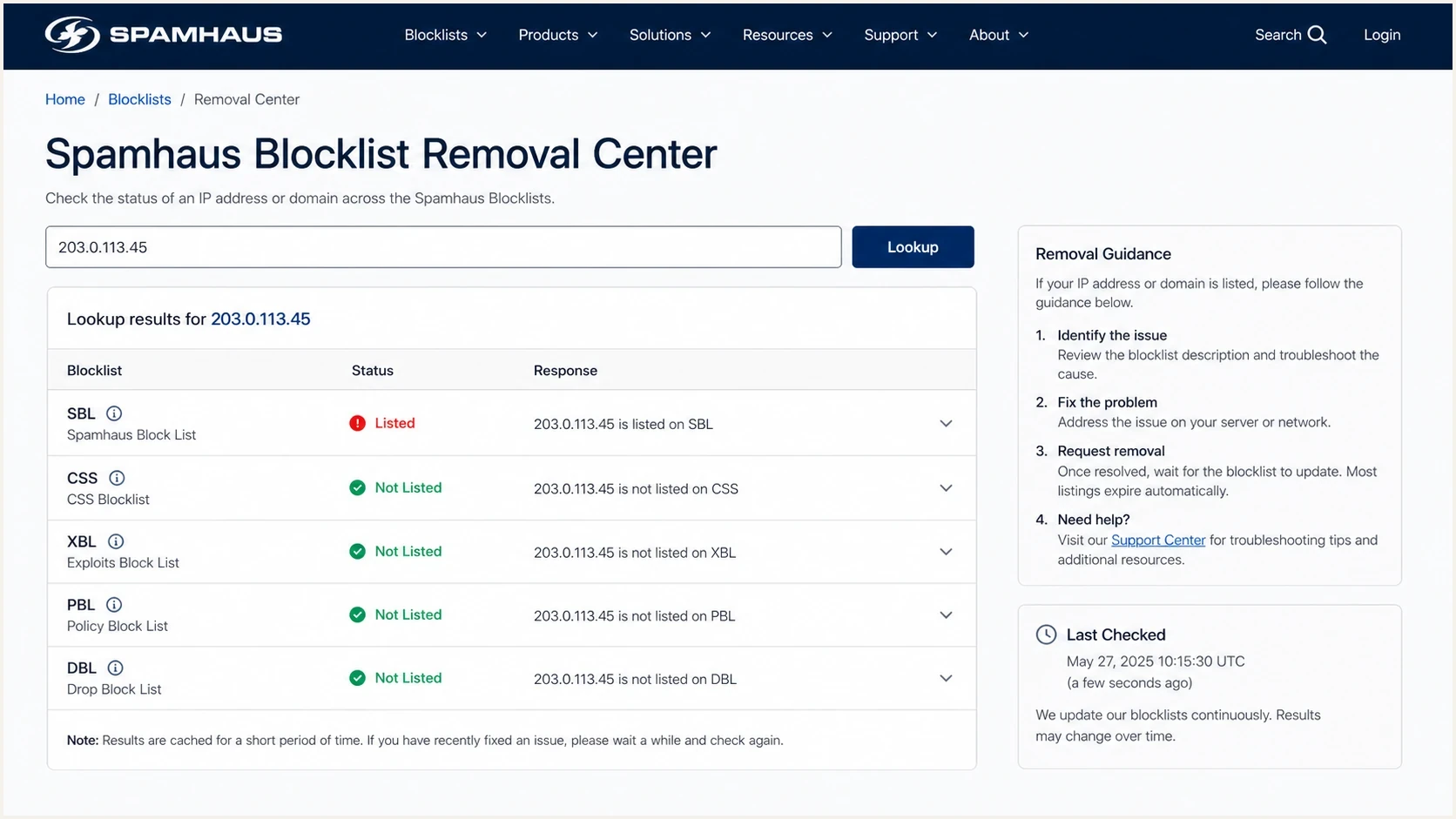
Example screenshot concept of Spamhaus listing status rows and removal guidance.
Abusix and Invaluement are also worth monitoring for senders with steady commercial volume. SpamCop is a useful complaint-led signal, but its list is time-based and can clear quickly after reports stop, so a lookup should be matched to bounces and recent traffic. SURBL and URIBL are useful when message URLs can be inspected, because domain and URL listings often point to landing pages, tracking domains, affiliate content, compromised assets, or customers whose content should be paused. A domain health check helps connect these signals with authentication and DNS issues.
Blocklist checker
Check your domain or IP against 144 blocklists.







Barracuda and Proofpoint need a different mindset. They are important because many businesses sit behind those filters, but the evidence often comes through rejection text, customer reports, or logs rather than a generic multi-list result. Cloudmark and Vade fit the same pattern. If a receiver says one of these systems blocked the message, treat it as high priority. If a lookup dashboard claims a generic issue without receiver evidence, keep it below confirmed blocks.
Domain, URL, and IP signals mean different things
Domain, URL, and IP listings should not go into the same bucket. A domain or URL hit often catches a content problem early. A reputation-based IP hit can show that unwanted traffic has already left the system, while XBL indicates compromise and PBL indicates direct-to-MX routing policy. Those differences change who owns the fix.
Domain and URL listings
- Best use: Catch suspicious content, tracking domains, compromised pages, and risky customer links before more mail leaves.
- Likely owner: Content, lifecycle, security, customer success, or agency teams.
- First fix: Pause the campaign, inspect URLs, remove unsafe links, and verify landing pages.
IP listings
- Best use: Find spam-source reputation problems, compromised devices, and unexpected direct-to-MX sending by reading the specific list type.
- Likely owner: Deliverability, compliance, security, ESP operations, or the sender using the dedicated IP.
- First fix: Stop the affected stream or compromised source, verify routing, suppress risky contacts, and request delisting after remediation.
For ESPs and agencies, this split is important. If message content is available through webhooks, APIs, or pre-send review, domain-based and URL-based blacklist checks can become an early warning system. Monitoring only IPs after messages leave mostly exposes the end of the problem. The more operational guide to identify the cause goes deeper on that investigation path.
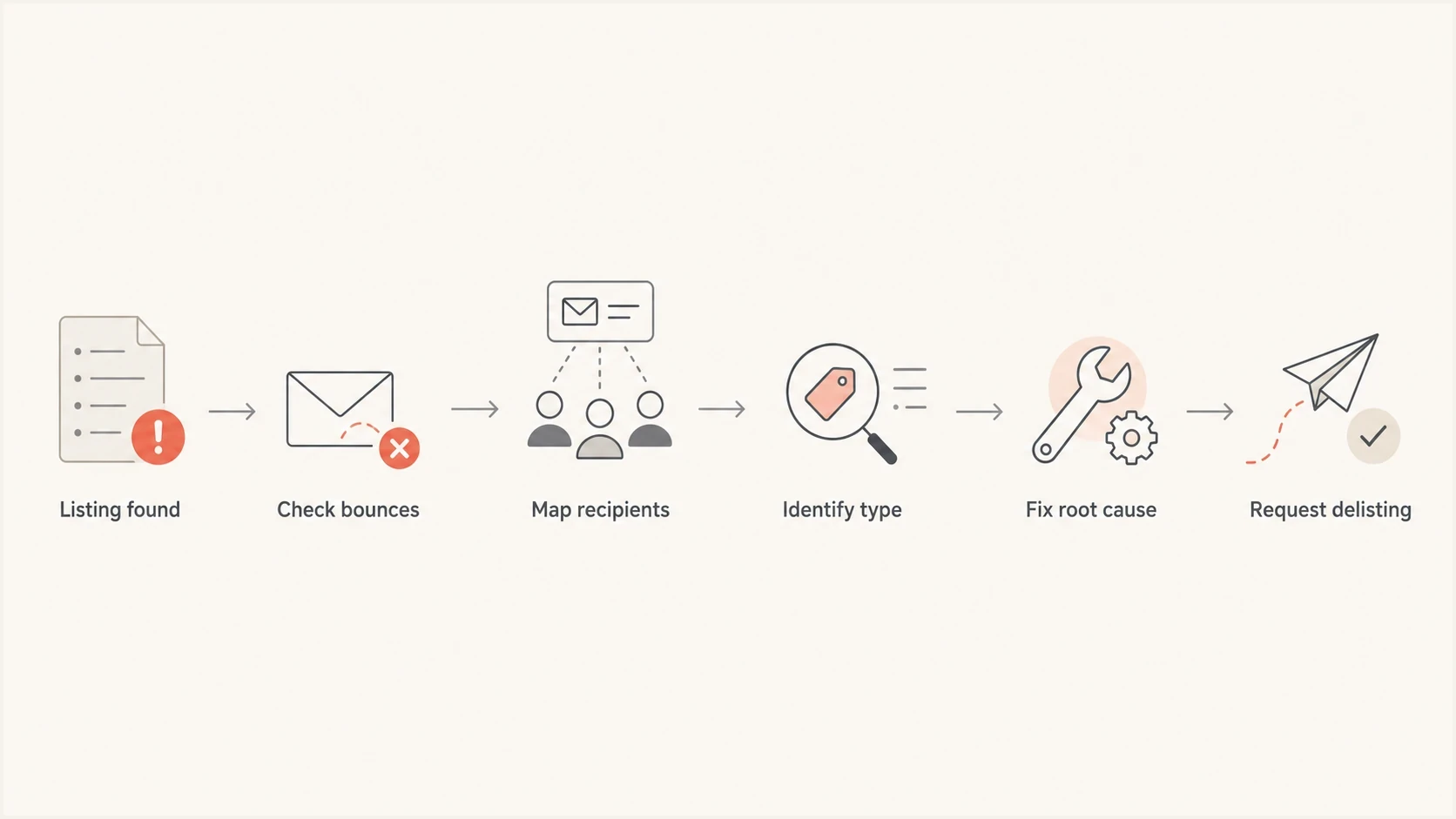
Flowchart showing how to move from a listing to evidence, root cause, and delisting.
How to confirm impact before escalation
A blacklist result becomes an escalation when it connects to delivery evidence. The strongest proof is a recipient-domain rejection or deferral that names the list and rejected sending IP or domain. A sudden delivery change at the same recipient group provides supporting evidence. Complaint spikes, weak engagement, and spam-trap exposure are better used to diagnose the cause than to prove that a specific blocklist caused the rejection.
- Check logs: Search SMTP responses for list names, policy codes, reputation text, recipient domains, and affected sending IPs.
- Segment recipients: Separate Gmail, Microsoft, business gateways, regional ISPs, and custom domains before assigning severity.
- Compare streams: Look at the affected campaign, customer, template, URL set, list source, and sending IP history.
- Test mail: Run an email test to catch authentication, content, and filtering symptoms in one place.
- Fix first: Request delisting after the bad source is stopped, not while the same traffic continues.
The common mistake
The wrong workflow is to chase every public blacklist entry with the same urgency. That burns time and teaches clients the wrong lesson. A low-impact listing with no affected mail does not deserve the same response as a Spamhaus SBL hit that blocks a dedicated IP across major recipient domains.
Recurrence matters too. A one-time listing after a single bad import is different from a sender that returns to the same list every month. Repeat listings point to a process problem such as list acquisition, consent capture, suppression handling, abandoned automations, affiliate content, or a customer with poor data hygiene.
How to prevent repeat listings and handle removal
A blocklist does not block mail by itself. A receiving system chooses whether and how to use the data, so remediation should address both the listing cause and the affected delivery route. Prevention has more value than repeated delisting.
- Strengthen permission: Use confirmed opt-in where risk is high, keep consent records, and apply a sunset policy to recipients who no longer engage.
- Protect collection points: Add rate limits, CAPTCHA or honeypot controls, and confirmation steps to forms that attackers can abuse.
- Honor negative signals: Suppress unsubscribes, complaints, hard bounces, and invalid recipients across every sending system.
- Secure sending access: Rotate exposed credentials, contain compromised accounts or devices, and review unexpected volume before resuming mail.
- Route ownership correctly: The sender controls a dedicated IP response. For a shared IP, send the complete rejection to the email provider that owns the infrastructure.
Removal comes after remediation
Follow the blocklist operator's removal process after the source is clean. Some automated lists expire when new reports stop. Do not pay anyone who claims they can remove a Spamhaus listing, and do not submit repeated requests while the same behavior continues. Record the cause, the corrective change, and any recurrence.
Where Suped fits
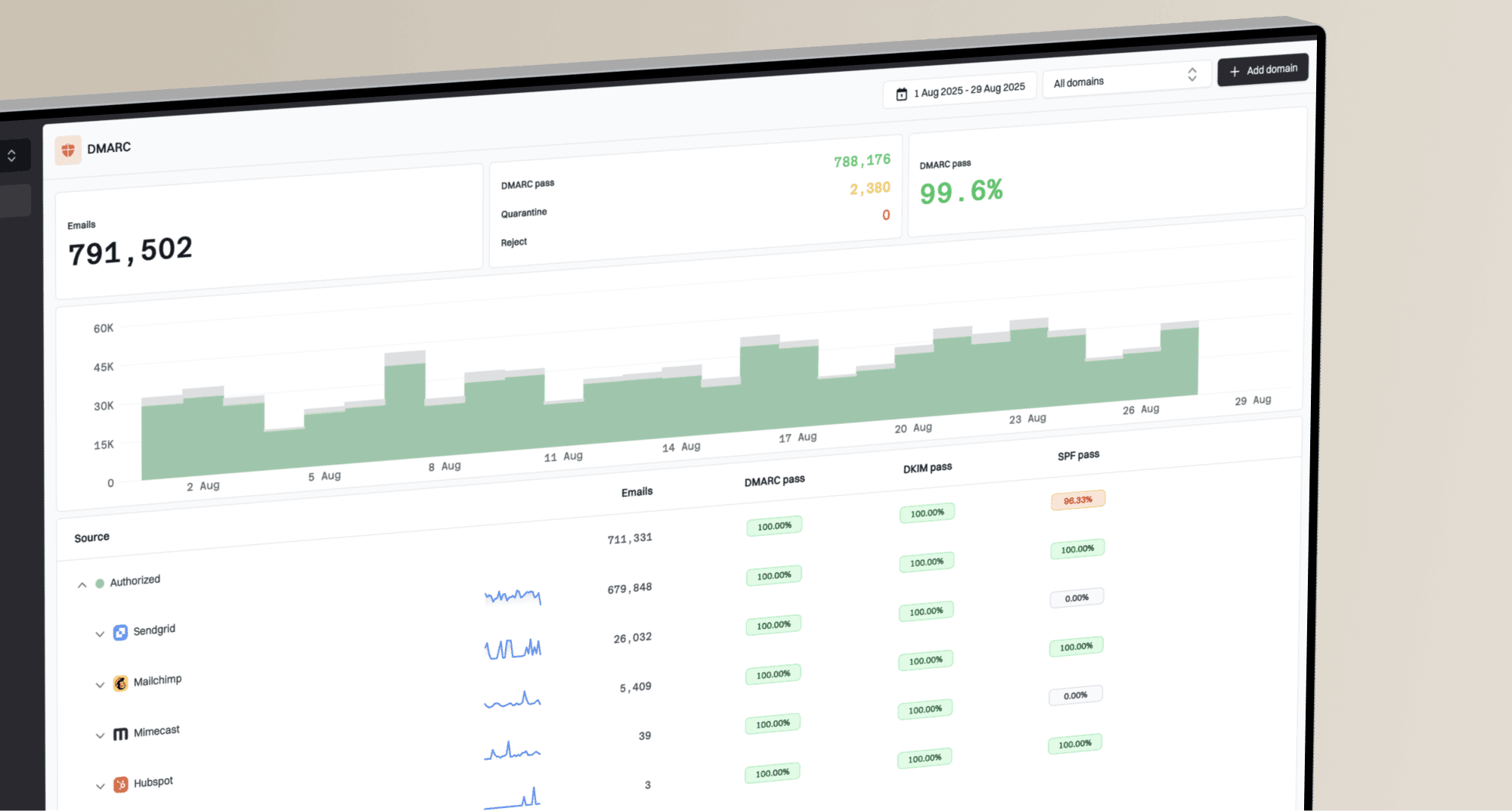
Suped's product supports this workflow by putting blocklist monitoring, DMARC reporting, authentication checks, and related DNS signals in one place. That context matters because a listing often sits next to authentication drift, a new sending source, a customer import, or a domain reputation change.
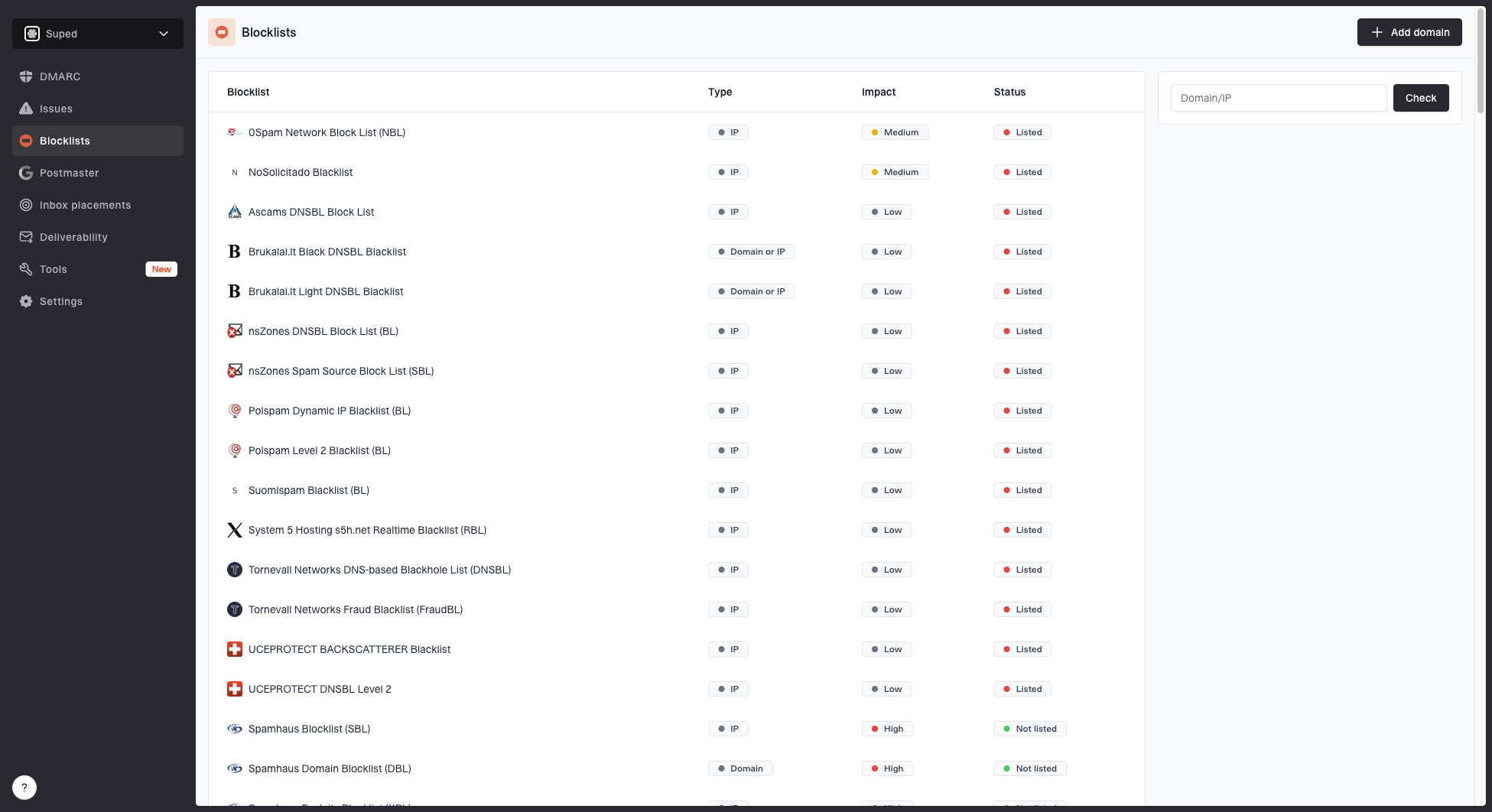
Blocklist monitoring page showing domain and IP checks across blocklists with importance and status
Suped's alerts flag a new listing, automated issue detection adds context, and the same workspace can show whether DMARC, SPF, DKIM, or DNS configuration contributes to the incident. MSPs and agencies can use multi-tenant views to separate one client's incident from shared infrastructure noise.
Best practice workflow
- Alert: Detect new domain and IP listings before a client reports missing mail.
- Correlate: Check authentication status, sending sources, recent volume shifts, and affected domains.
- Remediate: Fix the root cause, document the change, then use delisting only after the stream is clean.
- Report: Show clients which listings mattered, what changed, and what was ignored as low-impact noise.
Views from the trenches
Best practices
Prioritize a listing only after matching it to recipient domains, bounces, and mail volume.
Treat domain and IP listings as different signals, with separate owners, fixes, and urgency.
Track listing duration and repeat hits so one-off noise does not drive client escalations.
Common pitfalls
Ranking every blacklist globally hides the mailbox providers that actually receive your mail.
Assuming a public URL listing equals direct blocking leads to wasted investigation time.
Waiting for an IP blocklist hit misses earlier content, consent, and engagement signals.
Expert tips
Use SMTP logs and complaint data to prove whether a listing is affecting real recipients.
Separate public DNSBL checks from private filtering systems that cannot be queried directly.
Escalate local blocklists when the affected recipient region makes the listing material.
Marketer from Email Geeks says any RBL is important when a statistically meaningful part of the recipient base uses a mailbox provider that applies it.
2024-05-15 - Email Geeks
Marketer from Email Geeks says Spamhaus listings can directly damage delivery at many receivers, while SURBL hits often point to poor content or URL practices.
2024-05-15 - Email Geeks
The final priority order
The best priority list starts with the audience, not the blocklist brand. For a general sender, monitor Spamhaus SBL and CSS first, then DBL, followed by Abusix, Invaluement, SpamCop, SURBL, URIBL, Barracuda, Proofpoint, and relevant regional lists when delivery evidence supports the priority. Treat XBL as a security incident and PBL as a routing-policy check. Treat Cloudmark and Vade as high-impact private filtering evidence when they appear in bounces or recipient reports, not as normal public lookup targets.
The operational rule is simple: escalate listings that affect real recipients, reveal bad customer behavior, expose a compromised source, or point to unsafe content. Monitor the rest, but do not let obscure blacklist results drive the queue. Effective deliverability teams fix source quality, consent, authentication, routing, and content before they chase delisting forms.
For a repeatable process, connect blocklist checks with DMARC, SPF, DKIM, sending-source inventory, and actual email tests. Suped's product brings those signals into one workflow so teams can reduce false alarms and move directly to the relevant fix.