What is the Spamhaus content hash blocklist and how does it compare to DCC, Vipul's Razor, and Cloudmark?

Published 19 Jul 2025
Updated 19 Aug 2026
14 min read
Summarize with
Updated on 19 Aug 2026: We updated this guide with precise HBL token coverage, lookup scope, and a clearer DCC comparison.
The Spamhaus content hash blocklist, usually called the Spamhaus Hash Blocklist (HBL), is a content-based blocklist (blacklist) that lets a receiving mail system query cryptographic hashes of selected message elements. Its documented token categories cover email addresses, cryptocurrency wallets, URLs, and malicious or suspicious files. It is not a sender authentication system, an IP blacklist, or a generic hash of the whole message body. It answers a narrower question: does this extracted content element have a bad reputation in the HBL context used for the lookup?
The shortest comparison is this: Spamhaus HBL is closer to Vipul's Razor and Cloudmark than it is to DCC, because HBL attaches reputation to specific content tokens, while the Distributed Checksum Clearinghouse (DCC) mainly reports how often similar message checksums have been seen. DCC can tell a receiver that many recipients have seen similar mail. Spamhaus HBL tells a receiver that an extracted token matches an HBL entry. Cloudmark and Vipul's Razor also use fingerprint-style detection, but their trust models and product shapes differ.
For senders, this distinction matters. Passing SPF, DKIM, and DMARC does not prevent an HBL hit, because authentication proves which domain took responsibility for mail. It does not prove that a URL, attachment, cryptocurrency wallet, or address in the message is acceptable. If you need a wider grounding before this comparison, start with blocklist basics and then map the content signals back to your sending sources.
The direct answer
- Spamhaus HBL: A content hash blocklist that lets receivers query hashes of extracted email addresses, cryptocurrency wallets, URLs, and malicious or suspicious files in separate token contexts.
- DCC: A distributed fuzzy-checksum system that mainly answers whether similar mail has been seen in bulk. That makes it useful for scoring bulk mail, but unsafe when treated as proof of abuse.
- Vipul's Razor: A collaborative spam fingerprinting system where reported messages generate signatures that other systems can use for filtering decisions.
- Cloudmark: A commercial filtering system built around message fingerprinting, feedback, and network intelligence. It belongs in the same general family as Razor-style detection, rather than DCC-style bulk counting.
- Practical difference: HBL can identify a listed token inside a message, while DCC can identify repeated mail even when that mail is legitimate and wanted.
Treat content hash data as a receiver-side evidence layer. It helps decide what to do with a message after its content has been observed. It does not replace sender reputation, domain authentication, user feedback, complaint data, or local policy.
Spamhaus describes the value of Spamhaus hash blocklists as content-focused detection that can catch abusive material even when it arrives through shared infrastructure. The sending IP and authenticated domain remain useful signals, but HBL lets receivers check specific elements carried in the message.
How the Spamhaus content hash blocklist works
HBL processing starts when filtering software extracts a supported token, normalizes it as required for that token type, and computes a one-way cryptographic hash. The software then queries that hash in the matching HBL context. Spamhaus documentation describes SHA-256 hashes represented in Base32 for general use, with SHA-1 support in some contexts for compatibility.
This makes HBL a post-DATA control. The receiving system needs the relevant headers, body content, or attachments before it can extract tokens and run the lookups, but it can still apply its local action before final delivery. That differs from an IP DNSBL, which can reject during the SMTP connection based on the connecting IP. It also differs from a domain blocklist, which checks domains used for sending or found in message content.
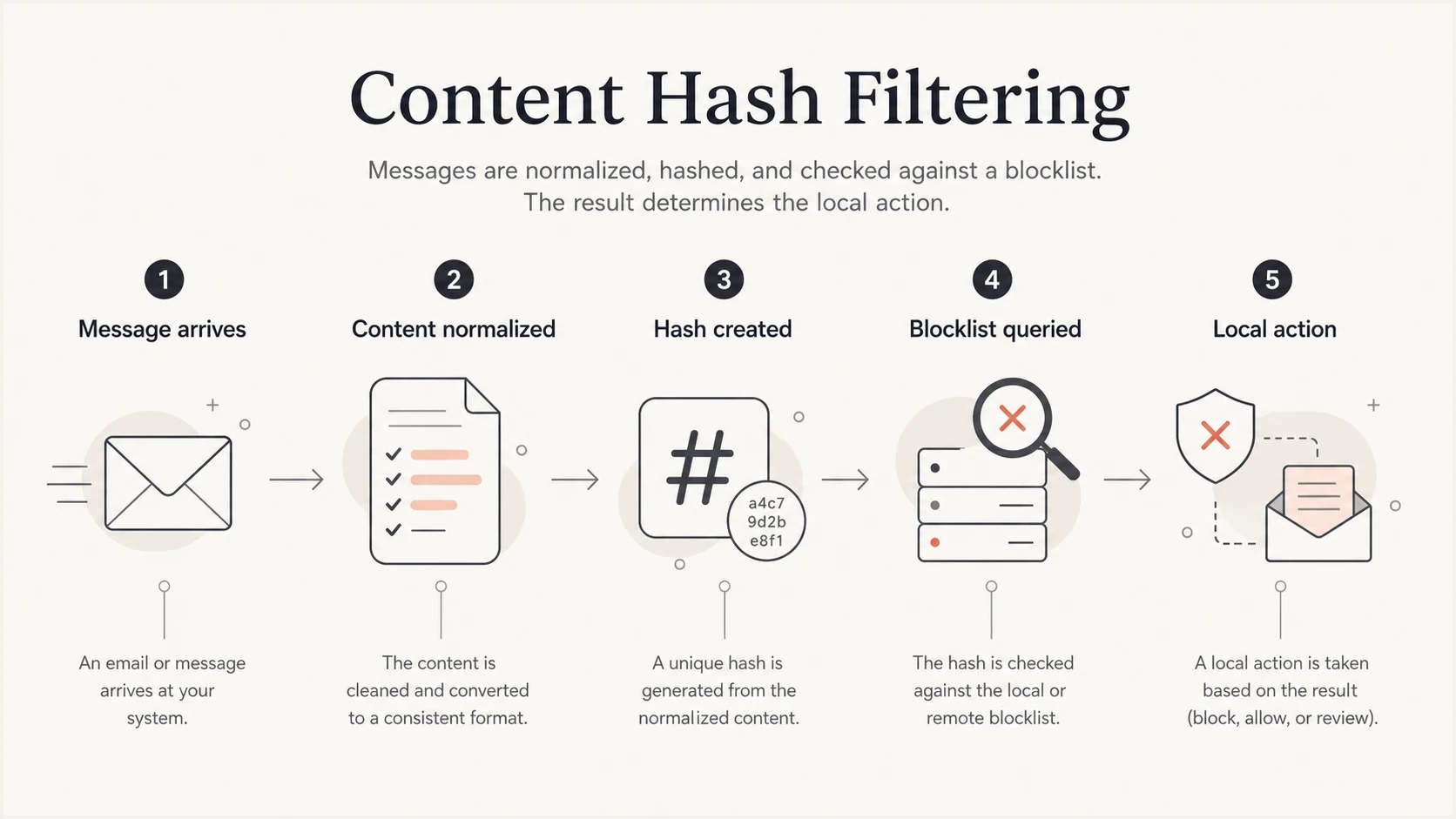
Content hash blocklist filtering flow from message arrival to local action.
The strongest use case is mail that looks technically legitimate at the transport and authentication layers but carries a token already associated with abuse. That includes a compromised sender address, a malicious or suspicious file, a cryptocurrency wallet used in a scam, or a campaign URL. A sender can have a valid DKIM signature and still send content that a receiver wants to quarantine.
URL hashing is a good example of why normalization and context matter. A harmful link can use a URL shortener, redirector, online file storage provider, or tracking path. Checking the specific URL token lets a receiver act on that resource without blocking the provider's whole domain or every legitimate user of the service.
That is also why the word blacklist still appears in real operations even though blocklist is the cleaner term in most documentation. A content blacklist hit applies to the queried token. It does not automatically place the whole sending domain or IP on a blacklist.
What HBL actually hashes
HBL organizes hashes by token context. The filtering software must extract the supported value, hash it in the documented format, and query the matching context. A hash without the correct context does not explain which kind of content matched.
|
|
|
|---|---|---|
Email address | A normalized full address extracted from a relevant message field | The address has a poor HBL reputation, including cases involving a compromised account |
Cryptocurrency wallet | A supported wallet address found in message content | The wallet has been observed in abusive mail |
URL | A normalized URL, including a shortener, redirector, or file-storage path | The specific URL has been classified as malicious or suspicious |
File | A cryptographic hash of an attached or extracted file | The file is known malware or has been observed as suspicious in spam |
Documented Spamhaus HBL token categories and the meaning of a match.
The one-way hashes reduce each token to a fixed-size value and avoid distributing the original address, wallet, URL, or file content. The lookup result still needs local interpretation, especially because the file context distinguishes known malware from files that are suspicious based on observation in spam.
Spamhaus HBL is an authorised commercial data service, not the public SBL IP DNSBL. A receiver needs access to the HBL data plus compatible extraction and lookup logic. A sender normally encounters it through a receiver's filtering result or through a Spamhaus listing investigation.
How HBL compares to DCC, Razor, and Cloudmark
|
|
|
|
|
|---|---|---|---|---|
Spamhaus HBL | Listed token hash | Token reputation | Targeted content filtering | Reused or compromised token |
DCC | Repeated fuzzy checksum | Bulk count | Bulk scoring | Wanted bulk |
Vipul's Razor | Reported fingerprint | Collaborative spam signal | Spam scoring | Shared message pattern |
Cloudmark | Network-classified fingerprint | Content and network signal | Commercial filtering | Provider-specific decision |
Compact comparison of content hash and checksum systems.
DCC is the odd one out. The Distributed Checksum Clearinghouse totals reports of fuzzy message checksums, so its core result says that similar mail is bulk. Bulk is not the same as unwanted. Password resets, receipts, order confirmations, school notices, appointment reminders, and security alerts can be high-volume and wanted. A receiver that weights DCC too heavily can block normal transactional mail even though DCC measured its bulk nature correctly.
DCC also depends on local filter configuration. SpamAssassin needs its DCC plugin enabled and separate DCC client software available. Rspamd needs a running DCC interface daemon and its DCC module configured before it emits DCC_BULK, DCC_REJECT, or DCC_FAIL. A missing DCC result can therefore mean that no check ran, rather than that the message was not bulk.
Vipul's Razor is closer to HBL because it uses fingerprints of messages reported as spam. The data model still differs. Razor is historically centered on collaborative reporting, while Spamhaus applies its own collection, analysis, and listing processes to supported token types. A receiver is asking both whether a fingerprint or token has been seen and who classified it.
Cloudmark is also closer in concept because it uses message fingerprinting, reporter trust, and network feedback inside a commercial filtering system. It is not a public checksum counter, and current Cloudmark filtering includes more than fingerprints alone. Its scoring, customer deployment, and operational policy make it distinct from both Razor and HBL.
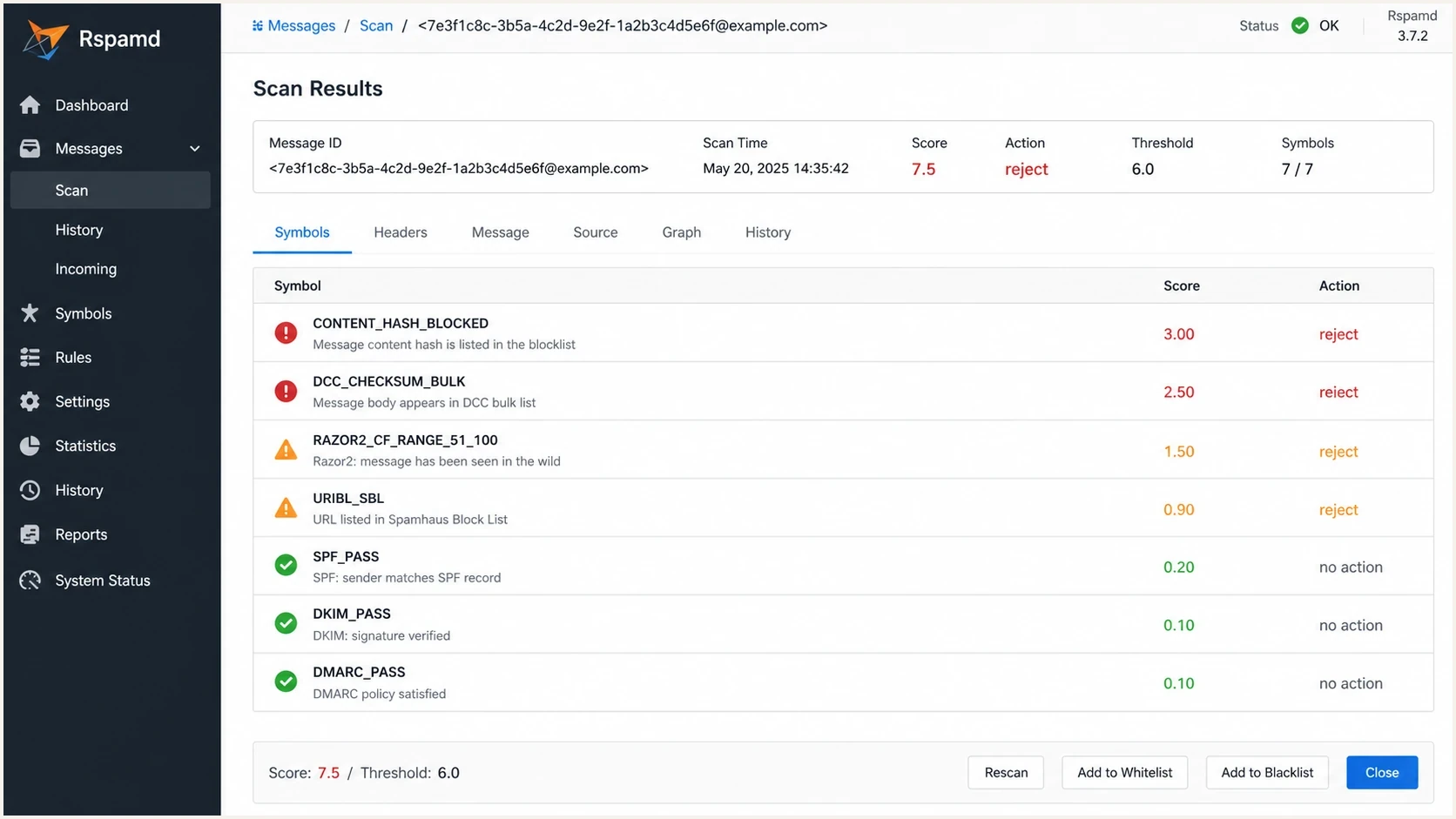
Rspamd scan results comparing content hash, DCC bulk checksum, and authentication signals.
Content reputation versus bulk detection
Content reputation systems
- Question: Does this token or message fingerprint match content classified as abusive or spam?
- Examples: Spamhaus HBL, Vipul's Razor, and Cloudmark-style fingerprinting.
- Strength: Can catch abusive campaigns that use reputable or shared infrastructure.
- Risk: Can affect legitimate senders when a listed address, URL, or shared asset appears in their mail.
Bulk checksum systems
- Question: Have many recipients reported a similar fuzzy checksum for this message?
- Example: DCC, especially when used as one input in a larger filter.
- Strength: Good at identifying repeated mail, including obvious campaign traffic.
- Risk: High-volume legitimate mail can be handled incorrectly when operators treat bulk as unwanted.
For that reason, DCC should not be called a content reputation verdict. DCC reputation data exists in commercial deployments, but the core distributed checksum result counts reports for message checksums. The receiving filter decides how that evidence affects scoring or delivery.
The better receiver pattern is weighted scoring. A DCC bulk result should rarely decide fate by itself. A high-confidence HBL token hit deserves more weight, especially when it appears with suspicious URLs, attachment risk, poor sender history, or broken domain authentication.
Example receiver scoring modeltext
# Example scoring idea, not a production policy
SPAMHAUS_HBL_HIT      8.0
DCC_BULK_HIT          2.0
RAZOR_HIT             3.0
AUTH_DOMAIN_PASS     -1.0
KNOWN_GOOD_SENDER    -3.0
LOCAL_REJECT_LEVEL    6.0
What this means for senders
From the sending side, the mistake is to look only at DMARC pass rates and assume content filters have no reason to complain. DMARC tells the receiver that an authenticated domain took responsibility for the mail. An HBL result tells the receiver that a specific extracted token has a reputation problem.
Check the supported HBL token categories first: a sender or reply address tied to a compromised account, a URL used in unwanted mail, a cryptocurrency wallet associated with abuse, or a malicious or suspicious file. In shared sending systems, one compromised tenant can introduce a listed token into otherwise authenticated mail.
Blocklist checker
Check your domain or IP against 144 blocklists.







Suped's product fits the surrounding workflow. It does not replace Spamhaus HBL inside a receiver's filter. It connects DMARC monitoring, blocklist monitoring, alerts, and fix steps so teams can see whether a suspected content problem appears alongside domain abuse, unknown sending sources, or authentication errors.
In Suped, the practical workflow is to watch DMARC sources, verify which services are allowed to send, monitor blocklist (blacklist) exposure, and alert the team when a domain or IP reputation signal changes. The blocklist monitoring workflow keeps blacklist status next to authentication and sender inventory instead of leaving each signal in a separate place.
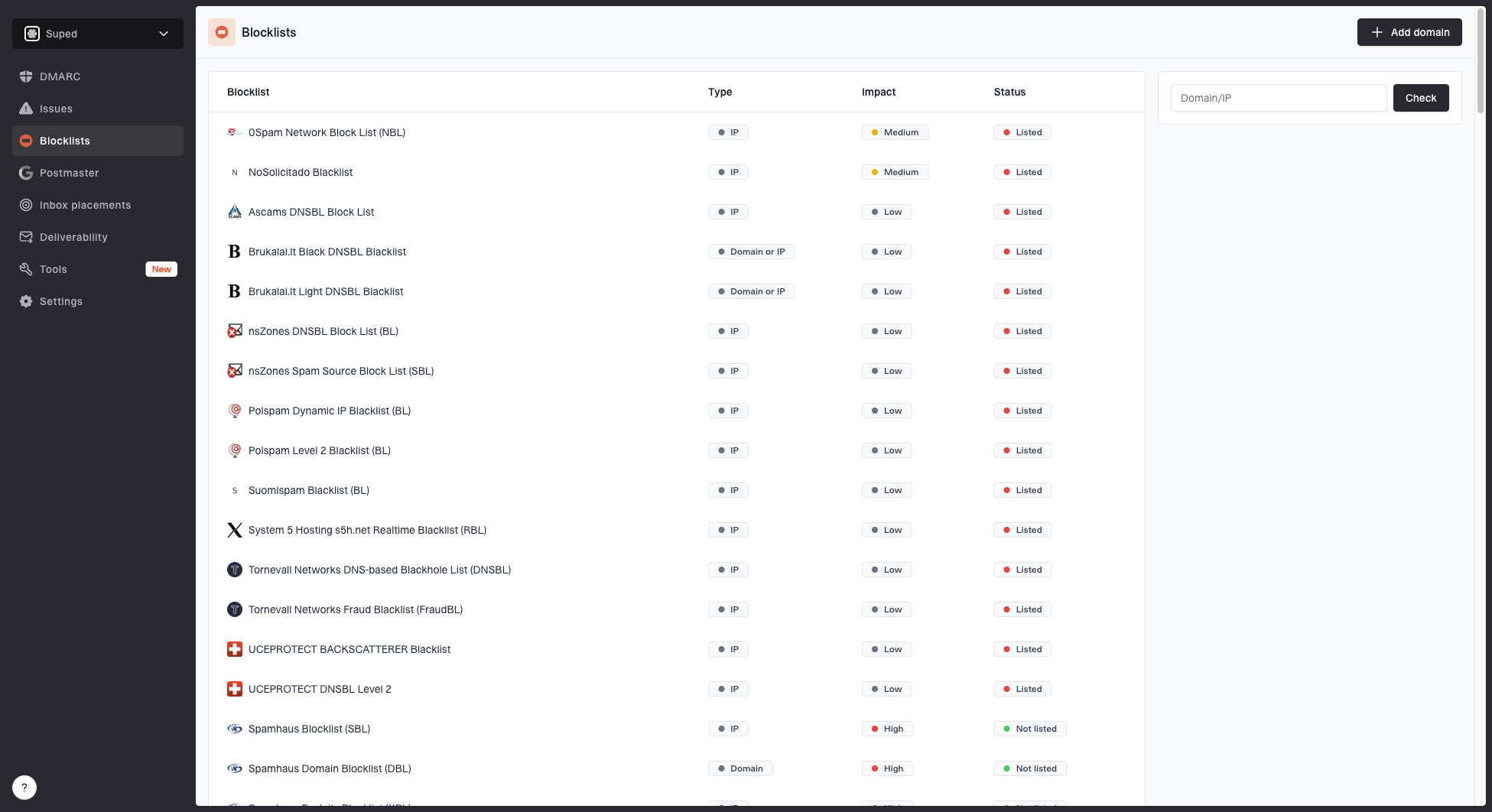
Blocklist monitoring page showing domain and IP checks across blocklists with importance and status
How to investigate a suspected content hash problem
A suspected HBL issue is easiest to fix when you separate message content from infrastructure evidence. Do not start by changing every DNS record. Start by proving which token or message change affects the receiver's decision.
- Capture samples: Save the exact raw message that was blocked, quarantined, or scored badly, including headers, body, and attachments.
- Confirm the named signal: Read the SMTP response, filter symbols, and receiver evidence to distinguish HBL from an IP, domain, DCC, Razor, or local content rule.
- Compare supported tokens: Change one item at a time, focusing on sender and reply addresses, full URLs, cryptocurrency wallets, and files before changing general template wording.
- Check authentication: Confirm SPF, DKIM, and DMARC pass for the domain that took responsibility for the message, while treating those results as separate evidence.
- Separate bulk signals: If the report includes DCC, confirm whether it was a SpamAssassin rule hit, an Rspamd symbol, or a gateway label that only resembles those systems.
- Test delivery: Send controlled samples through an email tester and compare authentication and reputation results against each content change.
Do not rotate domains, IPs, or tracking hosts just to escape a content hash hit. That can turn a content issue into a wider reputation issue. If a listed token is genuinely problematic, remove or remediate it. If the match is wrong, keep the raw samples and follow the listing operator's process.
If Spamhaus HBL is the suspected source, read more about Spamhaus HBL before you decide whether the issue is an email-address, wallet, URL, or file hash match, a related domain listing, or a broader reputation problem.
When removal is relevant, treat it as a technical correction process. Identify the matching token, remove or remediate the cause, then use the appropriate HBL removal path with raw-message evidence rather than guesses.
Where DCC still helps
DCC still has value when a receiver wants to know whether similar mail is being seen at scale across participating systems. It is especially useful as a low or moderate scoring input in a larger filter. The problem starts when a receiver treats bulk as a synonym for bad.
A practical DCC review separates wanted bulk, unwanted bulk, and unknown bulk that needs other signals. In SpamAssassin, that means checking whether the DCC plugin and client were enabled before trusting a missing or present DCC result. In Rspamd, it means reading DCC_BULK, DCC_REJECT, or DCC_FAIL beside thresholds, composite rules, and the final action.
How to weight the signal
A practical severity model for receiver-side filtering decisions.
No content hit
Low
Use normal authentication and reputation scoring.
DCC bulk only
Watch
Bulk evidence needs other signals before blocking.
Razor or HBL hit
High
A reported fingerprint or listed token deserves stronger scoring.
HBL plus bad auth
Critical
A listed token and poor domain trust support a strict action.
What not to infer from a hash hit
A hash hit is strong evidence about the value queried, but it is still one signal in the receiver's decision. Do not infer that the whole domain is malicious, that every message using the same sending service is bad, or that DMARC is broken. Those are separate questions.
- Domain status: A token match can affect one message while the sending domain still has valid authentication.
- IP status: An IP can pass normal DNSBL checks while a message token still matches a content blacklist.
- Content scope: An HBL match identifies the queried email address, wallet, URL, or file hash, not every part of the template.
- Fix status: A DNS change helps only when the separate root cause is sender authorization or domain misuse.
The clean path is to prove the failing layer. If the issue is a listed token, fix or remove that token and its source. If it is sender authorization, fix SPF, DKIM, and DMARC. If it is a blocklist issue, collect evidence and use the relevant listing process. Suped helps keep those layers visible so teams do not treat every delivery problem as the same problem.
Views from the trenches
Best practices
Treat content hash hits as strong evidence, then verify the exact message part that matched.
Score DCC as a bulk signal and pair it with authentication, reputation, and local policy.
Keep raw samples for every blocked campaign so changes can be tested one variable at a time.
Common pitfalls
Treating DCC as a spam verdict can block wanted transactional mail at normal campaign volume.
Rotating domains after a hash hit can expand the problem into a wider reputation incident.
Assuming DMARC pass clears content risk misses URL, template, attachment, and payload issues.
Expert tips
Compare a clean sample and bad sample to isolate URLs, footers, images, and attachments.
Use content hash data as one receiver signal, not as the only reason to reject all mail.
Monitor domain and IP reputation together so content issues do not hide source problems.
Marketer from Email Geeks says DCC should be treated as a bulk-mail signal, not proof that a sender or message is malicious.
2022-06-01 - Email Geeks
Marketer from Email Geeks says Spamhaus content hashes are more useful when they point to specific harmful content instead of repeated volume.
2022-06-01 - Email Geeks
The practical takeaway
Spamhaus HBL is a token-focused content blocklist. It can identify listed email addresses, cryptocurrency wallets, URLs, and files even when the mail comes through infrastructure with normal authentication. DCC is mainly a distributed bulk-checksum signal. Vipul's Razor and Cloudmark are closer comparisons because they use message fingerprinting tied to collaborative reports, trusted feedback, or network classification.
For senders, the answer is to keep authentication clean, control who sends for each domain, watch blacklist and blocklist exposure, and test the exact content receivers process. Suped's product supports that workflow by keeping DMARC source inventory, authentication results, blacklist and blocklist monitoring, and alerts in one operational view.