How do I get delisted from IVMuri and what causes listings?

Updated on 26 Sep 2026: We updated this guide for Invaluement's current ivmLinkingDomains name and lookup workflow, including domain ownership checks.
To get delisted from ivmLinkingDomains, previously called ivmURI and often written IVMuri, first confirm the exact domain or URI that is listed. Stop the sending or link behavior that triggered the listing, then select Delist Requests in Invaluement's lookup chooser. The list covers domains and a small number of IP addresses found in clickable message-body links, so changing a sending IP alone will not resolve the listing. Inspect every linked domain, including tracking hosts, redirect hops, image hosts, and landing pages.
Direct answer
- Use Invaluement's Delist Requests path after identifying the listed item and fixing the cause. Fast Lookups cannot start a delisting request.
- Typical causes include a link domain found in spam, a hijacked website, an abused shared tracking host, or an unsafe redirect destination.
- Preserve the message, raw HTML, lookup result, and operational logs because removal feedback might not include detailed cause data.
- Do not repeat the request before cleaning the source. If another company controls the listed domain, send the evidence to that operator.
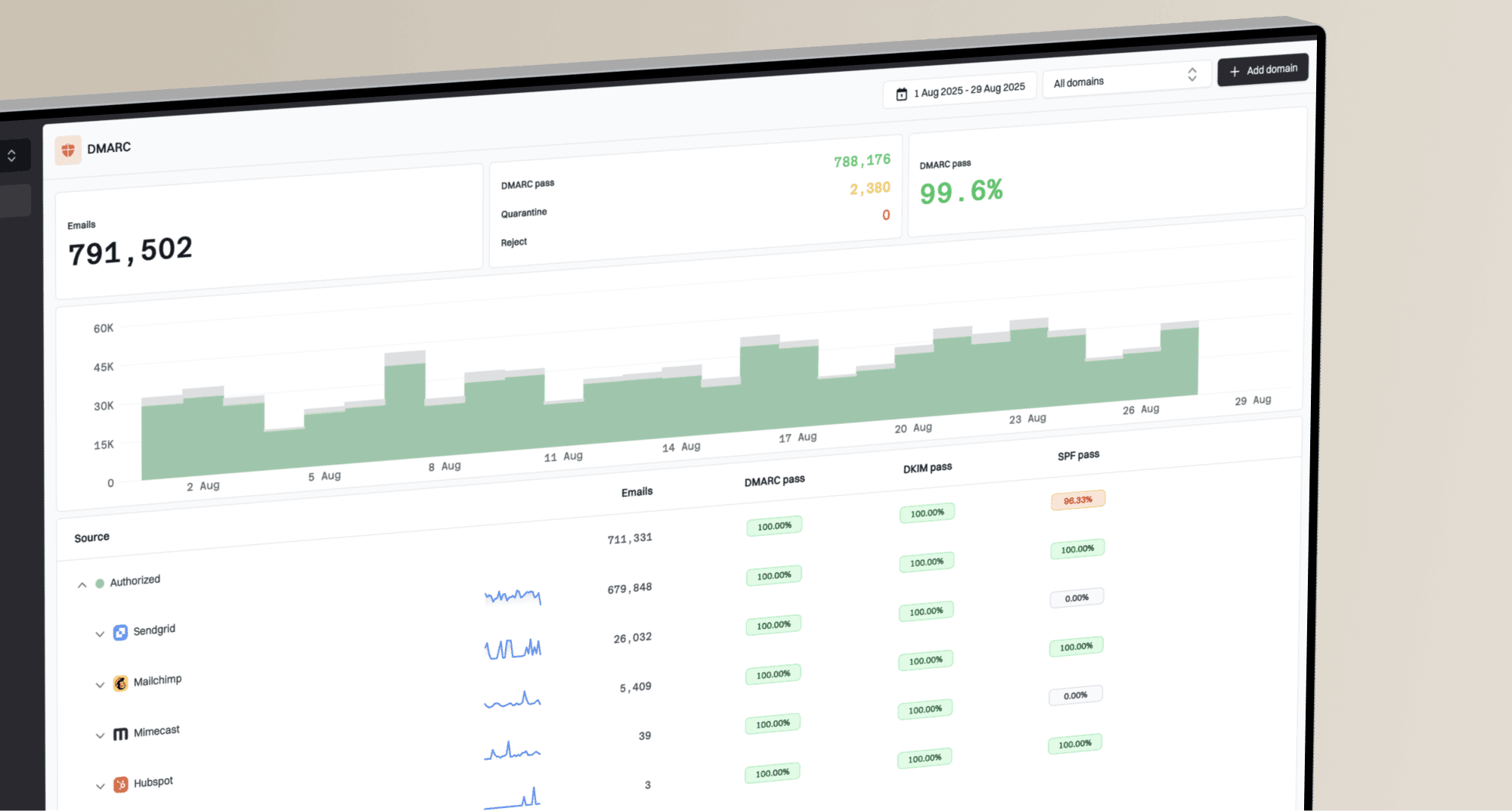
For ongoing operations, tie blocklist monitoring to authentication and source data instead of relying on a one-off lookup. Suped's blocklist monitoring supports that workflow by showing domain and IP listings beside DMARC source patterns. Teams can compare a listing time with active senders and start remediation.
What ivmLinkingDomains (formerly ivmURI) lists
Current DNS responses identify the list as ivmLinkingDomains and add "previously called ivmURI". Invaluement's website navigation still uses ivmURI. Both names refer to the URI-focused DNSBL, which lists domain names and a small number of IP addresses found in clickable links within spam messages.
A sender can have clean sending IPs and valid email authentication while messages are filtered because a body link contains a listed item. This differs from ivmSIP and ivmSIP/24, which focus on sending IP addresses or subnets. Open-relay checks and sending-IP replacement belong in an ivmSIP investigation, not an ivmLinkingDomains case unless the evidence shows both list types.
Start with the message body. Inspect visible links, tracking links, branded shorteners, redirect targets, image hosts, preference center URLs, and customer-controlled domains. If a registrable domain is listed, every campaign using that domain in a link has risk, even when a mailbox provider's bounce does not name Invaluement.
|
|
|
|---|---|---|
ivmLinkingDomains (ivmURI) | Clickable body links | Listed domain or IP |
ivmSIP | Sending IP | Sending system |
ivmSIP/24 | IP subnet | Shared range |
Invaluement list types at a glance.
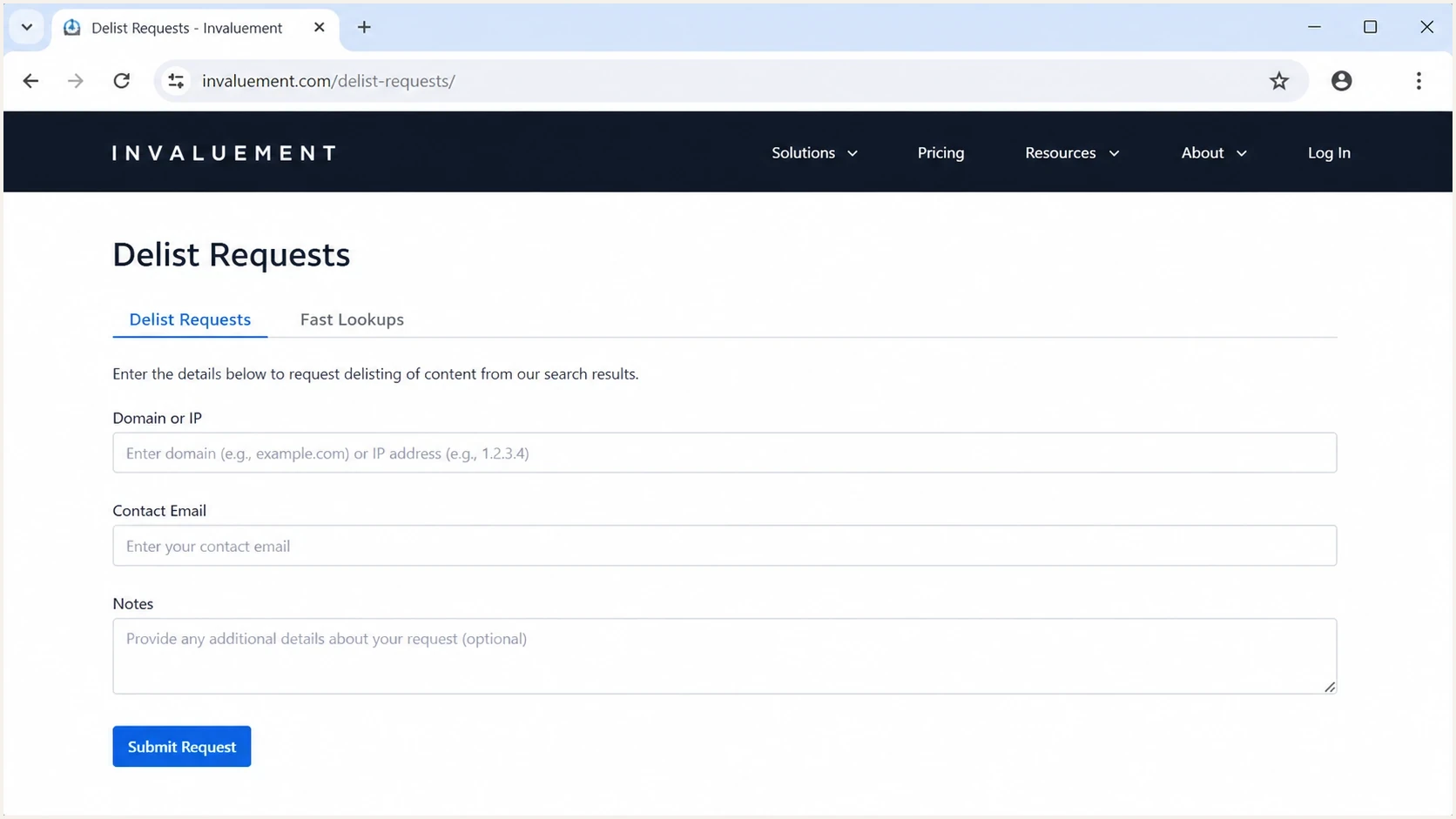
Screenshot-style view of the Invaluement delist request workflow.
Use Invaluement's own lookup chooser for sender diagnostics. It separates Fast Lookups, which cannot delist, from Delist Requests for an IP address or domain. A clean result from an unrelated lookup does not confirm the status of every Invaluement list.
A URI listing also changes the blast radius. If the listed domain is a shared tracking host, more than one brand or customer can feel the impact. If it is a customer landing page, the problem can sit outside the mail platform but still damage the campaign. Treat every case as a link reputation incident until the evidence proves otherwise.
Why ivmURI listings happen
Invaluement describes ivmURI as a list of domains and a few IP addresses found in clickable links within spam. It says most listed domains are owned by spammers, while a smaller group consists of normally legitimate domains hijacked by criminals. For legitimate senders, practical causes include compromised websites, abused shared tracking infrastructure, unsafe redirect paths, or mail reaching spam collection sources with the brand's link domain inside it.
- Old recipients, purchased data, scraped addresses, or abandoned domains increase the chance that mail containing the link reaches spam collection sources.
- A legitimate website, subdomain, user account, or redirect endpoint can be compromised and used in unwanted mail.
- A clean visible URL can pass through a weak tracking host or end at a customer-controlled destination with unsafe content.
- One abusive customer using a shared tracking domain can damage the same link reputation used by other senders.
- Long-unengaged subscribers and missing suppression rules keep risky recipients active after consent or interest has gone stale.
What the sender sees
- Mail logs show no obvious surge in complaints or hard bounces.
- Email authentication results look normal for the sending domain.
- The campaign belongs to a known company with a legitimate offer.
What the filter sees
- A linked host has little history or has appeared in unwanted mail.
- A campaign reached addresses that should not receive the message.
- A URI listing pushes a borderline message toward spam or rejection.
Operational domain variants are easy to miss. A main domain can have years of legitimate history while a mail-suffixed tracking domain has little history of its own. Email authentication does not validate every link in the message body. That gap makes link-domain choice a deliverability control, not a cosmetic branding detail.
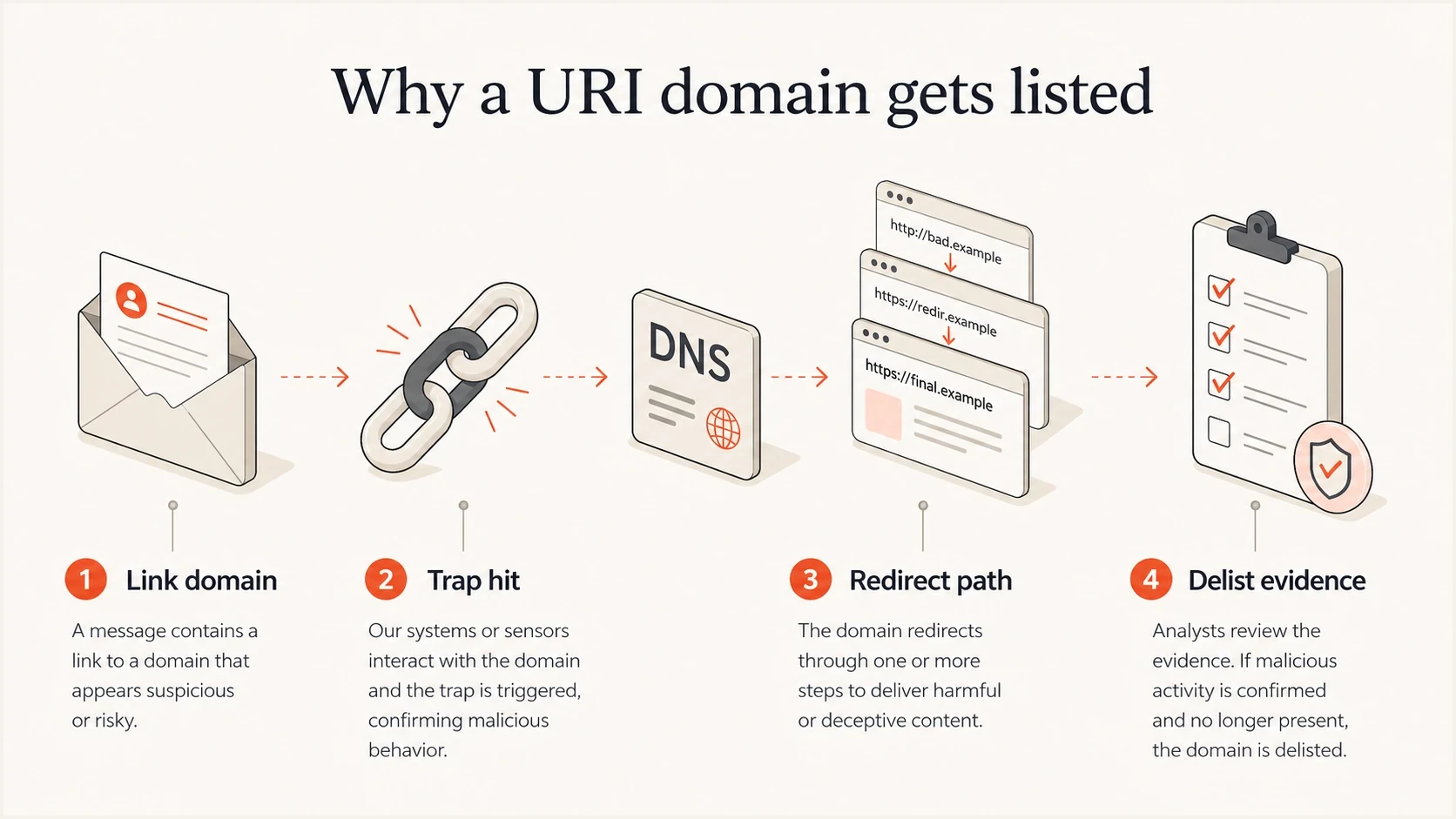
Infographic showing link domain, trap hit, redirect path, and delist evidence.
How to get delisted
Use the Delist Requests path after remediation, not the Fast Lookups path. Prepare the exact listed item, the cause found, the fix completed, and evidence that the same pattern has stopped. Detailed trap data is not normally available to the sender, so act on the evidence you control.
- Use Invaluement's lookup chooser to identify the exact item and list. Save the result and any SMTP rejection text.
- Pause the campaign, sender segment, customer, or link domain that matches the listing window.
- Follow every redirect and check whether the final page, tracker, hosted asset, user account, or website has been compromised.
- Remove stale recipients and addresses without clear consent. Secure abused sites and rotate credentials for affected accounts.
- Follow the generated Delist Requests instructions exactly. Include the listed item, completed fix, available NDR or DSN, and prevention control. If a vendor controls the domain, give the evidence to that operator because it controls the domain and request.
Delisting request notestext
Listed item: links.example.com
List: ivmLinkingDomains (formerly ivmURI)
Date first observed: 2026-05-22
Affected mail stream: Customer newsletter
Immediate action: paused customer segment
Root cause found: aged recipients and old tracking domain
Remediation: removed inactive addresses and changed tracking host
Prevention: engagement sunset policy added
Before submitting, review whether the issue is isolated or part of a wider blacklist (blocklist) pattern. An email blocklists review helps separate a single URI listing from broader sender reputation damage.
Blocklist checker
Check your domain or IP against 144 blocklists.







After delisting, watch the next sends closely and confirm the status through Invaluement's lookup. A repeat listing usually means the original cause was paused instead of fixed. This happens when one campaign stops but the same aged audience, customer data source, or risky redirect remains active.
Evidence to collect before you submit
Collect message evidence and operational evidence. Message evidence proves which domains and redirects were present. Operational evidence proves what changed after the listing. The request does not need a long story, but it needs enough detail to show that the listed item will not keep appearing in the same pattern.
|
|
|
|---|---|---|
Message and raw HTML | Link inventory | Yes |
Headers | Sending source | Yes |
NDR, DSN, or lookup result | Discovery evidence | Yes |
Audience source | Consent proof | Yes |
Fix log | Remediation proof | Yes |
Compact evidence checklist for an ivmURI delisting request.
Keep the rendered body and raw HTML for each message sample. Raw HTML reveals tracking hosts and image hosts, plus redirects that are not obvious in the visible creative. If the mail platform rewrites links, capture both the original and rewritten URL. Preserve the full NDR or DSN because it can include the rejecting system, response code, listed item, or lookup reference. If no NDR exists, record how the listing was discovered and save the lookup result.
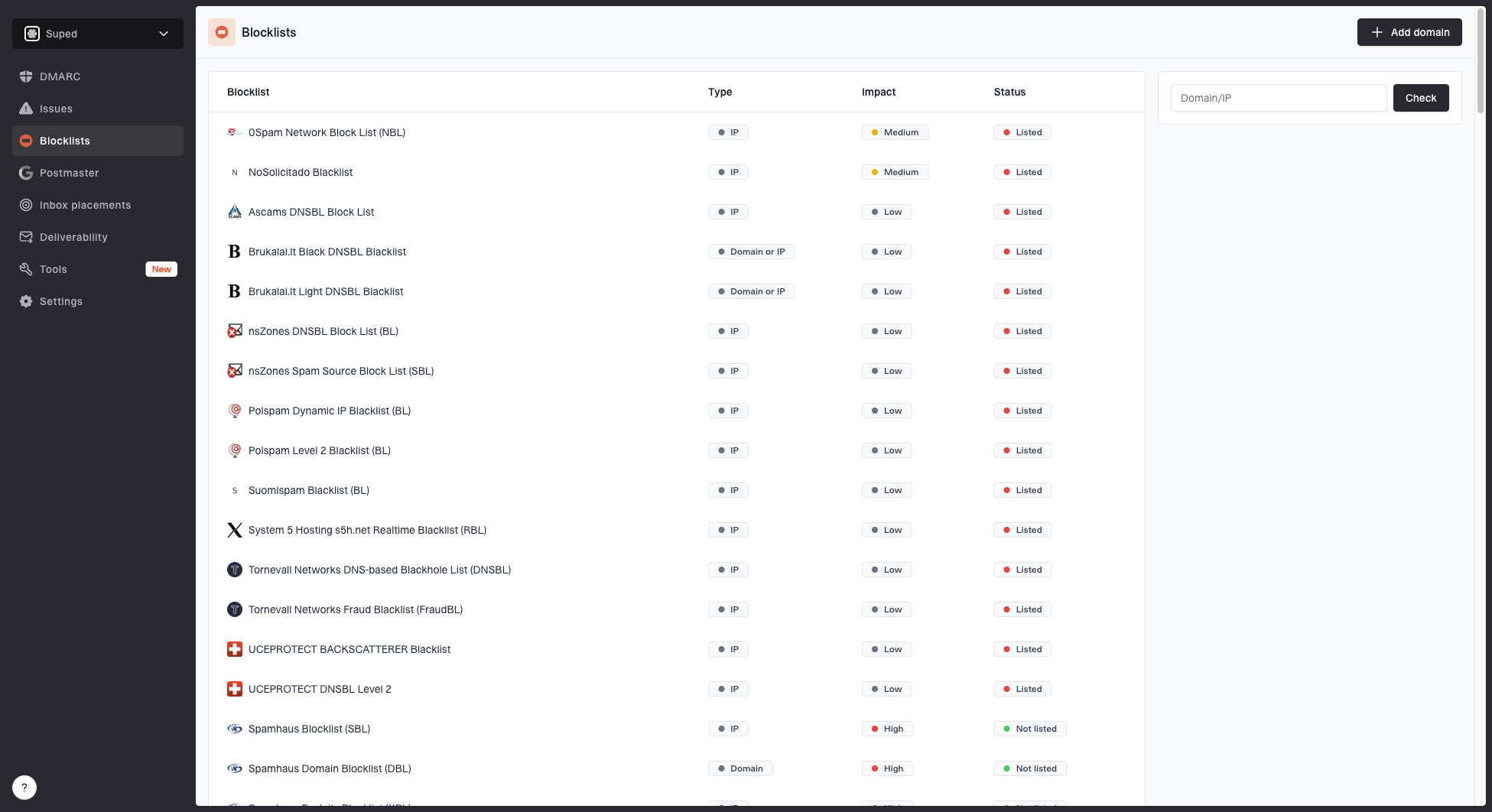
Blocklist monitoring page showing domain and IP checks across blocklists with importance and status
Suped's product supports this investigation by placing blocklist monitoring beside DMARC source data and domain authentication results. Teams can compare the listing time with active sending sources, verify the authenticated domain, and keep remediation evidence in one workflow.
Run a domain health check for the domain family. That check does not explain every ivmURI listing, but it catches DNS and authentication problems that can slow remediation or obscure which systems are authorized.
How to prevent relisting
Prevention depends on routine controls. Use stable link domains with legitimate history, avoid disposable brand variants, retire old recipient segments, and make each customer or business unit accountable for URLs placed in mail. A link-only domain still builds reputation, and bad link reputation can outweigh clean authentication.
Example engagement review windows
A starting framework for regular marketing mail. Adjust it to the normal sending cadence and documented business cycle.
Active
0-90 days
Continue normal sends with consent and complaint checks.
Review
91-180 days
Reduce frequency or use a documented re-permission plan.
Suppress
180+ days
Stop routine marketing unless a documented seasonal or contractual cycle supports a longer window.
For multi-customer platforms, separate link domains by risk tier. High-volume, vetted customers should not share the same tracking host with customers still under review. If every customer uses one URI domain, a weak list import can create a shared blacklist (blocklist) problem.
Practical prevention controls
- Use stable link domains that match the brand and have legitimate history.
- Keep the source, timestamp, signup context, and consent status for every imported audience.
- Suppress long-unengaged recipients before spamtrap or abandoned-address exposure becomes likely.
- Pause customers that import old lists or use unexplained redirect chains.
- Patch websites and extensions, scan for injected pages, protect forms, and rotate credentials after a compromise.
Authentication still matters even though this list focuses on message links. Clean authentication makes ownership clearer, reduces impersonation risk, and separates authorized mail from abuse using lookalike domains. Authentication controls the sending identity, while URI hygiene controls linked content.
Simple DMARC starting pointdns
_dmarc.example.com TXT "v=DMARC1; p=none; rua=mailto:d@example.com"
When it is a shared infrastructure problem
Shared infrastructure makes a listing harder because the platform can own the domain while one customer caused the bad behavior. Split the investigation by customer, campaign, link domain, and send time. Then identify the smallest sender group that explains the first listing window.
Keep a written escalation path for customers that trigger URI listings. Include a temporary pause, evidence request, list hygiene requirement, and clear rule for repeat incidents. When a vendor owns the listed tracking domain, the vendor must investigate its tenants and submit the delist request. The sender should supply message samples and timestamps instead of claiming control of the domain.
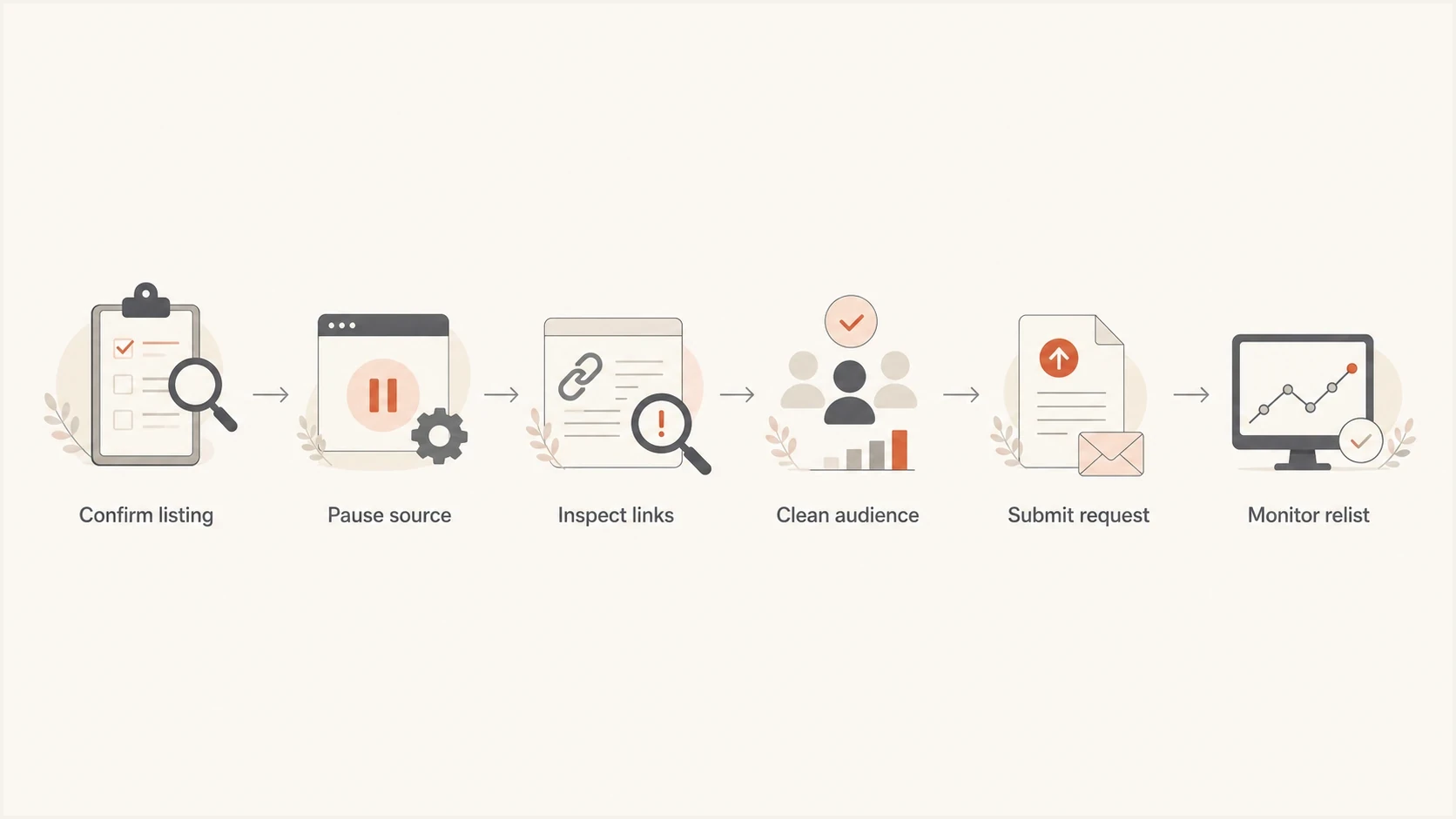
Flowchart showing the steps for IVMuri delisting and relisting prevention.
Use a broader shared infrastructure troubleshooting process when the platform has several customers or sending pools. Avoid treating the entire platform as the source when the evidence points to one customer, redirect path, or stale import.
Views from the trenches
Best practices
Confirm the exact listed URI before changing IPs, DNS, or unrelated sender settings.
Pause the smallest risky segment first, then preserve logs before routine retention clears them.
Document the fix in plain language, including the audience, link domain, and send window.
Common pitfalls
Assuming clean complaint logs prove safety misses silent filtering and trap-based signals.
Using a new tracking domain for speed creates a low-reputation URI that filters distrust.
Submitting repeated requests before remediation makes the listing harder to investigate.
Expert tips
Separate customer tracking domains by risk so one weak sender cannot affect every client.
Treat old domains in recipient lists as trap risk, even when the customer relationship was real.
Keep branded link domains close to the parent domain so legitimacy is easier to evaluate.
Marketer from Email Geeks says ivmURI cases can be hard to diagnose because normal bounce and complaint logs can look quiet.
2021-12-03 - Email Geeks
Marketer from Email Geeks says a focused delisting request with the required details is the right first move.
2021-12-03 - Email Geeks
ivmURI delisting checklist
An ivmLinkingDomains or ivmURI delisting request should be specific and based on a completed fix. Identify the listed item, pause the matching source, inspect redirects, remove stale recipients, secure compromised endpoints, and submit through Invaluement's Delist Requests path. Changing sending IPs does not fix a listed domain in the message body.
The lasting fix is a controlled sending program with stable link domains, customer approval gates, engagement-based suppression, and clear domain ownership. Suped connects DMARC monitoring with blocklist monitoring and real-time alerts, so teams can compare listings with authorized sending sources and track remediation work.